Black Spots on Bougainvillea: Causes, Checks & Fixes
Quick answer
On bougainvillea, black spots on the green oval leaves—especially after rain, misting, or humid conservatory air—usually mean fungal leaf spot or sooty mold from sap-sucking pests. First step: stop wetting foliage and thin crowded interior stems for airflow, wearing gloves around thorns.
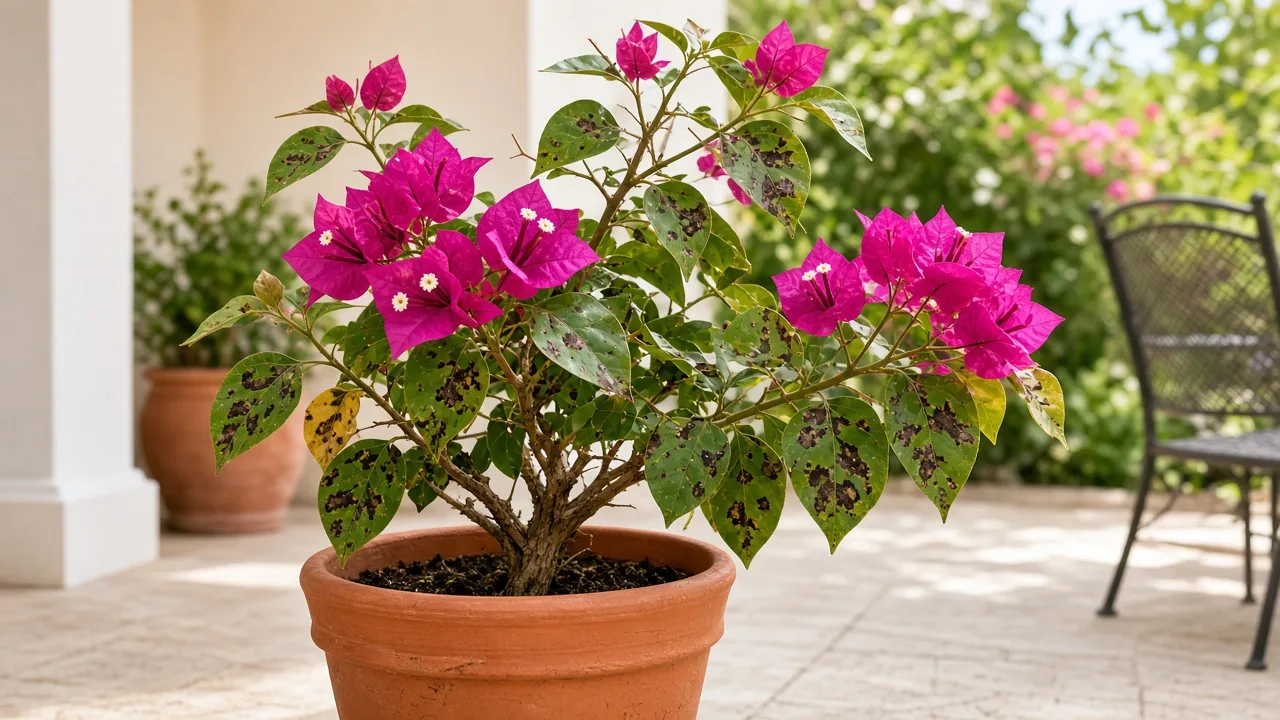
Black Spots on Bougainvillea: Causes, Checks & Fixes
This guide covers black spots on Bougainvillea. See also the general Black Spots guide, watering, and light pages for this plant.
Black Spots on Bougainvillea: Causes, Checks & Fixes
Quick answer
Black spots on bougainvillea (Bougainvillea spp.) are usually necrotic patches on the true green leaves—not the papery colored bracts that most people call the “flowers.” On this thorny, sun-loving vine, the pattern most often splits three ways: fungal leaf spot or leaf rot after foliage stays wet in humid air or rainy weather; sooty mold growing on honeydew from aphids, whiteflies, or mealybugs; or cosmetic marks on older leaves while the plant sheds foliage after a bloom flush. For how leaf-spot fungi spread in general, see our black spots guide. On bougainvillea, crowded scrambling stems trap dew on interior leaves longer than open, full-sun patio pots.
First step: stop wetting foliage and open airflow through the thorny canopy. Water at the soil line only, skip misting, and remove the most spotted interior leaves you can reach safely with gloves. Then decide whether you are dealing with wet-leaf fungi, pest-linked sooty mold, or overwatering stress—not a single generic “black spot” treatment.
When to use this page vs other Bougainvillea guides
| Your question | Best page |
|---|---|
| Dark dots or patches on green leaves | This page |
| Black powder that wipes off; sticky leaves | Aphids, whiteflies, sooty mold (below) |
| Yellow leaves on heavy wet pot | Overwatering |
| Mushy roots, sour mix, wilt on wet soil | Root rot |
| Whole leaves brown and crisp at margins | Brown leaves |
| Leggy growth, few bracts in shade | Not enough light |
Use the Bougainvillea problems hub when you need a wider triage list; use the overview for culture basics.
What black spots look like on Bougainvillea
Healthy bougainvillea carries oval, slightly waxy green leaves on woody, thorny stems. Showy bracts (pink, purple, orange, or white) surround tiny white tubular flowers. Black spotting problems almost always land on the true leaves first; bracts may later pick up sooty mold if pests drip honeydew overhead.
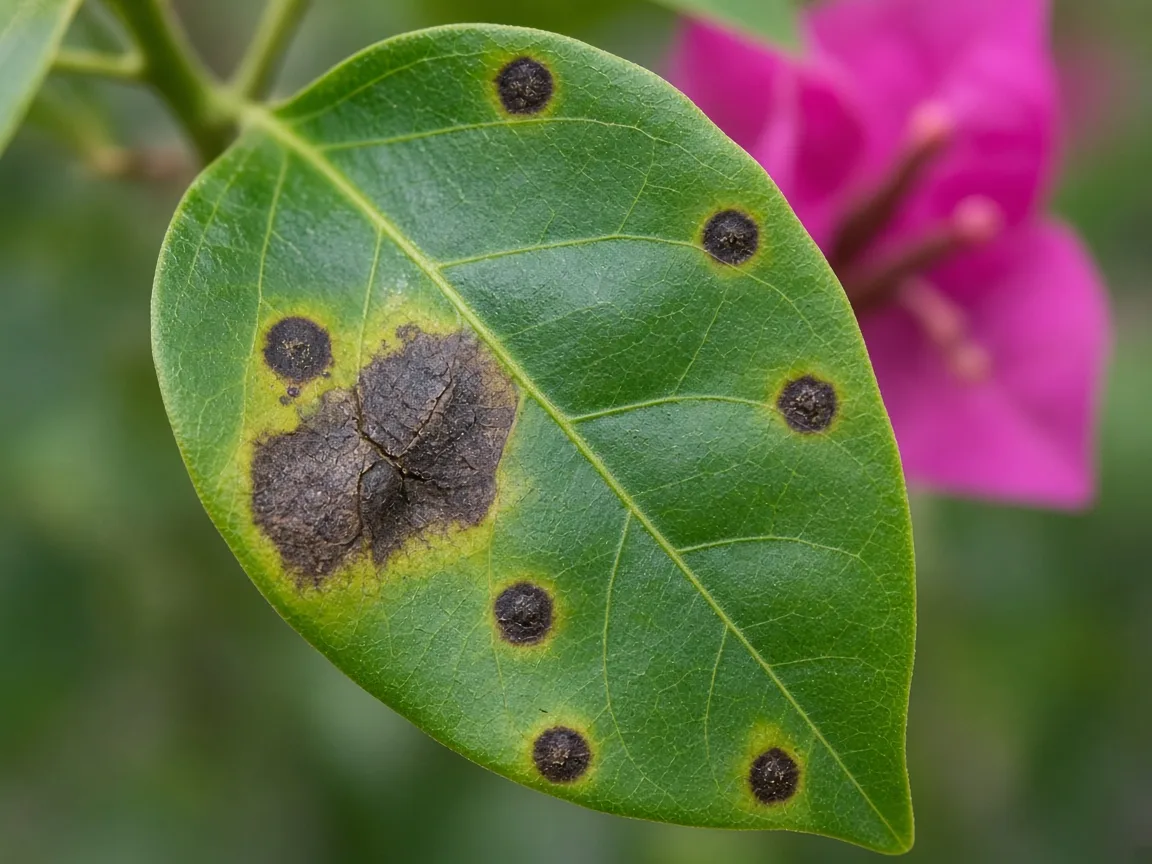
Black spot symptoms on Bougainvillea—compare necrotic tissue with healthy green leaf and nearby bracts.
Common patterns:
- Small brown to black dots that enlarge or merge on one or more green leaves, often on lower or interior foliage where airflow is weakest—typical of fungal leaf rot in humid, rainy periods on container and conservatory plants.
- Irregular black patches with a dry, papery feel on leaf tips or margins after weeks of overhead watering or evening hose spray—leaf-spot fungi favored by long leaf wetness (same wet-leaf principle as our global black spots hub).
- Uniform black or dark brown film on upper leaf or bract surfaces that can be smeared with a damp cloth—sooty mould fungi grow on honeydew from sap-sucking insects, not inside leaf tissue.
- Single dry black mark on one old leaf, no spread—thorn scrape, wind damage, or healed mechanical injury on a thorny branch.
- Mass leaf yellowing and drop without discrete round spots after heavy bloom—can be normal post-flowering shedding; UF/IFAS notes bougainvillea often loses many leaves following a flowering period before a new growth flush.
Spots on new leaves at actively growing stem tips are more urgent than a few marks on shaded interior foliage.
Why thorny Bougainvillea vines get black spots on interior leaves
Bougainvillea is built for full sun, sharp drainage, and dry intervals between waterings. NC State Extension recommends full sun in sandy or loamy acidic soils with good drainage and notes drought and heat tolerance. When culture drifts toward shade, crowded pots, or wet leaves, spotting follows predictable paths.
Humidity trapped inside scrambling stems. Bougainvillea climbs and arches with long thorns at leaf axils. Leaves pressed against walls, trellis boards, or neighboring pots stay damp overnight—exactly where fungal leaf spots start. RHS guidance on conservatory culture stresses ventilation to keep down fungal diseases when plants grow under glass.
Overhead watering and rain splash. Sprinklers, shower-rinsing, or monsoon rain wet waxy leaves that then dry slowly in partial shade. Too much shade and water discourages blooming and keeps tissues soft longer—inviting leaf pathogens.
Pest honeydew and sooty mold. RHS lists whitefly, mealybug, aphid, and red spider mite as bougainvillea pests. Their sticky exudate feeds sooty mould growth that looks like black dust on leaves and bracts.
Overwatering without root rot yet. Chronically wet mix weakens roots and can coincide with leaf drop and darkening, but discrete round spots on foliage still point to leaf-surface fungi or sooty mold first. Route soggy pots and sour smell to root rot and our watering guide.
How to confirm the cause
Work through these checks before repotting or spraying everything:
- Leaf vs bract — Pinch a spot gently. Necrotic tissue on a green leaf that does not wipe away supports fungal leaf spot. Black film on bracts or upper leaf surfaces that smears with a cloth supports sooty mold.
- Wipe test — Damp cloth on the spot. Residue on the cloth means honeydew/sooty mold; clean cloth with a fixed scar in the leaf means dead tissue.
- Moisture history — Did spots appear after rainy weeks, misting, or evening overhead watering? Timing that matches wet foliage supports fungi.
- Pest scan — Inspect undersides, young shoots, and thorny axils with a hand lens. Cottony clusters, flying white insects when disturbed, or curled sticky shoots point to pests—not standalone leaf spot.
- Light and airflow — Is the pot in shade or packed on a balcony? Bougainvillea needs full sun to perform; dim, stagnant air extends leaf wetness.
- Soil check — Probe the top 3–5 cm per our soil and drainage standards. Soggy mix plus wilt may mean roots, not leaves alone.
- Spread rate — New spots weekly on multiple stems = active disease or unchecked pests. Stable marks on a few old leaves after corrected culture may be leftover damage.
First fix for Bougainvillea
Stop wetting foliage and thin the interior canopy for airflow—today.
- Water at the soil line only; skip misting and overhead sprays on leaves and bracts.
- Wearing gloves, remove the most heavily spotted interior leaves you can reach without stripping the whole plant bare.
- Space pots or pull the vine slightly away from walls so leaves dry within a few hours after watering.
- If black coating wipes off, wash leaves with plain water, then treat the underlying aphids or whiteflies—sooty mold returns until honeydew stops.
Do not repot, heavily prune every thorny branch, and spray fungicide on the same day. Read the plant’s response for one to two weeks after dry-leaf culture.
Step-by-step recovery
Week 1–2: Dry-leaf culture and sanitation
Continue base watering when the top 3–5 cm of mix is dry—see Bougainvillea watering. Pick off new spotted leaves as they appear; bag them, do not compost. Improve sun exposure if the plant has been in deep shade; gradual moves prevent shock.
For sooty mold, control insects first. A strong plain-water rinse can remove superficial mold after pests decline.
Week 3–4: Fungicide only if spots persist on new growth
If new leaves still develop enlarging black lesions after two weeks of dry foliage and airflow, consider a labeled ornamental fungicide for leaf spot on woody ornamentals. Test-spray one branch in morning shade; follow label intervals. Fungicides protect healthy tissue—they do not heal necrotic spots already present.
Bacterial leaf issues are less common on bougainvillea in home culture; Epic Gardening notes bacterial leaf rot is often untreatable and requires removing affected parts—if lesions look water-soaked, greasy, and fast-spreading on stems, prune back to healthy wood with sanitized tools and improve dryness before any spray program.
Containers and conservatories
Potted bougainvillea under glass need maximum ventilation in humid months—crack vents, avoid crowding benches, and keep leaves from touching wet glass. Outdoor patio pots in full sun rarely need fungicide if you stop wetting foliage.
Recovery timeline
- Sooty mold: visible mold may fade within two to three weeks after insects are controlled; bracts look cleaner as new growth stays honeydew-free.
- Mild fungal leaf spot: new leaves should emerge without spots within two to four weeks once leaves stay dry and interior stems are opened.
- Severe defoliation: bougainvillea can releaf from woody stems; expect four to eight weeks for canopy refill in warm, bright conditions—not in cool winter dormancy.
Old blackened leaf tissue never turns green again. Judge recovery by clean new leaves and fresh bracts on new wood.
Lookalike symptoms
| What you see | Likely cause | Where to go |
|---|---|---|
| Black powder wipes off | Sooty mold on honeydew | Pest pages above |
| Round spots with yellow halos on wet leaves | Fungal leaf spot | This page |
| Uniform leaf drop after bloom, few spots | Post-flowering shed | Monitor; improve sun |
| Black soft stems at soil line | Root/stem rot | Root rot |
| Ragged holes, frass | Caterpillars | Not leaf spot |
| Stippling, fine webbing | Spider mites | Dry air pests |
Mistakes to avoid
- Misting bougainvillea in a dim room—waxy leaves stay wet; fungi and sooty mold both worsen.
- Feeding heavily while leaves are spotted—fix moisture, light, and pests before fertilizer pushes soft growth.
- Repotting into a huge pot on day one—extra wet mix invites root problems without fixing leaf wetness.
- Composting infected leaves—bag spotted debris if fungal leaf spot was confirmed.
- Bare-handed pruning—thorns are long and sharp; use gloves and sanitize pruners between cuts.
How to prevent black spots next time
Match the plant’s native rhythm: full sun, fast-draining mix per soil guide, and soak-and-dry watering. Train vines with airflow in mind—avoid letting interior leaves mat against solid surfaces. Quarantine new pots before mixing them on a crowded terrace. Scout weekly for sap-suckers during warm months so honeydew never builds into thick sooty mold.
After bloom, expect some leaf drop; do not panic-fertilize or overwater—let new growth flush in bright light per light requirements.
Related Bougainvillea guides
Use this page when you see discrete dark lesions or sooty films on green leaves and need to separate fungi, pests, and post-bloom shed. Use overwatering when the whole plant yellows on a heavy pot without a spot pattern.
Conclusion
Black spots on bougainvillea are manageable when you keep true leaves dry, ventilate the thorny interior canopy, and clear honeydew-producing pests before they fuel sooty mold. Bracts may stay colorful while leaves suffer—focus on green leaf tissue and new growth at the stem tips. Success means clean emerging leaves and bracts, not perfect old blades on a plant built for sun and sharp drainage.