Holes in Leaves on Bougainvillea: Causes, Checks & Fixes
Quick answer
Holes in Bougainvillea foliage mean tissue was removed—most often bougainvillea looper caterpillars, other chewing insects, or thorny-cane snags—not a normal leaf pattern. First step: look at the hole edge and search outer vines at dusk for scalloped chew marks, dark frass pellets, or a smooth inchworm-like larva before you change watering or spray.
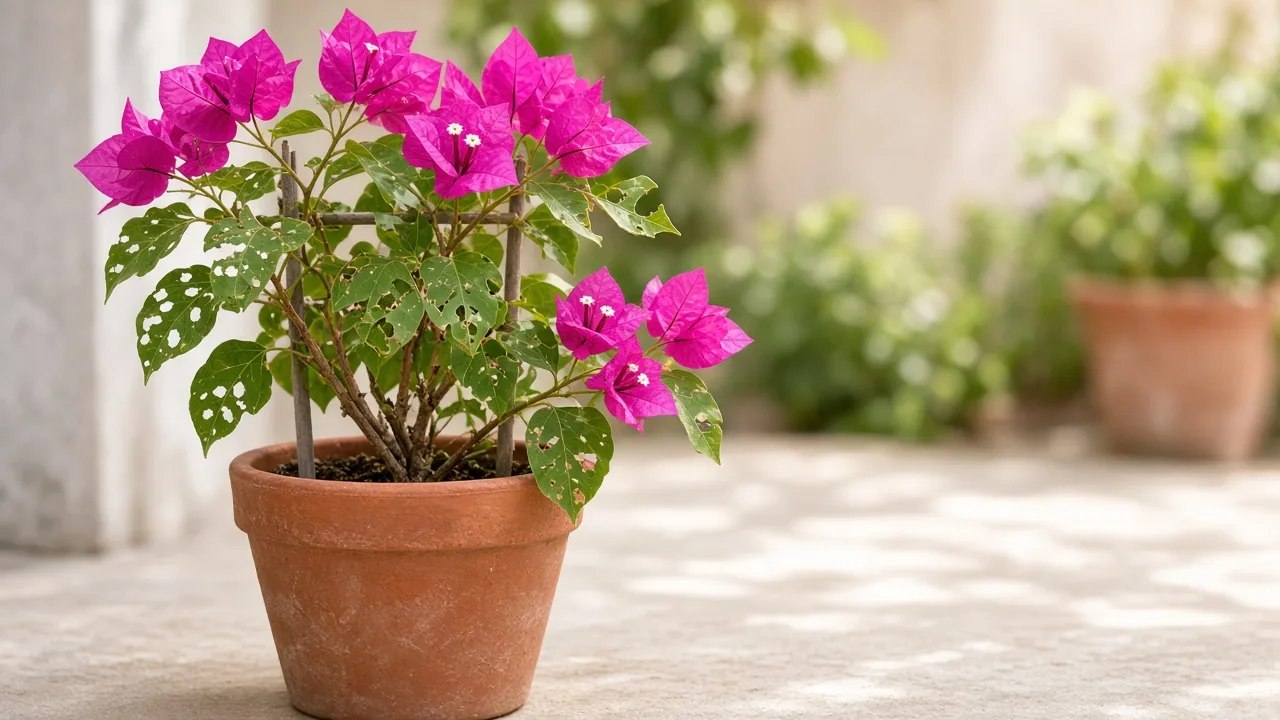
Holes in Leaves on Bougainvillea: Causes, Checks & Fixes
This guide covers holes in leaves on Bougainvillea. See also the general Holes in Leaves guide, watering, and light pages for this plant.
Holes in Leaves on Bougainvillea: Causes, Checks & Fixes
Quick answer
Holes in Bougainvillea (Bougainvillea spp.) mean something removed or tore tissue on the small green leaves—bougainvillea looper caterpillars, other chewers, leaf miners, trellis snags on thorny canes, or dried spots that fell out. The showy magenta, orange, or purple “flowers” are papery bracts; damage usually shows on the plain green foliage between them, not as natural fenestration.
For how chewing pests and mechanical tears work in general, see our holes in leaves guide. On Bougainvillea, the first place to look is soft new shoots on sun-exposed outer vines—where the bougainvillea looper scallops margins and chews through mature blades at night.
First step: read the hole edge, then inspect outer vine tips at dusk for scalloped chew marks, dark frass pellets, or a smooth inchworm-like larva. That single check separates loopers from miners, sap feeders, and one-time trellis tears before you repot or change watering.
When to use this page vs other Bougainvillea guides
| Pattern | Start here | Or route to… |
|---|---|---|
| Ragged holes with frass on green leaves | This page | Caterpillars |
| Scalloped margins, inchworm motion, night feeding | This page | Bougainvillea looper detail above |
| Serpentine tunnels inside the blade | Leaf miners | This page if holes are full-thickness |
| Silver streaks, scarred buds, distorted new tips | Thrips | — |
| Sticky leaves, no chew holes | Aphids or whiteflies | — |
| Brown halos before tissue drops out | Black spots | — |
| Soft stems, sour mix, yellowing canopy on wet soil | Root rot or overwatering | Firm canes with holed foliage only |
What holes in leaves look like on Bougainvillea
Bougainvillea leaves are heart-shaped and sit on long, stiff, thorny stems. Bracts provide the color; the true leaves are smaller, green, and ovate. When you see a hole, sort it by pattern:
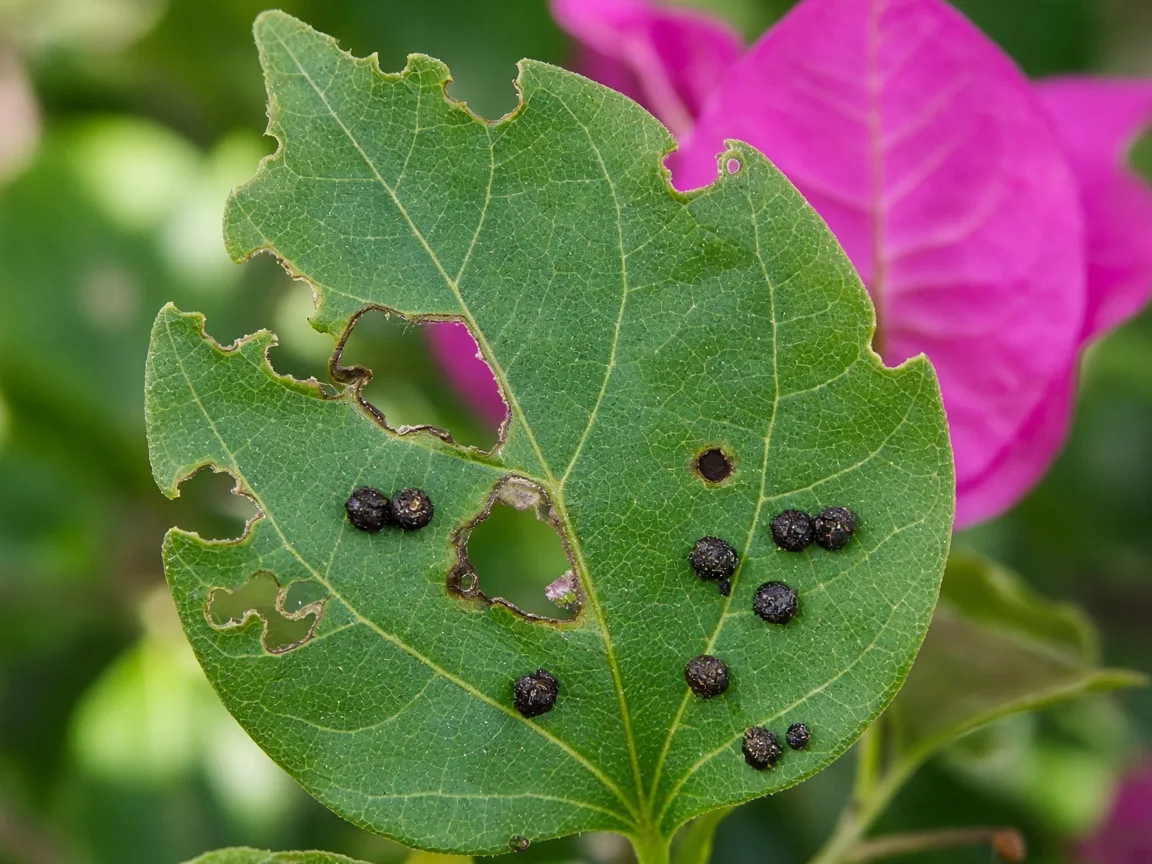
Ragged chew holes through Bougainvillea’s green leaf blade—compare scalloped margins and frass with healthy tissue on the same vine.
Bougainvillea looper chewing — Young larvae feed on tender shoots and leaf edges, making scalloped margins; older larvae chew through mature leaves. Look for dark fecal pellets on leaves or the pot below. The smooth green to brown caterpillar moves like an inchworm and feeds at night. Heavy infestations can defoliate sections of a patio vine.
Other caterpillar chewing — Irregular holes and notched margins on the softest new growth, often with frass on the rim or soil. Epic Gardening notes loopers and other chewers target tender leaves first, then move to older foliage as larvae grow. See caterpillars on Bougainvillea.
Leaf miner trails — Winding pale tunnels inside the leaf with a small exit hole—not a large ragged chew. Leaf miner larvae feed between leaf surfaces. Backlight the blade to see bordered trails. See leaf miners.
Thrips rasping — Silvery stippling and distorted young tips; full-thickness holes are less common than scarring. See thrips.
Trellis and thorn snags — Clean linear splits or one-time holes on outer leaves that brush wires, wall hooks, or neighboring pots. Damage stays on the same leaf after you reposition the cane; no frass, no internal trails. Common on thorny scrambling stems tied too tightly during pruning or training.
Shot holes from old leaf spots — Small round holes where necrotic tissue dropped out after black spots dried—usually with preceding brown halos, unlike clean mechanical tears.
Green foliage vs colorful bracts (Bougainvillea only)
Loopers and most chewers attack the small green leaves that photosynthesize between bracts. Bracts may stay bright while foliage looks ragged—a confusing sight if you only scan for faded “flowers.” Always inspect plain green blades on the same cane, especially on the windward outer arch where moths lay eggs.
Night scouting on patio vines (Bougainvillea only)
Because bougainvillea loopers are active at night, a midday glance can miss the culprit. After sunset, run a flashlight along outer shoots on warm evenings. Scalloped new growth plus pellets on the pot rim strongly confirm caterpillars even if no larva is visible yet.
Thorny canes and training wounds (Bougainvillea only)
Bougainvillea’s needlelike thorns and woody older canes make mechanical tears common when vines whip in wind or rub on galvanized trellis wire. If only one outer leaf shows a straight tear, loosen ties per the pruning guide before you treat for insects. Gloves matter—sap can irritate skin and thorns pierce easily.
Why Bougainvillea gets holes in leaves
Chewing insects are the most common cause of true holes on sun-grown Bougainvillea. UC IPM lists bougainvillea looper among the primary invertebrate pests, and Epic Gardening describes edge feeding that progresses to older leaves.
Soft shoots after a growth flush are the first target. Bougainvillea pushes tender leaves on long water shoots during warm weather, especially after bloom cycles when you prune for shape. Caterpillars concentrate there while lower woody sections still look fine.
Outdoor summer placement imports eggs. Patio pots grouped on sunny walls share moths, loopers, and leaf miners from neighboring ornamentals. Damage often appears weeks after a plant returns indoors—one looper can open several holes on sequential new leaves because growth concentrates at each tip.
Leaf miners tunnel inside thin blades. Miners are less dramatic than loopers but leave bordered trails; they show up on container vines that spent summer outside. Route internal damage to leaf miners.
Mechanical damage during training. Full sun on a balcony means frequent tying and rotating for even bloom. A leaf caught once between thorn and wire tears cleanly without spread.
Fungal spots can fall out. Chronic wet foliage in dim winter rooms can precede black spots; dried centers sometimes drop, leaving shot-hole appearance—usually with halos, unlike trellis tears.
Bougainvillea does not develop natural perforations like some aroids. Open holes always mean damage.
Water stress shows as wilting, yellow leaves, or bract drop—not random chew holes on otherwise firm canes. If stems are woody and the mix dries on schedule per watering, look for pests or snags before you soak again.
How to confirm the cause
Work through these checks in order:
- Edge test — Ragged, irregular margin with chew marks → insects. Clean linear tear → mechanical snag. Serpentine trail visible when backlit → leaf miner.
- Frass or larvae — Dark pellets on leaves or below the pot → caterpillars or loopers. Smooth inchworm motion at night → bougainvillea looper. Neither → consider old fungal shot holes or trellis damage.
- Location on the plant — Damage clustered on outer arching shoots in full sun → chewers. One lower leaf with a straight tear → placement. Trails scattered on leaves after outdoor summer → miners.
- Sap feeders — Sticky residue, curled tips without removed tissue → aphids or whiteflies, not this page.
- Root cross-check — Press the base of the cane. Firm wood with holes only on foliage → pests or mechanical. Soft base on soggy mix → root rot before pesticides.
The first fix to try
Inspect outer vine tips at dusk with a flashlight and remove any visible loopers or caterpillars by hand into soapy water. Wear gloves for thorns. Note scalloped margins and frass so you know chewing—not watering—is the issue.
That single step matches UC IPM’s recommendation to check periodically during warm weather for feeding damage and fecal pellets before reaching for sprays.
If you find only one clean trellis tear and no pellets, reposition and loosen ties instead of treating insects.
Step-by-step recovery
- Isolate patio pots that moved indoors if you see fresh holes spreading—isolate infested plants so loopers do not reach neighboring pots.
- Hand-pick loopers and caterpillars you see at night; crush frass-heavy leaves into a bag if mines or chews are localized on one shoot.
- Prune selectively — Cut back only the worst-stripped soft shoots after bloom, following pruning timing so you do not remove all flowering wood at once.
- Rinse foliage — A strong lukewarm spray on leaf undersides knocks off young larvae; let leaves dry in full sun to avoid mold on soil.
- Biological spray if needed — For young loopers, Bacillus thuringiensis can help; mature larvae may need spinosad per label directions. Apply in evening when loopers feed; avoid spraying open bracts if bees are active.
- Re-check weekly until two flushes of new leaves open clean.
Do not repot, hard-prune, and spray on the same day—change one variable so you can read the plant’s response.
Recovery timeline
| Severity | What you should see |
|---|---|
| Light chewing on a few outer leaves | New tips open clean within 1–2 weeks after pick-off or one targeted spray |
| Moderate strip on one arch | Side shoots leaf out in 2–4 weeks; bract color returns when sun and dry-down watering stay steady |
| Heavy defoliation on a section | Woody cane may releaf in 4–8 weeks; bloom may pause until the next flush |
Old holed leaves stay holed. Success means stopped spread and clean new blades.
Mistakes to avoid
- Soaking the pot because leaves look ugly—wet mix on a sun plant invites root problems without fixing chew holes.
- Fertilizing a stripped vine before pests are controlled—feed only after new growth looks healthy per fertilizer.
- Spraying in midday heat on a patio—stress plus pesticide burn on thin leaves.
- Ignoring thorn snags while repeating neem applications—fix ties first when the pattern is mechanical.
- Confusing miners with loopers—miners need mined-leaf removal, not only surface sprays.
Bougainvillea care cross-check
Holes on firm, woody stems in bright light almost never mean you chose the wrong soil mix alone. Cross-check:
- Did the plant just return from outdoors?
- Did you tie new growth tightly after a bloom flush?
- Is damage only on accessible outer leaves (pets, hoses, railings)?
- Are bracts still colorful while green leaves are holed (typical looper pattern)?
If yes to outdoor return or tight ties, prioritize scouting and mechanical fixes before changing your whole watering calendar.
How to prevent holes next time
- Scout outer vines weekly during warm weather; loopers are easier to crush when populations are small.
- Quarantine new Bougainvillea two weeks before mixing with other patio plants.
- Keep full sun and fast-draining mix so growth is vigorous but not overly soft from shade plus nitrogen.
- Tie canes loosely; pad trellis wires where arches rub.
- Rinse plants and inspect leaves before winter bring-in.
- Rotate blooming sections with pruning so you do not leave one soft shoot as the only caterpillar buffet.
When to worry
Escalate when:
- Fresh holes appear on multiple vines within a week
- Loopers defoliate an entire patio section despite nightly hand-picking
- Leaf-miner trails spread through most new growth
- Frass piles up while canes stay firm and you still see night feeding
- New tips stop expanding because tissue is stripped
A single old tear on one outer leaf, with firm woody stems and clean new growth elsewhere, is usually not an emergency.
Handling safety: Wear gloves for thorns and sap. Bougainvillea is toxic to pets if ingested—keep pruned debris out of reach per the overview safety notes.
Conclusion
Holes in Bougainvillea leaves always mean damage—looper chewing, other caterpillars, mining, trellis tears, or old spot drop-out—not a natural leaf pattern. Read the hole edge, scout thorny outer shoots at dusk, and match the pattern before you soak the pot or spray blindly. Bougainvillea releafs quickly from woody canes once the feeder is gone; focus on clean new green blades, sane tying, and quarantine after patio season.
Related Bougainvillea guides
- Bougainvillea overview — sun, bloom rhythm, and safety
- Bougainvillea problems — browse all common issues
- Bougainvillea watering — dry-down rhythm when holes are not the issue
- Bougainvillea light — six-plus hours of direct sun without weak growth
- Bougainvillea soil — drainage that protects roots on patios
- Caterpillars on Bougainvillea — ragged holes with frass
- Leaf miners on Bougainvillea — internal trails and exit holes
- Black spots on Bougainvillea — shot holes after lesions dry
Related tool
Use the Plant Problem Diagnosis Tool to narrow causes for holes in leaves on this plant before changing multiple variables at once.