Fungus Gnats Near Duckweed: Find the Real Source
Quick answer
First, inspect every damp terrestrial or emersed growing medium beside the Duckweed setup. Normal floating Duckweed has no potting mix for fungus gnat larvae; check nearby houseplant pots, propagation trays, wet mulch, and drains before treating anything. If no damp organic breeding source is confirmed, re-identify the insect instead of treating the water, and never put a pesticide into aquarium or pond water unless its label explicitly permits that exact use.
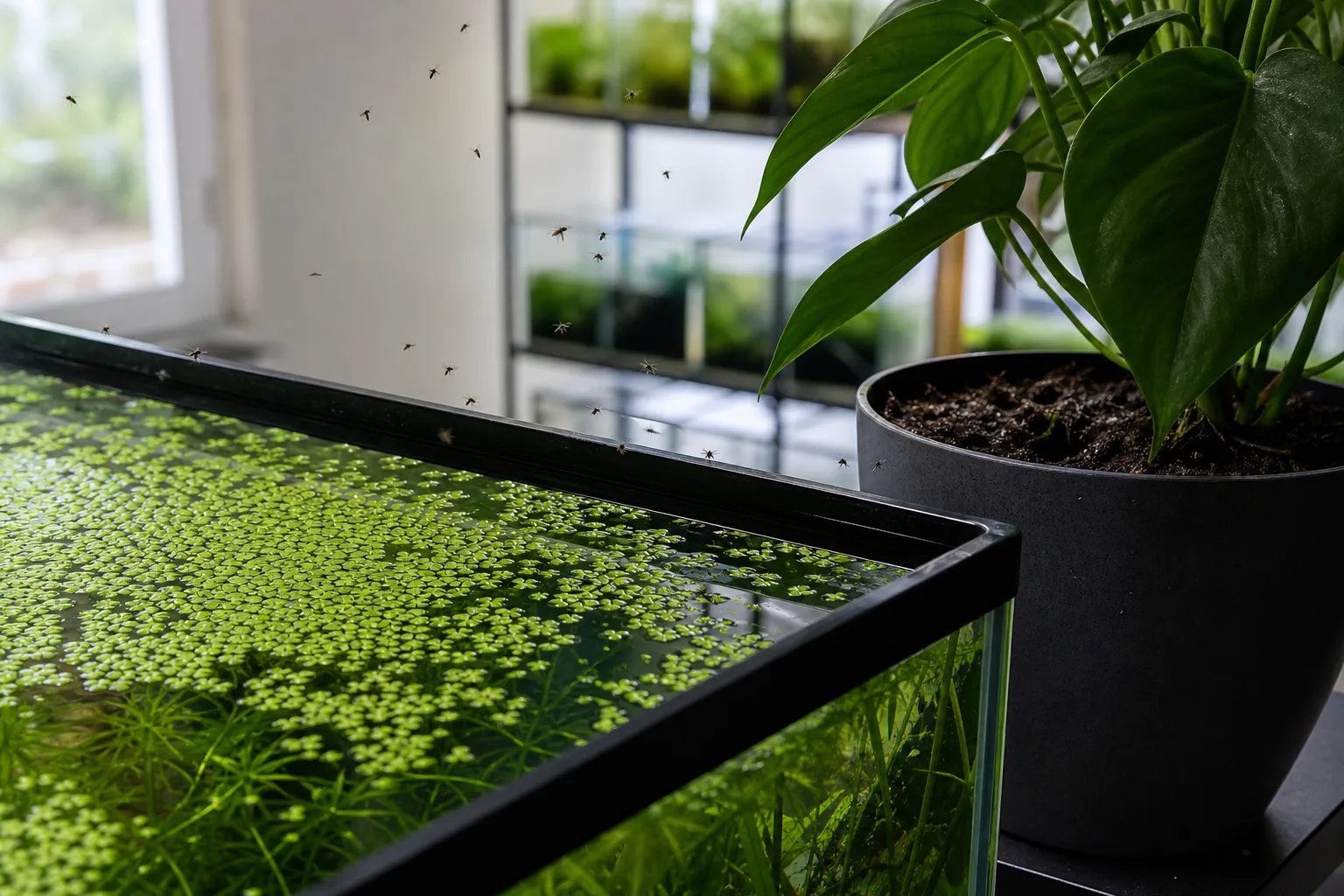
Fungus Gnats Near Duckweed: Find the Source & Fix It
This guide covers fungus gnats on Duckweed. See also the general Fungus Gnats guide, watering, and light pages for this plant.
Fungus Gnats Near Duckweed: Find the Source & Fix It
Quick answer
First, inspect every damp terrestrial or emersed growing medium beside the Duckweed setup. Common Duckweed (Lemna minor) forms a floating carpet on the water surface; normal aquarium or pond culture has no potting mix. Fungus gnats, by contrast, infest soil, container media, compost, wet mulch, and other decomposing organic material.
Use this decision path: adults over the water → inspect damp organic media nearby → confirm larvae or repeated emergence → correct only that confirmed source. If there is no damp soil, moss, compost, mulch, decaying tray medium, or similar source near the setup, stop. Re-identify the insect rather than treating the Duckweed or the water.
The general fungus-gnat guide explains the insect’s life cycle. This page focuses on the unusual part of a Duckweed setup: separating a terrestrial gnat source from an aquatic plant that may be directly below the adults.
Why floating Duckweed is usually not the breeding site
Fungus gnats lay eggs in moist organic debris or potting soil, and their pale larvae feed on fungi, decaying matter, and sometimes fine plant roots. UC IPM describes their breeding sites as soil, potting mix, container media, and organic decomposition. A healthy layer of free-floating Lemna, Spirodela, Landoltia, Wolffia, or Wolffiella fronds does not supply that air-filled, fungus-rich terrestrial medium.
This does not mean every wet place near Duckweed is irrelevant. An emersed propagation tray filled with peat or coir, a riparian planter with saturated soil, a clogged drain containing biofilm, or wet mulch pressed against a pond liner can support small flies. A drain may also point to a different small-fly problem. The useful distinction is open water with floating fronds versus damp organic medium at or above the waterline.
Do not try to “dry the top inch” of the Duckweed culture. The plant belongs at the water surface; use the Duckweed watering guide for water-level and water-quality care instead of applying a houseplant dry-down rule to an aquatic mat.
Identify the adult before blaming the tank
Adult darkwinged fungus gnats are delicate, mosquito-like flies, commonly about 1/16 to 1/8 inch long, with long legs and antennae. They are weak fliers and often remain near potting media, compost, wet mulch, foliage, or windows. UC IPM notes that common Bradysia adults have a Y-shaped vein in the wing, although a phone macro lens may be needed to see it.
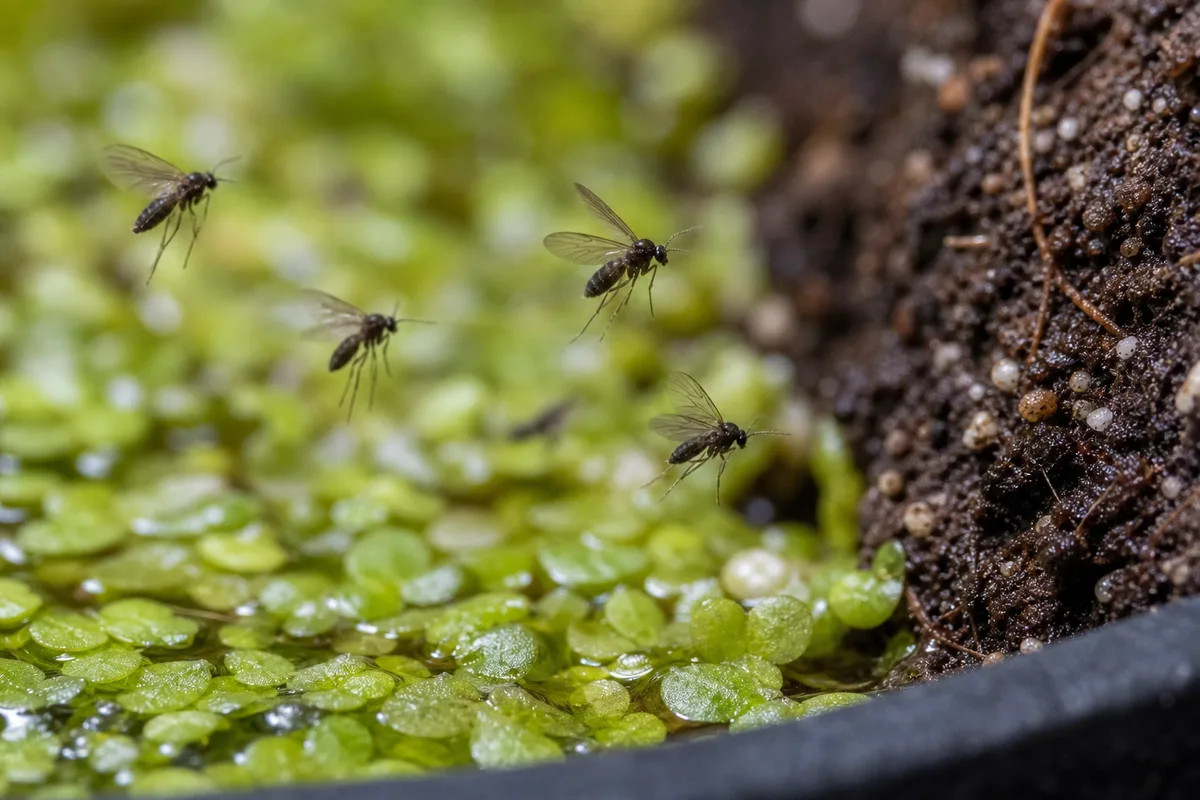
The hero and close-up on this page are illustrative generated diagnostic images, not photographs of a documented case. An adult above Duckweed does not prove where its larvae developed; confirm a damp organic breeding source separately.
Rule out common lookalikes:
| What you notice | More likely source | Best confirmation |
|---|---|---|
| Slender dark flies rise when a houseplant pot is disturbed | Fungus gnats | Inspect that pot’s surface and use a sticky card at the pot |
| Tan flies gather around fruit, recycling, or fermenting waste | Fruit flies | Remove the food source and watch where adults return |
| Fuzzy, moth-like flies rest near a sink or floor drain | Drain or moth flies | Inspect and clean drain biofilm |
| Stockier dark flies occur around algae in an emersed tray | Shore flies | Compare the shorter antennae and inspect algae-covered media |
| Tiny organisms jump from the water surface rather than fly | Springtails or other surface fauna | Observe movement with a hand lens before treating |
If the insect cannot be identified confidently, capture one on a card placed away from the tank and ask a local extension office or pest professional. Identification matters because a treatment aimed at potting mix will not solve a drain-fly source.
Map the source around an aquarium, turtle tub, or pond
Start at the water and work outward. Adult gnats may rest on Duckweed because the surface is still, brightly lit, and easy to see; that does not reveal where they emerged.
- Tank stand: Disturb every potted terrestrial plant, including pothos grown with roots in water but a crown still sitting in damp potting mix.
- Propagation station: Check peat plugs, seed-starting cells, moss boxes, and emersed aquatic-plant cups. Floating Duckweed propagated in plain water is different from an emersed tray containing organic medium.
- Equipment area: Look beneath wet filter pads, around leaking hoses, and near floor drains. These may point to other small-fly sources rather than fungus gnats.
- Outdoor pond margin: Inspect saturated planters, compost, leaf litter, wet mulch, and soil held against the liner. Do not assume the breeding site is inside the pond.
- Stored media: Check open bags of damp potting mix and buckets of decomposing plant waste.
Colorado State Extension notes that fungus gnats develop in potting soil and that excessively moist soil favors them. One wet pot can keep producing adults even while every aquatic parameter in the Duckweed tank is correct.
If no damp organic source is confirmed
Do not treat by proximity alone. UC IPM describes fungus gnats as flies of soil, potting mix, container media, and organic decomposition, so a careful search that finds none of those habitats weakens the fungus-gnat diagnosis. Re-identify the insect before choosing a control; open water and floating fronds are not substitutes for evidence of a larval site.
Capture an adult on a card mounted away from the water and compare its body shape, antennae, wings, and movement with the lookalikes above. Check drains for moth-like flies, algae-covered emersed trays for shore flies, and the water surface for organisms that jump rather than fly. If the specimen still cannot be identified, send a clear macro photograph or the trapped insect to a local extension office or pest professional before applying any control.
The correct outcome may be no treatment. Continue monitoring while keeping adhesives out of the tank; do not add Bti, peroxide, neem, pyrethrins, or any other product to the water as a diagnostic experiment.
Confirm larvae in the suspected medium
Place a yellow sticky card just above, not inside, a suspect pot. Adults accumulating there show where they are active, but a card alone does not prove where larvae live. UC IPM recommends checking for excessively moist media and organic debris; it also describes raw potato pieces placed cut-side down as a way to monitor larvae in a pot.
After a few days, lift the potato and look for slender, translucent larvae with shiny black heads. Dispose of the piece in a sealed bag. Repeat the check on different pots if adults remain, because multiple containers can be infested at the same time.
Do not place potato in the aquarium, bury it beneath Duckweed, or use it as an aquatic bait. That would add decomposing food to the water without testing the terrestrial medium where fungus gnat larvae are expected.
First fix: change the confirmed breeding medium
Once one pot or tray is confirmed, let its surface dry as far as that terrestrial plant safely tolerates before watering again. The instruction applies to the infested container—not to Duckweed water. Clear dead leaves from the surface, empty its saucer, and correct a blocked drain hole or leak that keeps the medium continuously wet.
UC IPM identifies reduced excess moisture and organic debris as key cultural controls and advises allowing container-soil surfaces to dry between waterings. Use the care needs of the plant in that pot to set the dry-down depth; do not deliberately dehydrate a moisture-sensitive terrestrial species.
Move the confirmed pot far enough from open water that runoff cannot enter the tank. If the source is an expendable, heavily infested emersed tray, discarding the medium may be safer and faster than treating it beside fish or turtles. Clean the shelf and restart only from material appropriate for aquatic culture.
Traps monitor adults; they do not cure the source
Attach yellow sticky cards to stakes in the confirmed terrestrial pots or mount them on a wall or shelf. Keep every adhesive surface beyond the reach of turtles, fish, birds, children, and other animals. Do not float a trap on Duckweed or suspend it where it can fall into the water.
Sticky cards can reduce and track flying adults, but Colorado State Extension cautions that trapping alone does not eliminate the population because immature stages remain in or around the plant medium. Date each card and compare counts weekly. A downward trend after the medium begins drying is more useful than the number caught on one day.
Bti belongs on a labeled substrate, not automatically in tank water
If cultural control is insufficient, a product containing Bacillus thuringiensis subsp. israelensis (Bti) may be labeled for fungus gnat larvae in potting media. UC IPM describes Bti as a soil drench or media treatment that must be applied according to label directions. The product, formulation, target pest, site, and rate all matter.
Near an aquarium, turtle tub, or wildlife pond, use this hard boundary:
- Do not pour a houseplant drench, mosquito product, hydrogen-peroxide mixture, neem product, pyrethrin, or other pesticide into the water because an ingredient sounds familiar.
- Do not spray over an open tank or allow treated-pot drainage, dust, granules, or adhesive to enter it.
- Do not infer safety for fish, shrimp, snails, amphibians, or turtles from a general statement that a microbial product is “natural.”
- Use a product only for the sites and methods its current label lists.
The National Pesticide Information Center states that a pesticide should not be used in a different setting without checking the label and that only specifically listed uses are permitted. If the exact aquatic use is absent or unclear, treat the terrestrial source away from the water or ask the manufacturer and an aquatic-animal professional before proceeding.
When the Duckweed itself looks unhealthy
Fungus gnat adults over a tank do not explain pale fronds, a thinning mat, sinking tissue, or a foul smell. Those symptoms call for an aquatic diagnosis:
- Pale or sparse growth: review the Duckweed light guide and slow-growth guide.
- Yellowing or melting fronds: use the yellow-leaves guide and check recent water changes, temperature, and chemical exposure.
- A foul-smelling, collapsing mat: remove decay and follow the Duckweed root-rot guide as a water-quality troubleshooting route.
- A surface packed so densely that gas exchange, feeding, or equipment access is affected: thin it using the Duckweed pruning guide.
Healthy Duckweed does not need a “gnat recovery.” Judge the insect-control result by fewer adults emerging from confirmed terrestrial media. Judge the aquatic plant separately by frond color, new daughter-frond production, water quality, and whether the mat remains afloat.
What improvement looks like
Expect adults to remain for a while after the first correction because eggs, larvae, pupae, and adults overlap. UC IPM reports that a generation can take about 17 days at 75°F, with development changing by temperature. Avoid promising a fixed eradication date; instead, keep the source drier where the terrestrial plant permits and compare dated trap counts over several weeks.
The plan is working when:
- fewer adults rise from the treated pot or tray;
- new sticky cards collect progressively fewer gnats;
- potato checks stop finding larvae;
- no additional nearby containers become active; and
- the Duckweed remains untreated and stable.
Widen the search if counts do not decline, especially when several potted plants, drains, compost containers, or pond-edge beds stay damp. Persistent heavy emergence may justify help from a local extension office or licensed pest professional.
Prevent recurrence without changing aquatic care
Keep terrestrial plants beside the aquarium only when their pots drain cleanly and their watering needs can be met without chronic saturation. Inspect potting media and propagation trays before bringing them into the fish room, and store unused mix dry and closed. Repair drips, clear wet plant debris from shelves, and avoid letting pond-edge mulch remain pressed against a liner.
For the aquatic side, follow the Duckweed overview and Duckweed fertilizer guide rather than adding terrestrial amendments to the water. Thin excess growth before it accumulates on filter foam or exposed ledges, but do not drain or dry a healthy floating culture to control an insect breeding elsewhere.
How this guide was prepared
This is a source-based editorial diagnosis, not a first-hand tank case. The workflow combines Extension guidance on Duckweed habitat, fungus-gnat identification and control, and pesticide-label use with an aquatic-specific source map. The generated images illustrate signs to inspect; they do not document a confirmed infestation or replace specimen identification.
Related Duckweed guides
Use this page when small flying insects hover near Duckweed and you need to locate—or rule out—a damp organic breeding substrate. Use the Duckweed problems hub when the fronds themselves show symptoms, and use the mold-on-soil guide when suspicious growth is on an adjacent emersed medium rather than open water.
The Duckweed overview covers routine aquatic setup and water-quality care. Choose the yellow-leaves guide for discolored fronds, the slow-growth guide for a mat that stops spreading, or the root-rot guide when decay and foul water—not flying adults—are the urgent concern.