Underwatering on Janet Craig Dracaena: Causes, Checks &
Quick answer
Underwatering on Janet Craig usually means drooping leaves with a very light pot and dry mix at half depth, especially in brighter placements. First fix: deep-soak once with low-fluoride water, then return to dry-down checks. If the pot is still heavy and the cane base feels soft, treat overwatering instead.
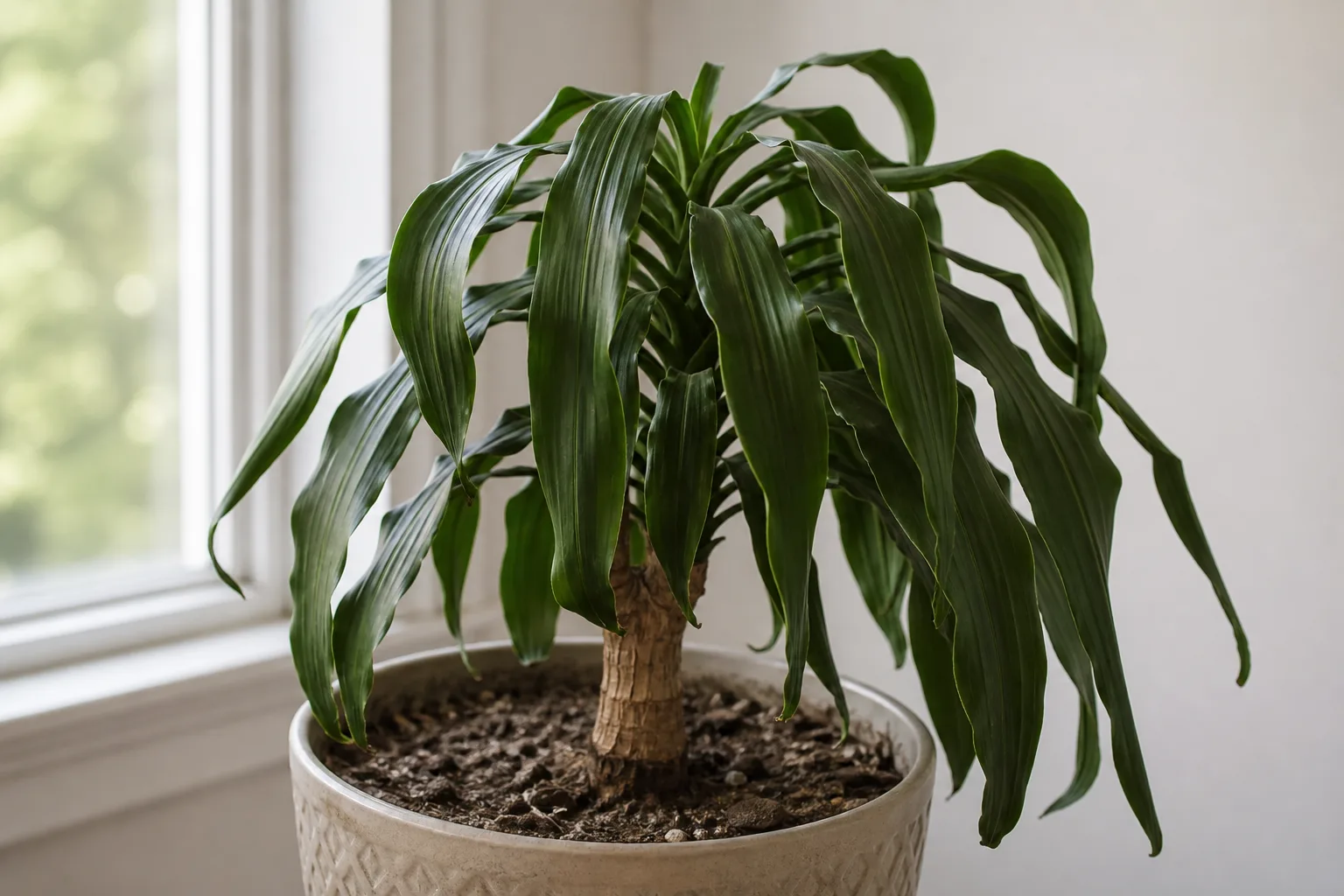
Underwatering on Janet Craig Dracaena: Causes, Checks & Fixes
This guide covers underwatering on Janet Craig Dracaena. See also the general Underwatering guide, watering, and light pages for this plant.
Underwatering on Janet Craig Dracaena: Causes, Checks & Fixes
Quick answer
Underwatering on Janet Craig Dracaena usually presents as drooping, slightly curled foliage on a pot that feels unexpectedly light. It happens most often when a plant that can survive low light is moved to bright to moderate filtered light but watering intervals stay “low-light long.” Your first move is one full soak with low-fluoride water, full drainage, and then a return to half-depth dry-down checks. If soil is still wet and the cane base feels soft, stop and follow /plants/janet-craig-dracaena/overwatering/ instead.
Why Janet Craig shows underwatering
Janet Craig is sold as a low-light office plant, but low-light tolerance is not the same as low water use in every room. In warmer, brighter placements, the same cultivar can dry much faster than in a dim hallway. When care stays on a conservative schedule, drought stress accumulates before owners notice.
A second trigger is old peat-heavy mix that turns hydrophobic. Water runs down pot edges and exits quickly, but the center root zone stays dry. Repeated shallow sips then worsen the cycle.
Tip burn can also look mixed: excessive drying between waterings can cause brown tips, and Dracaena is also sensitive to fluoride injury. That overlap is why confirmation checks matter more than treating by leaf color alone.
What underwatering looks like on Janet Craig Dracaena
Typical drought pattern on Janet Craig:
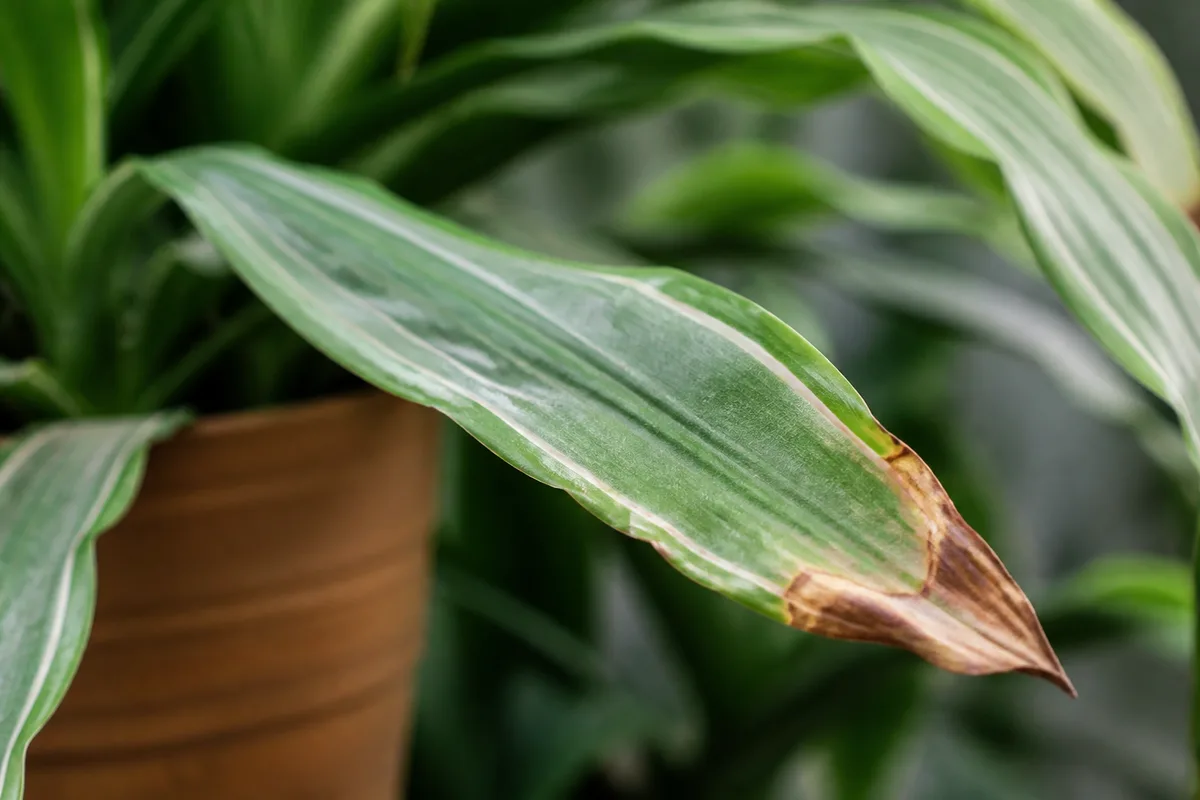
Underwatering symptoms on Janet Craig Dracaena - compare with healthy tissue on the same plant.
- Leaves lose firmness and arc downward, especially older outer leaves.
- Pot feels much lighter than usual.
- Mix is dry at half depth and may pull from pot walls.
- Leaf tips can crisp if dry spells repeat.
What usually does not fit pure underwatering:
- Sour smell from potting mix
- Fungus gnats around consistently wet media
- Soft cane base at the soil line
Those signs point toward excess moisture stress, and you should cross-check /plants/janet-craig-dracaena/overwatering/ before adding more water.
Underwatering vs overwatering vs fluoride tip burn
Use this quick triage:
- Underwatering likely: very light pot, dry mix at half depth or deeper, droop that improves after a deep soak.
- Overwatering likely: heavy pot, cool wet mix, yellowing leaves with no perk after watering, possible sour odor.
- Fluoride or tip-burn overlap likely: mostly brown margins or tips while moisture seems adequate, especially with tap water use on a fluoride-sensitive genus.
The Pacific Northwest extension note on Dracaena confirms that both drought and fluoride toxicity can brown margins. Clemson also notes Dracaena fluoride sensitivity and advises avoiding high-fluoride inputs.
How to confirm the cause
Run these checks in order:
1) Pot-weight check
Lift the pot right before watering and again one day after watering. A genuinely dry root ball feels markedly lighter. This is often more reliable than a quick finger touch at the surface.
2) Half-depth skewer check
Insert a bamboo skewer to about half pot depth. If it comes out dry and clean in multiple spots, underwatering is plausible. If it comes out cool and damp, do not irrigate again yet.
3) Cane-base firmness check
Press gently at the cane base where stem meets soil. Firm canes support a drought diagnosis. Soft tissue with wet media suggests root or crown stress from overwatering.
4) One-soak response test
After a complete soak and full drainage, mild drought droop should start improving within 24 hours and continue through 48 hours. No improvement means inspect roots and revisit lookalikes.
First fix for Janet Craig
Give one deep, complete rewet:
- Water slowly from the top until liquid runs from drainage holes.
- Wait 10 minutes and repeat once if the first pass drained too quickly.
- Empty the saucer fully.
- If mix repels water, bottom-soak 20 to 30 minutes, then drain.
Use filtered, rain, distilled, or reverse-osmosis water when possible because fluoride injury is well documented in Dracaena. After the first fix, return to moisture checks instead of frequent light top-ups.
If your mix repeatedly resists rewetting, read /plants/janet-craig-dracaena/dry-hydrophobic-soil/ and consider Janet Craig Dracaena repotting guide into fresh, well-draining media.
Step-by-step recovery
Days 1 to 2
Expect leaf posture to improve first. Existing scorched tips remain damaged.
Week 1
Recheck half-depth moisture and pot weight. Do not reflex-water if the lower profile is still moist.
Weeks 2 to 4
Watch for stable new growth and no new rapid tip crisping. If decline continues despite corrected watering, inspect roots and reassess light, humidity, and water quality.
Recovery timeline and realistic expectations
What can recover:
- Mild leaf droop
- General canopy posture
- Growth pace if roots remain viable
What usually cannot recover:
- Brown necrotic tips
- Fully yellow dead lower leaves
- Tissue that turned papery-crisp
Reasonable timeline: posture lift in 24 to 48 hours after correct watering, then steadier improvement over 2 to 6 weeks through new growth. Judge success by new leaves and stable cane firmness, not by old leaf tips turning green again.
What not to do
- Do not overcorrect by keeping mix constantly wet after one drought episode.
- Do not switch to daily shallow sips; that can leave the root core dry.
- Do not use softened water for sensitive Dracaena roots.
- Do not fertilize immediately after severe drought stress.
- Do not ignore a soft cane base; that is not a drought-only sign.
How to prevent underwatering
Build prevention around placement:
- In brighter indirect light, many indoor Janet Craig plants need checks around every 10 to 14 days.
- In dim offices, intervals may stretch toward 3 to 4 weeks.
- Always water by root-zone dryness and pot weight, not a fixed date.
NC State and Missouri Botanical Garden both describe Dracaena care as dry-slightly-between irrigations rather than constant saturation.
Keep this guide connected to your care system:
- /plants/janet-craig-dracaena/janet-craig-dracaena-overview/
- /plants/janet-craig-dracaena/watering/
- /plants/janet-craig-dracaena/overwatering/
- /plants/janet-craig-dracaena/brown-tips/
- /plants/janet-craig-dracaena/root-rot/
Dracaena is toxic to cats and dogs, so place and move pots carefully during watering routines.
When to worry and escalate
Escalate to deeper diagnosis when:
- Leaves do not improve 48 hours after a complete rewet.
- Cane base softens or darkens.
- Pot remains oddly heavy despite underwatering assumptions.
- New growth stalls for multiple weeks with worsening yellowing.
At that point, inspect roots and compare with /plants/janet-craig-dracaena/overwatering/ before repeating drought treatment.
When to use this page vs other Janet Craig Dracaena guides
- Janet Craig Dracaena watering guide - Use for routine moisture checks before assuming underwatering is the main issue.
- Janet Craig Dracaena problems hub - Browse all 50 common issues on this species.
- Brown Tips on Janet Craig Dracaena - Different entry point when symptoms overlap with underwatering.
- Yellow Leaves on Janet Craig Dracaena - Different entry point when symptoms overlap with underwatering.
- Overwatering on Janet Craig Dracaena - Different entry point when symptoms overlap with underwatering.
Related Janet Craig Dracaena guides
- Janet Craig Dracaena overview
- Janet Craig Dracaena watering
- Janet Craig Dracaena light
- Janet Craig Dracaena soil
- Brown Tips on Janet Craig Dracaena
- Yellow Leaves on Janet Craig Dracaena
- Overwatering on Janet Craig Dracaena
- Curling Leaves on Janet Craig Dracaena
- Brown Leaves on Janet Craig Dracaena
- Janet Craig Dracaena problems