Leggy Growth on Maranta Leuconeura: Causes, Checks & Fixes
Quick answer
Leggy growth on Maranta leuconeura means long internodes and stretched stems reaching for light-not the species' normal low clump habit. First step: move the pot within one to three feet of an east window or add a grow light, then wait for compact new leaves before trimming bare stems.
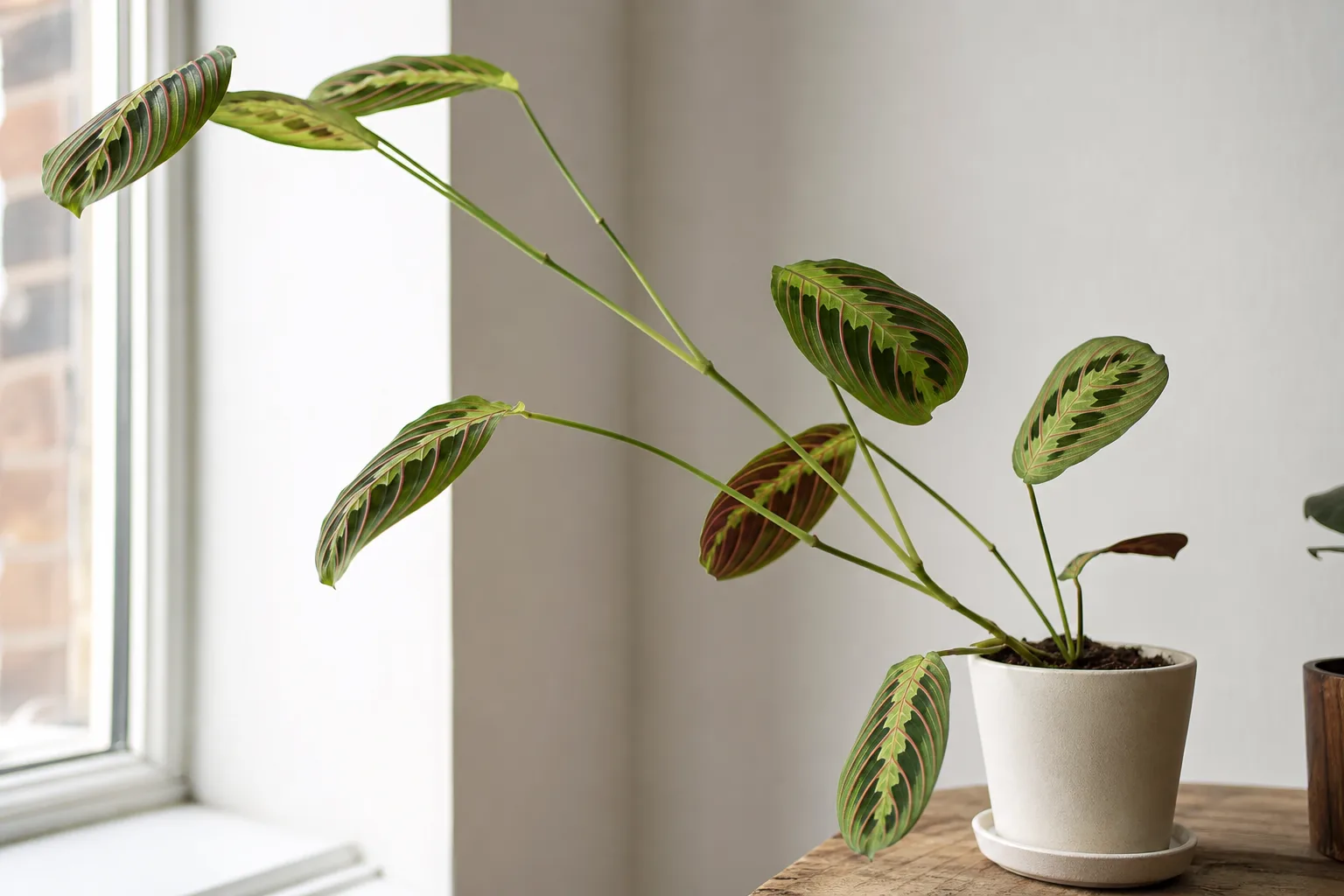
Leggy Growth on Maranta Leuconeura: Causes, Checks & Fixes
This guide covers leggy growth on Maranta Leuconeura. See also the general Leggy Growth guide, watering, and light pages for this plant.
Leggy Growth on Maranta Leuconeura: Causes, Checks & Fixes
Quick answer
Leggy growth on Maranta leuconeura-the prayer plant-means etiolation: the plant stretches internodes and produces long bare stem sections because it is not receiving enough light at the leaf surface to maintain its natural low, clump-forming habit. A healthy prayer plant stays compact, roughly 12–15 inches tall and wide, with tight leaf spacing. Leggy plants exceed that footprint vertically with weak, pale shoots leaning toward windows.
First step: move the pot to bright, indirect light within one to three feet of an east-facing window-or add a full-spectrum grow light if natural brightness is insufficient. Hold fertilizer and major pruning until compact new growth from the crown confirms the brighter placement is working. Existing stretched internodes will not shorten; judge recovery by the next one or two leaves, not by old bare stems improving.
Leggy growth vs. not enough light vs. thin stems - which guide to use
Prayer plant light problems overlap, but your primary symptom determines which page fits best:
| Your main complaint | Start here | Why |
|---|---|---|
| Long bare gaps between leaves; plant looks tall and sparse | This guide (leggy growth) | Etiolation-internode stretch-is the defining pattern |
| Faded herringbone pattern, stalled new growth, wet soil in a dim room | Not enough light | Broader dim-room syndrome beyond stretch alone |
| Weak, floppy, or mushy stems; crown feels soft | Thin stems | Structural weakness, rot, or pests-not cosmetic reach |
Many prayer plants show both stretch and pattern fade. If internode gaps are your clearest signal, stay on this page for confirmation and trim timing. If growth has stalled for months with muddy leaf color and constantly wet soil, read the not enough light guide for the full six-step confirmation and watering correction. For window placement detail year-round, see the Maranta leuconeura light guide.
What leggy growth looks like on Maranta Leuconeura
Leggy prayer plant is easy to spot once you know what compact growth should look like. Missouri Botanical Garden describes a mature clump as low-growing and spreading-stems hug the soil, not climb toward the ceiling.
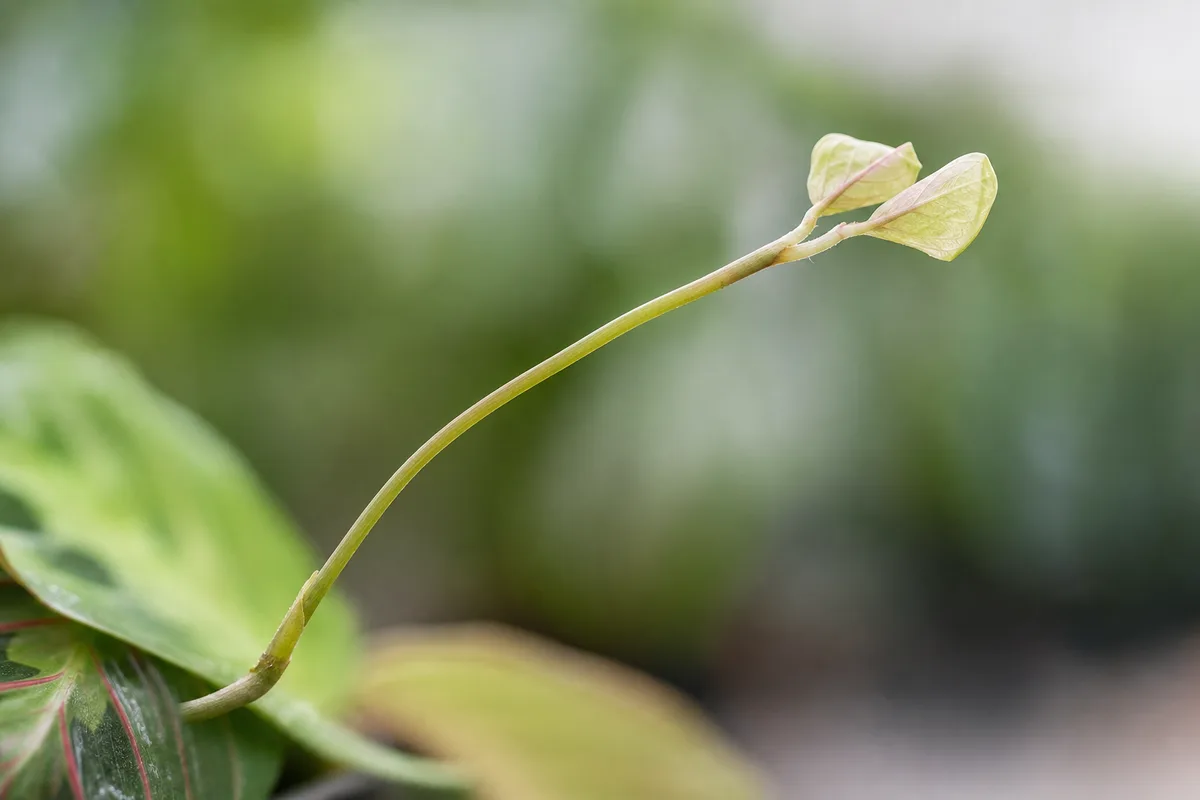
Leggy Growth symptoms on Maranta Leuconeura - compare with healthy tissue on the same plant.
Signature signs of etiolation on Maranta Leuconeura overview:
- Long bare sections between leaves-internode gaps wider than about one inch (2.5 cm) on established stems, often increasing on the shoots closest to the window
- Smaller new leaves on stretched shoots, with faded herringbone red veins and dull purple-grey undersides instead of rich burgundy
- Strong one-sided leaning toward the brightest window or lamp
- Vertical growth without horizontal fill-the clump grows taller and sparser while losing the painted, bushy look that makes prayer plant worth the shelf space
- Weakened night folding on thin new leaves-nyctinastic movement may continue on older foliage, but etiolated tissue often feels flimsy
On M. leuconeura var. erythroneura and similar red-veined cultivars, pattern fade on stretched stems is often the first obvious clue-the herringbone design washes out on new growth before leaves turn yellow. That makes prayer plant legginess more visually distinctive than generic pale-leaf etiolation on upright houseplants.
What leggy growth is not: Firm, short rhizomatous stems close to the soil with only slight lean-that is normal anatomy for this species. Sudden yellowing with sour-smelling wet soil is not etiolation alone; it points to root stress in shade and may need crown inspection.
Why prayer plant gets leggy
Low light and etiolation on a clump-forming species
Maranta leuconeura evolved on the Brazilian rainforest floor, where canopy trees filter direct sun. Indoors that translates to bright indirect light at the leaf surface-enough energy for vivid pigmentation and compact internodes, not a dim hallway shelf.
When daily light falls below what the plant needs, it runs an etiolation program: stems elongate, internodes widen, and leaves shrink as the plant reaches toward brightness-classic spindly stretch. Light intensity drops sharply with distance from windows; a pot six feet from an east sill is not getting the same exposure as one one to two feet from the glass.
Common indoor triggers:
- Decorative placement on interior shelves, bathroom corners, or desks far from windows
- Winter short days when the same sill that worked in June delivers marginal brightness in December
- Filtered or obstructed glass-sheers, tint, porch roofs, and dirty panes all cut usable light
- Dust on patterned leaves, which reduces the light tissue can absorb even when placement is otherwise correct
Unlike genuinely low-light-tolerant species sold beside prayer plants in shops, Maranta leuconeura will linger in shade without thriving-producing stretched stems while appearing superficially green until the clump looks unmistakably sparse.
Over-fertilizing in shade
Nutrients cannot replace missing photons. Fertilizing a dim prayer plant to “force bushiness” often produces weak, pale stretch rather than compact growth-the plant has building blocks but not enough light to assemble firm tissue. Illinois Extension recommends bright indirect or diffused sun as the baseline; fertilizer belongs only after light and watering are stable during active growth.
Winter short days without supplemental light
Prayer plants naturally slow in cool, short-day months. Missouri Botanical Garden advises reducing soil moisture and fertilizer substantially from autumn to late winter. Legginess that develops or worsens through a dark winter often needs a grow light, not just patience-see prevention below.
How to confirm the cause
Work through these checks before Maranta Leuconeura repotting guide, fertilizing, or heavy pruning:
- Internode spacing - Measure bare stem between two adjacent leaves on the most stretched shoot. Gaps consistently wider than one inch (2.5 cm) on a mature plant point to etiolation.
- Window distance and direction - Note how far the pot sits from glass and which exposure it faces. More than three feet from east or north glass, or more than five feet from filtered south or west glass, commonly produces leggy reach.
- Hand-shadow test at midday - Hold your hand between the plant and the window at canopy height. A soft, faint shadow suggests bright indirect light. Almost no shadow means too dim. A sharp dark shadow means direct sun is hitting leaves-a different problem.
- New-growth read - The newest rolled leaf tells the truth. If it opens with strong herringbone veins and firm burgundy undersides, current light may be adequate and stretch may be legacy from an old placement. If new leaves are smaller, paler, or absent for months while gaps widen, light is still limiting growth.
- Lean direction - Persistent tilt toward one window confirms active phototropism- the plant is still seeking more brightness.
- Rule out lookalikes - Firm crowns with only stretch point to light. Mushy crowns with sour wet soil point to rot-see thin stems. Bleached one-sided pale sectors toward glass suggest too much direct sun, not etiolation.
If four or more checks confirm dim placement and internode stretch-and the plant is not receiving harsh direct sun that could also fade patterns-you have enough evidence to fix light first.
The first fix to try
Move the pot to bright, indirect light within one to three feet of an east-facing window, or to the brightest filtered spot you can provide without direct midday sun on the leaves.
East exposure is the default for prayer plant: gentle morning sun through glass, then bright indirect light the rest of the day. North windows work when unobstructed. If only south or west glass is available, sit the plant three to five feet back or behind a sheer curtain so patterned tissue never sits in a harsh beam. Too much sun bleaches attractive leaf colors faster than it solves etiolation.
Increase brightness gradually over seven to ten days if the plant has lived in deep shade for months-move halfway to the target window first, watch for bleaching or curl, then advance. Prayer plant moving from dim to bright indirect usually tolerates a careful step-up better than a jump into unfiltered south sun.
Do not change watering, fertilizer, or pot size on the same day. Wait at least two weeks after the light move, then adjust watering to match how fast the mix dries in the brighter spot.
When to trim, pinch, or propagate stretched stems
Light correction stops new leggy growth; it does not reverse existing bare sections. After at least one compact new leaf confirms the brighter placement is working-usually three to six weeks in the warm season-cut long bare stems just above a healthy node with clean shears. Prayer plant roots easily from stem cuttings; place cuttings in water or moist mix to fill sparse areas in the same pot.
Spring and early summer are the safest windows for pruning and propagation. Hold off if the plant is still pushing only pale, widely spaced leaves-that means light is not yet adequate.
What not to do
- Do not jump to direct south or west sun to “fix” stretch quickly
- Do not fertilize heavily in the same dim corner
- Do not prune aggressively before light improves-weak regrowth in still-dim conditions produces more stretch
- Do not repot on day one when placement is the real issue
Recovery timeline and what improvement looks like
Expect three to six weeks before you can judge whether light correction worked, measured by new growth from the crown, not by old stems shortening.
- Weeks 1–2: The plant may look unchanged. Soil should dry slightly faster as photosynthesis increases. Avoid fertilizing.
- Weeks 3–4: A new rolled leaf may appear or an existing tube may unfurl with stronger vein contrast and shorter internode spacing than the previous leaf.
- Weeks 5–8: Two compact new leaves with vivid herringbone patterning confirm recovery. Stretched older internodes remain long-they will not shrink.
Winter recovery takes longer because day length is short. A grow light often outperforms window light alone from November through February.
Lookalike symptoms to rule out
| What you see | Likely cause | Why it is not pure leggy stretch |
|---|---|---|
| Floppy stems that bend under leaf weight; mushy crown | Wet crowns / rot | Stems fail structurally; internode stretch may be secondary-see thin stems |
| Faded pattern with no new growth for months; soil wet two weeks | Broad low light + slow metabolism | Stretch may be absent early; read not enough light |
| Bleached pale patches on window-facing leaves only | Too much direct sun | Damage is one-sided; internodes often stay compact |
| Fine webbing and stippled undersides | Spider mites | Inspect with a hand lens; pests drain vigor on thin new shoots |
| Brown crisp tips on compact growth | Low humidity or tap water | Stems are not elongated; herringbone contrast may still be strong |
Yellow leaves in a dim corner with wet soil are a common overlap: low light slows water use, chronic wetness stresses roots, and foliage yellows while stems may also stretch. Fix light and reduce watering frequency together.
Mistakes to avoid
- Treating prayer plant as a low-light species because it is labeled “tropical” in a shop display
- Judging success by old stretched stems-only new crown growth tells you the fix worked
- Increasing fertilizer instead of moving closer to a window
- Pruning before light correction-you remove the plant’s remaining photosynthetic surface while conditions are still dim
- Assuming rotation alone fixes stretch-rotation evens lean but does not raise total light if the spot is too dim
How to prevent leggy growth next time
- Place for the leaves, not the room-if the pot looks best on a bookshelf but receives almost no shadow at midday, the placement is wrong for prayer plant
- Reassess seasonally-move closer to glass or add a grow light before winter short days; see the light guide for window-by-window detail
- Rotate weekly and wipe dust from patterned leaves monthly so every surface captures light evenly
- Add a full-spectrum LED grow light positioned 12 to 18 inches (30 to 45 cm) above the tallest leaf, run 10 to 12 hours daily on a timer, when windows cannot deliver bright indirect at the canopy through winter
- Read the next new leaf after any move-pale unfurls with wide spacing mean adjust light before touching fertilizer
Conclusion
Leggy Maranta leuconeura is a light problem expressed as architecture-long internodes, bare stems, and a sparse clump reaching for brightness. Move to bright indirect light within one to three feet of an east window or add a grow light, wait for compact new leaves over three to six weeks, then trim or propagate the stretched sections. Old bare stems will not revert; the next herringbone-patterned leaf from the crown is your proof the fix worked. If stretch is only part of a wider dim-room picture-wet soil, stalled unfurls, muddy color-continue with the not enough light guide; if stems are mushy or collapsing, use the thin stems guide instead.
When to use this page vs other Maranta Leuconeura guides
- Maranta Leuconeura watering guide - Use for routine moisture checks before assuming leggy growth is the main issue.
- Maranta Leuconeura problems hub - Browse all 40 common issues on this species.
- Not Enough Light on Maranta Leuconeura - Different entry point when symptoms overlap with leggy growth.
- Slow Growth on Maranta Leuconeura - Different entry point when symptoms overlap with leggy growth.
- Yellow Leaves on Maranta Leuconeura - Different entry point when symptoms overlap with leggy growth.