Scale Insects on Marigold: Identify and Treat Them
Quick answer
Scale on Marigold looks like small, fixed tan or brown covers on stems, leaf joints, or leaf undersides. Confirm a live insect before treating; if you find one on a potted plant, first isolate it, then remove a small colony by hand.

Scale Insects on Marigold: How to Identify and Treat Them
This guide covers scale insects on Marigold. See also the general Scale Insects guide, watering, and light pages for this plant.
Scale Insects on Marigold: How to Identify and Treat Them
Quick answer
Scale insects on Marigold look like small, firmly attached tan or brown bumps on stems, leaf joints, or leaf undersides. African marigold (Tagetes erecta) is an annual with finely divided foliage; NC State lists thrips, slugs, and spider mites among its potential insect problems, so treat scale as a diagnosis to confirm rather than assuming every spot is a pest. NC State Plant Toolbox
If a bump contains a live scale, the first action is to separate a potted Marigold from nearby plants. For the general scale life cycle and signs shared across ornamental plants, see our scale insects symptom guide; this page focuses on where to look and how to respond on Marigold.
What scale looks like on Marigold
Adult scale insects can look like oval or round shells attached to leaves and stems, rather than like a typical moving insect. A confirmed colony may also leave yellowing, leaf drop, or slow growth; soft scales can produce sticky honeydew and sooty mold, while armored scales do not produce honeydew. UC IPM’s scale guide describes these signs and the differences between the two groups.
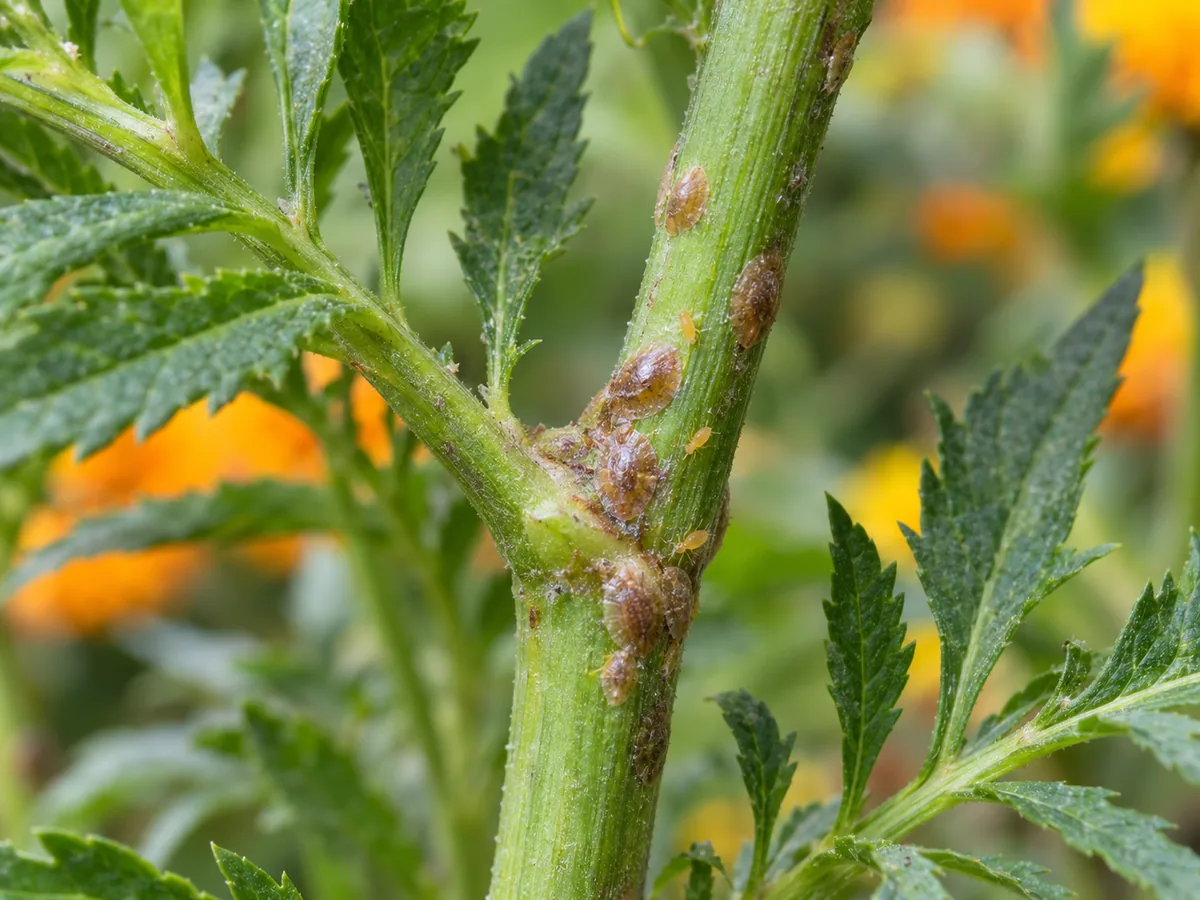
Look closely at the stem fork and leaf bases: scale covers stay attached, while the small crawler stage may move before it settles.
Scale type matters because the insect’s covering changes what you see. Soft scales tend to have a rounded, waxy body and may leave honeydew; an armored scale’s separate shield can lift while the insect remains beneath it. UGA’s ornamental-scale guide explains this distinction and notes that crawlers are the mobile stage. A lack of stickiness therefore does not rule out armored scale.
Where to inspect Marigold’s divided leaves
African marigold’s leaves are pinnately divided, with narrow toothed leaflets, so a quick glance at the flower heads can miss a scale tucked where a leaf stalk meets a stem. NC State’s plant profile describes this foliage. Trace each branching stem from its base upward, checking the lower leaf joints, leaflet undersides, and the bases of flower stalks with bright light or a hand lens.
Most settled scales are stationary; newly hatched crawlers are the stage most likely to move across the plant or onto a neighbor. RHS scale guidance also identifies shell-like bumps on stems and leaf undersides as a common sign. If you find only a stain or a bump that flakes away without an insect beneath it, keep watching new growth instead of spraying on sight.
Scale or a Marigold lookalike?
| What you find | What it suggests | Next check |
|---|---|---|
| Fixed oval or shell-like bumps on a stem or leaflet underside | Scale is plausible; honeydew supports soft scale, while armored scale may leave none | Inspect one bump with a hand lens and check nearby plants |
| Moving, soft-bodied insects clustered on tender tips | More consistent with aphids than settled adult scale | UC IPM describes aphids as soft-bodied insects with legs and antennae (identification guide); compare the plant with the Pest Identifier Tool below |
| White cottony or waxy clusters rather than firm shell-like covers | Could be mealybugs, which have a white waxy appearance | Use the Marigold mealybugs guide to compare the colony before choosing a treatment (Gardening Know How) |
| Fine pale stippling or webbing without attached bumps | Spider mites are a better fit than scale | Check leaflet undersides and compare with the Marigold spider mites guide; UC IPM describes stippling and webbing as common spider-mite signs (identification guide) |
| Yellow leaves without attached insects, honeydew, or crawlers | The yellowing alone does not confirm a pest | Check the Marigold yellow leaves guide and review water and light conditions |
First action: isolate the affected Marigold
Once you confirm a live scale, first move a potted Marigold away from other plants and inspect the neighboring pots. Crawlers can move after hatching, so isolation is a practical containment step while you assess how many stems are involved. UGA’s ornamental-scale guide describes mobile crawlers, and Gardening Know How’s scale-control guide recommends separating an infested plant from healthy ones.
If your Marigold is growing in a bed, leave it in place; inspect touching foliage and nearby plants, and avoid carrying prunings or tools through the bed before checking them. Do not spray every plant just because one has a suspicious bump. The care guidance for Marigold light and Marigold watering can help you spot stress, but neither a light change nor extra water removes scale.
Remove a small colony before using a spray
For a few visible scales, gently wipe or lift them from the stem and leaflet bases with a damp cotton swab or soft cloth, then discard the debris. Work over a pale surface so you can see whether anything is moving, and avoid scraping hard enough to break Marigold’s green stems. Gardening Know How describes hand-removal as an option for light infestations; on this plant, gentle removal avoids coating the whole divided canopy unnecessarily.
Prune only a heavily occupied or damaged stem if you can remove it without stripping much of the flowering plant. Put the clipping in a sealed bag rather than leaving it beside the pot. Recheck the same joints and neighboring growth over the next several days. A shell-like bump by itself does not confirm a live colony: UC IPM recommends checking whether scales are alive or parasitized before deciding that an additional insecticide treatment is needed.
If live scale keeps returning
For persistent colonies, consider a horticultural oil or insecticidal soap only if its label lists the plant and scale insects. These contact products need thorough coverage of infested stems and leaf surfaces; scale treatment is more effective when timed for crawler activity, which varies by species. UC IPM’s management guidance emphasizes coverage, timing, and following the product label.
Test the product on a small part of the Marigold first, and do not spray a wilted plant or apply oil in excessive heat or when foliage is wet. Oil can injure stressed plants, and product temperature limits differ, so use the label rather than a universal schedule. Colorado State University Extension’s oil guidance discusses heat, plant stress, and other precautions.
Avoid broad-spectrum or systemic insecticides for a few scales, especially while the Marigold is flowering. African marigolds can attract butterflies and hummingbirds, and UC IPM warns that some systemic treatments can affect pollinators feeding on flowers. NC State’s plant profile notes those visitors, and UC IPM’s scale management guidance advises protecting beneficial insects and pollinators. If a heavy infestation would require stronger control, get local extension advice and use only a product labeled for the intended setting.
What Marigold’s annual habit means for recovery
African marigold is a tender herbaceous annual, not a woody shrub that can be cut back to bare branches and kept for years. The Spruce’s reviewed growing guide describes its seasonal habit and fern-like foliage. A lightly affected plant that is still producing healthy shoots can be worth monitoring; if most stems are covered, the plant is declining, or flowering is nearly finished, removing it may be more sensible than escalating repeated treatments.
Use older discolored leaves as a record of damage, not the only measure of control. Progress is a lack of fresh crawlers, honeydew, and new colonies, plus cleaner growth at the next stem joints. Check once a week for several weeks because crawler timing differs among scale species; if the Marigold keeps losing new growth despite treatment, reconsider the diagnosis or end the season by removing the plant and debris.
Keep the Marigold growing without adding stress
Full sun supports African marigold’s flowering, and NC State recommends evenly moist, well-drained soil (plant profile). Marigold soil guidance and the Marigold watering guide are useful if the pot stays soggy or dries too quickly. Keep the plant’s normal care steady while you monitor it; fertilizing more will not remove sap-feeding insects.
Inspect new plants before placing them beside Marigold, and scan the stem forks and leaflet undersides each week while the plant is actively growing; scale can be easy to miss during a quick plant check. If the plant has repeated colonies, review nearby plants too, since crawlers may settle on neighboring foliage. For general Marigold placement and seasonal care, use the Marigold overview rather than changing several growing conditions at once.
When to use this page vs other Marigold guides
Use this guide when you can find attached shell-like insects or moving crawlers on Marigold. If you see a mobile colony on tender tips, use the Pest Identifier Tool below; if you see cottony white masses or fine webbing without fixed covers, compare the mealybugs or spider mites guides. When yellowing is the only sign, start with the yellow leaves guide; if growth is simply slow without attached insects, compare the Marigold slow growth guide.
Related tool
Use the Pest Identifier Tool if you cannot tell a scale cover from another insect. It can help narrow the diagnosis before you choose a treatment.
Related Marigold guides
Use the Marigold problems hub to compare other confirmed problems, or the Marigold overview for its broader seasonal care. This page is the right starting point only when the bump is an attached scale or crawlers are present.