Black Spots on Marigold: Causes, Checks & Fixes
Quick answer
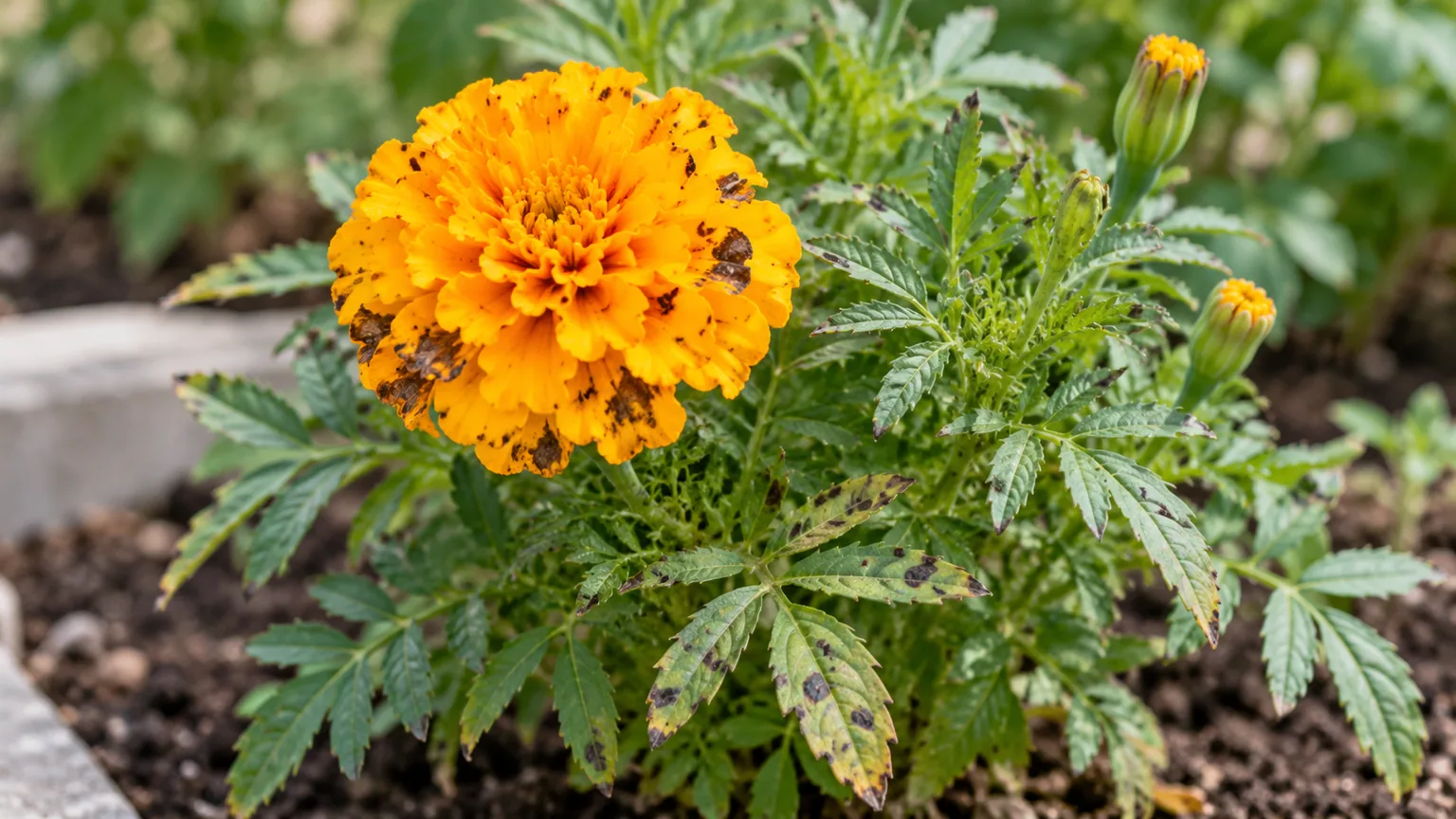
Black spots on marigold are usually fungal leaf spot from wet foliage: Alternaria makes purplish spots on leaves and stems, while Septoria makes gray-black spots with tiny dots starting on lower leaves. First step: stop wetting the leaves, switch to morning watering at the base, and snip off the worst spotted lower leaves with clean scissors.
Black Spots on Marigold: Causes, Checks & Fixes
This guide covers black spots on Marigold. See also the general Black Spots guide, watering, and light pages for this plant.
Black Spots on Marigold: Causes, Checks & Fixes
Quick answer
Black spots on marigold are most often fungal leaf spot after the foliage stays wet: purplish spots form on leaves and stems with Alternaria, or gray-to-black spots start on the lower leaves with Septoria. For general leaf-spot mechanics that apply to any plant, see our black spots symptom hub. On marigold, the pattern usually shows up after overhead watering, crowded bedding, or rainy weeks on dense ferny foliage — not from underwatering alone.
First step: keep every future drop of water off the leaves. Switch to watering at the base in the morning, then snip off the worst spotted lower leaves with clean scissors and bag them. Do not spray anything on day one; most mild cases stop spreading once leaves stay dry and air moves between plants. Full rhythm details live in the marigold watering guide.
What black spots look like on marigold
On Tagetes the spots start small on the lowest, most crowded leaves and work upward over one to three wet weeks. Early lesions look like dark pinpricks with a faint yellow halo; mature ones turn brown-black, sometimes with concentric rings inside a yellow outline when Alternaria is involved.
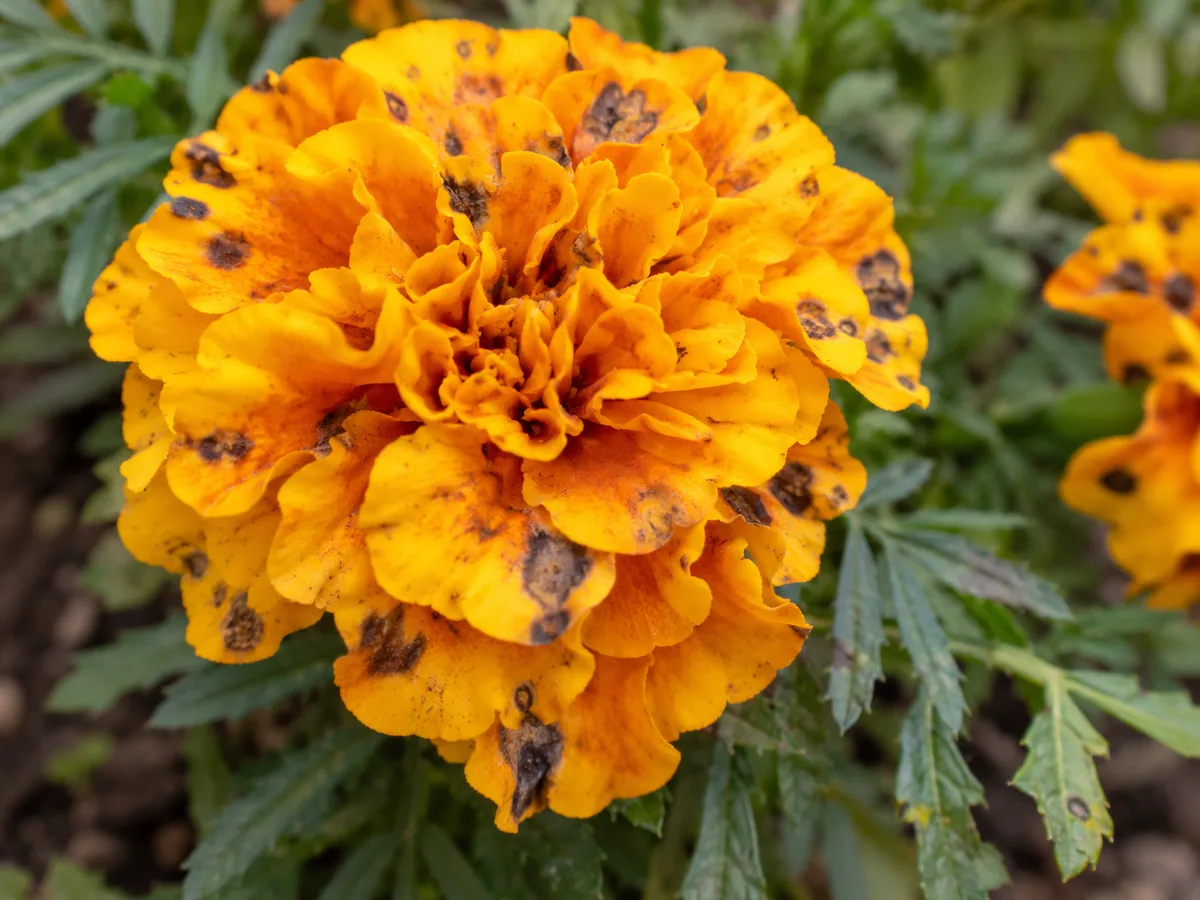
Black spot lesions on marigold foliage — note halos, rings, and tiny fruiting dots that separate fungal spot from bacterial damage.
Details that confirm leaf spot rather than pest or weather damage:
- Alternaria pattern: purplish-brown spots scattered across leaf blades and sometimes stems, enlarging and merging until whole leaflets yellow and dry.
- Septoria pattern: oval to irregular gray-to-black spots peppered with tiny dark dots — those dots are fungal fruiting bodies, and they start on lower leaves before spreading upward.
- Bacterial pattern: small 2 to 5 mm circular dead spots with purple margins on leaves and petioles that look water-soaked or greasy before they dry out.
- Flower involvement: with Alternaria blight, petals darken and shrivel instead of opening cleanly — a clue that separates it from plain faded flowers.
- Texture test: dry, papery spots point to fungus; soft, wet, rapidly collapsing black patches point to bacteria or advancing rot, which needs a different response closer to crown rot.
Why marigold foliage spots so readily
Marigold leaves are finely divided and ferny, and bedding plants are usually set close together for instant color. That combination traps dew and sprinkler water between leaflets for hours, which is exactly the extended wetness leaf-spot fungi need. Penn State lists three separate spot diseases on this one host — Alternaria, bacterial spot, and Septoria — so marigold is simply a crowded target, and conditions that keep foliage wet for extended periods decide which one appears.
Overhead watering is the most common home-garden trigger. Marigolds want water at the base of the plant, yet sprinklers, hose spray, and evening watering all soak the canopy right before cool night air slows drying. Add mulch or soil splash during heavy rain and the lower leaves — already shaded and slow to dry — become the infection beachhead. Compare your routine against the marigold overview before assuming the plant is weak.
Deadheading matters more here than on most annuals. Marigolds bloom so heavily that spent heads left pinched halfway or torn off leave small wounds on stems and pedicels during wet weather, giving Alternaria an entry point that moves from flower to leaf. Clean deadheading with a sharp pinch above a leaf joint, plus prompt removal of fallen petals from the bed, removes both wounds and spore food. When open blooms brown in place instead of buds aborting, cross-check bud drop to separate blight from stress loss.
African and French marigolds do not spot equally
This is the most marigold-specific fact in the whole diagnosis. Pacific Northwest trials found that cultivars of African marigold are susceptible to Septoria leaf spot while cultivars of French marigold resist it — same pathogen, different outcome by species. Both T. erecta and T. patula still catch Alternaria and bacterial spot when leaves stay wet, so use the species as a filter: classic dotted gray-black lower-leaf spots on a French marigold argue against Septoria and toward Alternaria.
Size and habit explain part of the gap. African types carry big double flower heads on tall stems that flop in rain, holding wet petals against upper leaves; French types stay compact with smaller blooms that shed water faster. Tall African varieties in windy, rainy sites also snap stems, and every break is an infection court. If your African bed spots every August while neighboring French rows stay clean, that is genetics plus canopy physics, not your watering alone — though fixing the watering still slows it down.
How to confirm which spot you have
Work top to bottom in this order; the answer usually appears before you need any product:
- Spot size and margin — Measure a few lesions. Dry spots near half an inch with rings or halos fit Alternaria; tiny 2 to 5 mm water-soaked circles with purple edges fit bacterial spot; dotted gray-black patches fit Septoria.
- Hand-lens check — Look for the tiny dark fruiting dots inside gray-black lesions. Dots confirm a fungal spot (Septoria) rather than bacteria or sun injury.
- Texture and smell — Dry and papery means fungus. Soft, greasy, fast-spreading black with any sour smell means bacteria or rot; isolate that plant.
- Distribution — Lower leaves first and upward spread fits Septoria and splash-driven Alternaria. Random all-over spotting after overhead watering fits Alternaria. Spots plus sticky residue or stippling mean pests are the real story — check spider mites and aphids.
- Wetness history — Evening sprinklers, a rainy week, or leaves touching wet mulch in the last ten days strongly supports fungal leaf spot. Spots that appeared during a dry spell with no wetting point toward mites, thrips, or sunburn.
- Stem and flower check — Black lesions climbing stems or shriveled dark petals mean the blight phase of Alternaria, which is more urgent than a few lower-leaf spots.
If spots are dry with halos on lower leaves after wet weather, fungal leaf spot is the working diagnosis — fix culture before anything else.
First fix for marigold
Dry the canopy and remove the spore source. Water only at the base the next morning, spacing the drink so the top 3 cm dries between waterings per the marigold watering guide. Then snip every heavily spotted lower leaf with clean scissors, bag the trimmings for the trash — spores overwinter on old plant debris and on fallen leaves left in the bed — and thin the planting so leaves no longer touch.
Do not fertilize, do not mist, and do not spray fungicide on day one. Feeding pushes soft new foliage that spots faster, and most mild Alternaria halts once leaves dry out. Reassess after ten to fourteen days: clean new growth means the fix worked; fresh spots on new leaves mean moving to the recovery steps below.
Step-by-step recovery
Branch by what you confirmed — do not stack every fix at once.
If Alternaria or Septoria (dry spots with halos or dots):
- Keep base-only morning watering for two full weeks; never let sprinklers hit the bed.
- Mulch lightly around — not against — stems to cut soil splash onto lower leaves.
- Stake or space floppy African types so flower heads do not rest on wet foliage.
- If new leaves still spot after two dry weeks, apply a fungicide labeled for leaf spot on ornamentals, covering upper and lower leaf surfaces per label; fungicides protect new tissue and do not erase old spots.
If bacterial spot (small water-soaked circles, purple margins):
- Remove and trash every affected leaf immediately; bacteria spread in splash, not just on debris.
- Disinfect scissors between cuts and keep hands and tools off healthy plants — spot fungi and bacteria alike spread via wind, splashing water, garden tools, and hands.
- Stop all overhead wetting and improve spacing before considering copper-based bactericides; severely affected annuals are usually better destroyed than sprayed, since Penn State advises destroying infected plants for bacterial leaf spot.
If spots came with pests or sun damage:
- Treat the actual cause first — rinse mites, manage thrips, or shade sunburned transplants — because spotted weak tissue will not heal until the stress lifts.
- Cross-check yellow leaves when spotting pairs with general yellowing, and root rot when wet wilt accompanies the spots.
Recovery timeline
Mild Alternaria on lower leaves: spread usually halts within seven to ten days of dry canopy culture; visibly clean new leaves emerge within two to three weeks. Old spots never green up — judge by new growth, not old blemishes.
Septoria working upward: expect two to four weeks before the canopy reads clean, because lower defoliation continues while upper leaves harden off. Plants stripped below but pushing healthy tips by week three are recovering.
Bacterial spot: fast-moving wet lesions should slow within a week of sanitation and dry culture. Continued spread past ten days despite removal means destroying the plant to protect neighbors.
Flower blight phase: shriveled dark petals drop; fresh buds open clean within one to two weeks once the canopy dries. Deadhead spent blooms every two to three days in the meantime.
Lookalike symptoms
| What you see | Likely cause | Key differentiator |
|---|---|---|
| Dry spots with yellow halos or rings, lower leaves first | Alternaria / Septoria leaf spot | Dots inside spots; follows wet foliage |
| Tiny 2–5 mm water-soaked circles, purple edges | Bacterial leaf spot | Greasy texture; destroy plant if spreading |
| Gray fuzz on browning flower parts, humid porch | Botrytis blight | Fuzzy spore masses when wet; see blight |
| White powdery coating, then blackened patches | Powdery mildew advance | White mildew first; see powdery mildew |
| Pale stippling plus fine webbing, dry heat | Spider mites | Moving specks on tap test; see spider mites |
| Yellow lower leaves, heavy wet soil, no rings | Overwatering / root stress | Soggy mix; see overwatering |
| Bleached papery patches after a hot move | Sunburn | Uniform bleaching, no halos; see sunburn |
| Purple-tinged spots on stems and leaves | Alternaria stem phase | Stem lesions; may link to brown tips |
Causes to rule out
- Nutrient deficiency — even yellowing or interveinal patterns without discrete spots belong with yellow leaves, not leaf spot.
- Downy mildew — grayish-purple fuzz concentrated on leaf undersides in cool damp weather; compare with downy mildew.
- Salt or fertilizer burn — crisp brown margins appearing days after feeding; check fertilizer burn when spots follow a feed.
- Natural lower-leaf aging — a few yellowing bottom leaves on an otherwise blooming plant late in the season, with no halos or dots, is senescence.
- Soil splash without infection — muddy speckles after rain wipe off; true spots are in the tissue and do not wipe away.
Mistakes to avoid
- Spraying fungicide before drying the canopy — wet leaves keep reinfecting no matter what you coat them with.
- Overhead watering in the evening — the single fastest way to restart the cycle you just broke.
- Composting spotted trimmings — home compost rarely kills these spores; trash or municipal green waste instead.
- Saving seed from heavily spotted plants — Alternaria rides on debris and can cling to seed; buy fresh seed for next season.
- Feeding a spotted plant to push growth — nitrogen grows soft tissue the fungus colonizes first.
- Crowding new transplants for instant color — tight spacing deletes the airflow that dries ferny foliage.
- Ignoring tools and hands — pruning healthy plants with the same unwashed snips spreads both fungal and bacterial spots down the row.
How to prevent it next time
Prevention is three habits: dry leaves, moving air, and clean beds.
Water at the base in the morning so any incidental splash dries by midday; the marigold watering guide sets the container-versus-bed rhythm. Drip or soaker lines beat sprinklers for this plant every time.
Space for sun and airflow — give bedding plants room so ferny leaflets do not interlock, and site beds in full sun in well-drained soils, since Missouri Botanical Garden lists marigold as susceptible to leaf spot and rots when conditions stay damp. Afternoon shade in extreme heat is fine; stagnant humid corners are not — the light guide helps balance the two.
Clean the bed relentlessly — pick up fallen leaves and spent blooms weekly; shorten leaf-wetness periods with spacing and morning watering as University of Maryland advises for fungal spots generally. End-of-season cleanup matters most: strip the whole planting because debris carries the next outbreak. Note that rapidly collapsing water-soaked black tissue leans bacterial rather than fungal — pull those plants instead of composting them in place. Refresh mulch in spring to bury surviving spores, and rotate marigold beds away from last year’s spotted patch.
Marigold care cross-check
Spotted marigolds recover fastest when baseline care already matches the species: full sun most of the day, moderately fertile soil that drains freely (see the soil guide), and deep base watering only when the top 3 cm dries. Excess nitrogen grows lush, spot-prone foliage with fewer flowers, so feed lightly and never on a sick plant.
Related Marigold guides:
- Marigold overview
- Marigold watering
- Marigold light
- Marigold soil
- Marigold problems hub
- Root Rot on Marigold
- Yellow Leaves on Marigold
- Blight on Marigold
When to worry
Ordinary leaf spot — dry halos confined to lower leaves on firm stems — is low urgency and usually resolves with dry culture. Escalate when:
- Spots turn soft, black, and water-soaked across new leaves within days — suspect bacterial spot; isolate and likely destroy the plant.
- Black lesions climb stems or flower heads shrivel across the planting — Alternaria blight phase; prune hard, dry the canopy, consider labeled fungicide.
- Whole-plant wilt pairs with spots and heavy wet soil — roots are failing; switch to root rot triage.
- Defoliation passes one-third of the canopy with no clean new growth after three weeks — a mid-season annual this far gone is usually replaced, not nursed.
- Gray mold spreads through blooms on a humid porch despite base watering — see blight for the botrytis protocol.
When to use this page vs other Marigold guides
- Marigold problems hub — browse all issues on this species when you are not sure spots are the main problem.
- Marigold watering guide — use for routine moisture rhythm once spots have stopped spreading.
- Downy mildew — use when fuzz sits mainly on leaf undersides in cool damp weather rather than discrete dry spots.
- Powdery mildew — use when a white powdery coating precedes the blackening.