Fertilizer Burn on Marigold: Causes, Checks & Fixes
Quick answer
Fertilizer burn on marigold shows up as brown crispy leaf tips on many leaves at once within days of feeding, often with a white salt crust on the mix and wilt even though the soil is moist. Stop feeding first, confirm the pot drains freely, then leach with plain water and pause fertilizer until clean new growth appears.
Fertilizer Burn on Marigold: Causes, Checks & Fixes
This guide covers fertilizer burn on Marigold. See also the general Fertilizer Burn guide, watering, and light pages for this plant.
Fertilizer Burn on Marigold: Causes, Checks & Fixes
Quick answer
Fertilizer burn on marigold is salt injury, not a disease. It usually appears within days of a heavy or poorly timed feed as brown, crispy tips and margins on many leaves at once, sometimes with a white crust on the mix and wilting even though the soil feels moist. For how salts injure container roots in general, see our fertilizer burn guide. On marigolds, the pattern usually shows up right after someone tries to push more blooms with extra food — and these light feeders punish that generosity fast.
First fix: stop all fertilizer, confirm the pot drains freely and the stem base is firm, then leach once with plain water and discard every drop of runoff. Do not feed again until clean new growth proves the roots are working.
What fertilizer burn looks like on marigold
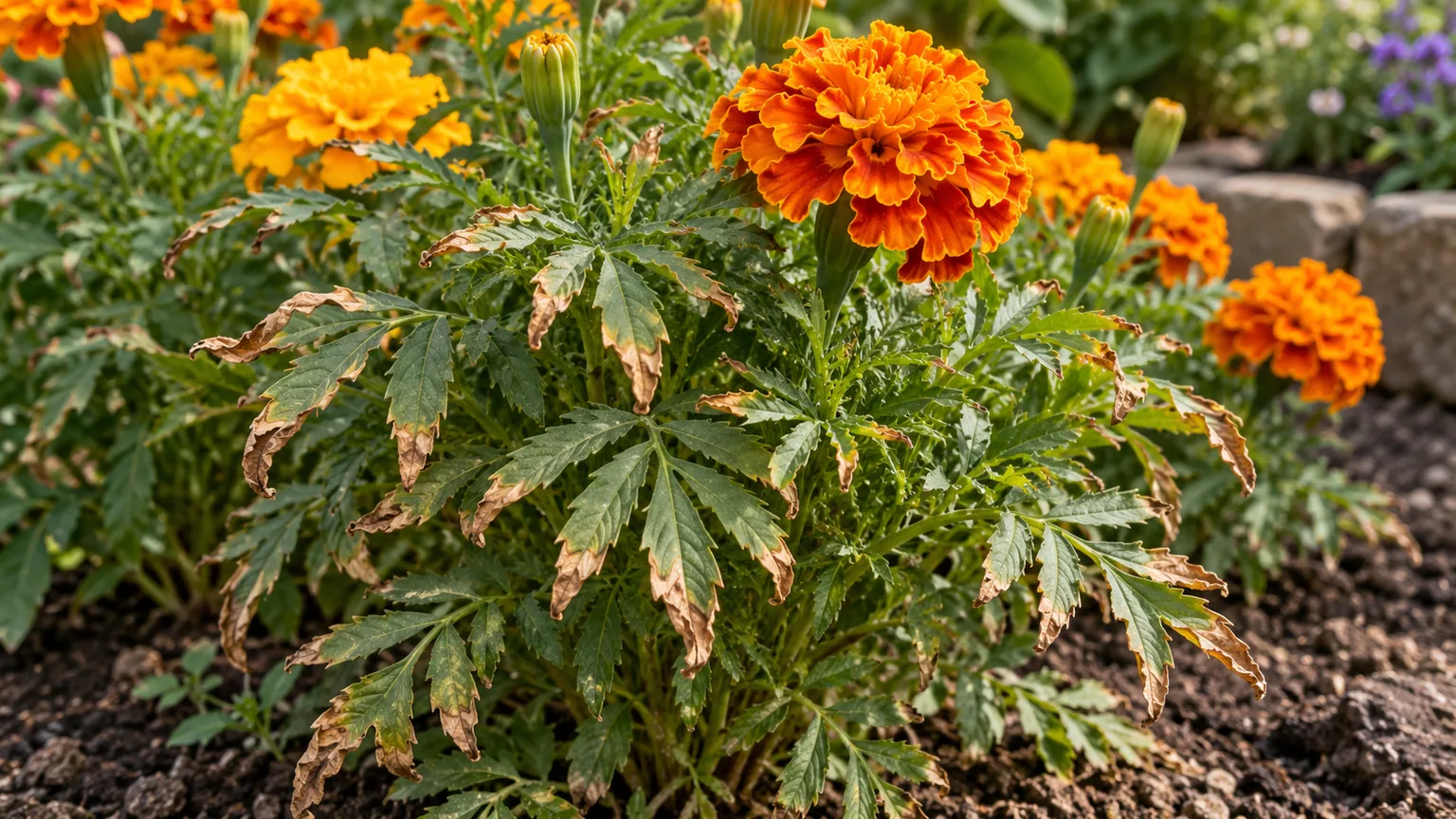
Marigold leaves are finely divided and ferny, so salt scorch reads clearly on them. Tips and outer margins of many leaves turn tan, then brown and papery, all at roughly the same time. Lower and mid-canopy leaves often show it first because they are the oldest tissue with the longest exposure, but after a single heavy dose the damage can appear across the whole plant within a few days. Flower buds stall, open blooms shrink or brown at the petal edges, and the plant stops pushing the fast new growth marigolds are known for.
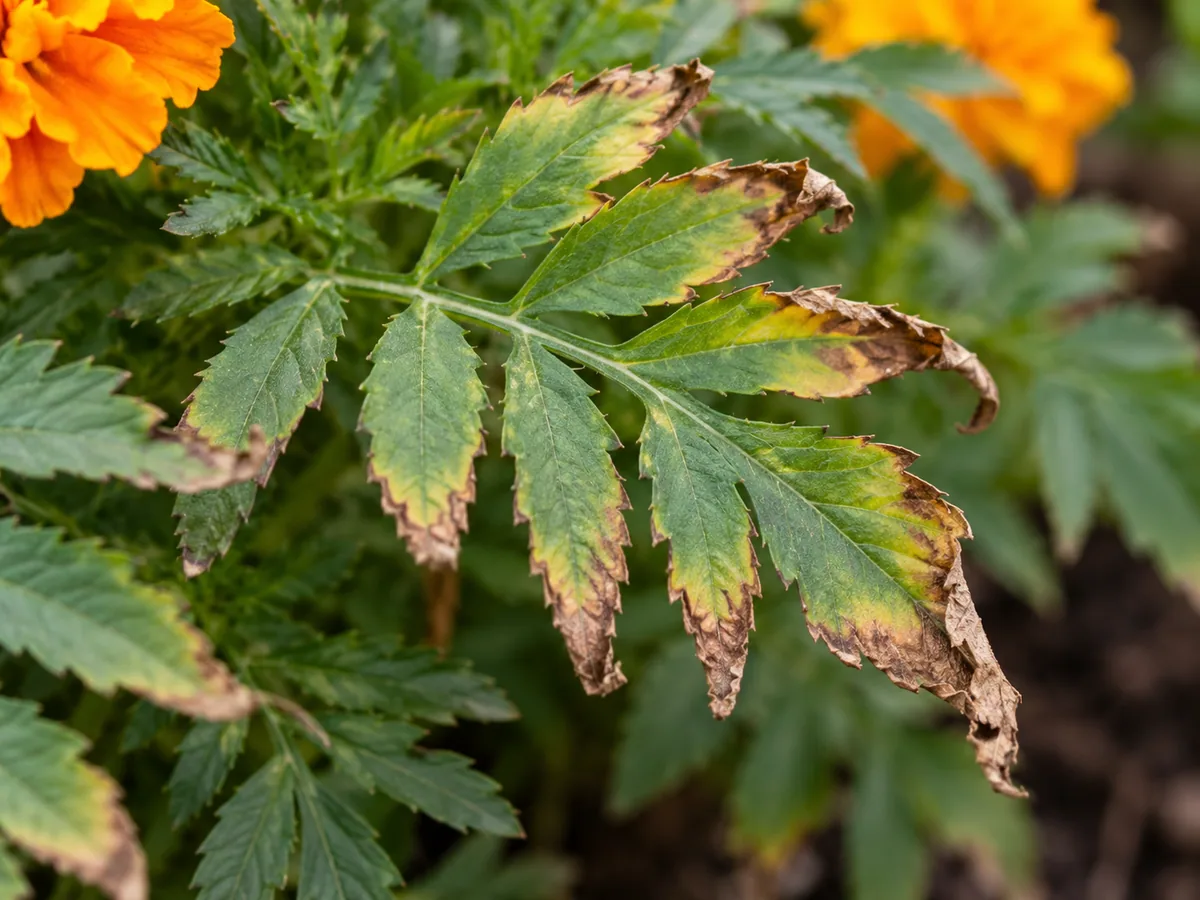
Burned marigold leaflets show dry brown margins on many leaves at once after a feed, not isolated spots on one old leaf.
Two supporting clues separate burn from ordinary stress. A fresh white or tan crust on the soil surface or pot rim after a recent feed confirms excess salts sitting in the root zone. Wilting on moist soil means root tips are too damaged to take up water — the soluble salts have reversed the normal water gradient. What stays normal in mild cases matters too: stems stay firm, the crown stays solid, and the mix smells neutral rather than sour. Soft, dark tissue at the soil line points away from pure burn and toward rot.
Why lean-soil marigolds burn faster than heavy feeders
Marigolds evolved to bloom hard in average, even lean soil. The University of Minnesota Extension marigold guide notes they perform well without rich inputs, and excess nitrogen pushes leafy growth at the expense of flowers. That low appetite is exactly why burn hits them so easily: a dose a hungry vegetable would shrug off overwhelms a marigold’s root zone. Container plants are the most exposed because every watering leaches nutrients out, which tempts growers into frequent heavy feeds that swing the root zone from starved to salty.
The classic marigold burn scenarios all share one theme — salts arriving faster than the plant can use them:
- A full-strength liquid dose applied to a bone-dry pot in summer heat, so concentrated solution hits dehydrated feeder roots directly
- Stacked products: slow-release prills already in the potting mix plus a heavy liquid feed in the same week
- High-nitrogen lawn or leafy-green formulas used instead of a balanced bloom feed, dumping salts while also suppressing flowers
- Feeding a newly transplanted or drought-wilted marigold before its roots have re-established
- Granular fertilizer piled against stems in a garden bed, then watered in unevenly
In-ground beds rarely burn from a single light feed, but containers concentrate every mistake into a small volume of mix with nowhere for salts to go.
African versus French marigolds handle extra feed differently
The two common types fail in opposite directions, and knowing which you grow sharpens both diagnosis and prevention. African marigolds (Tagetes erecta) are large plants that visibly deplete big pots by midsummer, so growers keep doubling the dose when blooms shrink — and the NC State Tagetes erecta profile confirms how vigorously these plants grow in full sun, which only increases the temptation. French marigolds (Tagetes patula) sit in small pots where even a modest over-measure spikes the salt concentration, so they burn from a single careless scoop rather than a season of escalation.
Both types answer excess nitrogen the same way: soft, lush foliage with fewer, smaller flowers. If your marigold is all leaves and no blooms after regular feeding, that is the early warning — tissue burn usually follows if the schedule continues.
How to confirm the cause
Work these checks in order. Post-feed timing plus fresh crust is the strongest confirmation pair.
Reconstruct the feed history
Write down the product, dilution, date, and whether slow-release pellets were already in the mix. Damage starting one to ten days after a feed implicates that feed. Gradual tip browning over months with no recent application points instead to salt build-up on marigold from hard water or chronic light overfeeding.
Scrape the surface and check the pattern
Lightly scrape the mix with a fingertip. A fresh white crust right after feeding supports acute burn. Confirm the leaf pattern too: synchronized dry margins on many leaves at once fits burn, while bleached tan patches only on the sun-facing side after a sudden move fit sunburn on marigold instead.
Test roots, crown, and pot weight
Lift the pot. Heavy plus wilted means roots cannot drink — consistent with burn. Then check the stem base and sniff the mix. Firm tissue with a neutral smell keeps you on this page. A soft dark crown, mushy roots, or sour odor means you need the root rot guide rather than more flushing, since pouring water through a rotted root zone only prolongs saturation.
| What you see | More likely cause | Quick check |
|---|---|---|
| Crispy margins days after one heavy feed, fresh crust | Fertilizer burn — this page | Feed history plus crust timing |
| Gradual tip burn and crust over months, hard tap water | Salt build-up | Little recent fertilizer; crust returns without new feeds |
| Brown tips with no crust and no feed event | Brown tips | Gradual onset; check water quality and humidity |
| Wilt on wet soil with soft base and sour mix | Root rot | Mushy roots; firm up diagnosis before flushing |
| Limp leaves that perk up after one deep watering | Underwatering | Light pot; fast recovery after drinking |
When to use this page versus other marigold guides
Use this page when a feed happened recently and the damage arrived on schedule. Move to salt build-up when crust and tip burn creep in gradually without any dosing event — the fix there is water quality and routine leaching, not emergency rescue. Move to brown tips when margins brown slowly on an unfed plant, and to overwatering or root rot the moment stems soften or the mix smells wrong. The full marigold problems hub lists every diagnosed issue if more than one pattern seems to fit.
First fix for marigold
Stop feeding, confirm drainage and root condition, then leach only if the pot drains freely and the crown is firm.
Carry a freely draining pot to a sink or tub. Pick off any visible slow-release pellets from the surface and scrape away loose crust without gouging roots. Water slowly with plain water until it runs from the holes, let it drain completely, and discard all runoff where children and pets cannot reach it. The University of Maryland guidance on fertilizer toxicity supports repeated clear-water irrigation for excess salts — but a sealed decorative pot with no drainage just redistributes the salts, so remove the nursery pot first and never let it sit in its own runoff. For general salt-leaching mechanics, Gardening Know How’s fertilizer burn treatment notes describe the same flood-and-drain approach.
One careful leach is the fix — not three flushes on a timer, and not a repot on the same day. Then return the plant to full sun and its normal marigold watering rhythm.
Step-by-step recovery
Mild case — tip burn only, firm plant
- Stop all fertilizer and remove surface pellets and crust.
- Complete one thorough leach as described above.
- Trim fully dead leaflet tips only for appearance; marigolds replace foliage fast in warm weather.
- Watch the next flush of buds — clean new leaflets with green margins mean the roots have recovered.
Moderate case — wilt on moist soil, stalled blooms
- Leach once, then let the pot run its normal wet-to-dry cycle without extra water.
- If crust returns within a week, unpot and rinse the root ball gently with plain water.
- Trim only dark, shrunken root tips; keep firm white or tan roots.
- Repot into fresh fast-draining mix with no added fertilizer, keeping the same pot size.
- Hold all feed for at least six weeks, then resume at half strength per the marigold fertilizer guide.
Severe case — spreading collapse after feeding
- Unpot immediately and assess. If most roots are brown and mushy or the crown is soft, treat as rot overlap, not pure burn.
- Remove only clearly dead tissue with clean tools and repot survivors into fresh marigold-appropriate soil.
- Pause fertilizer until the plant holds turgor through normal dry-downs and produces healthy new growth — this can take the rest of the season on an annual.
Recovery timeline
Marigolds grow fast, so the verdict arrives quickly in warm weather. No new tip damage in the first one to two weeks after leaching means the salt spike is dropping; old brown edges will never re-green, so ignore them. Fresh leaflets and resuming buds over the following two to four weeks confirm root recovery. Full cosmetic recovery depends on how much foliage must be replaced — a lightly burned plant looks itself again within a month, while a severely root-damaged one may limp until frost. These annuals do not get a second season, so a plant that stays stalled with spreading stem darkening after rescue is better replaced than nursed.
Mistakes to avoid
- Feeding again at full strength to “green up” burned leaves — it adds salts to an already shocked root zone
- Applying fertilizer to a dry root ball in hot sun without pre-watering
- Stacking a liquid feed on top of slow-release prills already in the mix
- Using high-nitrogen lawn fertilizer when flowers are the goal
- Feeding within two weeks of transplanting or while the plant is wilted
- Repotting into pre-fertilized mix while recovering from burn
- Flushing a pot with no drainage or a plant with a soft, sour crown
How to prevent it next time
Prevention for marigolds is simpler than for most flowers because the correct rate is already low. As detailed in the marigold fertilizer guide, feed containers every two to four weeks with half-strength balanced liquid during active growth, and give average garden beds just one application at planting plus optionally one midsummer boost. Clemson HGIC’s marigold guidance and Penn State Extension both frame marigolds as average-soil performers where compost at planting beats aggressive feeding.
Practical habits that prevent repeats:
- Always water lightly first if the mix is bone dry, then apply diluted feed to a moist root zone
- Log every feed date on the pot rim — heavy bloom tempts “extra help” that the plant never needed
- Run plain water through containers monthly in hot weather to stop salts accumulating
- Deadhead spent blooms instead of feeding harder when flowering pauses in extreme heat
- Keep plants in full sun before reaching for fertilizer; shade-weakened marigolds cannot use heavy feed
When to worry
Treat burn as urgent when leaves wilt persistently on wet soil, the stem base darkens or softens, or fresh leaves emerge already scorched after you flushed and stopped feeding. Those signs mean extensive root injury or an overlapping infection, and flushing alone will not reverse them. Inspect roots promptly, and if the crown is collapsing across multiple plants in the same bed, replace the worst cases rather than risking the season on rescue attempts.
Conclusion
Fertilizer burn on marigolds is almost always a generosity problem: a light feeder pushed with heavy food, often in a small pot where salts concentrate fast. The diagnosis rests on timing — synchronized tip burn days after feeding plus fresh crust — and the cure is restraint: stop feeding, leach once through a freely draining pot, and wait for clean new growth before fertilizing again. Burned edges never heal, so judge success by fresh leaflets and resuming buds, not by old damage disappearing. Feed these plants leanly and they will out-bloom every overfed neighbor on the balcony.
Related marigold guides
- Marigold fertilizer guide — correct half-strength schedules so this burn never repeats
- Salt build-up — when crust returns gradually without any recent feed
- Brown tips — slow marginal browning with no dosing event behind it
- Root rot — when the stem base softens or the mix smells sour after flushing
- Overwatering — heavy pots and wilt where drainage, not salts, is the cause
- Marigold overview — full care hub for sun, water, and seasonal rhythm
Related tool
Use the Fertilizer Dilution Calculator with marigold pre-selected to mix half-strength feeds accurately and avoid the measuring errors that cause most burn cases.