Caterpillars on Marigold: Causes, Checks & Fixes
Quick answer
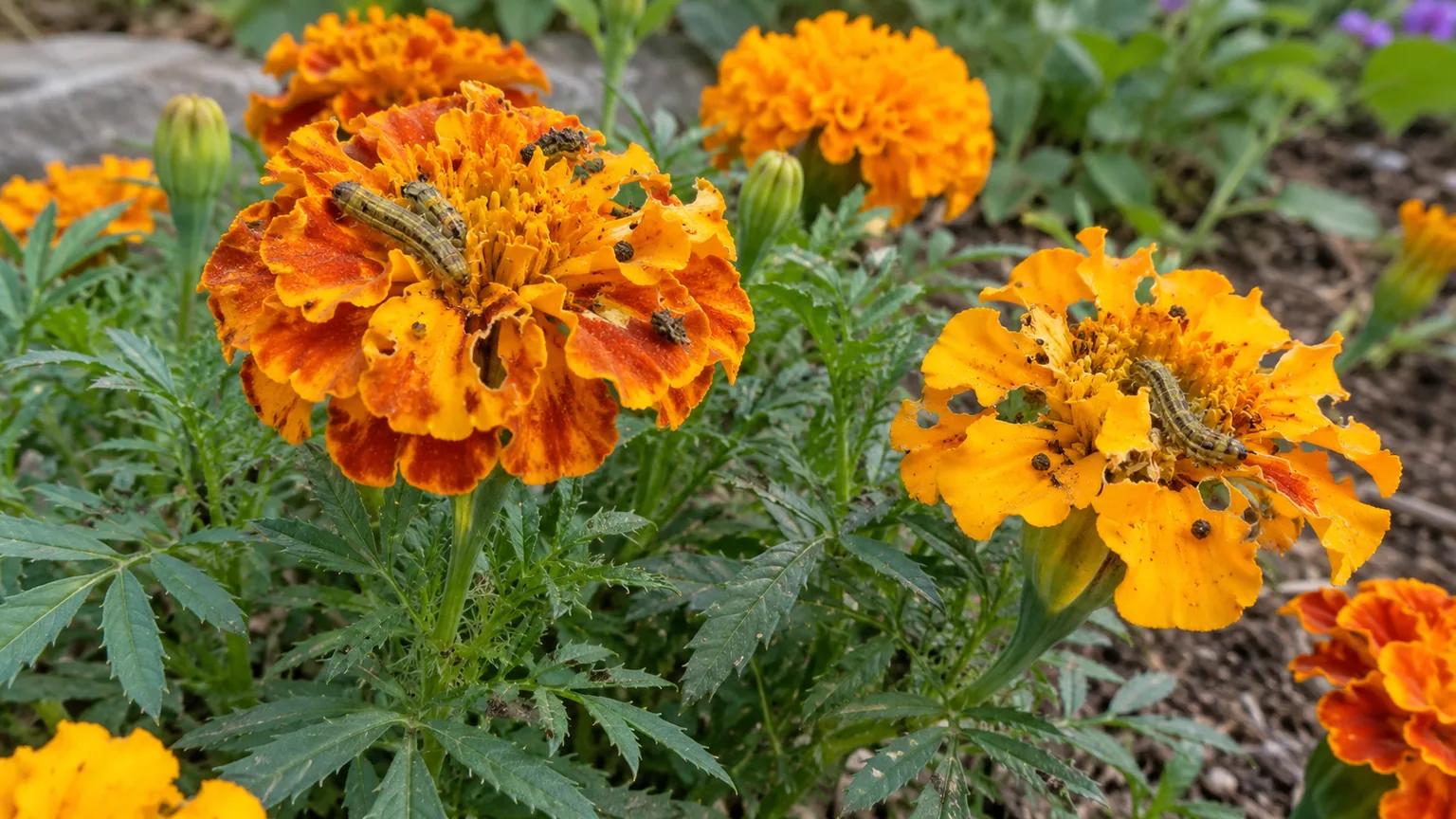
Caterpillars on marigold usually show up as round holes chewed in petals and buds plus small black frass pellets tucked between petals. First, inspect buds after dark with a flashlight and handpick every caterpillar you find, then snip off frass-fouled blooms so clean buds can open.
Caterpillars on Marigold: Causes, Checks & Fixes
This guide covers caterpillars on Marigold. See also the general Caterpillars guide, watering, and light pages for this plant.
Caterpillars on Marigold: Causes, Checks & Fixes
Quick answer
Caterpillars find marigold buds before you do. NC State Extension describes African marigold (Tagetes erecta) as a long-blooming annual with fragrant, showy flowers that attract butterflies — and where butterflies and moths visit, eggs follow. For general caterpillar biology beyond this plant, see our caterpillars guide. On marigold, the pattern usually shows up as round holes in petals, buds that never open cleanly, and black pellets wedged between petal layers. First fix: inspect every bud after dark with a flashlight, handpick all caterpillars into soapy water, and snip off frass-fouled blooms so the plant redirects energy into clean buds.
What caterpillars look like on marigold
On marigolds the damage centers on the flowers, not just the leaves. Suspect caterpillars when you see buds with one or two neat round holes, petals that look shredded from the inside, blooms stuck half-open, and small black pellets (frass) packed where petals meet the bud base. Larvae themselves are often greenish and easy to miss because they match bud tissue.
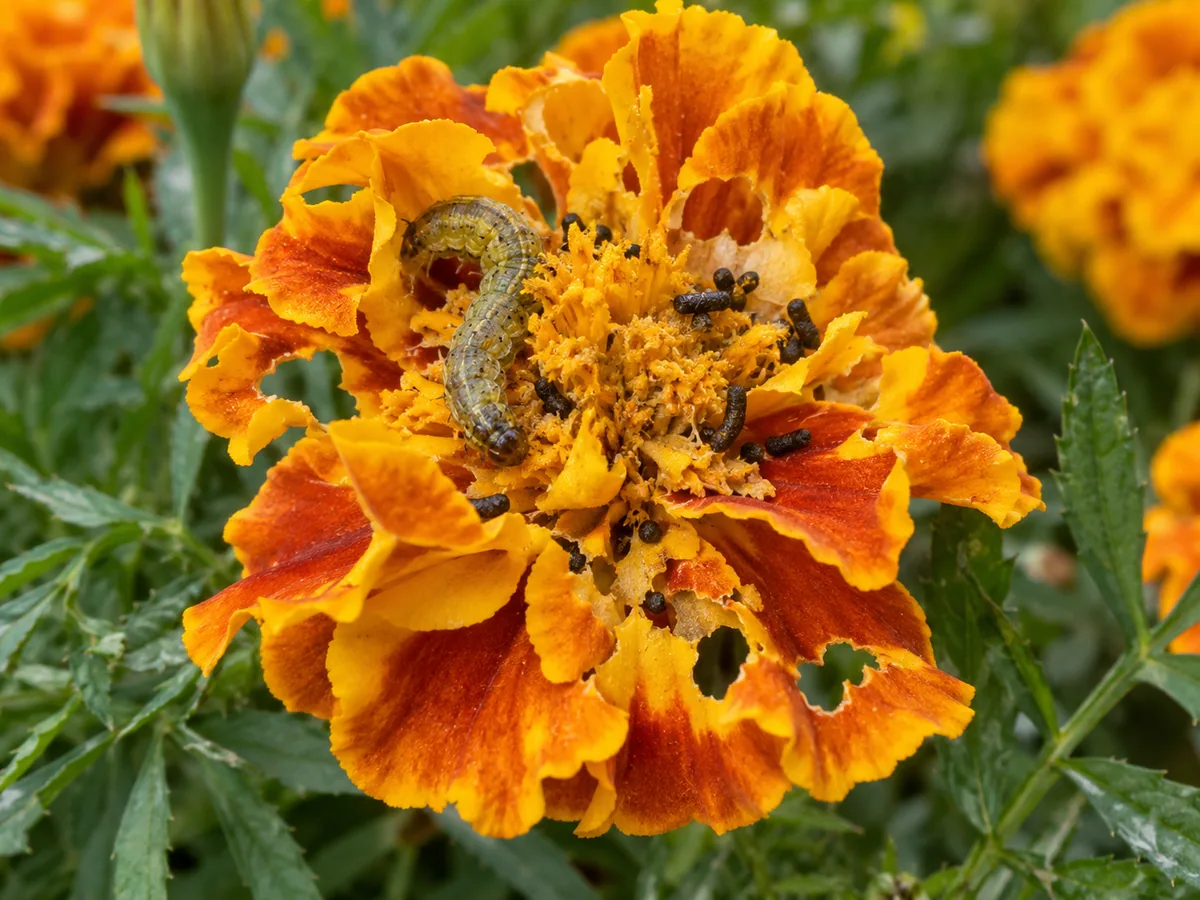
Caterpillar chewing and frass pellets packed inside a marigold bloom — compare with clean buds on the same plant.
Leaves get chewed too, but marigold foliage often shows the secondary sign first: smooth-edged notches on upper leaves near a damaged bud cluster. Budworm-type caterpillars leave round to oblong holes in petals and destroy blooms quickly if left alone, and marigold’s dense double blooms give them perfect cover while they feed.
Why marigold buds are a caterpillar target
Marigold is bred for exactly what bud-laying moths want: a long season of soft, fragrant buds in full sun. NC State Extension notes the long bloom season and fragrant flowers of Tagetes erecta, which means weeks of egg-laying opportunity per plant. Female moths lay eggs directly on buds, so larvae hatch already inside their food.
Three marigold-specific factors raise the odds:
- Dense double blooms hide larvae. African marigold pom-poms have dozens of petal layers; a half-inch larva can feed for days before you notice.
- Deadheading gaps accumulate eggs. Spent blooms left on the plant keep sheltering larvae while new buds open beside them.
- Companion-planting irony. Marigolds are planted to repel some pests, yet their own flowers still host budworms and loopers — presence in a vegetable bed is not protection against caterpillars on the marigold itself.
Warm, still evenings favor moth flight and egg-laying, so damage often appears in waves a week or two after hot spells.
How to confirm the cause
Check in this order, starting with the buds:
- Part damaged petals in daylight. Look for green or brownish larvae, shed skins, and black pellets packed at the bud base.
- Repeat after dark with a flashlight. Budworm caterpillars hide during daylight and come out to feed at night, so a bud that looks empty at noon may hold a feeding larva at 10 p.m.
- Read the frass. Dry black pellets wedged in blooms point to caterpillars; shiny slime trails on leaves or soil point to slugs instead.
- Check the soil surface under the plant. Mature budworms drop to the ground and pupate in the soil for about three weeks before emerging as moths, so disturbed soil or small cocoons under heavily damaged plants support the diagnosis.
- Review the timeline. New holes appearing overnight across several buds, with buds failing in sequence, fits caterpillars better than a one-time weather event.
Lookalikes to rule out on marigold
| Problem | Typical pattern | What is usually missing |
|---|---|---|
| Caterpillars | Round petal holes, frass pellets in buds, night feeding | Slime trails |
| Slugs and snails | Ragged holes, shiny slime on leaves and soil | Dry frass pellets in blooms |
| Bud drop | Whole buds fall without chew marks | Holes and frass |
| Flowers turning brown | Browning from petal edges, often weather or age | Chew holes and larvae |
If buds fall cleanly with no chewing, cross-check bud drop on marigold and flowers turning brown on marigold before treating for pests. If slime trails are present, use slugs and snails on marigold instead.
First fix for marigold
Handpick tonight, then deadhead. Go out after dark with a flashlight, pull every larva off buds and blooms into a cup of soapy water, and snip off blooms packed with frass. Bag the debris rather than dropping it on the soil, since larvae and eggs fall with it.
Do this one step first and recheck the next evening before reaching for any spray. Handpicking works because most home marigold plantings hold only a few larvae, and removing them plus their fouled shelter stops that generation immediately. If two nightly checks find nothing new and no fresh holes appear, you are done — keep scouting weekly.
Step-by-step recovery by severity
Light damage (a few holed petals, one or two larvae)
- Handpick at night for two consecutive evenings.
- Deadhead all damaged blooms to expose hiding spots.
- Check new buds twice weekly for two weeks.
Moderate damage (several buds failing, larvae keep appearing)
- Continue nightly handpicking.
- Apply Bacillus thuringiensis (Bt, kurstaki strain) labeled for caterpillars on ornamentals, coating buds and upper leaves. Bt is a naturally occurring soil bacterium whose crystal protein paralyzes the caterpillar digestive system so it stops feeding.
- Time it right: spray in the evening so the toxin works overnight before sunlight inactivates it, and target young, actively feeding larvae. Peer-reviewed work confirms Bt Cry proteins are a widespread, effective caterpillar control.
- Reapply per the label after rain or overhead watering, since wash-off shortens the effective period.
- Keep deadheading so new buds open into a clean canopy.
Heavy damage (most buds ruined, larvae on every bloom)
- Cut the plant back hard or pull it if bloom production has fully collapsed — chewed tissue will not heal, and a stripped annual rarely earns its bed space back mid-season.
- Bag and discard (do not compost) all bud debris and the top layer of mulch under the plant to remove eggs and pupae.
- Treat neighboring marigolds and nearby flowering plants as a group, since moths lay across the whole bed.
- Replant or succession-sow only after nightly checks show no fresh damage for a week.
Always read the product label before using Bt, and skip it near butterfly host plantings — Bt kills butterfly larvae as well as pest caterpillars even though it does not harm adult butterflies.
Recovery timeline
Marigolds do not repair chewed petals; they outgrow the damage. Expect clean new buds to start opening normally within 7 to 14 days after feeding stops, with full display returning over two to three weeks on healthy plants. Judge progress by fresh buds opening without holes, not by old blooms improving.
Recovery stalls when larvae keep hatching (check for new frass every few days), when plants sit in deep shade with weak regrowth, or when overhead watering keeps damaged blooms soggy. Marigolds want full sun and base watering — review marigold watering and marigold light if regrowth is slow after the caterpillars are gone.
Mistakes that make caterpillars worse
- Starting with broad-spectrum insecticides. Sevin-type products kill the parasitic wasps and predators that suppress caterpillars, and Gardening Know How notes Sevin use can open plants to secondary spider-mite attack by killing mite predators.
- Spraying Bt at midday in sun. UV degrades it fast; evening application is the point.
- Leaving frass-packed blooms on the plant. Deadheading matters here — regular deadheading keeps marigolds producing flowers over a longer period, and each removed bloom takes hidden larvae and eggs with it.
- Watering overhead late in the day. Wet, damaged blooms invite botrytis gray mold on top of insect injury; marigold flowers must dry quickly.
- Fertilizing a chewed-up plant. Extra nitrogen pushes soft growth moths prefer; feed only once clean buds are opening again, per the marigold fertilizer guide.
How to prevent caterpillars next season
- Deadhead weekly from first bloom so spent flowers never become nurseries.
- Scout buds from first color, not from first damage — part a few petals weekly in peak moth season.
- Clear finished annual marigolds and surface debris at season end to break the soil-pupation cycle in the bed.
- Space plants for airflow and sun; vigorous, sun-grown marigolds replace lost buds faster.
- Protect predators: avoid broad-spectrum sprays and leave small undisturbed areas where parasitic wasps overwinter.
- In containers, refresh the top few centimeters of mix each season to discard pupae.
For bed planning, keep soil and spacing right with marigold soil and the marigold overview, and browse the full marigold problems hub when symptoms overlap.
When to worry
Escalate when buds fail faster than new ones open for two straight weeks, when larvae appear on every bloom despite handpicking plus correctly timed Bt, or when damage spreads into neighboring vegetables and ornamentals. At that point pull the worst plants to protect the bed, and consider local extension diagnostics if a second planting fails the same way.
Marigold care cross-check
Caterpillar holes are easy to blame for everything. If new growth is pale or stalled rather than chewed, check small flowers on marigold and no flowers on marigold for nutrition and light causes. If foliage yellows without chew marks, see yellow leaves on marigold.
When to use this page vs other marigold guides
- Marigold watering guide — use for moisture and base-watering routine before assuming pests are the main issue.
- Marigold problems hub — browse all common issues on this species when the pattern is unclear.
- Slugs and Snails on Marigold — use when slime trails accompany the holes.
- Bud Drop on Marigold — use when whole buds fall without chew marks or frass.
Related marigold guides
- Marigold overview — placement, sun, and seasonal rhythm for bloom production.
- Marigold watering — base-watering routine that keeps blooms dry.
- Marigold light — full-sun needs that drive fast bud replacement.
- Marigold soil — draining mix and container setup.
- Slugs and Snails on Marigold — the closest lookalike when holes appear overnight.
- Bud Drop on Marigold — when buds fail without chewing.
- Marigold problems — full issue list for this species.
- No Flowers on Marigold — when bloom failure is not pest-driven.