Crispy Leaves on Marigold: Causes, Checks & Fixes
Quick answer
Press soil at 3 cm first: dry soil with crispy oldest leaves means drought; moist soil with crispy leaves means heat scorch, leaf-spot fungi, or spider mites instead. Water deeply at the base once for drought, and look under leaves with a magnifier before spraying anything.
Crispy Leaves on Marigold: Causes, Checks & Fixes
This guide covers crispy leaves on Marigold. See also the general Crispy Leaves guide, watering, and light pages for this plant.
Crispy Leaves on Marigold: Causes, Checks & Fixes
Quick answer
Crispy leaves on marigold are four problems wearing one look: drought crisp, heat scorch, fungal leaf spots that dry out, and spider-mite stippling that turns brittle. The separator is soil moisture plus leaf undersides:
- Dry soil at 3 cm, pot feels light, oldest lower leaves crisp first → drought crisp. Give one deep base watering until runoff, then empty the saucer.
- Moist soil, plant wilted but foliage still dark green after a hot afternoon → heat stress, not thirst. Shade the pot and hold your normal rhythm instead of soaking it.
- Tan-to-brown spots with dry centers on leaves that were wet often → leaf-spot fungi. Stop overhead wetting and remove spotted leaves.
- Fine yellow-white speckling plus faint webbing under leaves → spider mites. Rinse and treat the mites; extra water alone will not fix it.
First step: press soil at 3 cm, lift the pot, and flip three leaves to check undersides. For how dry tissue fails in general, see our crispy leaves guide. On marigold, the pattern almost always traces back to the container drying faster than the grower expected in full sun.
What crispy leaves look like on marigold
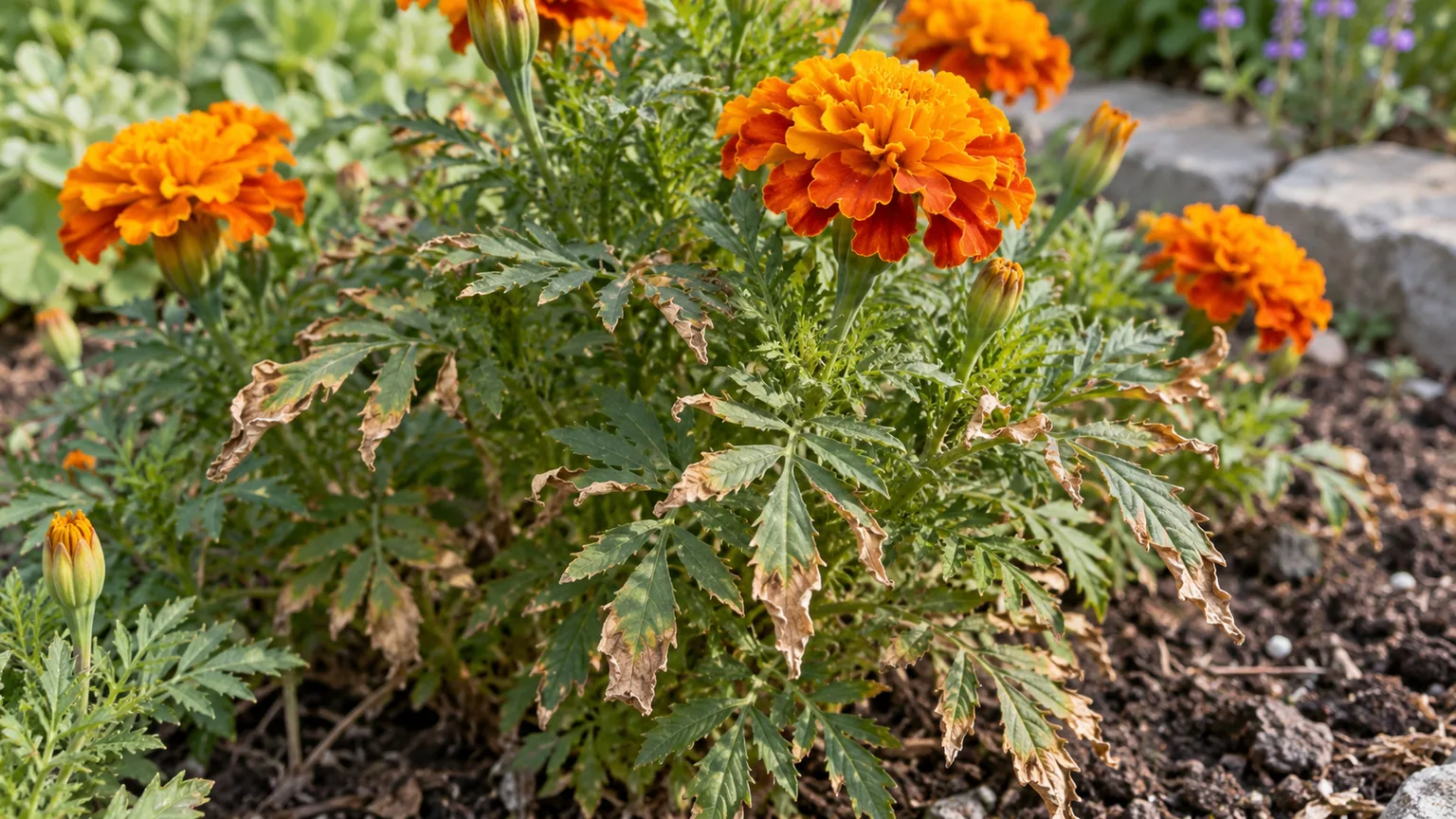
Marigold leaves are pinnate and finely divided, so crisp damage shows as dried leaflets, browned segment tips, and whole lower leaves turning papery while the flower heads may still look fine. New center growth is the honest signal: clean new leaflets mean the plant is coping, while crisp spreading upward into new growth means the cause is still active.
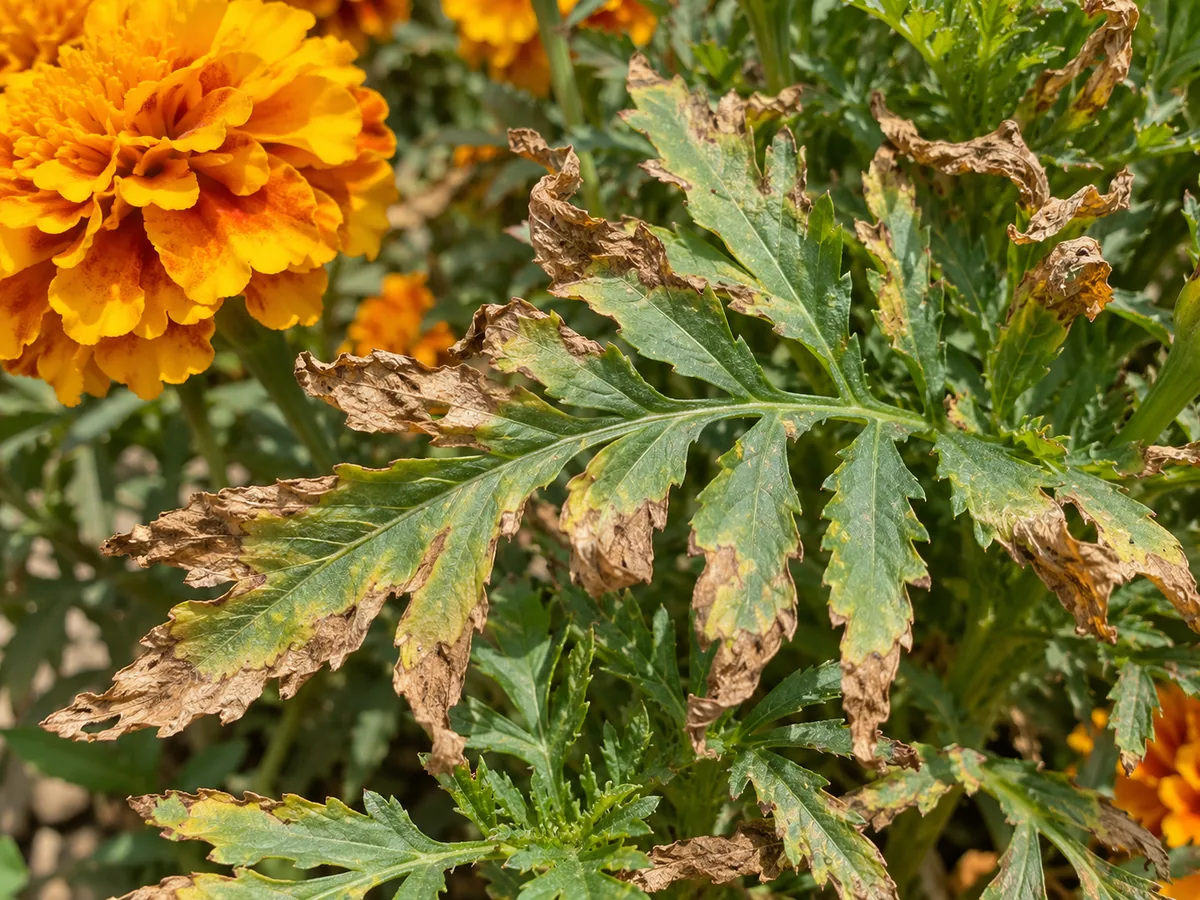
Crispy leaflets and dried margins on marigold - compare affected lower leaves with clean new center growth.
Drought crisp on lower leaves
The classic container pattern: oldest lower leaflets dry from the tips inward, feel papery, and crumble when pinched, while the pot feels light and soil pulls slightly from the rim. Plants may wilt at midday and partially recover by evening. Tall African types (Tagetes erecta, up to 3–4 feet) with big double flowers lose water fastest on hot balconies — Wisconsin Horticulture notes African marigolds run taller with a strong upright habit while French types stay compact around 6–12 inches, so pot size must match the habit (Wisconsin marigold culture).
Heat scorch with moist soil
After a heatwave, leaflet edges bleach pale then turn crispy brown even though soil at 3 cm is still moist. Epic Gardening’s marigold diagnostics draw the key distinction: a too-dry plant looks faded and sometimes brown or crispy, while a heat-stressed plant keeps normal dark green foliage despite wilting (marigold heat and wilt patterns). Reflected heat from white walls and paving makes this worse on exposed balconies.
Spot-crisped leaves from fungi
Leaf-spot diseases start as spots and end as crisp: Connecticut’s pest handbook describes circular to irregular tan-to-brown spots from Septoria and Alternaria on marigold leaves (Marigold pest handbook). Penn State adds purplish spots on leaves and stems for Alternaria leaf spot and small 2–5 mm circular dead spots with purple margins for bacterial leaf spot (marigold disease table). Dead centers dry, crack, and tear, so the leaf looks crispy rather than merely spotted.
Mite-speckled leaves turning brittle
Spider mites and aphids stipple marigold foliage until it bronzes and dries. Epic Gardening notes yellow or brown speckling from aphids or spider mites on flowering annuals such as marigolds, with mites building fine webs and a sticky coating (mite damage on marigolds). Heavily stippled leaflets lose chlorophyll across the whole surface, then crisp from the edges — a pattern drought alone does not produce.
Crispy patterns compared
| Pattern | First leaves hit | Soil at 3 cm | Undersides | First fix |
|---|---|---|---|---|
| Drought crisp | Oldest lower leaflets | Dry, pot light | Clean | One deep base watering; empty saucer |
| Heat scorch | Sun-exposed side | Moist, pot normal | Clean, foliage dark green | Afternoon shade for pot; hold rhythm |
| Leaf-spot crisp | Scattered, wettest zones | Any; worse after overhead wetting | Spots with dry centers, no webbing | Stop overhead water; strip spotted leaves |
| Mite/aphid crisp | Patchy stippling, buds too | Any | Speckling, webbing, tiny insects | Dislodge pests; treat infestation |
| Salt or pH edge burn | Margins after feeding | Moist possible; crust on surface | Clean | Flush; pause feed (see fertilizer guide) |
| Wilt-disease drying | Lower leaves, one side first | Moist; plant still wilts | Clean; stems may discolor | Stop watering; inspect crown and roots |
Pick one leading row before combining treatments.
Why marigold gets crispy leaves
Full-sun containers outrun the watering can
Marigolds demand full sun of 6–8 hours direct and prefer moderate, even moisture without waterlogging. That combination is unforgiving in small pots: a 20 cm container of Tagetes erecta in July sun can swing from moist to dry in a single afternoon, and broad leaflets crisp at the margins first. Routine rhythm lives in the marigold watering guide — check the top 3 cm before every drink rather than watering by calendar.
Heat stress without dry soil
When temperatures stay high, the plant cannot move soil water fast enough to cool itself, so leaves wilt and scorch while roots sit in adequate moisture. Soaking a heat-stressed marigold deprives roots of oxygen and deepens the stress — hold the regular schedule and cool the pot instead. Site choice matters here; review exposure in the marigold light guide if scorch repeats on moist soil.
Overhead watering invites leaf spots
Wet foliage is the common thread behind marigold leaf spots. Both Penn State and Connecticut extension guidance converge on avoiding overhead irrigation and watering early so foliage dries (disease management; pest handbook). Dense plantings with no airflow keep lower leaflets wet after rain, and those are the first to spot, dry, and crisp.
Hot dry weather favors spider mites
Mite colonies build fastest in hot, dry conditions — exactly the balcony weather marigolds love. Because marigolds are often planted as pest deterrents, growers assume the foliage is immune; it is not. Mites colonize leaf undersides first, so damage looks like mysterious crisping from above until you flip a leaf. Identification detail is covered in Gardening Know How’s mite guide.
Low-feeder roots meet heavy feeding
Marigolds are low feeders that do not require heavy fertilization. Repeated full-strength doses in containers leave salts behind, and leaf margins burn crisp days after feeding — sometimes with a white crust on the mix. Acid imbalance browns tips the same way. Full flush protocol sits in the marigold fertilizer guide; the marigold soil guide covers the well-drained pH 6–7 mix that buffers both problems.
Wilt diseases that mimic drought
When lower leaves yellow and crisp while soil stays moist, suspect vascular wilt rather than thirst. Connecticut describes Fusarium and Verticillium wilt on marigold: young plants can suddenly dry up, while older plants turn pale green with lower-leaf wilt often starting on one side before the whole plant collapses (wilt description). No amount of watering reverses wilt — it accelerates it.
Lookalike symptoms to rule out
| Symptom | What it is | How it differs from true crisp |
|---|---|---|
| Whole-plant midday wilt, recovers evenings | Early underwatering on marigold | Leaves limp but not yet papery; soil dry |
| Yellow lower leaves, heavy wet pot | Overwatering on marigold or root rot on marigold | Soft yellow tissue, sour mix — opposite fix |
| Dry brown margins only after feeding | Fertilizer burn on marigold | Follows feed schedule; crust on soil |
| Grey fuzzy coating on spent blooms | Botrytis flower blight | Soft wet decay on petals, not papery leaves |
| Few oldest leaves browning in autumn | End-of-season senescence | Isolated lower leaves as flowering winds down |
| Sudden overnight collapse on wet soil | Wilting on marigold | Whole stems limp; check crown firmness same day |
How to confirm the cause
Run in order; stop at the first positive:
- Soil at 3 cm and pot weight. Dry plus light pot supports drought. Moist plus heavy pot rules drought out.
- Wilt timing. Midday wilt that recovers by evening on dry soil is drought. Wilt on moist soil with dark green leaves is heat stress.
- Flip three leaves. Speckling, webbing, or moving dots mean mites or aphids — tap a leaf over white paper to confirm.
- Spot check. Tan-brown spots with dry centers, purple margins, or purplish stem spots mean fungal or bacterial leaf spot, especially after overhead watering or rainy spells.
- Feed and crust history. White crust or crisping days after feeding means salt burn; flush rather than water on schedule.
- Crown and root check. If soil stays wet 48 hours after you stop watering and lower leaves keep crisping, slide the plant out: firm white roots point to a foliage problem, mushy brown roots with sour smell point to rot or wilt disease.
First fix for marigold
Choose one based on the inspection above:
- Dry path: one deep base watering until water runs freely from drainage, then empty the saucer within 30 minutes. Recheck at 3 cm daily in heat.
- Heat path: move the pot out of reflected afternoon heat for 24 hours and keep the normal watering rhythm. Do not soak.
- Spot path: strip spotted lower leaves into the bin (not compost), switch to morning base watering, and space crowded stems for airflow.
- Mite path: blast leaf undersides with a firm morning water jet, then follow with a miticide or insecticidal soap labelled for ornamentals, repeating per label.
- Salt path: flush the pot with plain water until excess drains freely and hold all fertilizer until new growth emerges clean.
- Wet path: stop watering immediately and escalate to root rot on marigold if crowns soften or smell sour.
Step-by-step recovery
Drought crisp
- Deep base water once; confirm drainage flows.
- Check daily in peak heat — many balcony pots need water every 1–2 days in July.
- Deadhead spent blooms so the plant spends energy on new leaflets.
- Trim fully papery leaflets only after one week of stable moisture; they will not re-green.
Heat scorch
- Shade the pot (not necessarily the flowers) from harsh afternoon reflection.
- Maintain even moisture; mulch container surfaces lightly to slow evaporation.
- Expect limp afternoons for a few days; judge by morning turgor, not 3 p.m. posture.
Leaf-spot crisp
- Remove affected leaves promptly — Connecticut notes picking symptomatic leaves early limits spread (handbook).
- Water at the base early in the day so foliage dries before night.
- Thin crowded stems; avoid evening overhead irrigation entirely.
- Reserve labelled fungicides for severe, spreading cases per local extension advice.
Mite and aphid crisp
- Isolate the plant if others grow nearby.
- Rinse undersides firmly in the morning; repeat every few days to break the mite cycle.
- Apply insecticidal soap or a labelled miticide, covering undersides.
- Recheck with the white-paper tap test weekly for two weeks before declaring victory.
Recovery timeline
New leaflets without crisp typically appear within one to two weeks once the correct fix holds. Old papery tissue never re-greens — judge recovery on new center growth and on crisping stopping its upward spread, not on old margins improving.
In peak summer heat, monitor daily for the first week on the drought or heat path. In mild spring weather, checks every two to three days are enough. If crisping keeps climbing into new growth after two corrected weeks, re-run the confirmation steps — the lead cause was probably wrong.
What not to do
- Do not fertilize a crispy, stressed marigold to force green growth — salts deepen margin burn on a low feeder.
- Do not soak a wilted plant before checking soil; heat-stressed roots drown while drought roots drink.
- Do not overhead-water in the evening to “rehydrate” leaves — wet nights spread leaf spots and botrytis.
- Do not strip half the foliage for appearance while the cause is active; leaves feed recovery.
- Do not stack repotting, pruning, and spraying on the same day; make one correction and read the response.
How to prevent it next time
- Water by the top-3-cm test with the rhythm in the marigold watering guide.
- Always water at the base, early in the day, so foliage dries fast.
- Feed lightly per the marigold fertilizer guide — excess nitrogen pushes leaves at the expense of blooms and invites salt burn.
- Plant in the well-drained mix from the marigold soil guide and match pot volume to African versus French mature size (see the marigold overview).
- Give full sun with airflow rather than sun plus a stagnant corner; space containers so lower leaflets dry after rain.
- Deadhead and clear fallen debris weekly during humid spells.
Marigold care cross-check
Crisp on marigold usually means the sun load, container volume, and watering rhythm fell out of balance — not a mysterious new disease. Tall African cultivars in small pots on reflective balconies are the highest-risk combination; compact French types in beds with mulch are the most forgiving. If crisp appeared alongside yellow lower leaves rather than instead of them, compare yellow leaves on marigold before treating, and browse the marigold problems hub when more than one symptom overlaps.
When to worry
Escalate the same day when crisping spreads visibly day to day, stems soften, crowns feel mushy, soil smells sour, or a young plant dries up suddenly on moist soil — vascular wilt and advanced rot do not wait. Contact your local extension office if wilt-pattern drying repeats across fresh mix and clean pots. Low urgency for dry margins alone on an otherwise firm plant pushing clean new growth.
Related marigold problems
- Brown tips on marigold — margin burn patterns: drought vs salt vs wet roots
- Underwatering on marigold — dry-soil wilt before tissue turns papery
- Overwatering on marigold — heavy pots and saturation habits
- Root rot on marigold — mushy roots, sour soil, crown softness
- Wilting on marigold — overnight collapse and heat wilt
- Yellow leaves on marigold — when crisp comes with yellowing lowers
- Marigold watering guide — container vs bed rhythm
- Marigold overview — sun, soil, and African vs French basics
When to use this page vs other Marigold guides
- Marigold watering guide — Use for routine moisture checks before deciding crisp is the main issue.
- Marigold problems hub — Browse all common issues on this species.
- Brown Tips on Marigold — Different entry point when only leaf margins are brown.
- Underwatering on Marigold — Different entry point when the plant wilts but leaves are not yet papery.
- Overwatering on Marigold — Different entry point when pots stay heavy and lowers yellow.