Bacterial Wilt on Marigold: Causes, Checks & Fixes
Quick answer
Bacterial wilt makes a marigold collapse while its leaves are still green, and no spray or watering fix cures it. Cut one suspect stem and stand it in a glass of clean water for 10 minutes before you pull or water anything — milky streaming confirms bacteria. Confirmed plants must be bagged and destroyed, never composted.
Bacterial Wilt on Marigold: Causes, Checks & Fixes
This guide covers bacterial wilt on Marigold. See also the general Bacterial Wilt guide, watering, and light pages for this plant.
Bacterial Wilt on Marigold: Causes, Checks & Fixes
Quick answer
Related: bacterial-wilt guides A marigold with bacterial wilt goes limp while its leaves are still green, fails to perk up overnight even though the soil is moist, and then collapses within days. The cause is the soilborne bacterium Ralstonia solanacearum, which marigold is a known host of and which clogs the stem’s water vessels from the inside. There is no cure for an infected plant, so the only useful sequence is: confirm with the 10-minute stem test below, then bag and destroy the plant before the bacteria spread through the bed.
For how this pathogen behaves across all host plants, see our bacterial wilt guide. On marigolds, the pattern usually shows up as a mid-summer bed collapse in warm, wet soil — which is what the rest of this page covers.
What bacterial wilt looks like on Marigold
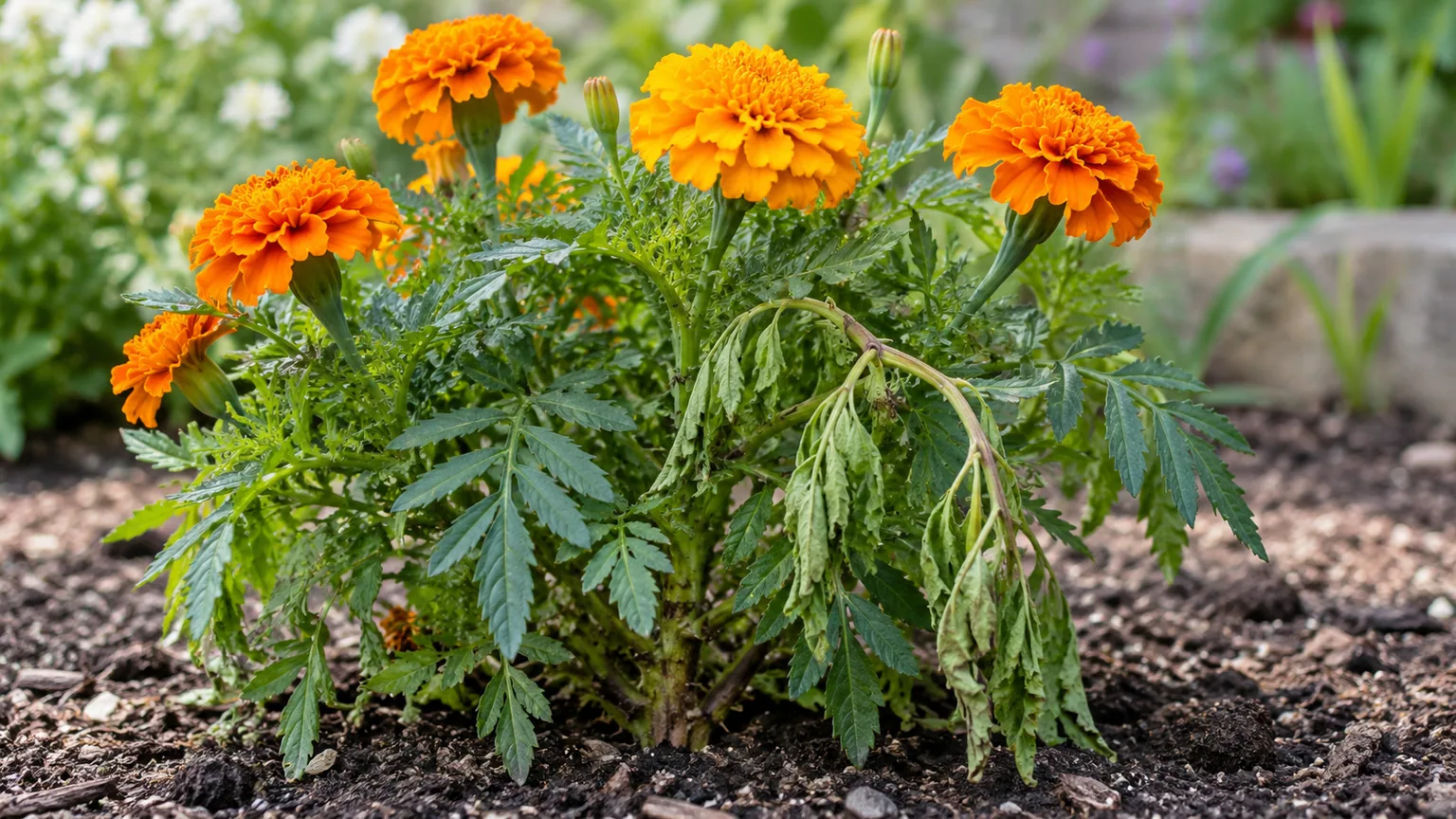
Early on, one plant — or one branch of a plant — wilts in the afternoon heat while its leaves stay green. That detail matters: drought-wilted marigolds yellow or crisp first, while bacterial-wilted ones look freshly watered and still fall over. A classic signature is the overnight fake-out: the plant appears to recover overnight only to wilt again when temperatures rise during the day.
As the blockage spreads, lower leaves yellow, growth stalls, and the stem base darkens. Split a stem lengthwise and you may see brown streaks in the vascular ring. Late-stage plants rot at the base, collapse entirely, and die — often within 7 to 14 days of the first symptoms.
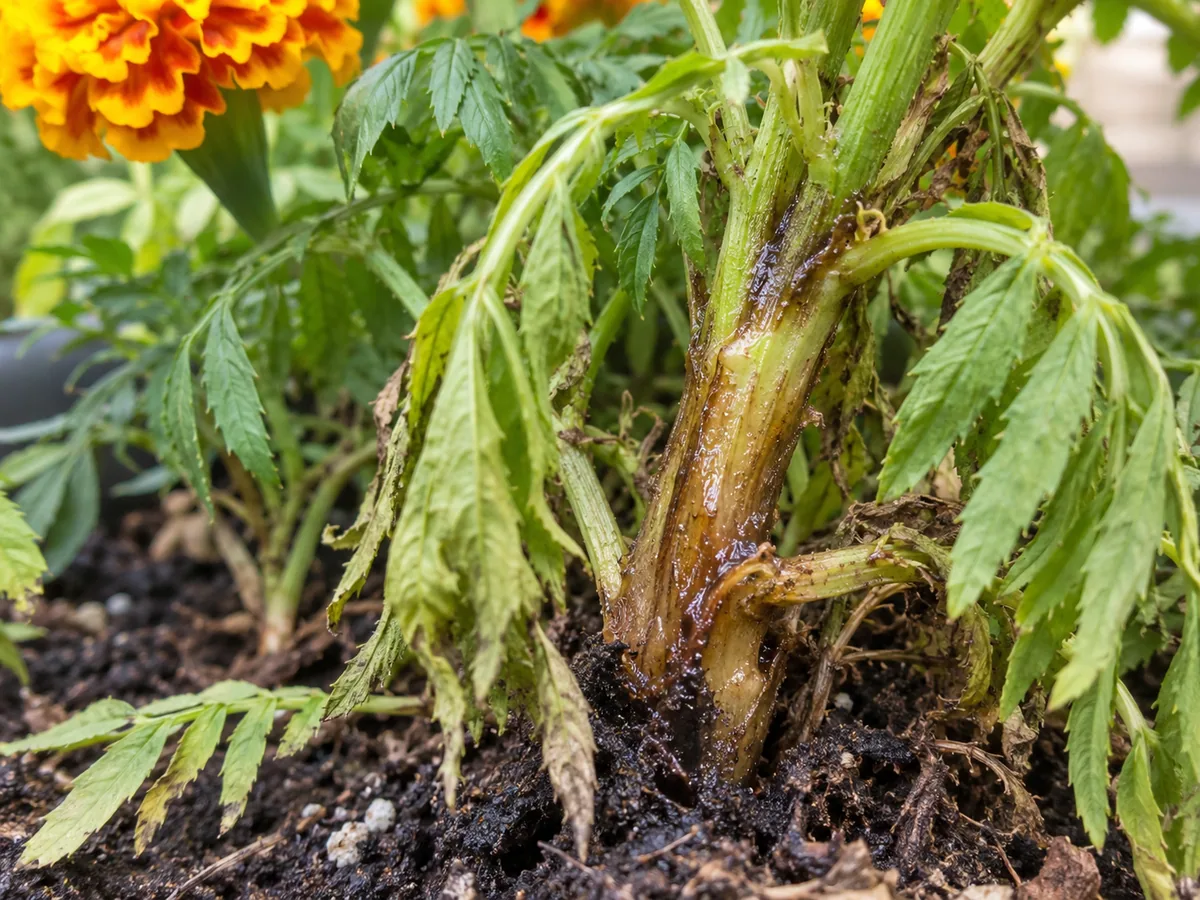
Green wilt with a darkened stem base on marigold — compare with healthy firm tissue on a neighboring plant.
Why marigolds get bacterial wilt
Ralstonia lives in soil and enters through microscopic root and stem wounds — transplant damage, hoe nicks, insect feeding, and the tiny tears left by deadheading. Once inside, the bacteria multiply in the xylem and physically plug water transport, so the plant starves for water while standing in damp soil. Disease development is favored by warm temperatures above 85°F and wet soils, which is exactly the monsoon-and-summer window when marigolds are bedded out and watered heavily.
Three marigold habits raise the odds. First, growers replant marigolds in the same bed season after season, and the pathogen can survive for several years in soil. Second, overhead watering and rain splash move bacteria from soil to stems and plant to plant. Third, frequent deadheading with uncleaned snips turns one infected plant into a bed-wide problem, since the pathogen also spreads on the surface of infested tools.
African vs French marigolds show it differently
African marigolds (Tagetes erecta) grow tall with heavy double heads on thick stems. When bacteria clog those stems, whole heavy branches fold suddenly — a dramatic one-sided collapse that beginners mistake for a broken stem. Because the stems are thick, the internal brown vascular streaking is easy to see when you split one open, which makes the confirmation test below especially readable on this type.
French marigolds (Tagetes patula) stay short with thinner stems and smaller root systems in dense bedding rows. They tend to show the overnight fake-out pattern — limp at noon, slightly better at dawn — for several days before collapsing, and crowded rows trap humidity at the base that speeds spread to neighbors. In containers, French types in fresh soil-less mix rarely get this disease at all; a container French marigold that wilts is far more likely facing drooping leaves on Marigold from simple moisture stress.
How to confirm it: the glass-of-water stem test
Do this before you pull or treat anything, because watering a bacterial-wilted plant spreads the pathogen and pulling a drought-wilted plant wastes a rescueable marigold.
- Pick the right stem. Choose a freshly wilted but still-green stem, not a long-dead mushy one.
- Cut a 10 cm section with clean scissors and rinse off surface soil.
- Stand the cut end in a glass of clean, room-temperature water and wait a few minutes without stirring.
- Watch for milky threads. Thin, smoke-like strands streaming from the cut are bacterial ooze — a reliable assay for bacterial wilt caused by Ralstonia. No streaming after 15 to 20 minutes argues against bacterial wilt.
- Split a second stem lengthwise. Brown streaks confined to the vascular ring support the diagnosis; clean white-green tissue throughout points elsewhere.
If the test is positive, treat the plant as infectious from that moment: do not compost it, do not shake soil off the roots near the bed, and disinfect the scissors before touching another plant. If results are unclear and a whole bed is failing, contact your local extension plant clinic for diagnosis rather than guessing.
The first fix for Marigold
Run the cut-stem water test before you change anything. Do not flood the plant “to help” and do not rip it out on suspicion alone. Ten minutes in a glass tells you whether you are dealing with an incurable infection or a thirsty marigold, and that single answer decides everything that follows.
Step-by-step cleanup after confirmation
Once streaming confirms bacteria, the goal shifts from saving the plant to saving the bed. Few chemical or biological options control this disease, so cultural controls carry the whole job.
- Bag the whole plant. Lift it with its root ball and surrounding loose soil straight into a trash bag. Collect fallen leaves and petals from the soil surface too.
- Trash, never compost. Home compost never gets hot enough to kill Ralstonia. Bin it with household waste.
- Disinfect tools and hands. Wash snips, trowels, and pots that touched the plant with soap and water, then disinfect. Avoid moving infested bed soil to clean areas on equipment, tools, and boots.
- Stop overhead watering the bed. Switch remaining plants to base watering so splash stops carrying bacteria stem to stem. Good sanitation practices are essential to containing bacterial diseases.
- Quarantine replacements. Hold new seedlings apart from the bed for 10 to 14 days of observation before planting, and buy from reputable suppliers rather than swapping soil-rooted divisions with neighbors.
- Replant the spot with a non-host. If the bed has a history of wilt, grow grasses or another non-host there next season, or set marigolds in containers of fresh soil-less mix on top of the bed instead of in the ground.
Lookalikes on marigold
| What you see | More likely | How to split it |
|---|---|---|
| Wilt on dry soil, recovers overnight | Drought or heat | See wilting on Marigold — soil test decides in seconds |
| Yellow lower leaves, brown sunken roots, stem base cracked | Root rot on Marigold | Roots mushy with stringy cores; root rot favors cool wet poorly drained soil |
| Single branch wilts, tan stem, fluffy white growth, hard black pellets inside stem | White mold | White mold sclerotia on marigold stems distinguish it — cottony growth and black pellets are absent in bacterial wilt |
| One-sided yellowing, black streaks up one side, salmon spore masses in wet weather | Fusarium wilt | Penn State lists Fusarium wilt separately on marigold with vascular streaking but no bacterial streaming |
| Seedlings topple at the soil line in trays | Damping-off on Marigold | Hits seedlings, not established blooming plants |
| Wilt plus sticky residue, visible insects, stippled leaves | Pests | Check leaf undersides before blaming bacteria |
Recovery timeline: what honesty requires
The infected plant does not recover — plan on losing it within one to two weeks of the first limp afternoon. What recovers is the bed: neighbors that test negative and stay firm for two weeks after you remove the source plant and switch to base watering are very likely safe. If collapses keep appearing in the same spot across successive plantings, the soil itself is infested and no marigold planted there will finish the season — rotate the bed or go to containers.
What not to do
Do not drench the plant with extra water once green wilt appears — saturation favors the bacterium and splash spreads it. Do not apply fungicides or bactericides expecting a cure; extension guidance is explicit that infected plants should be destroyed, not sprayed. Do not prune out the wilted branch and hope the rest survives — the bacteria are already systemic in the vessels. And do not replant a fresh marigold seedling into the same hole the same week.
Preventing it next season in marigold beds
Marigolds are succession-sown annuals, so prevention is mostly about breaking the soil chain between crops. Rotate marigolds out of any bed that showed wilt — even one season elsewhere starves the pathogen of hosts. Where rotation is impossible, fill planter boxes with fresh soil-less mix and set them on top of the bed; planting into new soil rather than infested ground is the recommended workaround for ornamentals.
Match the rest to how marigolds actually grow: keep the full sun and free-draining mix that dries the soil surface fast, water at the base, never overhead, and space bedding rows so foliage dries by evening. During deadheading season, dip snips in disinfectant between plants instead of shearing the whole row with the same blades. Trials in wilt-sick plots have screened African marigold hybrids for resistance, so when buying seed for a problem bed, ask the supplier whether the variety carries any bacterial wilt tolerance rather than replanting a known-susceptible favorite.
Marigold care cross-check
Before you call it wilt, confirm the basics from the Marigold overview: full sun, top 3 cm dry between waterings, and a moderately fertile mix that is not nitrogen-heavy. Review routine moisture habits in the Marigold watering guide and mix drainage in the Marigold soil guide. A marigold in shade with soggy dense mix can look half-dead from yellow leaves on Marigold and wet feet alone — fixable problems that should never trigger a wilt-plant pull.
When to worry
Worry when green wilt ignores watering, when the streaming test is positive, or when a second plant collapses in the same bed within a week. A single container plant wilting in fresh mix on a hot afternoon is almost never this disease — check water first. A bed-wide collapse in warm wet weather after overhead irrigation is the textbook emergency: remove, bag, sanitize, and replant elsewhere.
Conclusion
Bacterial wilt on marigold announces itself as green, unrecoverable wilt in warm wet soil, and the stem-streaming test separates it from every fixable lookalike in minutes. Accept the hard limit — confirmed plants are destroyed, not treated — and spend your effort on the bed: sanitation, base watering, rotation, and fresh mix. Browse the full Marigold problems hub if the symptoms here do not match what you see.
When to use this page vs other Marigold guides
- Marigold watering guide — Use for routine moisture checks before assuming a wilt is bacterial.
- Marigold problems hub — Browse all common issues on this species when the diagnosis is still open.
- Wilting on Marigold — Start here when the cause is unknown; this bacterial-wilt page is the infectious branch of that decision.
- Root Rot on Marigold — Use when roots are mushy and the streaming test is negative.
- Drooping Leaves on Marigold — Use for soft daytime droop that recovers, usually heat or thirst.
Related Marigold guides
- Marigold overview — variety choice, sun, and seasonal rhythm for the whole plant.
- Marigold watering — base-watering routine that keeps foliage dry and vessels unstressed.
- Marigold soil — draining mixes and container options for infested beds.
- Wilting on Marigold — dry-vs-wet split for any unexplained droop.
- Root Rot on Marigold — the main wet-soil lookalike with root-level checks.
- Drooping Leaves on Marigold — heat and thirst droop that recovers overnight.
- Damping-off on Marigold — seedling collapse in trays, a different pathogen stage.
- Yellow Leaves on Marigold — yellowing-first patterns that usually are not wilt.
- Marigold problems — full index when symptoms span several pages.