Downy Mildew on Marigold: Causes, Checks & Fixes
Quick answer
Downy mildew on marigold shows as yellow angular patches on upper leaves with pale gray fuzz on the undersides after cool, wet weather. Isolate the plant, switch to morning base-only watering, and strip affected leaves; judge recovery by clean new growth, not old spots.

Downy Mildew on Marigold: Causes, Checks & Fixes
This guide covers downy mildew on Marigold. See also the general Downy Mildew guide, watering, and light pages for this plant.
Downy Mildew on Marigold: Causes, Checks & Fixes
Quick answer
Downy mildew is an uncommon but real cool-weather disease on marigolds (Tagetes erecta, African marigold, and Tagetes patula, French marigold). It shows as yellow angular patches on upper leaf surfaces with soft pale fuzz on the undersides, starting on lower leaves after stretches of wet foliage and cool nights.
First fix: isolate the plant and switch to morning base-only watering so no water ever sits on the leaves. That single change removes the leaf-wetness engine the pathogen needs, and tells you within days whether cultural correction alone will hold the line.
For the general mechanics of how this disease family works across hosts, see our downy mildew guide. On marigold, the pattern usually starts in crowded nursery six-packs or tight bedding displays during cool spring weather - not in the hot dry spells that favor spider mites and powdery mildew.
When to use this page vs other Marigold guides
| Pattern | Read next |
|---|---|
| Yellow angular patches with fuzz on undersides after cool wet weather | Downy mildew (this page) |
| White powder on upper leaf surfaces in warm dry weather | Powdery mildew on marigold |
| Pale stippling plus fine webbing in summer heat | Spider mites on marigold |
| Wilt on wet soil with mushy roots | Root rot on marigold |
| Whole-plant wilt, wet versus dry fork | Wilting on marigold |
| Routine moisture rhythm and container checks | Marigold watering guide |
What downy mildew looks like on marigold
Lower leaves yellow first in irregular patches that look angular because veins wall them off - the classic downy mildew signature on ornamentals. Flip a suspect leaf on a cool, humid morning and look for soft white to gray growth on the underside directly beneath the discolored area on top. That underside fuzz may only be visible during very humid spells and can vanish by hot afternoon, which is why morning inspection matters.
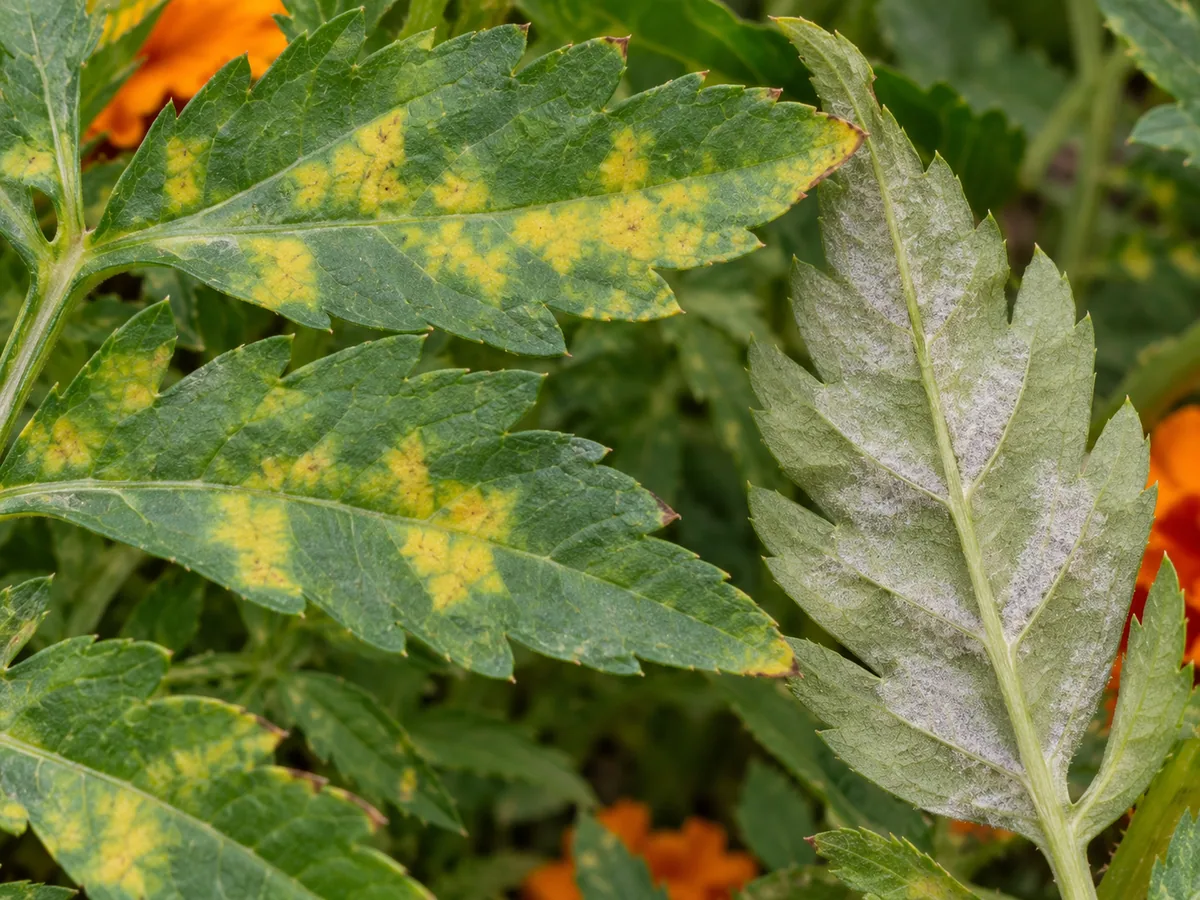
Downy mildew on marigold: yellow vein-delimited patches above, pale sporulation below - compare with healthy tissue on the same plant.
As lesions multiply they coalesce, heavily spotted leaves drop, and young seedlings can stall or collapse outright. Established bloomers usually keep flowering at the top while lower foliage thins - ugly but survivable if you dry the canopy out. Downy mildew on ornamentals is caused by organisms in the genera Peronospora or Plasmopara, and each species has a narrow host range, so marigold mildew will not jump to your roses or cucumbers.
Nursery six-packs and bedding displays: where it starts on marigold
Most home-garden cases trace back to the garden center, not your backyard. Spring marigold six-packs sit tightly packed under cover with frequent overhead watering - exactly the cool, leaf-wet production conditions where downy mildew thrives. Recently purchased plants may carry invisible infection that erupts days after you bring them home, a pattern extension pathologists flag specifically for ornamentals moved from production into landscapes.
Inspect before you buy: reject six-packs with yellow lower leaves, dropped foliage in the cells, or any underside fuzz. At planting time, space transplants to their mature width instead of cramming for instant color - instant-fill bedding displays recreate nursery crowding in your own bed and keep foliage wet long after rain or irrigation stops.
African vs French marigold canopy habits
The two species trap humidity differently. Tall African marigolds (T. erecta) build dense, layered canopies where lower leaves stay shaded and damp for hours after the tops dry - so check the lowest foliage layer first, pushing leaves aside rather than glancing at the flower dome. Compact French marigolds (T. patula) sit closer to mulch and soil, where splash from rain or hose watering throws pathogen spores upward onto low leaves; mulch plus base watering breaks that splash bridge.
Both types bloom continuously for months, which creates a marigold-only sanitation chore: spent flower heads that lodge on wet lower leaves rot in place and hold moisture against the foliage. Regular deadheading therefore doubles as disease control on marigolds in a way it does not on foliage-only houseplants.
Why cool, wet foliage triggers it
Unlike powdery mildew, which is a true fungus of warm dry weather, downy mildew is caused by organisms more closely related to algae - which is why it needs liquid water to infect. The disease favors cool temperatures of 50 to 75°F with relative humidity above 85 percent, the exact profile of a rainy spring week or a humid enclosed porch. Its swimming spores travel in films of water across wet leaves, and the organism survives between seasons as long-lived resting spores on plant debris.
That cycle explains the seasonality home growers see: spring outbreaks that seem to vanish in summer heat. The epidemic fades once temperatures climb and moisture drops, though resting spores can wait out summer and reappear the next cool wet spell. Marigolds need full sun and open air partly for this reason - shaded, crowded, overhead-watered plants stay in the pathogen’s comfort zone weeks longer than sunny, spaced ones.
How to confirm the cause
Run these checks in order on a cool morning, before sun and breeze dry the evidence:
- Underside inspection - flip lower leaves with yellow patches and use a hand lens. Soft grayish-white fuzz directly under the discoloration confirms downy mildew; white powder sitting on top surfaces points to powdery mildew on marigold instead.
- Patch shape - downy mildew spots look angular and delimited by leaf veins, then merge into larger dead areas. Round spots with purple margins suggest bacterial leaf spot; oval gray-black spots with tiny fruiting dots suggest Septoria - both confirmed by the marigold disease table.
- Weather history - cool rainy stretch or humid enclosed porch in the past one to two weeks supports downy mildew. Hot dry weeks with stippled leaves and silk instead implicate spider mites on marigold.
- Canopy position - lowest shaded leaves first fits downy mildew; new-tip distortion with honeydew fits aphids; whole-plant wilt on wet soil fits root rot on marigold.
- Spread speed - lesions multiplying across neighbors within days of wet weather means active sporulation; isolated spots that never spread suggest old transplant stress, not ongoing infection.
First fix for marigold
Isolate the plant and switch to morning base-only watering so foliage stays completely dry. Move containers apart for airflow, water at the soil line in late morning so any accidental splash dries fast, and empty saucers so humidity around the pot drops.
Do not spray anything on day one. Most home-garden cases never need fungicide - extension guidance notes fungicides are generally not recommended for home gardens against this disease - and spraying wet foliage only extends the leaf-wetness the pathogen wants.
Step-by-step recovery by severity
Light: a few spotted lower leaves on firm plants
- Pick off affected leaves the moment you see them, bag them, and trash them - do not compost.
- Keep the base-watering-only routine and widen spacing around the plant.
- Deadhead spent blooms so none rest on foliage.
- Watch new growth for one to two weeks; clean new leaves mean the fix held.
Moderate: spreading patches across the lower half
- Strip all visibly lesioned leaves plus fallen debris on the soil surface.
- Thin neighboring plants or move pots so air moves freely through the canopy.
- Shift watering to late morning and switch beds to drip or soaker delivery rather than overhead sprinklers.
- If spots keep multiplying after a week of dry foliage, treat as a nursery-source epidemic and consider replacing annuals rather than escalating to sprays.
Severe: seedlings collapsing or whole-canopy lesions
- Rogue and trash collapsed seedlings and heavily defoliated plants - recovery is unlikely and they seed spores onto neighbors.
- Replace with clean stock from a different batch, spacing at mature width in well-drained soil in full sun.
- Clean the bed of debris before replanting, since the pathogen overwinters on dead plant material.
Recovery timeline
Spotted leaves never re-green - judge everything by new leaves opening clean and spot-free. Light cases stabilize within one to two weeks of dry foliage; moderate cases need two to three weeks plus steady deadheading. Seedling infections that stall tip growth have usually lost their season even if they linger, because marigolds are short-season annuals with no time to rebuild from a bare stem. If fresh upper leaves keep spotting despite a full week of dry-leaf culture, the planting is re-infecting from debris or neighbors and replacement beats rescue.
Lookalike symptoms to rule out
| Signal | Downy mildew | Powdery mildew | Spider mites | Leaf spot diseases |
|---|---|---|---|---|
| Growth location | Fuzz on leaf undersides | Powder on upper surfaces | Silk plus specks, undersides | No fuzz; spots with margins |
| Patch shape | Angular, vein-delimited | Fluffy blotches | Dry stippling dots | Purplish or gray-black round spots |
| Weather | Cool and wet | Warm and dry | Hot and dry | Wet foliage, any warmth |
| First tissue | Lower shaded leaves | Lower leaves, spreads up | Leaf undersides in heat | Lower leaves, moves up |
| Fix | Dry foliage, strip leaves | Airflow, avoid evening wetting | Rinse undersides | Avoid overhead irrigation, remove leaves |
Aster yellows - vein clearing, witches-broom shoots, green distorted flowers - is a separate phytoplasma problem spread by leafhoppers, not a foliage-wetness disease, and infected plants must be removed rather than dried out.
What not to do
Do not mist the plant or syringe foliage hoping to wash the disease off - every wetting event helps spores swim to new infections. Do not fertilize a defoliating plant; soft forced growth is more susceptible, not less. Do not overhead-water in the evening, compost diseased leaves, or crowd replacements into the same tight spacing that started the outbreak. And do not apply leftover rose or vegetable fungicides to edible or pollinator-visited marigold blooms without a label that covers marigolds - cultural control resolves most home cases.
How to prevent it next time
Buy clean stock, space to mature width, and water at the soil line so leaves never stay wet overnight. Water early in the day so foliage dries before nighttime, mulch French types to block soil splash, and deadhead weekly so spent blooms never mat onto wet leaves. Practice genuine garden hygiene: clear dead plant material from beds each fall rather than tilling it in where marigolds will sit next spring. Rotate marigolds to a fresh bed after a heavy spring outbreak year, and favor sunny open positions - shade plus slow dry-down is the preventable half of this disease on marigolds.
Marigold care cross-check
Downy mildew on marigolds almost always rides on a sun, water, and spacing mismatch. Confirm the plant gets full sun through the marigold light guide, steady base moisture through the marigold watering guide, and open, airy mix - heavy garden soil in pots keeps both roots and lower foliage wet. If the same pot also shows wilt on wet soil, work the moisture fork on wilting on marigold before blaming weather alone.
When to worry
Treat as urgent when lesions spread across most of the plant within days, seedlings damp off at the soil line, or several bedding neighbors spot simultaneously after a wet week - that is an active epidemic, not background blemishes. A few spotted lower leaves on an otherwise blooming plant in a sunny bed can wait for your next deadheading round. Escalate to your county extension clinic when angular spots appear alongside mosaic patterns or flower distortion, which point beyond downy mildew toward virus or phytoplasma problems needing professional diagnosis.
Related Marigold guides
- Marigold overview - sun, soil, and type differences
- Marigold problems hub - browse all issues on this species
- Marigold watering - base-watering rhythm that keeps foliage dry
- Powdery mildew on marigold - warm-weather white-powder lookalike
- Root rot on marigold - wet-soil wilt and repot thresholds
- Spider mites on marigold - hot-weather stippling lookalike
- Overwatering on marigold - chronic wet-mix recovery
Conclusion
Downy mildew on marigold is a cool-wet foliage disease: confirm it by morning fuzz on leaf undersides beneath vein-delimited yellow patches, rule out powdery mildew and mites by weather and growth location, then dry the canopy out with isolation and morning base-only watering. Strip affected leaves into the trash, deadhead spent blooms off wet foliage, and judge recovery by clean new growth within two weeks. Keep spacing open and debris cleared each fall, and this uncommon marigold disease stays a one-spring story instead of a yearly repeat.
Related tool
Use the Plant Problem Diagnosis Tool to narrow causes for downy mildew on this plant before changing multiple variables at once.