Powdery Mildew on Marigold: Causes, Checks & Fixes
Quick answer
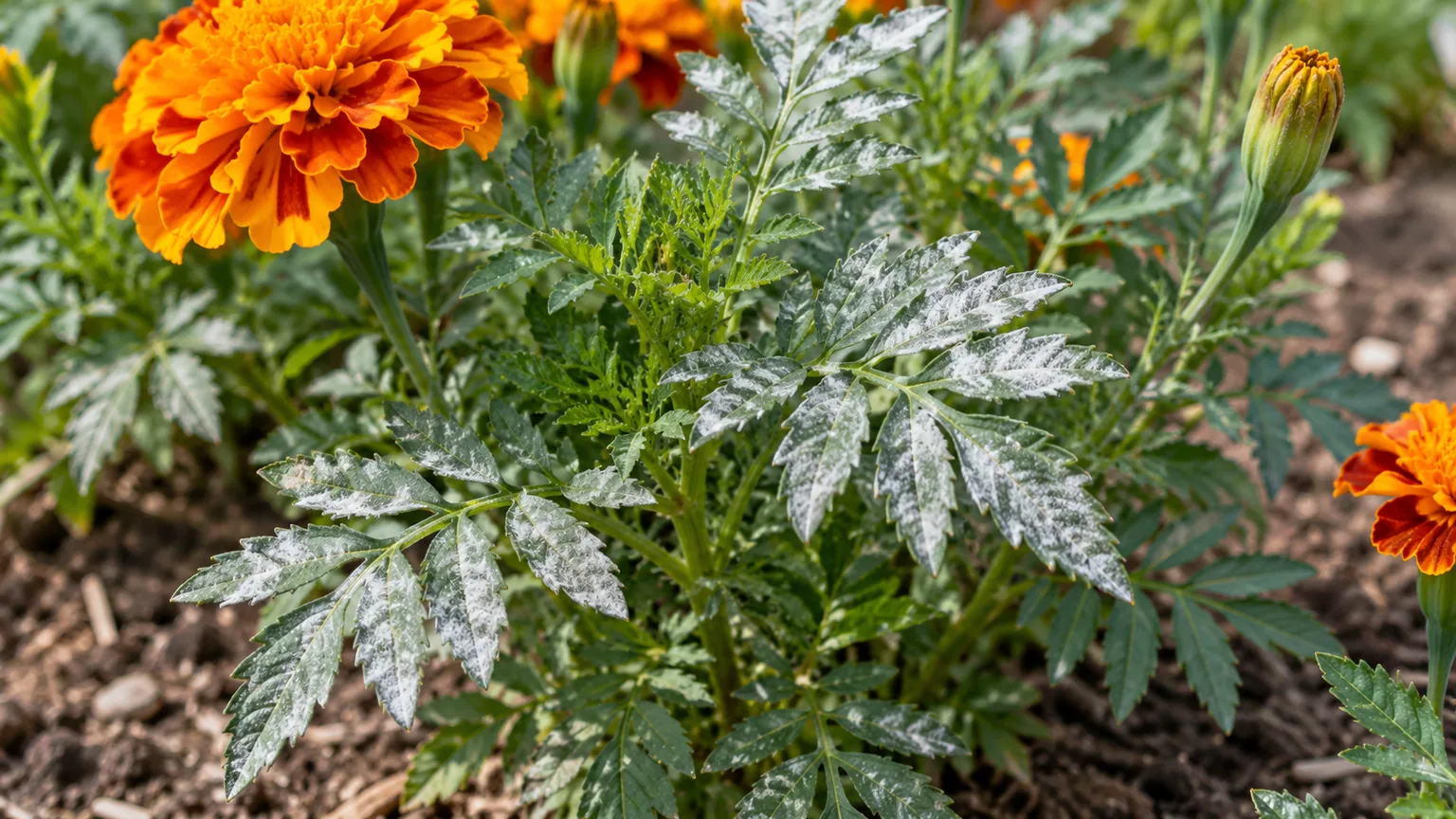
Powdery mildew on marigold shows as a dry white to gray powder on upper leaf surfaces that spreads during warm days and humid nights. Thin the canopy for airflow, switch to morning base-only watering, and strip the worst leaves; judge recovery by clean new growth, not old patches.
Powdery Mildew on Marigold: Causes, Checks & Fixes
This guide covers powdery mildew on Marigold. See also the general Powdery Mildew guide, watering, and light pages for this plant.
Powdery Mildew on Marigold: Causes, Checks & Fixes
Quick answer
Powdery mildew on marigolds (Tagetes erecta, African marigold, and Tagetes patula, French marigold) shows as a dry white to light-gray powder on upper leaf surfaces, starting on lower leaves and spreading upward during stretches of warm days and humid nights. The coating is a living fungal mat, not dust, and it will not rinse off.
First fix: open the canopy for airflow and switch to morning base-only watering so foliage stays dry. That one change removes the stagnant humid air the fungus exploits, and tells you within a week whether cultural correction alone will hold the line.
For the general mechanics of how this disease family works across hosts, see our powdery mildew guide. On marigold, the pattern usually starts in crowded bedding displays or nursery six-packs where dense pinnate foliage traps humidity - not on widely spaced plants in open sun.
When to use this page vs other Marigold guides
| Pattern | Read next |
|---|---|
| Dry white powder on upper leaf surfaces in warm dry weather | Powdery mildew (this page) |
| Yellow angular patches with fuzz on leaf undersides after cool wet weather | Downy mildew on marigold |
| Pale stippling plus fine webbing in summer heat | Spider mites on marigold |
| Whole-plant wilt, wet versus dry fork | Wilting on marigold |
| Wilt on wet soil with mushy roots | Root rot on marigold |
| Routine moisture rhythm and container checks | Marigold watering guide |
What powdery mildew looks like on marigold
Early colonies look like someone dusted flour across a few lower leaves - small white blotches on the upper surface of marigold’s finely divided leaflets. The powder is composed of mycelium and colorless chains of spores on upright stalks, and because the fungus sinks feeding structures into leaf cells, it will not brush off like dust.
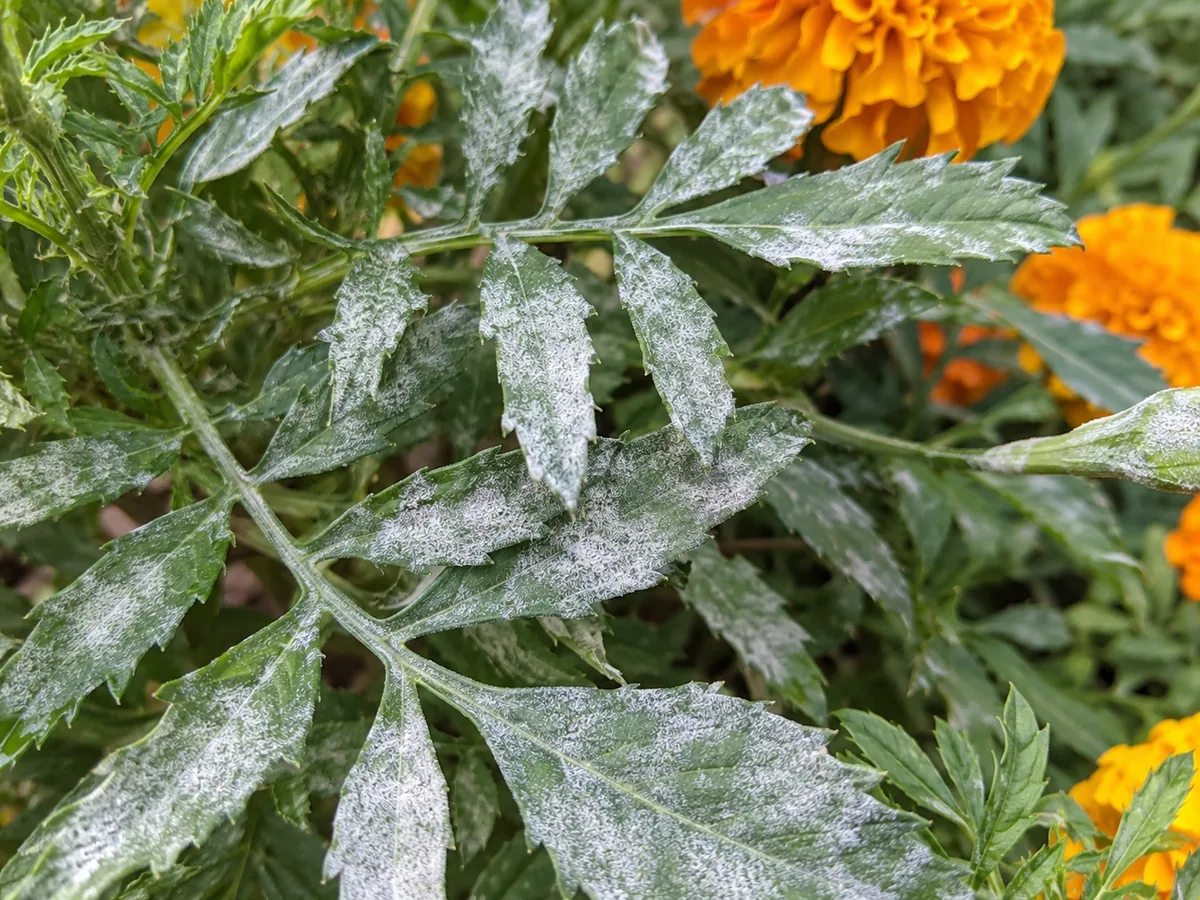
Powdery mildew on marigold: dry white surface powder on upper leaflets - compare with healthy tissue on the same plant.
As colonies merge, entire leaves and stems can appear white. Later you may see dark pepper-like spots among the powder - overwintering spore capsules, not dirt. Heavily coated leaves yellow at the edges, curl, and drop; buds on coated stems may fail to open. Photosynthesis is impaired and growth may be stunted, so a badly mildewed marigold keeps limping along with short stems and small pale flowers rather than collapsing outright.
Deadheading and the flower-head moisture trap
Marigolds bloom continuously for months, and their heavy spent flower heads create a disease chore no foliage houseplant has. A finished bloom that lodges on lower leaves pins damp petals against the foliage and holds humidity exactly where powdery mildew colonies start. The Tagetes erecta habit of carrying heavy flower heads that can snap stems means un-deadheaded plants combine mechanical stress with a moisture trap in one spot.
Deadhead weekly through the outbreak: snap or snip each spent bloom back to the first set of leaves, and flick any fallen petals off the foliage rather than letting them mat down. Bag the worst-coated trimmings with diseased leaves instead of dropping them on the soil, because the fungus winters over on plant debris and fallen leaves. On marigolds, deadheading is genuine disease control, not just cosmetic grooming.
African vs French marigold: where colonies start
The two species trap humidity in different places, so inspect accordingly. Tall African marigolds (T. erecta) build dense layered canopies where lower leaves sit in shade for hours after the flower dome dries - push the foliage aside and check the lowest leaflet layer first, not the sunny top. Compact French marigolds (T. patula) hunker near mulch and soil, where poor ground-level air movement keeps the inner foliage humid long after morning; lift the outer skirt of leaves to see the interior stems.
Both types share the marigold-only risk factor of pungent finely divided foliage planted for instant-fill color. Bedding displays crammed shoulder-to-shoulder for immediate effect recreate nursery crowding in your own bed, and spacing plants for good air circulation matters more on marigolds than on open-habit annuals. Thin self-sown volunteers and separate container neighbors so leaves of adjacent plants barely touch.
Why warm dry days with humid nights trigger it
Powdery mildew breaks the usual fungus rule: it does not need wet leaves. The pathogen is favored by conditions that produce high humidity but dry leaves, the classic late-summer pattern of hot dry afternoons followed by cool humid nights. Spores germinate without free moisture, and a new generation can appear every 72 hours when conditions suit - which is why a light dusting can coat a bed within two weeks.
Reassuringly, each powdery mildew species attacks only a narrow range of hosts, and different strains affect different species, so marigold mildew will not jump to unrelated plants. Your roses, cucumbers, and marigolds can each mildew independently from their own specialist fungus in the same humid week. The disease is considered more unsightly than harmful, and death of the plant is rare - but on a short-season annual grown for flowers, an unsightly coating that blocks sunlight and starves buds ruins the reason you planted it.
How to confirm the cause
Run these checks in order on a dry afternoon, when dew and lookalikes have declared themselves:
- Surface test - rub a white patch gently. Powdery mildew stays put because it is rooted into the leaf; dust and spray residue wipe away. Powder on upper surfaces points here; soft fuzz confined to undersides points to downy mildew on marigold.
- Canopy position - lowest shaded interior leaves first fits mildew. Damage starting on newest tips with honeydew fits aphids instead; dry stippling plus silk in heat fits spider mites on marigold.
- Weather history - warm dry days with humid nights over the past one to two weeks supports powdery mildew. A cool rainy stretch with vein-delimited yellow patches supports downy mildew; whole-plant wilt tracking soil moisture fits wilting on marigold.
- Spread speed - blotches doubling across neighbors within days mean active sporulation; isolated spots that never spread suggest old transplant stress.
- Flower check - buds failing to mature on stems with coated leaves confirms the infection is costing the plant energy, not just cosmetic foliage damage.
First fix for marigold
Space the plants for airflow and switch to morning base-only watering so foliage stays completely dry. Move containers apart until leaves barely touch, water at the soil line in the morning so any splash dries fast, and deadhead spent blooms so none rest on leaves. Do not spray anything on day one - most home-garden cases stabilize on airflow and dry foliage alone, and wetting the canopy to apply a remedy feeds the exact conditions the fungus wants.
Step-by-step recovery by severity
Light: scattered powder on a few lower leaves
- Pick off the worst-coated leaves, bag them, and trash them - never compost infected material.
- Widen spacing and deadhead all spent blooms off the foliage.
- Hold the morning base-watering routine for one to two weeks and watch new leaves.
Moderate: powder across the lower half, buds still opening
- Strip all heavily coated leaves plus fallen debris on the soil surface.
- Thin neighboring plants so air moves freely through every canopy layer.
- Lay a thin mulch layer to block spores from splashing upward onto low French-type foliage.
- If new growth still powders after a week of dry foliage, apply a labeled option such as neem oil or a baking-soda spray on dry leaves in the morning, testing a few leaves first since some plants are damaged by baking soda treatments. Always follow the product label.
Severe: most leaves white, buds failing, growth stalled
- Rogue and trash the worst annuals - on a short-season marigold, a bare stripped stem has no time to rebuild before frost.
- Keep one or two firm-stemmed plants as a test case under corrected culture; replace the rest with clean stock spaced to mature width in full sun.
- Clear the bed of debris before replanting, since the fungus survives on dead plant material between seasons.
Recovery timeline
Coated leaves never clean themselves - judge everything by new leaves opening free of powder. Light cases stabilize within one to two weeks of open airflow and dry foliage. Moderate cases need two to three weeks plus steady deadheading before the upper canopy looks presentable. Because marigolds are short-season annuals, severe late-season infections rarely pay back rescue effort: flowers produced on coated stems stay small, and the practical call is replacement rather than a month of nursing bare stems.
Lookalike symptoms to rule out
| Signal | Powdery mildew | Downy mildew | Spider mites | Leaf spot diseases |
|---|---|---|---|---|
| Growth location | Powder on upper surfaces | Fuzz on leaf undersides | Silk plus specks, undersides | No powder; spots with margins |
| Removability | Rooted into tissue, will not brush off | Wipes with the fuzz | Mites move under lens | Spots are in the tissue |
| Weather | Warm dry days, humid nights | Cool and wet | Hot and dry | Wet foliage, any warmth |
| First tissue | Lower shaded leaves | Lower shaded leaves | Leaf undersides in heat | Lower leaves, moves up |
| Fix | Airflow, dry foliage | Dry foliage, strip leaves | Rinse undersides | Avoid overhead watering, remove leaves |
White moldy flowers that turn papery brown with gray fuzz are botrytis blight, not powdery mildew - Connecticut’s marigold handbook flags Botrytis on senescing flowers in extended humid weather, and its fix centers on grooming spent blooms rather than leaf-canopy airflow.
What not to do
Do not mist the plant or hose foliage hoping to wash the powder off - wetting spreads the problem on susceptible neighbors and the coating is anchored in the leaf. Do not fertilize a coated plant; powdery mildew attacks new succulent growth, so avoid high-nitrogen feeding that pushes soft vulnerable leaves. Do not handle wet foliage and then touch healthy plants, do not compost diseased leaves, and do not crowd replacements into the same tight spacing that started the outbreak.
How to prevent it next time
Buy clean nursery stock and reject six-packs with dusty lower leaves. Space transplants to mature width in full sun, which African marigolds need for bloom, and water early in the day so foliage dries before nighttime - always at the soil line, never overhead. Deadhead weekly, mulch low French types to block soil splash, and remove and destroy infected plants and debris at season end rather than tilling them in. Favor sunny open positions over shady corners: too much shade makes the problem worse.
Marigold care cross-check
Powdery mildew on marigolds almost always rides on a sun, water, and spacing mismatch. Confirm the plant gets full sun through the marigold light guide, steady base moisture through the marigold watering guide, and open airy placement - heavy overhead watering in a crowded bed keeps the interior canopy humid for days. If the same pot also wilts despite wet soil, work the moisture fork on root rot on marigold before blaming weather alone.
When to worry
Treat as urgent when most leaves coat within days, buds across the planting fail together, or seedlings stall with white stems - that is an active epidemic seeding every neighbor. A few dusty lower leaves on an otherwise blooming plant in a sunny bed can wait for your next deadheading round. Escalate to your county extension clinic when white powder appears alongside mosaic patterns, stunting with flower distortion, or vein clearing, which point beyond mildew toward virus or phytoplasma problems needing professional diagnosis.
Related Marigold guides
- Marigold overview - sun, soil, and type differences
- Marigold problems hub - browse all issues on this species
- Marigold watering - base-watering rhythm that keeps foliage dry
- Downy mildew on marigold - cool-weather underside-fuzz lookalike
- Spider mites on marigold - hot-weather stippling lookalike
- Root rot on marigold - wet-soil wilt and repot thresholds
- Marigold light - full-sun placement that dries the canopy
Conclusion
Powdery mildew on marigold is a warm-weather surface fungus: confirm it by dry white powder on upper leaf surfaces that will not brush off, rule out downy mildew and mites by growth location and weather, then open the canopy with spacing and morning base-only watering. Strip coated leaves into the trash, deadhead spent blooms off damp foliage, and judge recovery by clean new growth within two weeks. Keep plantings sunny, spaced, and debris-free, and this common marigold disease stays a brief late-summer story instead of a season-long coating.
Related tool
Use the Plant Problem Diagnosis Tool to narrow causes for powdery mildew on this plant before changing multiple variables at once.