Low Humidity on Mint: Causes, Checks & Fixes
Quick answer
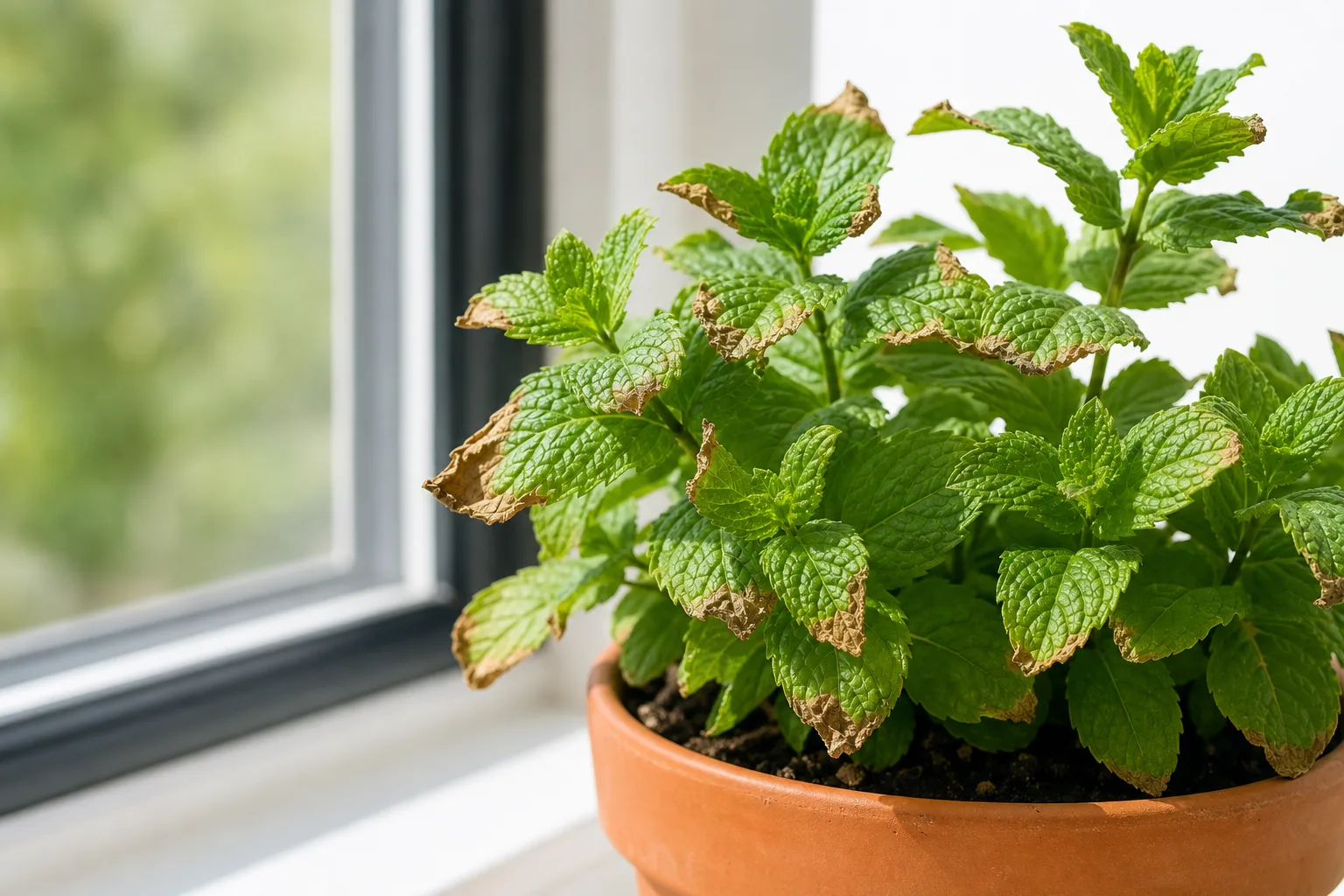
Dry indoor air crisps mint leaf margins first-especially spearmint and peppermint on a windowsill above a radiator or in AC blast. First step: move the pot out of direct vent or radiator drafts, then log humidity at leaf height for seven days while keeping compost evenly moist.
Low Humidity on Mint: Causes, Checks & Fixes
This guide covers low humidity on Mint. See also the general Low Humidity guide, watering, and light pages for this plant.
Low Humidity on Mint: Causes, Checks & Fixes
Quick answer
Your kitchen mint looked fine until winter heat kicked in. Now vent-facing leaf edges are crisp and papery, the pot dries faster between waterings, and the plant wilts slightly at midday even though you watered yesterday. On container Mentha-especially spearmint (Mentha spicata) and peppermint (Mentha × piperita)-that pattern usually means dry air is pulling moisture through tender leaf margins faster than roots replace it, often with a vent or radiator draft accelerating the loss.
First step: move the pot out of direct heater, radiator, or AC airflow before changing anything else.
| What you notice first | Likely branch | First move |
|---|---|---|
| Crisp margins worst on leaves nearest a vent | Low humidity / draft stress | Relocate pot; log RH at leaf height |
| Limp leaves, light dry pot, dusty top 2 cm | Underwatering | See underwatering on mint |
| Brown edges, heavy wet pot, soft stem base | Root stress / overwatering | See overwatering on mint |
| Fine stippling + webbing on undersides | Spider mites | See spider mites on mint |
| Even margin burn after recent feeding | Salt buildup | See overfertilization on mint |
Do not stack a humidifier, heavier watering, and fertilizer on day one-one airflow correction makes the next seven days of diagnosis readable.
What low humidity damage looks on mint
Dry-air stress on mint follows the leaf surface, not random spots.
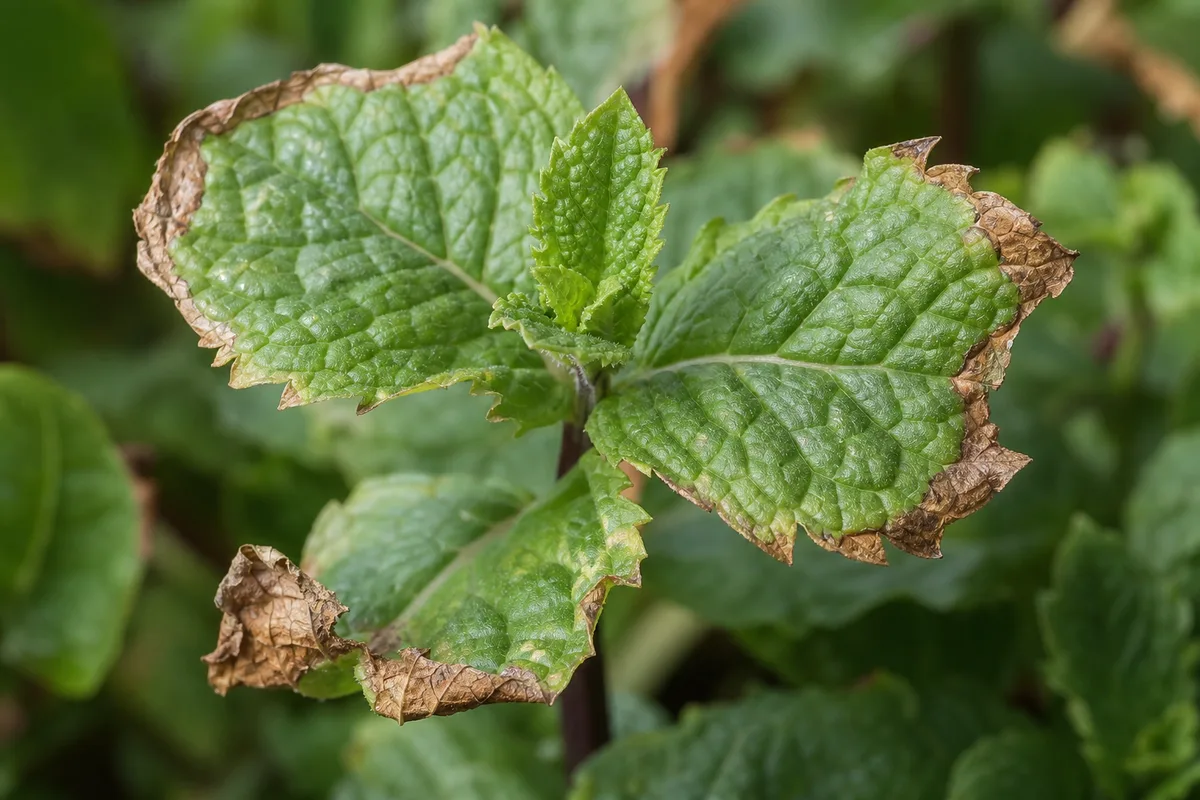
Low Humidity symptoms on Mint - compare with healthy tissue on the same plant.
Edge-first crisping: Tender margins and tips desiccate before the leaf center. Tissue feels papery and brittle, not soft and mushy like rot. Damage often clusters on shoots closest to a heat register, space heater, or winter window draft while inner leaves still look greener.
Midday wilt on moist soil: Mint transpires heavily through thin leaf tissue. When ambient humidity drops, the plant may droop at midday even though the top 2 cm of mix is still moist-unlike underwatering, where the whole pot is light and dusty dry.
Dull, thin foliage: Leaves lose their supple feel and look slightly matte before full margin burn appears. Aromatic oil production can dip in stressed plants, though scent alone is not diagnostic.
Mite overlap warning: Fine yellow-white stippling on upper leaf faces and silk on undersides often appears in the same dry, warm microclimate. Pure humidity damage does not produce webbing; stippling that spreads while you raise RH points to spider mites.
What low humidity does not look like: Sour root odor, mushy rhizomes at the soil line, or stem collapse on constantly wet mix-that is root stress or root rot, not dry air alone.
Peppermint vs. spearmint indoors
Both culinary mints show edge crisping in dry blast zones, but they do not react identically:
- Spearmint (M. spicata) - grows best in full sun to part shade and generally forgives brief dry spells when roots stay evenly moist. Edge burn on vent-facing leaves is the classic winter-kitchen pattern.
- Peppermint (M. × piperita) - slightly more aromatic and often grown in the same small pot; margins can crisp faster when the same vent line hits a dense leaf cluster. Recovery still follows airflow correction plus steady moisture-do not assume peppermint needs greenhouse humidity, only protection from direct dry drafts.
- Apple or pineapple mint - slower, softer leaves may show damage later but follow the same vent-proximity rule.
Mint’s running rhizomes and fast shoot turnover mean a small container loses canopy moisture quickly when forced air hits open stomata-unlike thick-leaved succulents that close up in dry rooms.
Documented winter windowsill pattern
A common indoor pattern: 15 cm spearmint on a south windowsill directly above a baseboard heater, RH at leaf height reading 28–32% during heat cycles, crisp margins on outer shoots only, firm roots, evenly moist (not soggy) mix. After moving the pot 60 cm sideways off the heat line and placing a pebble tray nearby, RH at the canopy rose to roughly 42–48% within three days. New shoot tips emerged with clean edges in about 10 days; older burned margins stayed brown.
That timeline is a field observation template-your room may recover faster or slower-but new growth, not old tissue, is the scorecard.
Why mint gets humidity stress indoors
Fast transpiration through tender margins
Low indoor humidity increases transpiration stress in houseplants: dry air steepens the vapor-pressure gradient at leaf surfaces, so water exits stomata faster than roots absorb it. Mint’s thin, high-surface-area leaves amplify that loss compared with waxy or succulent houseplants.
Small pots dry on two fronts at once
Container mint needs regular moisture and can swing from moist to dry quickly in heat. Dry air accelerates canopy water loss while the same heating season speeds soil dry-down-growers sometimes underwater and fight low humidity simultaneously. Check both watering rhythm and air placement.
Forced-air microclimates
Radiators, heat pumps, and AC returns create localized RH crashes that a room-center hygrometer misses. A pot 30 cm from a vent can sit in dry blast air while the living room reads 45% RH.
Dry air invites mite pressure
Warm, dry indoor conditions favor spider mites on houseplants. Stressed mint with open damage is easier to misread as “only humidity” while mites establish on undersides-treat both branches when signs overlap.
Over-correction trap
Raising humidity while overwatering to compensate for wilt stacks two stresses: soggy rhizomes plus damp foliage. Constantly wet soil encourages root rots in herbs-especially indoors in winter. Fix airflow first; keep even moisture, not saturation.
What to rule out first (lookalike matrix)
Work this table before buying equipment or repotting:
| Symptom combo on mint | Low humidity | Underwatering | Overwatering / root stress | Spider mites | Salt / overfeed |
|---|---|---|---|---|---|
| Leaf pattern | Crisp vent-facing margins | Wilt, dull whole leaf | Brown margins on wet mix | Stippling + bronzing | Tip burn after feeding |
| Pot feel | Normal cycling weight | Light, dusty top 2 cm | Heavy days after water | Usually normal weight | Normal |
| Stem / root | Firm rhizomes | Firm | Soft base, sour smell | Firm | Firm |
| RH / placement | Low at leaf height near vent | Any | Any | Often dry warm room | Any |
| Webbing | None | None | None | Fine silk on shoots | None |
| First move | Move off vents; log RH 7 days | Soak per watering guide | Dry-down; inspect roots | Rinse; mite workflow | Flush; pause feed |
| Read next | This page | Underwatering | Overwatering | Spider mites | Overfertilization |
If several columns match, address airflow and moisture first, then re-check pests at day seven.
How to confirm low humidity in 7 days
Use this measured protocol instead of guessing:
- Relocate off drafts - Move the pot so no leaf canopy sits in direct heater, radiator, or AC airflow. This is both first fix and test condition.
- Log RH at leaf height - Place a hygrometer beside the worst-affected shoots (not across the room) for seven days. Note readings during active heat or AC cycles. Sustained below ~35% at the canopy with vent-proximate crisping supports dry-air stress; mid-40s with damage only on vent-facing leaves still implicates microclimate drafts.
- Track symptom timing - Record whether edge burn worsens when heat cycles on. That daily pattern is more diagnostic than a single snapshot reading.
- Check moisture rhythm - Confirm the top 2 cm cycles dry then moist without staying soggy. Mint prefers consistently moist but draining media.
- Inspect undersides - Hand lens or white-paper tap test for stippling and webbing per UMN indoor pest guidance.
- Smell and pinch rhizomes - Firm, white roots with no sour odor rule out wet-root decline.
- Reassess new growth on day 7–10 - If edge burn on new shoots slows and tips stay supple, low humidity was likely a primary driver.
Decision after seven days:
| Outcome | Next step |
|---|---|
| New tips clean; RH stable; no webbing | Continue prevention below-humidity was likely primary |
| Crisping spreads to inner shoots; RH already 45%+ | Suspect mites, salt, or root issue-use matrix above |
| Webbing or stippling advancing | Open spider mites workflow |
| Soft stems on wet mix | Open overwatering before adding humidity |
First fix (do this before anything else)
Move the pot out of direct vent, radiator, or AC airflow.
That single change lowers excess transpiration at the worst-affected leaves and separates dry-air stress from watering mistakes. Only after relocation:
- Stabilize moisture - Keep compost evenly moist, not swinging between bone-dry and saturated RHS mint guidance.
- Rinse foliage weekly - Morning rinse reduces dust and early mites in dry periods UMN spider mite management.
- Raise local RH if needed - Pebble tray, grouping with other pots, or a room humidifier when canopy RH stays low after the move Iowa State environmental diagnosis.
- Trim dead margins later - Remove fully crisp tissue only after new healthy leaves appear.
Mild, moderate, and severe branches
Mild - Crisp tips on vent-facing shoots only, firm roots, no webbing: relocate, log RH seven days, maintain watering rhythm; expect cleaner new tips in 7–14 days.
Moderate - Widespread margin burn in a heated room, canopy RH under ~35%: relocate, pebble tray or humidifier, weekly rinse; reassess at day 10.
Severe - Crisping plus advancing stippling/webbing or soft stems on wet soil: treat the pest or root branch first-humidity alone will not fix an active mite bloom or rotting rhizomes.
Recovery workflow with timing checkpoints
| Day | What to check | Good sign | Bad sign → branch |
|---|---|---|---|
| 0 | Pot moved off vents | Leaves out of direct blast | Still in draft-move farther |
| 1–3 | RH trend at canopy | RH rises or damage stable | RH under 30%-add tray or humidifier |
| 4–7 | New shoot tips | Supple new leaves forming | Stippling spreads → mites |
| 7–10 | Edge progression | Burn stops on newest growth | Crisping on inner shoots → re-run matrix |
| 14 | Overall vigor | Bushy new growth, stable moisture | Decline on wet soil → overwatering |
| 21 | Full reassessment | Consistent clean tips | Still declining → expert help below |
Existing brown edges stay brown-recovery is judged by new tissue, not re-greening old margins.
What not to do
- Do not overwater to fight wilt - Wilt on moist soil in dry air is transpiration stress, not thirst. Soggy mix invites root rot.
- Do not rely on heavy evening misting - Persistent leaf wetness in cool air raises powdery mildew risk.
- Do not ignore webbing - Mites thrive in warm, dry conditions and can overrun stressed mint within days.
- Do not repot on day one - Unless roots are mushy or soil is hydrophobic from salt, fix environment first.
When humidity is not the main problem
Escalate past this guide when:
- Decline continues two full weeks after corrected airflow, stable moisture, and reasonable canopy RH (roughly 40%+).
- Webbing covers multiple shoots - primary issue is mites, not humidity.
- Stem softening or sour root odor on wet mix - see overwatering and root rot.
- Uniform tip burn after heavy feeding - suspect salt; see overfertilization.
- Damage only on oldest lowers with dark green new tips - may be normal harvest turnover; see brown tips for broader edge-burn differentials.
Persistent symptoms after corrective care may involve pH, crowding, or combined stressors beyond a single humidity fix-contact your local cooperative extension office with photos of leaves, roots, pot setup, and your seven-day RH log.
Prevention plan for heating and AC seasons
- Keep mint off direct vent lines year-round; summer AC blasts mimic winter heater damage.
- Monitor RH at leaf height during the first month of heating-not just room center readings.
- Maintain even watering tied to top-2-cm dry-down, not calendar autopilot.
- Rinse and inspect undersides weekly when indoor air is dry UMN houseplant pests.
- Group pots for modest microclimate lift; use a humidifier when canopy RH chronically sits below comfortable range.
- Divide crowded rhizomes yearly so inner stems do not trap stale, dry air against the window glass.
When to use this page vs. sibling guides
| Your main question | Start here | Or use sibling page |
|---|---|---|
| ”Edges crisp near heater/AC-is it dry air?” | This page - vent fork, 7-day RH log, lookalike matrix | |
| ”Pot light, dusty, wilts hard” | Rule out dry air here, then | Underwatering |
| ”Wet heavy pot, soft stems, gnats” | Overwatering | |
| ”Stippling and webbing on undersides” | Spider mites | |
| ”Brown tips but not sure which cause” | Brown tips |
This URL is the low-humidity and dry-draft differential hub for container mint. Sibling pages go deeper on one cause; start here when margins crisp in heated or air-conditioned rooms.
Related tool
Use the Humidity Calculator to narrow causes for low humidity on this plant before changing multiple variables at once.