Why Mogra Seeds Are Not Germinating: Causes & Checks
Quick answer
If Mogra seeds are not germinating, first inspect one seed from the edge of the tray without disturbing the rest. A soft, collapsing seed points toward decay; an intact seed does not prove viability, so check the botanical name, lot date, and sowing directions before changing temperature or moisture. There is no dependable universal germination timetable for every jasmine species.
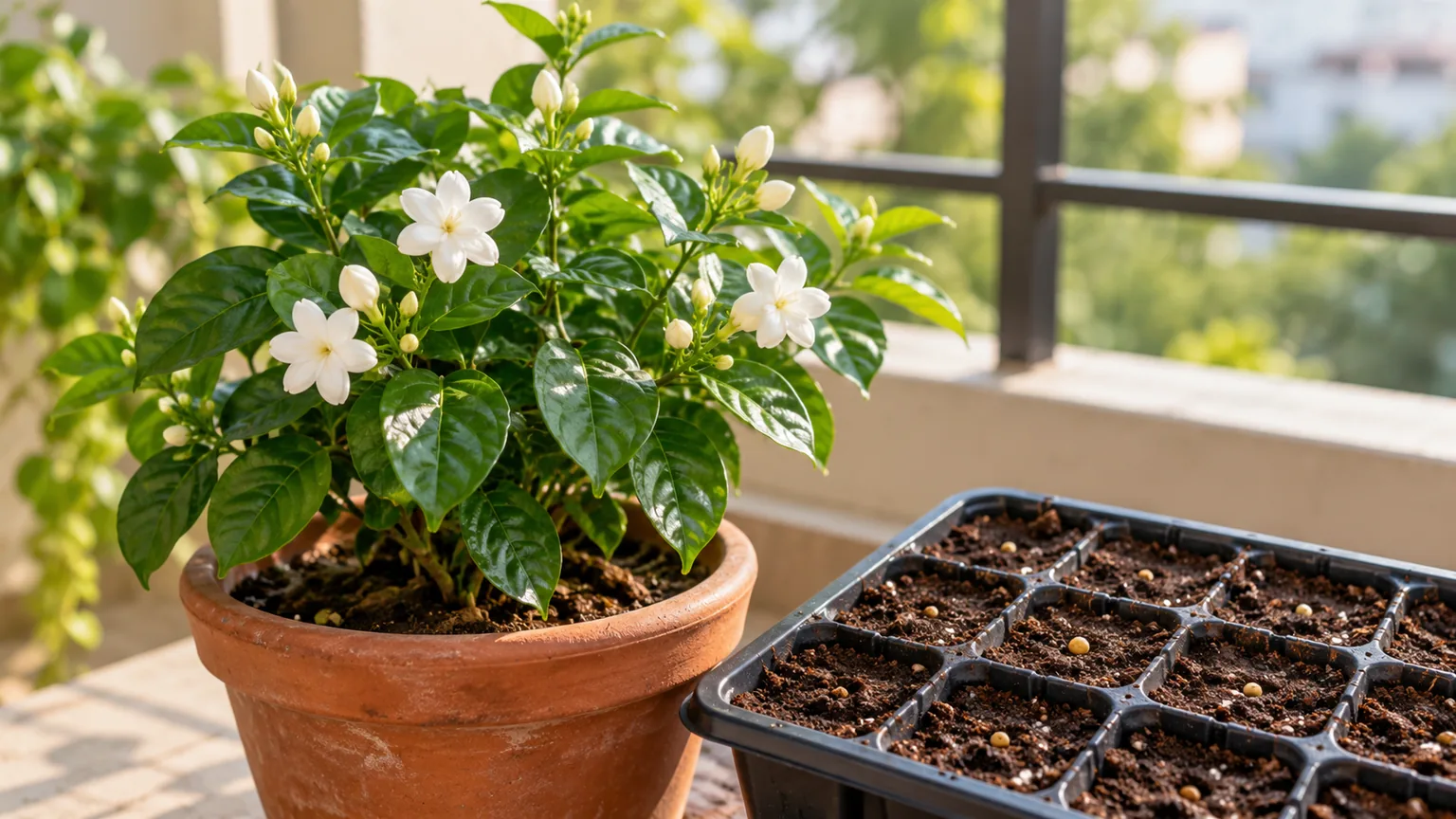
Seeds Not Germinating on Mogra: Causes, Checks & Fixes
This guide covers seeds not germinating on Mogra. See also the general Seeds Not Germinating guide, watering, and light pages for this plant.
Seeds Not Germinating on Mogra: Causes, Checks & Fixes
Search Intent
The reader has sown seeds sold as Mogra or Arabian jasmine and wants to know whether they are too old, incorrectly identified, rotting, or simply taking longer than expected. They need a safe way to inspect the batch, reset the seed tray, and decide whether to keep waiting or propagate a known Mogra by cuttings.
SEO Title Planning
- Curiosity-driven: Why Mogra Seeds Stay Buried: Checks Before You Start Over
- Straightforward: Seeds Not Germinating on Mogra: Causes, Checks & Fixes
- Benefit-driven: How to Troubleshoot Mogra Seeds That Will Not Sprout Best: Seeds Not Germinating on Mogra: Causes, Checks & Fixes — it states the exact issue and promises practical diagnosis without promising a germination result.
Meta Description Planning
- Mogra seeds not sprouting? Check seed identity, freshness, moisture, temperature, and decay before changing the whole tray or starting over.
- Troubleshoot Mogra seeds that will not germinate with a careful sample check, species-aware sowing advice, and realistic next steps.
- Learn why Jasminum sambac seeds may fail to sprout, what to inspect first, and when a cutting is a more reliable option. Best: Troubleshoot Mogra seeds that will not germinate with a careful sample check, species-aware sowing advice, and realistic next steps.
Primary and Supporting Keywords
- Primary: Mogra seeds not germinating
- Supporting: Mogra seeds not sprouting; Jasminum sambac seeds; Arabian jasmine seed germination; Mogra seed viability; jasmine seed rot; Mogra propagation; grow Mogra from seed; Mogra cutting propagation; jasmine seed sowing conditions; Mogra seedlings
NLP Entities
Mogra; Arabian jasmine; Jasminum sambac; jasmine; seed lot; seed viability; mature seed; seed tray; seed-starting mix; damping-off; moisture; drainage; seed depth; germination window; stem cutting; cultivar.
People Also Ask Questions
- Why are my Mogra seeds not sprouting?
- How can I tell if jasmine seeds are still viable?
- Do Mogra seeds need soaking or scarification?
- How long do Arabian jasmine seeds take to germinate?
- Can Mogra grow from seed?
- Is it better to propagate Mogra from a cutting?
- Can overwatering stop jasmine seeds from germinating?
- What should I do with a seed that has turned soft in the tray?
E-E-A-T Signals
The guide distinguishes the species Jasminum sambac from other plants sold as jasmine, separates a failed seed from a collapsed seedling, asks readers to inspect one sample before disturbing a batch, and avoids inventing a Mogra-specific germination temperature or deadline. It uses a botanical garden source for Mogra propagation, a university extension source for damping-off, and editorial seed guidance with species-level caveats.
Featured Snippet Opportunities
- Paragraph: first check when Mogra seeds do not sprout
- List: signs to inspect in one seed sample
- Table: intact, dry, or decayed seed and the next check
- Definition: how pre-emergence damping-off differs from slow germination
Helpful Content Checklist
This page adds Mogra-specific identity and propagation context to general seed-tray troubleshooting. It helps a reader separate uncertain seed quality from sowing conditions, avoid unverified seed treatments, and choose a practical fallback without assuming that every product labeled jasmine is Jasminum sambac.
- Why Mogra Seeds Stay Buried: Checks Before You Start Over
- Seeds Not Germinating on Mogra: Causes, Checks & Fixes
- How to Troubleshoot Mogra Seeds That Will Not Sprout
Seeds Not Germinating on Mogra: Causes, Checks & Fixes
- Mogra seeds not sprouting? Check seed identity, freshness, moisture, temperature, and decay before changing the whole tray or starting over.
- Troubleshoot Mogra seeds that will not germinate with a careful sample check, species-aware sowing advice, and realistic next steps.
- Learn why Jasminum sambac seeds may fail to sprout, what to inspect first, and when a cutting is a more reliable option.
Troubleshoot Mogra seeds that will not germinate with a careful sample check, species-aware sowing advice, and realistic next steps.
- H1: Seeds Not Germinating on Mogra: Causes, Checks & Fixes
- H2: Quick answer
- H2: What a Mogra seed tray can and cannot tell you
- H2: Why Mogra seeds may fail before a sprout appears
- H3: The packet may not contain Jasminum sambac
- H3: The seed may be immature, old, or damaged
- H3: Moisture, depth, or temperature may not match the seed lot
- H3: Pre-emergence rot can look like slow germination
- H2: Inspect one Mogra seed before changing the tray
- H2: Reset the sowing conditions without guessing
- H2: Keep Mogra parent-plant care separate from seed care
- H2: When Mogra cuttings are the more reliable route
- H2: How to prevent another failed Mogra seed batch
- H2: When to use this guide vs other Mogra guides
- H2: Related tool
- H2: Related Mogra guides
Seeds Not Germinating on Mogra: Causes, Checks & Fixes
Quick answer
Related: seeds-not-germinating guides If Mogra seeds have not sprouted, first inspect one seed from the edge of the tray; do not dig through the whole batch. A seed that has softened or started to decay may have rotted before emergence, while a seed that still looks intact may have been sown under unsuitable conditions or may not be viable. Appearance is a clue, not a germination test.
Before changing the setup, verify that the packet names Jasminum sambac, the botanical name for Mogra, and look for a lot or packing date plus species-specific sowing instructions. The Mogra overview uses the same botanical identity, which matters because “jasmine” is used for several different Jasminum species. Do not assume that one seed-depth, chilling, soaking, or temperature rule applies to all of them.
What a Mogra seed tray can and cannot tell you
No seedlings above the mix does not tell you whether the seed was dead, planted too deeply, too wet, too dry, or simply slower than expected. It also does not identify the plant in the packet. The name “Mogra” points to Jasminum sambac, but a common-name label without a botanical name leaves the identity uncertain.
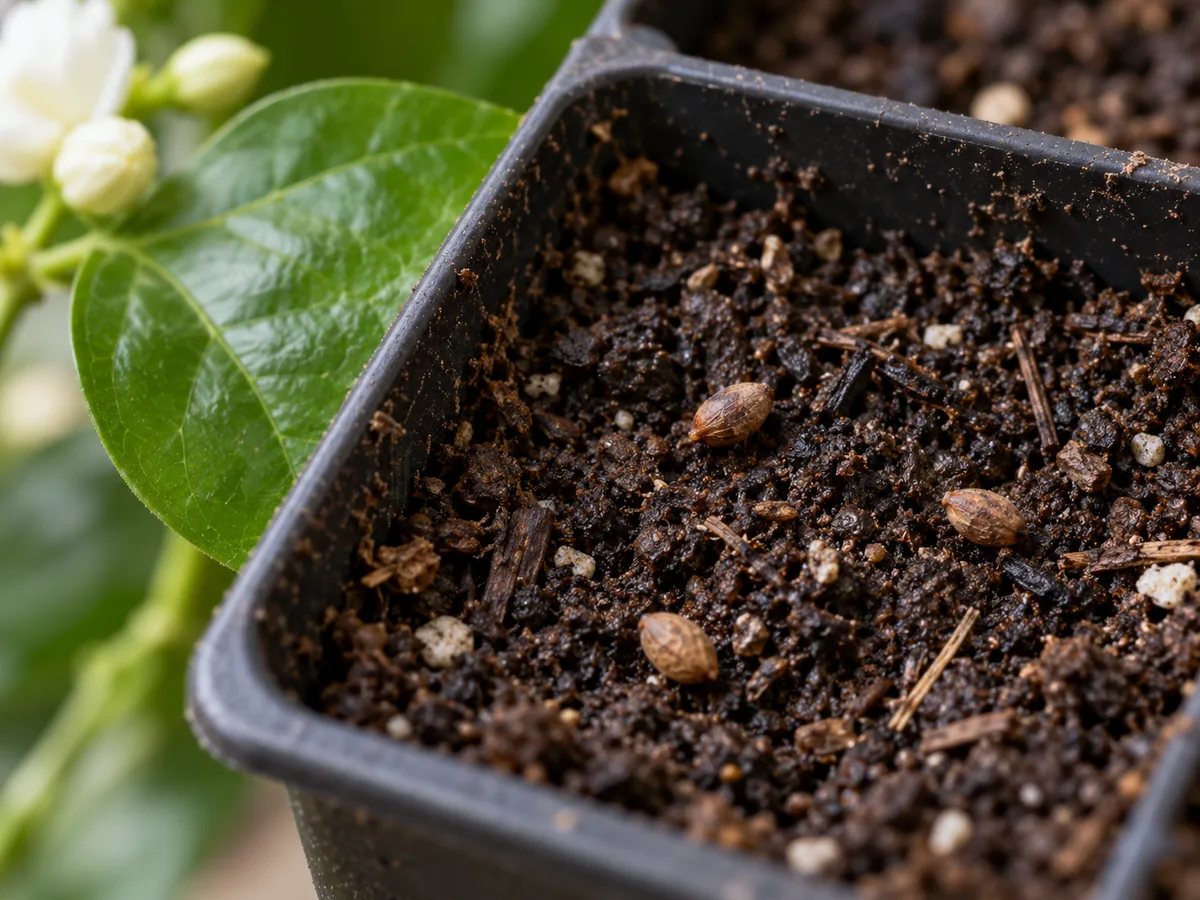
A quiet tray is not a viability test. Inspect one seed at the edge before changing conditions across the batch.
Look closely at the surface without scraping it. Note whether the mix has pulled away and dried, is glossy or persistently wet, has a sour smell, or has a white fuzzy patch. Those observations help you choose what to inspect next; they cannot prove a seed is viable. If anything has emerged and then collapsed at the soil line, that is a different pattern from a seed that never appears.
Why Mogra seeds may fail before a sprout appears
The packet may not contain Jasminum sambac
A packet labeled only “jasmine” may refer to a different species, and the species name changes the advice that applies. The Royal Horticultural Society’s jasmine guide describes several jasmine species with different growth habits and growing needs, so a general jasmine article cannot confirm that a seed tray is following Mogra instructions. Check for Jasminum sambac on the packet or ask the seller for the scientific name and the seed lot details.
This distinction matters especially when seeds come from a marketplace listing. A large count, “heirloom” wording, or a photograph of white flowers does not establish botanical identity or viability. Keep a screenshot or label from the source and ask whether the seed was harvested from a named Mogra plant, when it was packed, and which sowing directions were tested for that species. If the seller cannot answer, treat the lot as uncertain rather than compensating with extra heat, soaking, or fertilizer.
The Missouri Botanical Garden identifies Jasminum sambac as Arabian jasmine and lists summer stem cuttings as a propagation method in its Mogra plant profile. That does not mean seed-grown Mogra is impossible; it means a packet of purported Mogra seed deserves a closer identity and freshness check before you blame your technique. If your goal is simply to grow another plant, consider the established cutting route.
The seed may be immature, old, or damaged
For jasmine generally, Gardening Know How advises starting with fresh seed that has matured fully; this is useful genus-level guidance, not a measured viability claim for a particular Mogra lot. A seed can look intact after sowing and still be too immature or past its useful life. If the packet gives no harvest or packing date, you cannot infer freshness from the number of seeds printed on the front.
If you collected seed yourself, confirm that it came from an actual mature seed structure on the parent plant rather than from a spent flower or dried bud. Do not collect only the newest fallen material and assume it is ripe. If you bought the seed, record the supplier, packet date, storage conditions described on the label, and any germination guarantee. These details are more actionable than guessing at a hidden dormancy period.
Do not apply soaking or seed-coat scratching automatically to Jasminum sambac. Use either treatment only when directions for the exact botanical species and seed lot call for it; otherwise, test the untreated batch first. The RHS germination guide shows why copying a universal schedule is risky: its seed instructions vary by species, including sowing depth, light, pretreatment, and the time allowed for emergence.
Moisture, depth, or temperature may not match the seed lot
Seed trays need moisture, but constant saturation is not the same as even moisture. Excess moisture favors damping-off, and the seed itself can decay before emergence. If the tray is waterlogged, has no drainage, or sits in a saucer of standing water, stop adding water and correct the drainage before resowing.
A very dry surface can also leave a seed without the moisture needed to begin growth. Check the medium at seed depth rather than judging only the top. The Mogra watering guide describes how to assess moisture for the established plant, but use the seed packet’s moisture directions rather than the adult plant’s watering interval. Use a small tray with drainage so excess water can leave the sowing cells.
Depth and warmth should come from directions for the species, not from a generic “jasmine” timetable. Some seeds are sown on the surface while others are covered; RHS instructions show both approaches across different species. If the packet lists a temperature range, measure near the tray and keep it steady within that range; do not invent a higher target to force germination.
Pre-emergence rot can look like slow germination
Damping-off is a fungal or water-mold problem that can destroy a seed before it reaches the surface or collapse a seedling near the soil line. Penn State Extension describes both damping-off stages: pre-emergence seed decay and post-emergence stem rot. A soft, discolored seed, a seedling that falls over at the mix line, or a localized patch of decay is more concerning than a firm seed with an unchanged surface.
Do not respond by pouring fungicide into the tray. The cause is not confirmed by a lack of sprouts alone, and treatment advice depends on identifying the problem and the label. Remove a visibly rotten sample, wash hands and tools, and use a clean container with fresh seed-starting mix for the next small test. Penn State includes clean growing media, sanitized containers, and avoiding saturated conditions in its damping-off control advice.
Inspect one Mogra seed before changing the tray
Choose a seed near the edge so you can lift it without disturbing any neighboring seed that may be rooting. Use a clean spoon or label to loosen a little mix. Note the seed’s condition and smell, then stop; opening every pocket in the tray can damage a seed that is still developing.
| What the sample looks like | What it suggests | Next check |
|---|---|---|
| Soft, mushy, discolored, or foul-smelling | Decay is likely; the seed may have rotted before emergence | Check drainage and how wet the mix has stayed |
| Shriveled and very dry | The seed may have dried out, but appearance alone cannot confirm it is dead | Compare the moisture at seed depth with the packet directions |
| Firm and intact | The seed may still be viable, but this does not prove it | Review identity, age, depth, and the seller’s germination window |
| Split with a pale tip or root | Germination may have begun below the surface | Re-cover gently if the directions call for it and keep conditions stable |
| Seedling emerged, then pinched or collapsed at soil level | Suspect post-emergence damping-off rather than delayed germination | Isolate that cell and review moisture, drainage, and sanitation |
This check is deliberately small. Do not discard an entire packet because one seed sinks, floats, or looks different from its neighbors; those observations are not a germination test. If the sample is intact, sow a small labeled subset separately under the packet directions. That gives you a controlled comparison and preserves most of the batch while you troubleshoot.
Reset the sowing conditions without guessing
After the sample check, change only a condition that the evidence points to. If the mix is saturated, drain it and let the tray return to the packet’s recommended moisture level. If it is dry at seed depth, re-moisten gently rather than flooding the cells. If the seed was buried more deeply than the instructions specify, use fresh cells for a small comparison instead of excavating every seed.
Use fresh, clean seed-starting medium and a container with open drainage for a new test. Label each sowing with the botanical name, supplier or collection date, date sown, and the exact treatment used. If you want to compare two conditions, make separate small groups and change only one factor; otherwise, you will not know which correction mattered. Keep a photo and a simple daily note of moisture, tray location, and any emergence.
Do not add fertilizer to unsprouted seeds. Fertilizer will not correct a wrong species, an immature seed, or a poor seed lot. Keep a covered tray in a bright, stable location that stays within the packet’s temperature range. If you use a humidity cover, vent it according to the seed-starting directions and remove it as seedlings emerge.
Avoid cold stratification, hot-water treatment, or seed-coat nicking unless instructions for Jasminum sambac specifically call for that treatment. Generic jasmine instructions may combine several species, and the RHS germination guide makes clear that pretreatment is not universal. When a seller has provided no species-specific guidance, ask before applying a treatment to the full packet; an untreated control is safer and more informative.
Keep Mogra parent-plant care separate from seed care
A mature Mogra’s watering rhythm is not a germination recipe. Adult Jasminum sambac grows as a shrub or twining plant and is described by the Missouri Botanical Garden as preferring evenly moist, well-drained soil in its plant profile; those notes apply to established plants. Treat seed-tray moisture as a separate condition from adult Mogra pot care. Use the Mogra soil guide for the adult plant’s potting mix, then select a seed-starting medium and watering method suited to seeds.
Likewise, do not move the parent Mogra into stronger sun, change its fertilizer, or repot it because a seed tray has not sprouted. Those actions do not establish whether the seed lot is viable. If the parent is also declining, diagnose that separately through the Mogra problem hub. If it is healthy, leave its care steady while you test a small seed sample.
After emergence, shift attention from the seed to the seedling. Give the new plant bright light gradually and protect it from a sudden jump into hot, direct afternoon sun. Keep the young root zone evenly moist but not stagnant, and avoid crowded cells where stems and leaves stay pressed together. If a seedling emerges but becomes long, thin, and weak, use the separate Mogra leggy-seedlings guide to assess light and spacing; that is no longer a germination failure.
When Mogra cuttings are the more reliable route
If your goal is a Mogra plant and not the experience of raising one from seed, choose a healthy stem cutting from an identified parent instead of depending on a packet with unknown identity. Follow the Mogra propagation guide for a species-specific overview and take material only from a healthy parent.
A cutting is also the better choice when you want to preserve a named form or flower characteristics. General jasmine propagation guidance notes that some hybrids may not come true from seed, so a seed is not a guaranteed copy of the Mogra you bought. That is a general limitation of seed propagation, not proof that a specific Mogra cultivar is sterile. The jasmine overview notes that seed reliability varies across varieties and presents cuttings as an easier fallback; use that as genus-level context, not a Mogra germination rate. For a seed experiment, accept uncertainty; for a repeatable plant, use vegetative propagation.
How to prevent another failed Mogra seed batch
Before ordering, ask for the full botanical name, the harvest or packing date, the germination window, and any treatment instructions. Keep the seller’s response with the packet. If the only description is “jasmine,” or the photo and species name do not match, do not buy a large quantity expecting it to behave like verified Mogra seed.
When collecting from your own plant, keep the source plant labeled and wait for seed to mature fully before sowing. Do not assume every faded Mogra flower has produced viable seed. If no mature seed is available, use cuttings from a healthy plant rather than attempting to turn dried petals or buds into a seed source. A fresh, correctly identified lot is a better starting point than trying multiple unverified treatments on uncertain material.
For the next sowing, keep a control group untreated and record one variable at a time. Use the packet’s sowing depth, temperature, and moisture instructions; keep the container clean and draining; and compare emergence with the stated germination window. A second small test can help separate poor technique from a poor lot, but it cannot guarantee every seed will sprout.
When to use this page vs other Mogra guides
Use this page when seeds labeled Mogra or Jasminum sambac have not produced visible seedlings. For the general causes of stalled or rotten seed, see the seeds not germinating hub; this guide narrows those checks to a Mogra seed source and its usual cutting-based propagation. If you have a healthy seedling that has emerged but is stretching, use the leggy-seedlings guide. If the adult plant itself has yellowing, wilting, or poor growth, diagnose that symptom separately rather than changing the seed tray and parent plant at once.
Related tool
Use the Plant Problem Diagnosis Tool if the parent Mogra also shows yellowing, wilting, or decline. It can help narrow adult-plant care causes, but it cannot test whether a seed lot is viable.
Related Mogra guides
- Mogra overview: identify the plant and review its general care.
- Mogra propagation: use when you want a reliable new plant from a cutting.
- Mogra soil: review the established plant’s mix and drainage if the parent is also struggling.
- Mogra watering: use for moisture questions about an adult Mogra, not a seed tray.
- Mogra light: use when the parent plant or emerged seedling has a light problem.
FAQ 1 Question: How do I know whether my Mogra seeds are still viable? Answer: A firm-looking seed is only a reason to keep testing; appearance alone cannot confirm viability. Sow a small labeled sample under the packet directions and compare it with the stated germination window.
FAQ 2 Question: What should I check first when Mogra seeds do not sprout? Answer: Inspect one seed at the edge of the tray, then verify that the packet identifies Jasminum sambac and gives a lot or packing date. Do not soak, chill, or nick the full batch before checking species-specific instructions.
FAQ 3 Question: How long do Mogra seeds take to germinate? Answer: Use the time range printed for the exact seed lot, because jasmine species do not all share one sowing schedule. If the seller gives no species-specific window, ask for one rather than treating a generic jasmine timetable as a Mogra guarantee.
FAQ 4 Question: Should I discard Mogra seeds if they have not sprouted? Answer: Do not discard the entire batch just because the surface looks unchanged. If a sample is mushy or rotten, remove that seed; if it remains intact, test a small portion separately before deciding the lot has failed.
FAQ 5 Question: Is it easier to grow Mogra from cuttings than seeds? Answer: For a dependable plant with the same cultivar traits, a healthy stem cutting is usually the more practical route. The Missouri Botanical Garden lists summer cuttings for Jasminum sambac propagation, while seed results depend on receiving correctly identified, mature, viable seed.