Aphids on Monstera Adansonii: Causes, Checks & Fixes
Quick answer
Aphids on Monstera Adansonii cluster on soft unfurling leaves at vine tips, moss-pole crowns, and tight nodes along thin trailing stems. First step: isolate the pot, inspect the newest perforated growth with bright light, and rinse or spray aphids off before honeydew attracts ants or sooty mold.
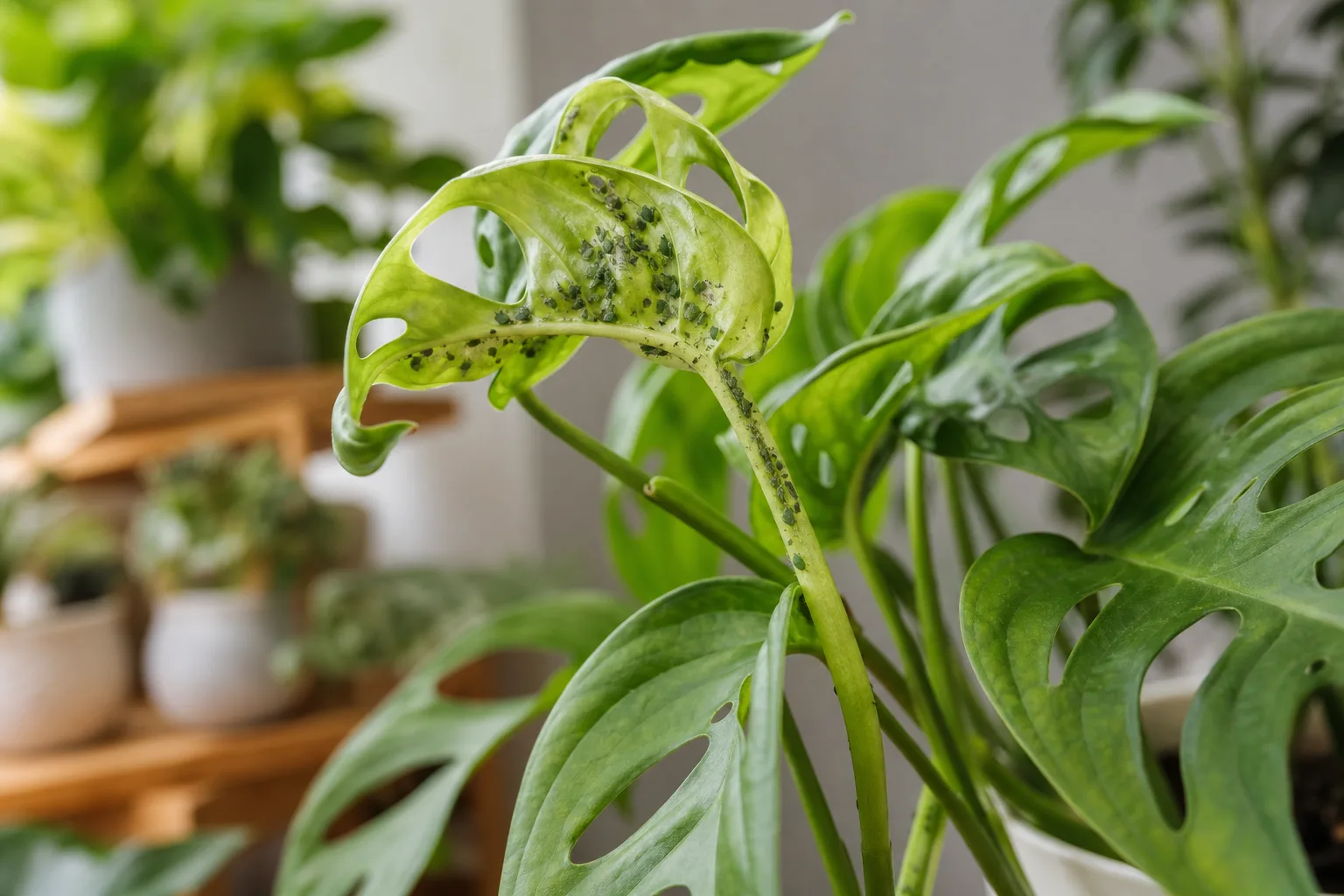
Aphids on Monstera Adansonii: Causes, Checks & Fixes
This guide covers aphids on Monstera Adansonii. See also the general Aphids guide, watering, and light pages for this plant.
Aphids on Monstera Adansonii: Causes, Checks & Fixes
Quick answer
Aphids on Monstera Adansonii (Monstera adansonii, Swiss cheese vine) are small soft-bodied sap feeders that cluster on the tender new growth this rapid vining aroid pushes from trailing stem tips, moss-pole crowns, and tight nodes along thin petioles. First step: isolate the pot away from other philodendrons, pothos, and monsteras, then inspect the newest unfurling fenestrated leaves with bright light before rinsing or spraying the colony.
Adansonii’s thin perforated leaves mark and curl faster than thick Monstera deliciosa foliage, so aphid feeding shows up quickly as sticky honeydew on glossy green tissue, distorted unfurling tips, or ant trails climbing toward fresh vine growth. Catching colonies on one soft leaf before honeydew spreads down a long trailing stem-or before ants protect aphids from natural predators-is far easier than rescuing a weakened Swiss cheese vine coated in sooty mold.
What aphids look like on Monstera Adansonii
Aphids are pear-shaped, soft-bodied insects with long legs and a pair of tubelike cornicles on the hind end. On houseplants they appear green, black, brown, or white. Most owners first notice them as slow-moving clusters rather than individual specks.
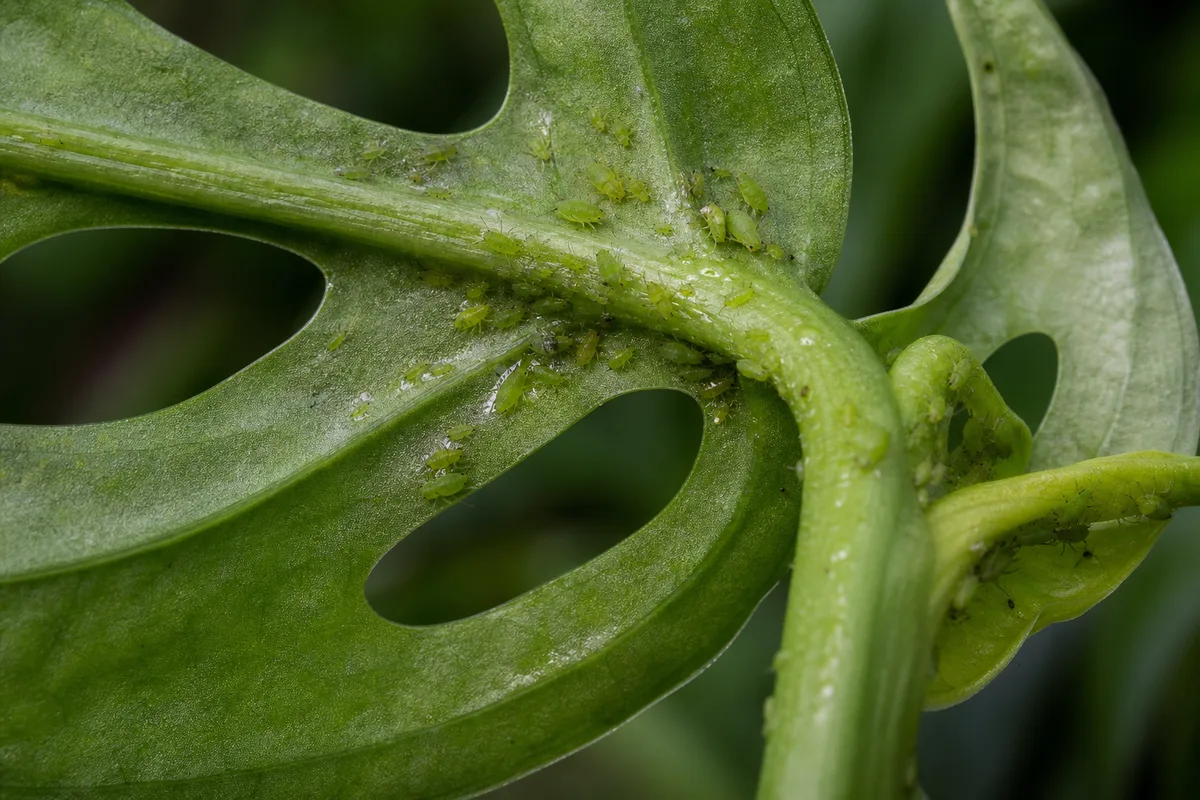
Aphids symptoms on Monstera Adansonii - compare with healthy tissue on the same plant.
Typical signs on Swiss cheese vine:
- Clusters on unfurling fenestrated leaves, juvenile unfenestrated tips, and soft nodes where petioles meet thin vining stems
- Pear-shaped insects tucked inside curled new leaves or along moss-pole attachment points
- Sticky, shiny honeydew on perforated foliage, pot rims, shelves, or floors below hanging baskets
- Curled or puckered young leaves when feeding is heavy on thin adansonii tissue
- Black sooty mold growing on untreated honeydew, dulling leaf holes and green color
- Ant activity on pot rims, moss poles, or trellis legs traveling toward vine tips
- Slowed new leaf production or stalled hole development on the current growth flush
Unlike spider mites-which leave fine stippling and webbing in dry heated air-aphids are visible without magnification on moderate infestations. Unlike mealybugs, aphids lack white cottony wax in leaf axils. Unlike scale, they have no hard immobile shell attached to stems.
Why Monstera Adansonii gets aphids
Soft vine-tip growth is the main attractant. Indoor Adansonii extends its longest trailing or climbing stems during warm months, producing the soft unfurling leaves aphids prefer and reproduce on quickly. NC State Extension lists aphids among pests to monitor on Monstera adansonii alongside mealybugs, spider mites, and scale.
Common entry routes on Adansonii:
- New nursery plants without quarantine - Aphids hide on the backs of newest leaves and at nodes where aerial roots attach to moss poles.
- Outdoor summer placement - Winged aphids disperse from garden plants through open windows and land on indoor vine tips.
- Nearby infested collections - Aphids spread between monsteras, pothos, and philodendrons sharing a shelf.
- Ant-protected colonies - Once ants harvest honeydew, they shield aphids from lady beetles and lacewings that would otherwise control populations indoors.
- Nitrogen-rich soft shoots - Heavy feeding pushes tender vine-tip growth aphids colonize faster than hardened fenestrated leaves lower on the stem.
Long vining stems hide colonies. Overlapping heart-shaped leaves and aerial roots along a trailing or climbing vine give aphids sheltered feeding sites that can build honeydew for a week before sticky shine on perforated foliage or ants on the plant gives them away. Moss-pole crowns and hanging-basket centers are easy to miss during casual watering checks because outer leaves mask the softest tissue inside.
Lookalike symptoms to rule out
| What you see | Likely cause | Key difference on Adansonii |
|---|---|---|
| Pear-shaped clusters on soft vine tips + sticky honeydew | Aphids | Insects move when disturbed; cornicles visible with a hand lens |
| White cottony wax in leaf axils along thin petioles | Mealybugs | Does not smear green; wax resists water rinse |
| Immobile brown or tan bumps on stems | Scale | Shell does not move when touched; no pear shape |
| Fine stippling + webbing on hardened leaves in dry air | Spider mites | No honeydew; damage on older fenestrated foliage, not just new tips |
| Silvery scars + black specks inside tight new leaves | Thrips | Insects jump or run quickly; no sticky residue |
| Sticky shine without visible insects | Honeydew from prior pest or sticky leaves | Wipe leaf-if stickiness returns within days, active sap feeders remain |
| Yellow lower leaves, firm stems, no insects | Overwatering or watering stress | Check top 3–5 cm of mix dryness before treating pests |
How to confirm the cause
Work through this checklist before spraying anything:
- Isolate first - Move Adansonii away from other houseplants until you finish inspection and initial treatment.
- Vine-tip scan - Inspect the highest unfurling leaves on trailing stems, moss-pole crowns, and juvenile unfenestrated tips where tissue is softest.
- Node and petiole check - Lift overlapping leaves and examine where petioles meet stems and where aerial roots attach.
- Movement test - Disturb a cluster with a cotton swab. Aphids move slowly; scale does not move at all.
- Crush test - Press one insect between fingers (wear gloves). Aphids smear green or black. Mealybugs leave waxy pink or orange residue.
- Honeydew check - Wipe a glossy perforated leaf with a damp cloth. Sticky residue that returns within a day confirms active sap feeders.
- Ant trail follow - Trace ants from pot rim or shelf upward to where they stop on the vine-that endpoint is your primary inspection zone.
- Neighbor scan - Check other plants on the same shelf or windowsill for shared aphid colonies.
- Recent history - Note new purchases, outdoor summering, propagation cuttings, or fertilizer spikes in the past month.
If you find pear-shaped insects with cornicles plus honeydew on Adansonii new growth, aphids are confirmed. Yellowing across many lower leaves with soggy mix and no insects points to overwatering-not aphids.
First fix for Monstera Adansonii
Isolate the pot and rinse or spray aphids off the newest vine growth before stacking additional treatments.
For light colonies on a few unfurling leaves, take Adansonii to a sink or shower and knock aphids off with a firm water stream-wrap the soil surface in plastic so mix stays contained, tilt the pot to drain freely, and direct water along leaf undersides, nodes, and petiole joints. Adansonii tolerates rinsing but hates chronically wet roots; do not let the mix stay saturated after showering.
For moderate colonies or aphids tucked inside curled new leaves, follow the rinse with insecticidal soap or horticultural oil labeled for ornamentals after a 48-hour test on one perforated leaf. Cover all infested tissue thoroughly-soap must contact the insect directly because it has no residual effect.
Wear gloves when handling infested foliage-Monstera Adansonii is toxic to cats and dogs and contains calcium oxalate crystals that irritate skin. Do not repot, prune heavily, or fertilize on the same day you start pest treatment.
Step-by-step recovery
Light infestation (a few clusters on one or two vine tips)
- Isolate away from other aroids and monsteras.
- Rinse aphids off with firm water in a sink or shower; let foliage dry in bright filtered light-not direct sun.
- Inspect again in three days. Spot-treat any survivors with insecticidal soap on the test leaf first, then full coverage if no burn appears.
Moderate infestation (multiple nodes, honeydew on perforated leaves)
- Isolate and rinse as above.
- After a 48-hour test leaf shows no burn, apply insecticidal soap or horticultural oil to all infested tissue including leaf undersides, petiole bases, and moss-pole crowns.
- Repeat every five to seven days for two to three full cycles-aphids reproduce quickly and eggs hatch between passes.
- Wipe honeydew from fenestrated leaves with a damp cloth once pests are controlled.
- If ants are present, treat aphids first; see ants on Monstera Adansonii for ant-trail triage.
Heavy infestation (colonies across most of a long trailing stem)
- Isolate immediately and consider trimming the most heavily coated vine section if you can propagate a clean tip cutting later.
- Combine rinsing with repeated insecticidal soap passes every five to seven days for at least three cycles.
- Inspect moss-pole wraps and hanging-basket crown centers where spray coverage is easy to miss.
- Hold fertilizer until new growth looks clean for two weeks-soft nitrogen-rich shoots invite reinfestation.
- Do not return the plant to a shared shelf after a single treatment pass.
Recovery timeline
Populations should crash within one to two treatment cycles if spray coverage reaches curled leaves and hidden nodes. Watch for two more weeks-aphids on tender new shoots reproduce quickly in warm indoor conditions.
Judge long-term success by clean new fenestrated growth from vine tips, which can appear within two to four weeks on a healthy Adansonii in bright filtered light. Distorted leaves on the current flush may keep slight curling once hardened. Firm stems and stable older foliage throughout treatment are good signs.
Sticky residue should stop accumulating within days of controlling the colony. Black sooty mold wipes off after pests clear and leaves dry-it does not require a separate fungicide on indoor Adansonii.
What not to do
- Do not apply insecticidal soap or horticultural oil to wilted, sunburned, or drought-stressed Adansonii-avoid spraying soap or oil in direct sun or on hot days, especially on thin perforated leaves already showing stress.
- Do not use homemade dish soap sprays; commercial insecticidal soaps are formulated for plant contact and reduce phytotoxicity risk on thin perforated leaves.
- Do not soak the entire vine crown with repeated whole-plant drenches-target infested nodes and unfurling tips instead of saturating every leaf hole unnecessarily.
- Do not leave wet foliage in direct sun after rinsing; Adansonii leaves scorch easily.
- Do not ignore ants while treating aphids-ants protect colonies until honeydew stops.
- Do not return an isolated plant to the collection after one treatment pass.
- Do not fertilize during an active infestation-that fuels more soft growth aphids prefer.
Monstera Adansonii care cross-check
After aphids clear, support recovery with stable care rather than aggressive changes:
- Light - Bright filtered indirect light helps Adansonii push clean new perforated leaves; dim light slows recovery and invites spider mites in dry air.
- Watering - Let the top 3–5 cm of well-draining aroid mix dry between waterings. Overwatering yellows lower leaves and softens thin petioles-a separate problem from aphid damage.
- Pruning - Remove only heavily distorted or sooty-coated leaves that block light to healthy tissue; see pruning guidance for safe cuts on vining stems.
- Quarantine discipline - Keep recovered plants isolated until two full weeks pass with no new aphids or honeydew on vine tips.
How to prevent aphids on Monstera Adansonii
Quarantine every new Monstera Adansonii for two weeks before placing it near other plants. Scout trailing stems and moss-pole tips weekly during spring and summer growth spurts-the same weeks Adansonii extends its longest vines.
Control aphids and mealybugs early with rinsing or tested sprays before ant trails establish on pot rims or shelf legs. Avoid heavy nitrogen fertilizer that produces soft pest-attracting shoots at vine ends. When moving plants between indoors and outdoors for summer, inspect unfurling tips before they share a shelf again.
For ongoing care rhythm that keeps Adansonii resilient, see the watering guide and overview hub.
When to worry
Escalate if aphid colonies cover most active spring vine growth after three full treatment cycles, if honeydew and sooty mold coat fenestrated leaves and block light needed for hole development, or if ants protect large colonies you cannot reach inside tightly curled new leaves.
Chronic sap loss during a growth spurt can weaken thin petioles and distort new leaves-even when roots have not rotted. Consider propagating a clean tip cutting from an unaffected vine section if the main stem stays heavily infested despite repeated treatment.
A few aphids on one unfurling leaf are manageable with prompt isolation and rinsing. Populations that rebound within days of each spray pass mean hidden colonies remain in curled leaves, moss-pole crowns, or on a nearby plant-reinspect the full collection before adding stronger products.
Conclusion
Aphids on Monstera Adansonii concentrate on the soft unfurling leaves and tight nodes this fast vining aroid produces at stem tips, moss-pole crowns, and hanging-basket centers. Isolate first, confirm pear-shaped colonies with honeydew on fenestrated foliage, rinse or spray with tested insecticidal soap on a repeat schedule, and judge recovery by clean new perforated growth-not by old curled leaves. Scout vine tips during weekly care, quarantine new plants, and treat sap feeders before ant trails shield the colony along a long trailing stem.
When to use this page vs other Monstera Adansonii guides
- Monstera Adansonii watering guide - Use for routine moisture checks before assuming aphids is the main issue.
- Monstera Adansonii problems hub - Browse all 22 common issues on this species.
- Sticky Leaves on Monstera Adansonii - Different entry point when symptoms overlap with aphids.
- Ants on Plant on Monstera Adansonii - Different entry point when symptoms overlap with aphids.
- Curling Leaves on Monstera Adansonii - Different entry point when symptoms overlap with aphids.
Related Monstera Adansonii guides
- Monstera Adansonii overview
- Monstera Adansonii watering
- Monstera Adansonii light
- Monstera Adansonii soil
- Sticky Leaves on Monstera Adansonii
- Ants on Plant on Monstera Adansonii
- Curling Leaves on Monstera Adansonii
- Yellow Leaves on Monstera Adansonii
- Leaf Drop on Monstera Adansonii
- Monstera Adansonii problems