Whiteflies on Monstera Adansonii: Confirm and Treat
Quick answer
If a small white, moth-like insect lifts from a Monstera adansonii leaf when you touch it, isolate the plant and inspect the leaf undersides before treating. Whitefly adults plus pale, flat nymphs attached beneath leaves support the diagnosis; sticky residue or yellowing alone does not.
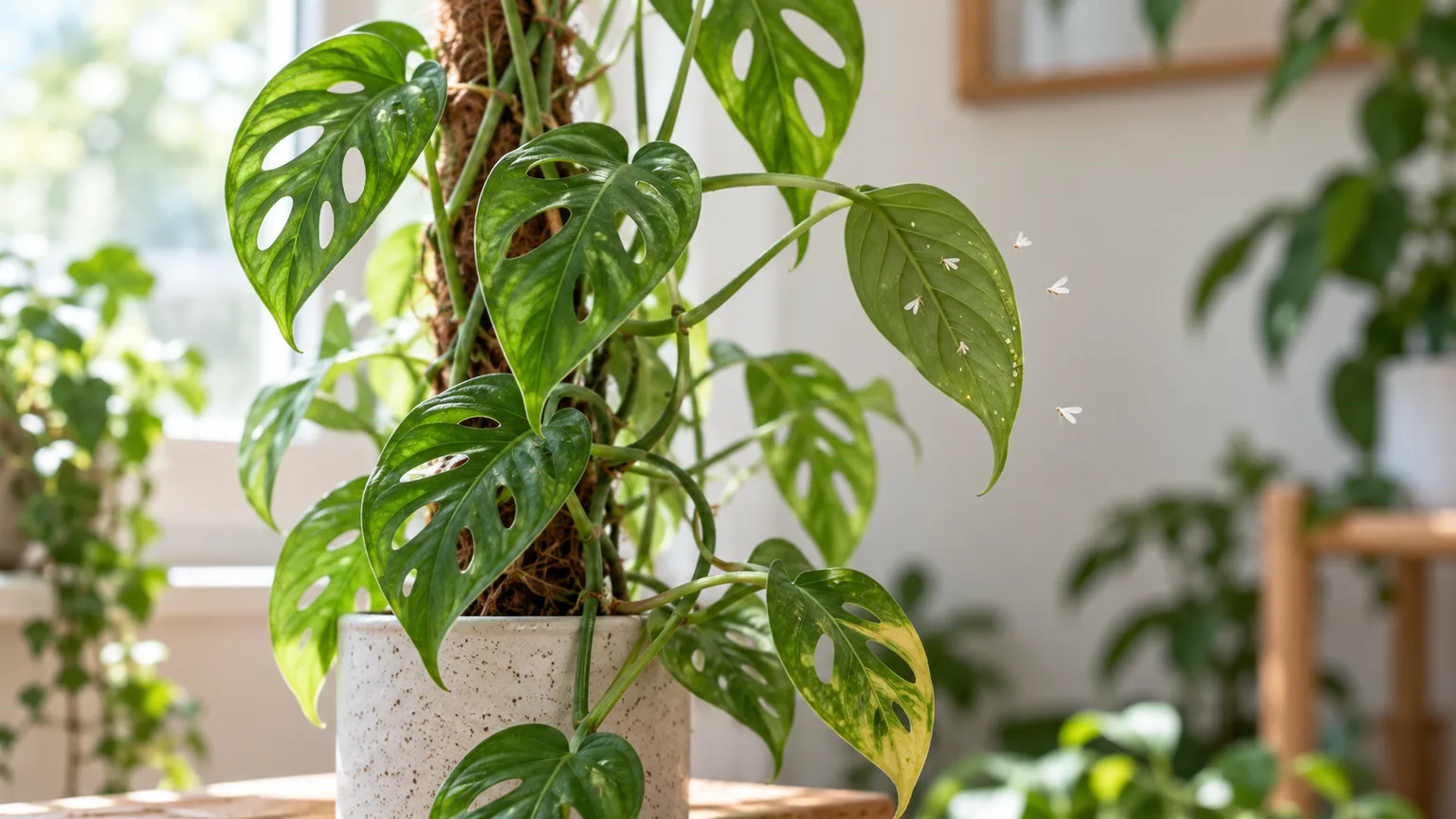
Whiteflies on Monstera Adansonii: How to Confirm and Treat Them
This guide covers whiteflies on Monstera Adansonii. See also the general Whiteflies guide, watering, and light pages for this plant.
Whiteflies on Monstera Adansonii: How to Confirm and Treat Them
Quick answer
If tiny white, moth-like insects lift from a Monstera adansonii leaf when it is touched, treat whiteflies as a possibility and isolate the pot first. Then check the undersides of leaves for pale, flat, attached nymphs. Seeing both the flying adults and immature stages gives a much stronger diagnosis than yellowing, stickiness, or one white speck by itself.
North Carolina State Extension lists whiteflies among pests to monitor on Monstera adansonii, whose climbing stems and perforated leaves create several places an owner needs to inspect. That list establishes whiteflies as a relevant pest to watch for; it does not show that every Monstera adansonii is especially susceptible or that symptoms alone confirm an infestation. For the general whitefly life cycle and management background, use the whiteflies pest guide. This page focuses on tracing and treating a slender, trailing or supported Monstera vine without confusing normal leaf openings with pest damage. NC State Extension’s Monstera adansonii profile describes its climbing habit and characteristic perforated leaves.
The first task is containment, not spraying: move the plant away from its neighbors and confirm what is on the leaf. If the diagnosis is supported, a careful water rinse is the least complicated first treatment. Keep the Monstera in stable light and assess the next leaves it produces; old yellow or scarred tissue usually remains marked even after feeding stops.
What whiteflies look like on Monstera adansonii
Adult whiteflies are tiny, pale insects that resemble small moths. On indoor plants, they often remain on the underside of foliage until movement sends them up into the air. University of Minnesota Extension describes them as white, moth-like adults and notes that infested houseplant leaves can yellow or drop and lose vigor, although whiteflies usually do not kill an established houseplant. That is useful context for triage, but the insect itself still needs to be identified before a treatment is chosen. The extension’s indoor whitefly description shows the adult form and summarizes the usual indoor impact.
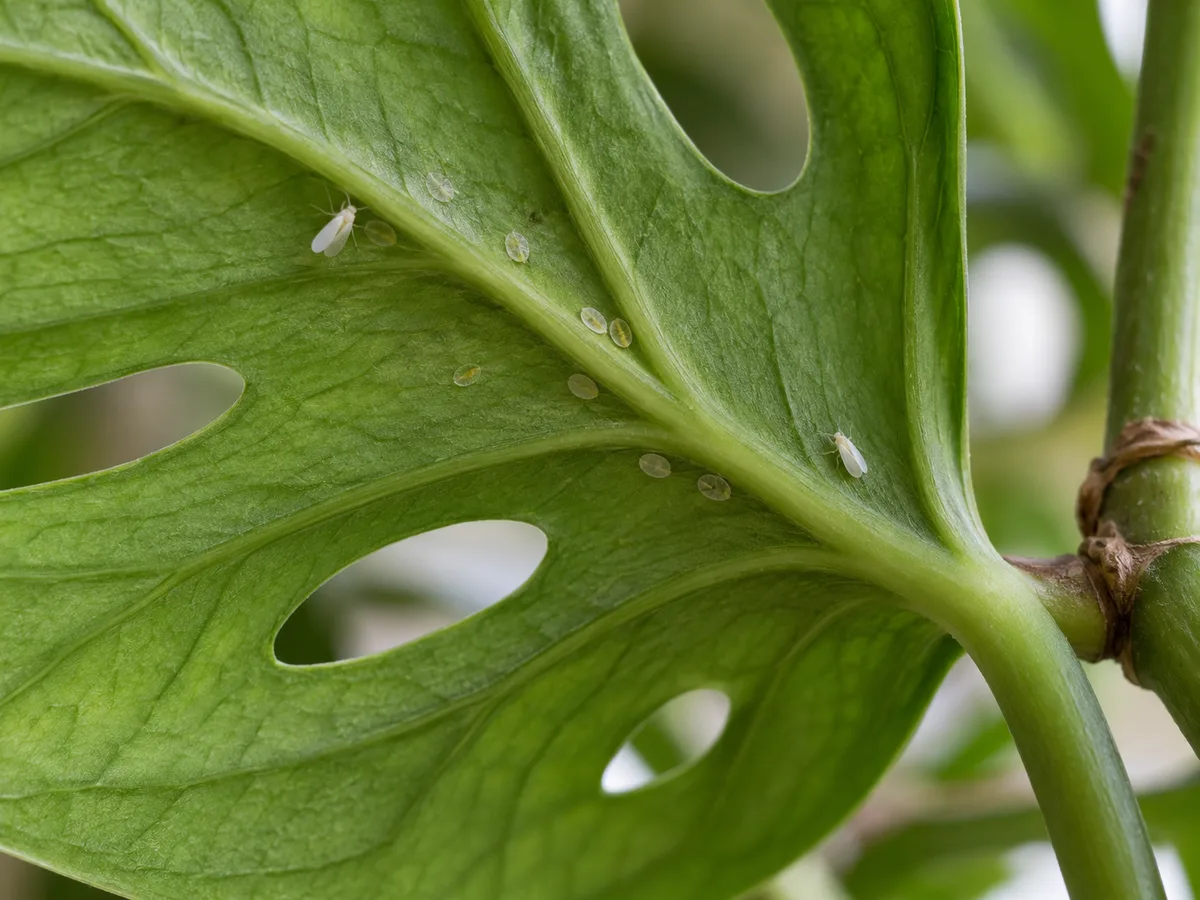
Look along the underside vein and around the petiole: adults may fly when disturbed while the immature whiteflies stay attached to the leaf.
The small white adult is only one life stage. Eggs are laid on leaf undersides, and after hatching the early crawler can move briefly before settling. Later nymphs are flattened and oval, lack visible wings, and remain fixed to the leaf while feeding. UC IPM describes those settled stages as the main source of feeding damage; adults moving through the room may be conspicuous, but they are not the only place to look. A whitefly infestation is more convincing when an adult cloud is paired with attached immature stages or characteristic sap-feeding signs on the same plant. UC IPM’s whitefly identification and life-cycle guidance covers the stages and why colonies develop beneath leaves.
On this species, natural oval holes in mature leaves are not “whitefly holes.” The pest feeds from the leaf surface and sap-conducting tissue; it does not make the clean, repeated openings that identify Monstera adansonii. More relevant signs are pale stippling, yellowing, drying, or a leaf that drops while flat nymphs remain beneath it. A shiny patch may be honeydew, the sugary liquid whiteflies excrete, but residue alone could also come from another sap feeder or a spill. Treat the holes as normal plant anatomy and look for insects and the pattern of fresh damage instead.
Why whiteflies can appear on Monstera adansonii
Whiteflies are not evidence that you watered this Monstera incorrectly or that it lacks humidity. They are sap-feeding insects, and warm indoor conditions can let a population persist when eggs or nymphs have already reached the foliage. NC State’s plant profile names whiteflies on its watch list for Monstera adansonii, but no source consulted establishes a special preference for this species over other indoor ornamentals. Avoid turning a pest sighting into an unsupported diagnosis about the plant’s care or weakness.
The more useful question is how the insects arrived. A new nursery plant, a plant that spent time outdoors, or an infested neighbor can bring flying adults or leaf-bound stages into the collection. Adults can move between nearby foliage; young nymphs are easy to overlook because they look more like flat flecks than moving insects. The Gardening Know How houseplant guide recommends checking leaf undersides on incoming plants and describes yellow traps as a way to monitor or reduce adults. These are practical collection checks, not proof that any one source introduced the insects.
A climbing or trailing Monstera has a distinctive inspection problem: stems can pass behind a moss pole, spill over a basket rim, or overlap so one leaf hides another. If the plant hangs near other pots, adult whiteflies may also shift to adjacent foliage when disturbed. The vine’s form changes where to search, not whether it can host the pest. Treat all likely hiding places as inspection zones, and scan nearby plants before you return the Monstera to its usual shelf.
Where to inspect the vine
Begin with the underside of the newest fully opened leaves, then trace each vine back toward the pot. Whiteflies are usually easier to find on the leaf surface than in the potting mix, so do not spend the first inspection digging at roots. On Monstera adansonii, gently lift overlapping leaves and check the lower surface beside the midrib, along smaller veins, and around the petiole where it joins the blade. Use the fenestrations as access points that let you see the other side of a leaf, not as a reason to tug the thin lobes.
Next follow the stem through every node. Look where a petiole meets the stem and where aerial roots begin, particularly if those nodes press against a support. A whitefly colony is not defined by a vine’s holes, but a crowded set of leaves may hide the underside where eggs or nymphs sit. If the plant climbs, turn the pot to inspect the side facing the wall and gently part leaves beside the pole. If it trails, lift one section at a time onto a clean surface so the vine is supported rather than pulled taut.
Continue from the upper growth to the lower leaves, including the shaded side of the basket. Record which leaves have adults, attached nymphs, yellowing, or sticky residue. This map helps you see whether a few insects are confined to one leaf or whether more than one section of the vine is affected. Inspect the plants that touched the Monstera and the shelf beneath it, but do not spray an entire collection just because adults flew through the room.
How to confirm a whitefly diagnosis
Use two different observations instead of deciding from color alone:
- Tap test: Hold a white piece of paper below a leaf and tap the petiole once. Whiteflies tend to rise as a small cloud of pale adults from the foliage; black flies that lift from the soil surface point toward a different pest.
- Underside check: Use a hand lens or a phone’s close-up camera to look for pale, flattened, oval nymphs attached beneath the leaf. Check near the veins and petiole, not only around the fenestrations.
- Damage check: Note yellowing, a dull or drying patch, or sticky honeydew on the same part of the plant. These signs support the finding when insects are present, but none identifies whiteflies by itself.
- Vine check: Follow the affected leaf’s petiole back to its node and inspect the next leaf above and below it. Then inspect the rest of the trailing or pole-grown stem for a second colony.
- Neighbor check: Examine leaves on plants that shared a shelf or touched the vine. A few adults may have moved, but a separate plant still needs its own evidence before you treat it.
A confirmed finding is an adult whitefly associated with the plant plus one or more attached nymphs or eggs beneath a leaf. An adult caught on a sticky card by a bright window, with no signs on the Monstera, is not enough to label this vine infested. Likewise, sticky residue without the insect or immature stage can come from aphids, mealybugs, or scale. If the clues do not line up, take a clear photograph of the underside and revisit the diagnosis before applying a product.
Lookalikes on Monstera adansonii
| What you observe | What to check next | Related guide |
|---|---|---|
| Pale winged adults lift from leaf undersides, with flat pale nymphs attached | Whiteflies are plausible; confirm both stages on the plant | This whiteflies guide |
| Dark small flies rise from the potting mix when it is disturbed | Check the mix and use the fungus gnats guide | Fungus gnats |
| Cottony white tufts sit at leaf joints or along stems | Look for waxy clusters rather than moth-like adults; compare with mealybugs | Mealybugs |
| Soft-bodied insects cluster on a tender tip and sticky residue returns | Inspect the newest leaf and petiole joints; compare with aphids | Aphids |
| Fixed brown or pale bumps remain attached to a stem | Test one bump gently; use scale insects if a shell-like cover is present | Scale insects |
| Fine stippling or webbing appears without pale flying adults | Inspect undersides with a lens and compare with spider mites | Spider mites |
| Silvery scars, dark specks, or distorted new leaves appear without adults | Check the leaf surface for other insects and compare with thrips | Thrips |
The table is a routing aid, not a substitute for seeing the pest. Honeydew can be produced by several sap feeders, and an older leaf may yellow for reasons that have nothing to do with insects. If the only sign is stickiness, use the sticky leaves guide to work through residue and other sap-feeder possibilities before calling it whiteflies.
First response: isolate, then rinse once confirmed
First action: move the Monstera adansonii away from neighboring plants. Choose a separate room if possible, or create enough distance that the vine cannot touch another pot. Carry it upright so the trailing stems do not brush across the collection. Isolation limits immediate contact while you inspect and makes it easier to tell whether adults continue emerging from this plant or another nearby host.
Once whiteflies are supported by the inspection, rinse the foliage with a gentle stream of water. Work over a sink, shower, or washable area, and tilt the pot so water drains away rather than pooling in the cachepot. Support a leaf from underneath and direct water across its lower surface, from the petiole toward the tip. On a climbing specimen, turn the pot and work around the pole; on a hanging specimen, bring each vine section within reach without twisting or sharply bending the nodes. A gentle spray can dislodge eggs and nymphs from leaves, which is why water removal is a useful first treatment for a small infestation. Garden Design’s whitefly guide describes water sprays for removing these leaf-bound stages.
Let the foliage drain in bright, indirect light. Keep the plant apart from other plants and repeat the inspection over the next few days, because adults you missed or stages that were not dislodged can remain. If a single leaf carries many visible nymphs and can be removed without leaving the vine bare, prune that leaf cleanly and bag it. Do not strip multiple healthy leaves from a Monstera with only scattered insects: its remaining leaves support continued growth, and a cut does not guarantee the rest of the vine is clear.
A yellow sticky card near the canopy can help you notice adults moving through the room, but it will not reach eggs or nymphs attached underneath leaves. Use it as a monitor beside direct inspection, not as the treatment itself. For the Monstera, your own record of which leaves still have nymphs is the more useful measure of progress.
When to consider a labeled contact product
Consider a contact product only if the rinse and limited removal do not keep the infestation from rebuilding, or if several leaves carry nymphs. Choose an insecticidal soap or horticultural oil only when its label names indoor ornamental plants and the target pest. Read and follow the product directions for dilution, coverage, ventilation, repeat timing, and where the plant may be kept while foliage dries. UC IPM notes that soaps and oils may reduce whitefly populations, that coverage of leaf undersides matters, and that repeat applications may be needed; it also cautions that these products may not eliminate a population. UC IPM’s management guidance supports using coverage and follow-up as part of a broader control approach.
Before treating the whole vine, use the product’s directions for a small test area and wait the stated interval. Monstera adansonii leaves have oval openings and narrow lobes, so inspect the test area for discoloration, translucent patches, or new marks before expanding treatment. Apply only as directed to the foliage where the insects are present, paying attention to the underside, petiole base, and node. Do not use a product that lacks an indoor ornamental use on its label, guess a dilution, or substitute a homemade soap mixture for the labeled product.
Contact sprays can miss eggs and protected nymphs if they do not reach the leaf underside. A leaf that looks clean from above can still shelter a colony along its midrib, and spray runoff does not substitute for directed coverage. If you cannot safely reach a dense pole-grown section, first reposition the pot or support the vine for access instead of soaking the whole plant. If infestation continues despite correct label use and repeated inspection, consult a local extension service or qualified horticulture professional about identifying the whitefly species and choosing a suitable control.
Recovery: read the next growth, not one leaf
The first sign of progress is a smaller or absent cloud of adults when you check the same leaves, followed by fewer live nymphs and no fresh honeydew. Whitefly development can move quickly in warm conditions, so do not judge success from a single rinse or from an adult-free room on the following morning. Check the underside of every leaf you recorded as affected, then trace its node and inspect adjacent leaves. Keep using the same route so that “no whiteflies” means the plant has been checked in the same places, not just viewed from above.
Old damage does not have to reverse for treatment to work. Yellow tissue may stay yellow or eventually drop, and a pale feeding mark will not become green again. The University of Minnesota Extension notes that whiteflies can reduce houseplant vigor and cause yellowing or leaf drop, but they usually do not kill established houseplants; treat widespread loss of leaves as a reason to assess the whole plant rather than a guarantee that it will die. A healthy root zone and stable care help the Monstera continue growing while it replaces lost foliage, but neither watering nor fertilizer removes whiteflies.
The clearest recovery signal is clean growth from the vine tips and nodes: new leaves open without fresh nymphs underneath, and no new yellow areas appear in the affected run of foliage. A new leaf can take time to emerge, so absence of a new leaf over a few days is not a useful pest-control test. Keep checking weekly for several weeks, especially if the plant was near other infested plants or a treatment label calls for repeat application. If the population returns, map where it reappears and examine whether a hidden leaf or neighboring plant was missed.
Escalate inspection if honeydew spreads to more leaves, adults repeatedly rise from several sections of the vine, or new leaves yellow before they open. That pattern suggests that active stages remain or that another plant is serving as a source. If whiteflies stop appearing but yellowing continues, compare the pattern with the yellow leaves guide and review the Monstera’s recent watering and placement rather than repeating sprays without new pest evidence.
Mistakes that make whitefly checks unreliable
- Treating yellowing as proof. Whiteflies can yellow leaves, but so can several care problems. Confirm insects or attached nymphs before selecting a pest treatment.
- Looking only at the upper leaf surface. On a Monstera vine, a glance at the fenestrations can miss the underside, petiole base, or leaf facing a support.
- Assuming a sticky leaf identifies the pest. Honeydew is a clue shared by sap feeders. Follow the residue back to a living insect instead of applying the first spray you have.
- Using a yellow trap as proof of control. A trap may capture adults while immobile stages remain on the vine. Continue checking the undersides by hand.
- Rinsing a pole-grown plant without supporting it. Pulling a wet vine by the leaf tips can tear a lobe or damage a node. Move the pot and hold each section close to the stem.
- Changing care at the same time as pest treatment. Repotting, moving into harsh light, pruning heavily, and spraying on one day make the response difficult to interpret. Whiteflies live on foliage; repot only for a separate root-zone reason.
- Spraying a product without checking the label. A product intended for outdoor use or a different pest may be unsuitable indoors. Follow its directions and do not increase the concentration to compensate for an incomplete inspection.
Do not fertilize as a response to whiteflies. Feeding cannot remove insects or repair the old leaf, and a nutrient change gives you another variable while you are trying to read pest activity. Keep the Monstera’s normal care stable while you isolate and inspect it; use the plant’s light guide and soil guide if a separate care concern appears.
How to prevent whiteflies returning
Inspect new Monstera adansonii plants before placing them beside established vines. Turn a few leaves over, check petioles and nodes, and look for adults that rise when the plant is moved. Keep the new plant separated while you monitor it; the point is to catch a pest before a long trailing vine shares leaves with other pots. NC State Extension lists whiteflies among the insects to monitor on this species, so adding an underside check to an incoming-plant inspection is reasonable without assuming every specimen carries them.
Make the plant easy to inspect during ordinary care. A hanging basket can be rotated, and a climbing vine can be arranged so the lower leaves and stem are not sealed against the pole. Remove fallen leaves and wipe sticky residue from the shelf after identifying its source. If a yellow card is used near the foliage, check it periodically and replace it when its surface is full; a card is a monitoring aid, not a substitute for looking at leaf undersides.
When you water, use a moment to scan a few leaves, but keep the watering decision tied to the mix rather than the presence of insects. The plant-detail guide describes a well-draining mix and allowing the top few centimeters to dry; follow the Monstera adansonii watering guide for that routine. Stable light and moisture may help the vine maintain growth, but they do not make an infestation impossible or act as whitefly treatment. Do not raise humidity or change the pot merely because whiteflies were found.
If a whitefly infestation appeared after a plant was moved indoors from outside, keep watching the entire collection for a while rather than repeatedly spraying only the Monstera. Check plants that shared its window, shelf, or support area, and isolate any plant with its own confirmed adults and nymphs. A simple note of the date, affected leaves, and treatment pass will help distinguish an old attached shell or stain from a new active colony.
When to use this page vs other Monstera adansonii guides
Use this guide when pale flying adults rise from the Monstera’s leaves and you can find attached whitefly stages beneath them. If you see only yellowing, soft leaves, or dark flies around the pot, start with the matching symptom guide rather than assuming whiteflies. A pest that feeds on leaves can coexist with root or light stress, so keep the diagnosis tied to insect evidence and use care pages for independent care changes.
If there is sticky residue but no white adult cloud or flat nymphs, compare the aphids guide, mealybugs guide, and scale insects guide. If leaf damage is silvery or distorted and no whiteflies are visible, inspect the thrips guide. For general species care and the rest of this plant’s symptom set, use the Monstera adansonii overview and its plant problems hub.
Related Monstera Adansonii guides
- Monstera adansonii overview — use for the plant’s overall growing context and identity.
- Monstera adansonii watering — use when the pot stays wet or dries too quickly; a watering change does not control leaf-bound whiteflies.
- Monstera adansonii light — use when growth is weak or leaves show light stress without confirming insects.
- Monstera adansonii soil — use for mix or drainage problems, not as a whitefly treatment.
- Monstera adansonii sticky leaves — use when tacky residue is the only clue and the insect remains unidentified.
- Monstera adansonii spider mites — use for stippling or webbing without the whitefly adult-and-nymph pattern.
Related tool
Use the Plant Problem Diagnosis Tool to compare confirmed whitefly signs with other possible problems before changing several parts of the Monstera’s care.