Aphids on Monstera Deliciosa: Causes, Checks & Fixes
Quick answer
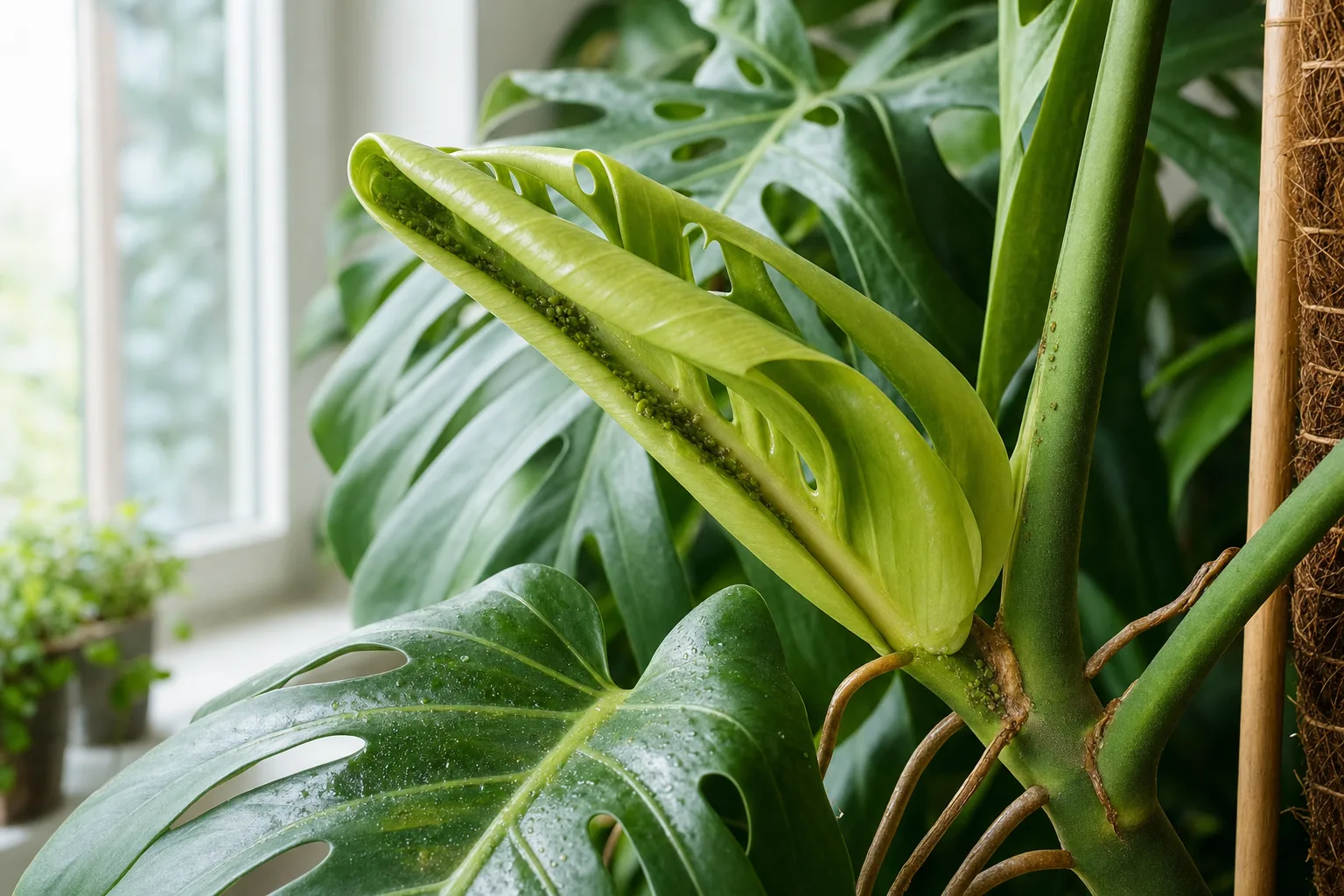
Aphids on Monstera Deliciosa show up as soft clusters inside unfurling fenestrated leaves, on flower stalks, and in leaf axils near aerial roots-often with sticky honeydew on broad lower blades. First step: isolate the plant and shower-rinse leaf undersides and stems with lukewarm water before reaching for sprays.
Aphids on Monstera Deliciosa: Causes, Checks & Fixes
This guide covers aphids on Monstera Deliciosa. See also the general Aphids guide, watering, and light pages for this plant.
Aphids on Monstera Deliciosa: Causes, Checks & Fixes
Quick answer
Aphids on Monstera Deliciosa are small, soft-bodied sap feeders that colonize the tender tissue this large split-leaf aroid (Monstera deliciosa) produces at unfurling tips, flower stalks, and leaf axils near aerial roots. Healthy specimens in bright indirect light push new fenestrated leaves through spring and summer, and aphids prefer that soft new growth over older hardened split blades.
First step: isolate the plant and shower-rinse leaf undersides and stems with lukewarm water. Move a floor specimen to the shower or use a handheld sprayer in the sink for smaller pots. Wrap the pot in plastic to keep soil contained. Confirm live insects before adding soap or oil-many sticky-leaf reports on Monstera turn out to be honeydew from aphids, not a separate disease. See the sticky leaves guide if tackiness is your first clue.
Why Monstera Deliciosa gets aphids
Monstera Deliciosa is a vigorous climbing aroid that keeps producing new shoots as long as light and water support growth. That habit is exactly what aphids exploit. Aphids use slender mouthparts to pierce stems and leaves and suck fluids, concentrating on the softest tissue available-which on Deliciosa means unfurling fenestrated leaves still rolled in their sheaths, pale new petioles, indoor flower spadix stalks, and the moist axils where thick petioles meet the stem above aerial roots.
Most indoor infestations start with introduction, not spontaneous generation. Aphids may arrive on new nursery plants or enter through open windows and then crawl or fly short distances to neighbors. Monstera Deliciosa often sits as a tall floor specimen above smaller pots, on a moss pole against a wall, or returned from a summer patio-so one missed colony on a new purchase can seed several plants within a week. Honeydew from upper feeding sites drips onto massive lower split leaves and the floor, which is why owners notice stickiness on blades that look clean on top.
Soft unfurling leaves and flower stalks
Each new Monstera leaf passes through a vulnerable window while the sheath is still tight and the tissue is thin. Aphids thrive on lush new growth, and Deliciosa responds to nitrogen and bright light with larger successive leaves. Colonies inside an unfurling tip are sheltered from casual inspection and direct spray contact until the leaf opens-by then distortion and honeydew may already be visible on the broad blade below.
Mature indoor specimens occasionally produce a flower stalk with a spadix. Aphids cluster on that soft tissue aggressively because it is even more tender than vegetative tips. Treat flower stalk colonies early; heavy feeding there can abort bud development before you notice damage on split leaves.
Introduction routes and nitrogen-rich spring growth
Big-box nursery stock, shared plant swaps, and patio summering are the usual entry points. Inspect regularly during quarantine before placing a new Deliciosa beside an established floor plant. Recent fertilizer pushes soft shoots that aphids colonize faster than firm mature tissue-this does not mean you should starve a healthy plant, but it explains why a recently fed specimen in a bright window can show aphids before a slow-growing corner plant.
Large waxy leaves also work against you. Owners inspect the dramatic split upper surfaces and miss colonies tucked inside unfurling sheaths, under petiole bases, or along moss-pole contact points where stems stay shaded and humid.
What aphids look like on Monstera Deliciosa
Typical aphid signs on Deliciosa:
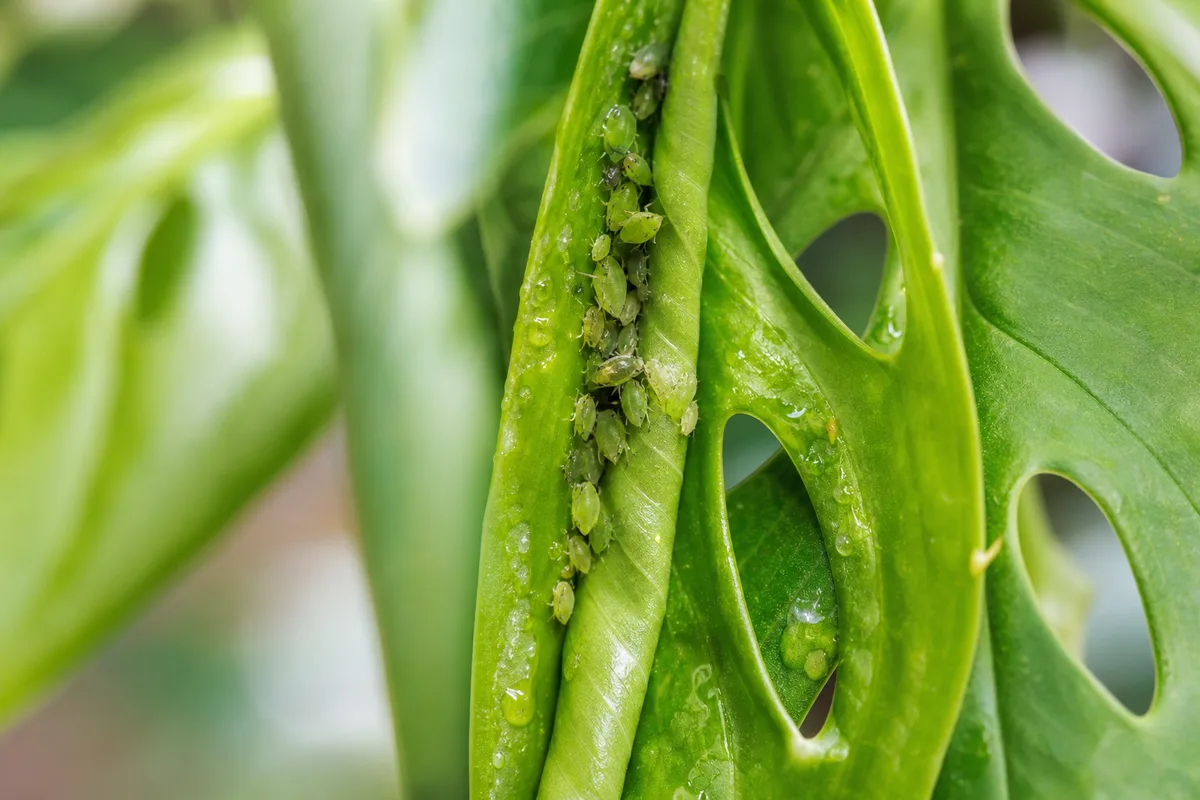
Aphids symptoms on Monstera Deliciosa - compare with healthy tissue on the same plant.
- Soft pear-shaped insects about 1/16 to 1/8 inch long, usually green but sometimes black, brown, yellow, or white
- Dense clusters inside unfurling fenestrated leaves, on flower spadix stalks, and in leaf axils near aerial roots
- Shiny sticky honeydew on broad lower split leaves, petioles, floors, or furniture below feeding sites
- Black sooty mold that wipes off with a damp cloth-fungus growing on honeydew, not Monstera tissue
- New leaves curling, puckering, or showing delayed fenestrations when feeding is heavy
- Yellowing on individual young blades or stalled extension of a formerly fast vine
- Whitish cast skins shed by growing nymphs, often stuck near colonies
- Ants traveling along pot rims, moss poles, or stems-see ants on plant when honeydew farming is involved
On Deliciosa, vegetative tips and any indoor flower stalk carry most colonies. A single aphid is easy to miss on a plant with dozens of large leaves; look for groups, sticky residue, and the narrow zone of new growth at each vine end rather than scanning every mature split blade.
How to confirm the cause
Work through these checks in order before you treat:
- Unfurling tip inspection - Follow the longest active shoot to its end. Gently peel back the leaf sheath still rolled around the newest fenestrations and check the interior with a hand lens. Aphids cluster inside young leaves before they open flat.
- Flower stalk pass - If a spadix stalk is present, inspect its full length and the bract base. Colonies here confirm aphids even when mature split leaves look clean.
- Axil and aerial-root bases - Run your finger along petiole bases where leaves meet the stem and where aerial roots attach. Sticky residue or soft bumps at these joints confirms sap feeders.
- Underside pass - Lift large lower leaves and inspect backs, especially on the upper third of the plant where growth is newest. Many aphid species prefer the underside of leaves.
- Movement test - Touch a suspect cluster with a cotton swab. Aphids move slowly; crushed bodies leave a green or brown smear. Mineral dust and dried water spots do not.
- Honeydew trail - Check massive lower blades and the floor directly below the pot. Localized tackiness below growing tips points to aphids above, not whole-plant humidity issues.
- Neighbor scan - Inspect other houseplants on the same shelf or at the same floor level. Aphids spread by crawling and short flight between pots in tight displays.
If you find insects plus honeydew, aphids are confirmed. If leaves are sticky but no insects appear after two careful searches a few days apart, reconsider mealybugs (cottony masses in axils), scale insects (hard domes on thick petioles), spider mites (fine stippling and webbing in hot dry air), or guttation (clear water beads at leaf margins after watering-not sugary tackiness).
First fix for Monstera Deliciosa
Isolate the plant and shower-rinse leaf undersides and stems with lukewarm water.
Move the Deliciosa away from other plants-ideally into a shower for floor specimens, or a large sink for smaller pots. Wrap the pot in a plastic bag to keep soil contained. Wash plants with lukewarm water to remove aphids, honeydew, and sooty mold, angling the spray upward so undersides of broad split leaves get direct contact. Support heavy petioles with one hand while you rinse with the other so waxy blades do not snap.
This one step is the right first response because it knocks off live insects without chemical risk to large Monstera leaves, clears fresh honeydew before ants arrive, and lets you see how large the colony actually is. Aphids drop when disturbed but may climb back, so plan on repeats-not a single splash.
Do not spray insecticidal soap or neem on day one if you have not confirmed insects. Do not fertilize a pest-hit Deliciosa hoping to replace damaged leaves; soft nitrogen-driven growth feeds the next generation.
Step-by-step recovery
After the initial rinse:
- Repeat water washes every two to three days until live aphids are gone on inspection. Deliciosa handles repeated rinsing well thanks to thick waxy cuticle on mature leaves, but let foliage dry the same day.
- Prune isolated hotspots if a few tips carry dense colonies inside curled new leaves or on a heavily infested flower stalk. Snip back to healthy tissue and dispose of cuttings in sealed trash-not the compost pail indoors.
- Apply insecticidal soap if rinsing alone does not control the population after one week. Insecticidal soaps kill by smothering and require direct contact. Coat undersides, axils, and unfurling sheaths thoroughly; repeat every four to five days through at least three applications.
- Add neem oil only if soap falls short on persistent colonies. UMN Extension lists neem as effective against aphids on indoor plants. Test one newly unfurled leaf first if the plant was recently stressed by sun or drought.
- Wipe sooty mold off lower split leaves with a damp cloth once honeydew production stops. Thick mold blocks light through fenestrations when it coats upper blade surfaces.
- Manage ants on pot rims or moss poles if they are protecting colonies. Controlling ants on plant makes biological control easier.
- Re-check neighbors weekly for two weeks after the Deliciosa looks clean. Aphids reproduce quickly in warm rooms-each adult can produce many offspring within days.
Reserve systemic insecticides for severe, repeated infestations on high-value specimens, and use them only according to label directions for indoor ornamentals. They are a later escalation, not a first fix.
Recovery timeline
Water rinses show results within two to three days when colonies are small and confined to one or two unfurling tips. Moderate infestations across several vine ends may need one to two weeks of wash-and-soap cycles before new growth emerges clean. Because Deliciosa grows fast in warm bright conditions, judge success by uninfected new leaves at vine ends-not by whether old blemished split blades revert.
Sooty mold fades as honeydew dries up; expect cleaner-looking lower leaves within one to three weeks after insects stay gone. Severely distorted young fenestrations that already hardened may keep their curl; trim them for appearance once the plant is pest-free.
Lookalike symptoms to rule out
Mealybugs form white cottony masses in leaf axils, crown crevices, and aerial-root bases-not loose pear-shaped clusters on unfurling tips. See the mealybugs guide for alcohol-swab routing.
Scale insects show hard brown or tan domes on thick petioles and stems. They do not cluster as soft groups inside unfurling sheaths.
Spider mites cause fine stippling and webbing in hot dry conditions, not heavy stickiness. Confirm with a white-paper tap test under suspected leaves on the spider mites page.
Thrips leave silvery scars and black specks on young tissue rather than dense soft colonies with honeydew.
Normal Monstera guttation can leave tiny clear droplets on leaf margins after thorough watering. Guttation is water, not sticky honeydew, and appears without insects or ants-a common confusion on split-leaf margins.
Mistakes to avoid
Do not treat only the dramatic upper surfaces of split leaves. Deliciosa hides aphids inside unfurling sheaths, flower stalks, and axils near aerial roots.
Do not return an isolated plant to a mixed collection after a single rinse. Quarantine until pest-free for at least two weeks of monitoring.
Do not use homemade dish soap sprays. Commercial insecticidal soap is formulated for plants; harsh detergents can burn waxy Monstera blades.
Do not apply soap or oil to wilted, drought-stressed, or sunburned leaves without a spot test. Oils and soaps can damage sensitive or heat-stressed tissue.
Do not ignore ants. Controlling aphids is harder while ants defend colonies from lady beetles and other predators.
Do not over-fertilize during recovery. Lush nitrogen-driven shoots give aphids more feeding sites.
Because Monstera Deliciosa is toxic to cats and dogs, keep rinsed leaves, pruned cuttings, and treated foliage off floors where pets chew while sprays dry. Rinse reachable lower blades if a pet may contact residue.
Monstera Deliciosa care cross-check during treatment
Aphids are a pest problem first, but weak or stressed Deliciosa recovers more slowly. Confirm the basics while you treat:
- Light - Bright indirect light supports steady fenestration without the ultra-soft shoots that appear when a plant is pushed with strong feed in harsh direct sun. See the light guide for placement.
- Water - Water when the top quarter to third of the mix dries. Chronically wet soil will not cause aphids, but it stresses roots and slows the new growth you are using as a recovery signal. Match rhythm to the watering guide.
- Airflow - Large leaves pressed against walls or neighboring pots create humid pockets where honeydew and sooty mold build faster. Give blades space to dry after rinsing.
- Fertilizer - Hold feeding until new growth emerges clean. Resume monthly half-strength applications only after at least two weeks without live aphids.
How to prevent aphids next time
Quarantine new Deliciosa and companions for two to four weeks before mixing them in a shared room. Inspect regularly during isolation and treat any hitchhikers before integration.
Scout unfurling tips weekly during fast growth in spring and summer. A ten-power hand lens makes early colonies visible inside rolled sheaths before honeydew spreads across massive lower blades.
Wipe dust from leaf surfaces during regular care. Clean blades are easier to inspect and support healthier photosynthesis through fenestrations.
Avoid excess nitrogen that produces large soft shoots with tender tissue. Slow-release or moderate fertilizer reduces lush aphid-friendly growth without starving the plant.
Check patio specimens before indoor return in fall. Outdoor Deliciosa often looks clean on upper split surfaces while aphids hide on undersides and in axils.
Space floor displays so honeydew from a tall specimen cannot drip unnoticed onto lower pots for weeks.
When to worry and escalate
Treat as urgent when honeydew and sooty mold spread across most of the canopy within a few days, ants swarm multiple stems, or colonies jump to several plants in one room. Large aphid populations can yellow leaves and stunt shoots; a formerly fast Deliciosa with stalled unfurling tips after heavy feeding may need aggressive pruning plus repeated treatment.
Escalate when three weekly soap cycles fail to reach colonies hidden inside tight unfurling sheaths or along an indoor flower stalk you cannot rinse thoroughly. Contact your local extension office for persistent indoor infestations on high-value specimens.
Discard extremely infested small specimens if every active tip carries colonies and rinsing fails after two weeks. Propagation from a clean node is often faster than fighting entrenched aphids on a dense multi-stem plant.
Monstera Deliciosa rarely dies from aphids alone when roots are healthy. Worry when pest pressure combines with root rot, severe leggy growth from low light, or repeated reinfestation because neighbors were never treated.
Conclusion
Aphids on Monstera Deliciosa concentrate on the soft new growth this large aroid keeps producing-inside unfurling fenestrated sheaths, on flower stalks, and in axils above aerial roots. Isolate, shower-rinse undersides first, and repeat until vine tips stay clean. That path stops honeydew before sooty mold and ants complicate the job, and it keeps chemical treatments as a second step rather than the default.
For the full care picture, see the Monstera deliciosa overview, plus guides on watering, light, and related pest pages for sticky leaves, mealybugs, and spider mites.
When to use this page vs other Monstera Deliciosa guides
- Monstera Deliciosa watering guide - Use for routine moisture checks before assuming aphids is the main issue.
- Monstera Deliciosa problems hub - Browse all 18 common issues on this species.
- Sticky Leaves on Monstera Deliciosa - Different entry point when symptoms overlap with aphids.
- Ants on Plant on Monstera Deliciosa - Different entry point when symptoms overlap with aphids.
- Yellow Leaves on Monstera Deliciosa - Different entry point when symptoms overlap with aphids.