Parsley Light Needs: Sun, Shade and Indoor Placement
Parsley Light Needs: Sun, Shade and Indoor Placement
Parsley Light Needs: Sun, Shade and Indoor Placement
Parsley (Petroselinum crispum) grows in full sun or partial shade. The useful choice depends on temperature: give it a bright position during mild weather, then protect it from punishing afternoon heat if the leaves wilt or its pot dries too fast. RHS recommends sun or partial shade for parsley, and NC State Extension lists the same light range. Parsley does not need a dark corner, but it also does not benefit from being baked in a hot container.
The Light Range Parsley Can Use
Parsley can grow in an open sunny spot or in light shade. In a cool spring, more direct sun generally supports steady leaf growth. A little shade is useful where afternoons are hot, especially for young plants and containers. University of Delaware Extension includes parsley among herbs suited to full sun or partial shade, while BBC Gardeners’ World notes that it grows in part shade.
Think of shade as a way to manage heat, not as a substitute for brightness. Dense shade can leave the plant thin and slow to replace harvested leaves. If your site is shaded for much of the day, choose the brightest available part of it and monitor new growth.
When Full Sun Suits Parsley
Full sun is a good choice in mild weather, particularly in spring and early autumn. A sunny bed warms earlier and gives parsley enough light to build a compact rosette. Full sun can also work in cooler coastal or high-altitude conditions, as long as the soil does not dry out completely.
The response depends on the whole site: reflected heat from stone or paving, wind, pot size, and soil moisture all affect how hot the roots become. Do not move a plant into intense midday sun all at once if it has been growing indoors or under shade. Acclimate it gradually over several days, as RHS guidance on growing parsley outdoors recommends for young plants.
When Partial Shade Is the Better Choice
Give parsley afternoon shade when warm weather makes the leaves droop repeatedly or when a container becomes difficult to keep evenly moist. Morning sun followed by shade through the hottest part of the day is a practical arrangement in hot regions. The goal is to keep the plant bright while reducing direct heat load.
A few hours of shade do not automatically mean poor growth. Parsley tolerates partial shade, though a deeply shaded site may produce slower, less vigorous foliage. UF/IFAS describes parsley as suitable for full sun to partial shade. Watch new leaves over a week or two after changing the position rather than judging by one hot afternoon.
How Hot Weather Changes the Best Position
Parsley is a cool-season herb. Heat can make a plant wilt temporarily even when the roots are not dry, and sustained stress can shorten the period of useful leaf harvest. In warm climates, prioritize morning sun, afternoon shade, and moisture-retentive but freely draining soil rather than leaving a dark cover over the plant all day.
If the plant droops only in the afternoon and recovers by evening, check the soil before watering. If it is already moist, add shade or move the pot out of reflected heat instead of soaking the roots. For a full moisture routine, see the Parsley watering guide.
Choosing a Garden-Bed Site
Choose a bed that receives direct sun during cooler parts of the day and some shelter from harsh afternoon exposure if your summers are hot. Avoid sites directly beside a heat-reflecting wall if parsley has repeatedly wilted there. The bed should also drain well; shade will not fix waterlogged soil.
Parsley can share an herb bed with plants that enjoy similar moisture, but do not crowd it under tall, dense foliage. Check the sun pattern after neighboring plants leaf out because spring light can be brighter than summer light. Purdue Extension’s production guide discusses parsley as a leafy crop grown in open field conditions, while Wisconsin Extension’s species guide describes its garden growth habit.
Placing Parsley in a Container
Set a parsley pot where it gets a bright stretch of sun but can be shifted out of severe afternoon heat. Dark pots on exposed paving may warm and dry faster than a bed, so the same sunny location can be fine for a large container and too harsh for a small one. Choose a pot with drainage holes and check its moisture more frequently on hot, windy days.
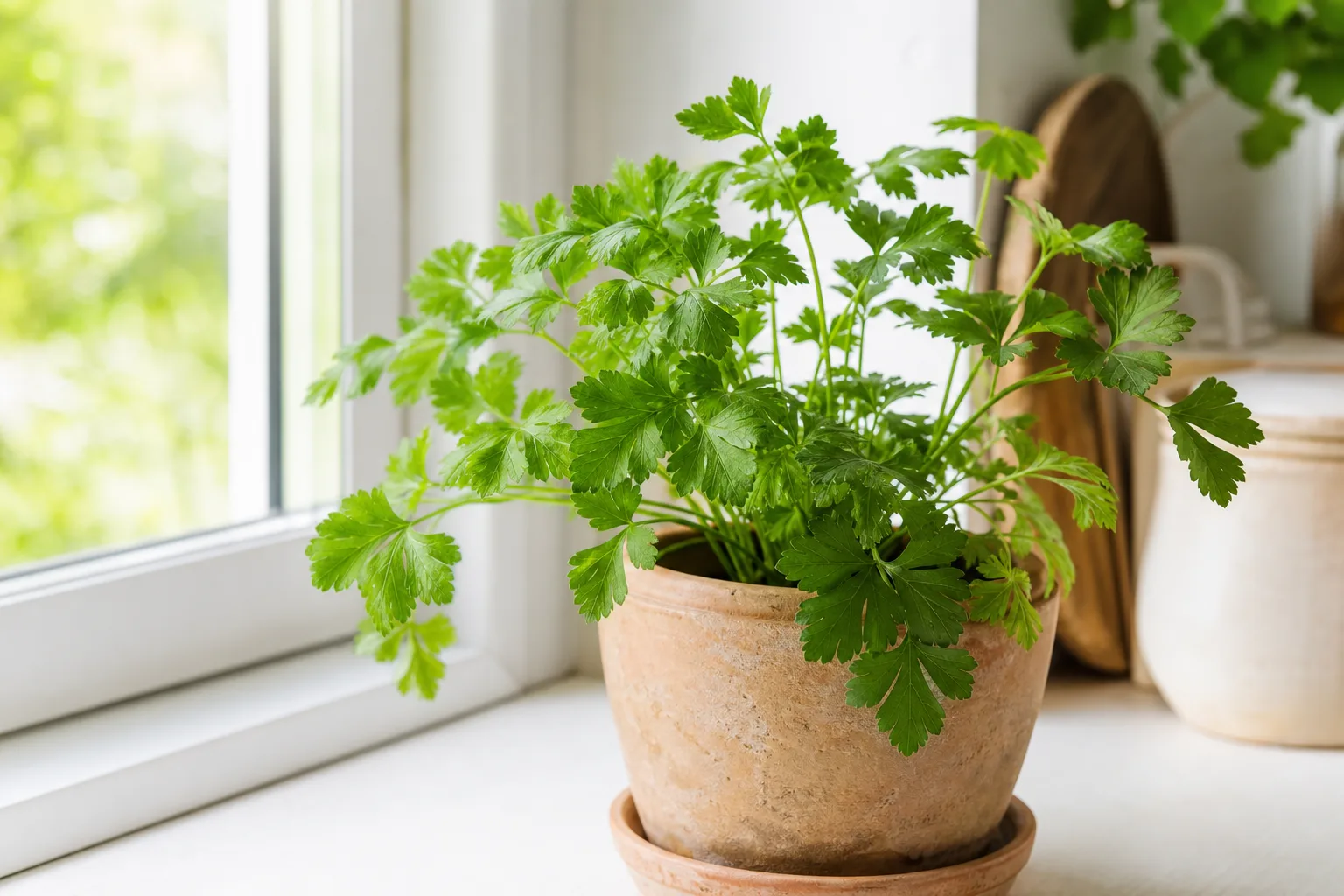
Container parsley can be grown outside or on a bright windowsill. RHS recommends a container at least about 25 cm wide and deep, which gives roots more room and slows moisture swings compared with a tiny pot. More on the container and soil setup is in the Parsley soil guide.
Giving Indoor Parsley Enough Window Light
For an indoor plant, use the brightest window available, ideally where the plant receives direct sun for part of the day without being pressed against hot glass. Rotate the pot occasionally if leaves lean toward one direction. If the window receives little natural light, parsley may survive but produce long petioles and sparse new growth.
An indoor plant’s leaves may also become limp because the pot is too dry, too wet, or root-bound. Check the mix before blaming light. Savvy Gardening notes that indoor parsley needs close attention to light and watering; Gardening Know How also discusses growing parsley in containers indoors.
When to Use a Grow Light
Use a grow light when the brightest window still leaves new growth stretched or pale, or when winter days are very short in your home. Place the light according to its manufacturer’s distance and coverage directions, then observe the plant’s new leaves. There is no single timing rule that fits every fixture.
Keep the light close enough to illuminate the foliage evenly without warming or bleaching it. If a lamp makes leaves hot to the touch, raise it or use a lower setting. A grow light adds brightness; it does not correct poor drainage, an exhausted potting mix, or an established plant entering its second-year flowering stage.
Signs Parsley Is Not Getting Enough Light
Low-light parsley often grows slowly and unevenly. Stems may stretch toward a window, the centre can become open, and the plant may replace harvested foliage slowly. These signs are clues, not a diagnosis: weak roots or irregular watering can look similar.
Move the pot to a brighter position in stages and compare new growth over the next couple of weeks. Do not expect already-stretched stems to become compact again. Harvest a few outer stems as needed and let the new growth show whether the change helped. The Parsley pruning guide explains how to harvest without removing the central growing point.
Telling Low Light From Water Stress
A plant that wilts in strong afternoon sun may be heat-stressed even if the mix is moist. A plant that remains limp in the morning with dry soil is more likely short of water. Yellowing leaves can reflect normal older-leaf loss, root stress, or the second-year shift toward flowering; look for a pattern rather than treating every yellow leaf as a light problem.
Check the soil at the root zone, inspect drainage, and note whether the plant recovers overnight. If it is wet, do not water again just because leaves droop. The Parsley overview describes the plant’s biennial cycle; the watering guide helps separate dry soil from waterlogged roots.
How Light Affects Watering and Feeding
A sunnier, warmer position usually dries a pot more quickly than a cool shaded one. That means you may need to check moisture more often, not automatically water every day. In shade, a container may stay wet longer, so frequent watering can create saturated soil.
Keep feeding decisions separate from light decisions. Pale or slow growth in a dark position is not proof that the plant needs fertilizer. Improve the light first and confirm the plant is growing actively before feeding. For the right balance, see the Parsley fertilizer guide and the soil guide.
Adjusting Light Across the Year
In spring and autumn, let parsley receive more direct sun while temperatures remain mild. During a hot spell, add afternoon shade or move a pot to a cooler bright position. In winter, keep indoor parsley near the brightest window; outdoor plants may grow slowly when days are short and cool.
Parsley is a biennial and often flowers in its second year. Flowering is part of its normal life cycle, not a sign that the plant needs more light. If you want tender leaves, sow a replacement while the older plant is still productive. The RHS profile describes parsley’s second-year flowers, and Savvy Gardening explains the harvest decline around flowering.
Moving a Parsley Plant Safely
If you need to relocate a pot, choose a bright, cooler spot and avoid a sudden jump from deep shade to intense sun. For an established bed plant, moving it is often less successful because parsley develops a taproot. It is usually better to adjust nearby shade or leave the plant in place and sow a new one at the preferred site.
When moving a young seedling, keep its rootball intact and water it in after planting. Wisconsin Extension notes that parsley’s taproot makes disturbance a concern. The Parsley repotting guide covers when a move is worth the risk.
Common Light Mistakes
- Treating partial shade as deep shade: parsley can tolerate some shade, but it still needs a bright site.
- Keeping a small pot in reflected afternoon heat: the leaves and rootball can overheat and dry rapidly.
- Moving an indoor plant straight into full outdoor sun: acclimate it gradually.
- Watering every time leaves droop: first check whether the soil is dry or still wet.
- Feeding a stretched plant instead of improving light: fertilizer will not replace missing brightness.
Conclusion
Give parsley bright light, using full sun in mild weather and partial shade when heat makes the leaves or pot struggle. Indoor plants need the brightest practical window, while containers benefit from a position that can be adjusted as seasons change. Check soil moisture before watering, and remember that second-year flowering is normal. For the broader routine, start with the Parsley overview; use the watering and soil guides when light-related symptoms may actually come from the roots.
When to use this page vs other Parsley guides
Use this page to choose the site or window. The overview covers the full care routine; watering explains moisture checks; and soil covers drainage and potting mix. Use fertilizer for feeding decisions, repotting for moving a crowded plant, propagation to start seed, and pruning for harvest cuts.
Related Parsley guides
- Parsley overview — put light in context with the whole care routine.
- Parsley watering — adapt watering to sun, shade, heat, and pot size.
- Parsley soil — choose moisture-retentive, freely draining mix.
- Parsley fertilizer — decide whether a slow-growing plant needs feeding.
- Parsley repotting — move young parsley with minimal root disturbance.
- Parsley propagation — start parsley from seed.
- Parsley pruning — harvest foliage without cutting out the centre.