Parsley Care Guide: Light, Water, Soil and Harvest
Petroselinum crispum
Learn how to grow parsley (Petroselinum crispum) in moist, fertile soil, manage its slow-germinating seed, care for containers, and harvest leafy stems.
Parsley Care Guide: Light, Water, Soil and Harvest
Start with wateringThe most common care mistake for ParsleyWatering guide →Parsley care essentials
Light
Water
Keep the soil evenly moist but well-drained. Water when the surface begins to dry, and do not let a container stand in water. Parsley can wilt in hot weather, so check pots and young plants regularly.
Soil
Fertile, organic-rich soil that holds some moisture while draining freely; parsley prefers consistently moist conditions rather than the lean, dry mix used for Mediterranean woody herbs.
Humidity
Temperature
Fertilizer
About Parsley
Parsley is native to Mediterranean region, including southern Europe and western Asia, typically reaches Leaf rosette about 30–45 cm tall in its first year; flowering stems may reach 60–90 cm in the second year, depending on cultivar indoors, with slow and sometimes uneven from seed, followed by steady leafy growth once established growth. Parsley has a hardy biennial herb usually grown as an annual for its leaves; forms a leafy rosette in year one and flowers in year two growth habit and part of the Apiaceae family. It is also known as Curly-leaved parsley, Italian parsley, Flat-leaf parsley, and Hamburg parsley.
| Detail | Information |
|---|---|
| Also known as | Curly-leaved parsley, Italian parsley, Flat-leaf parsley, Hamburg parsley |
| Native region | Mediterranean region, including southern Europe and western Asia |
| Mature size | Leaf rosette about 30–45 cm tall in its first year; flowering stems may reach 60–90 cm in the second year, depending on cultivar |
| Growth rate | Slow and sometimes uneven from seed, followed by steady leafy growth once established |
| Growth habit | Hardy Biennial Herb Usually Grown As An Annual For Its Leaves; Forms A Leafy Rosette In Year One And Flowers In Year Two |
| Scientific name | Petroselinum crispum |
| Family | Apiaceae |
Parsley Care Guide: Light, Water, Soil and Harvest
Parsley (Petroselinum crispum) is a leafy biennial herb in the carrot family, usually grown as an annual for its leaves. It suits a garden bed or a roomy pot, but it rewards steady moisture and careful handling more than neglect or repeated moves. The first step is to match care to its cool-season growth: give it sun or light shade, fertile soil that drains, and enough time for slow seed to sprout. NC State Extension describes parsley as a hardy biennial commonly grown as an annual, while the University of Delaware Extension profile also covers its garden and container culture.
What Parsley Does in Its First and Second Year
In its first year, parsley forms a low rosette of leaves. If it survives winter, the plant usually sends up flowering stems in its second year, then sets seed and declines. That cycle is why a parsley plant that suddenly grows taller and produces fewer tender leaves is not necessarily failing: it may be entering its natural reproductive stage. The RHS plant profile describes parsley’s biennial habit and second-year flowers; Savvy Gardening’s parsley guide notes that leaf production drops as flowering begins.
For a steady supply, sow a small new batch before an older plant bolts. In warm climates, parsley may struggle through hot weather or a stressful dry spell, so treat it as a cool-season crop and use partial afternoon shade when heat is intense. Do not expect one plant to provide equally tender leaves forever.
Choose the Parsley Type You Want to Grow
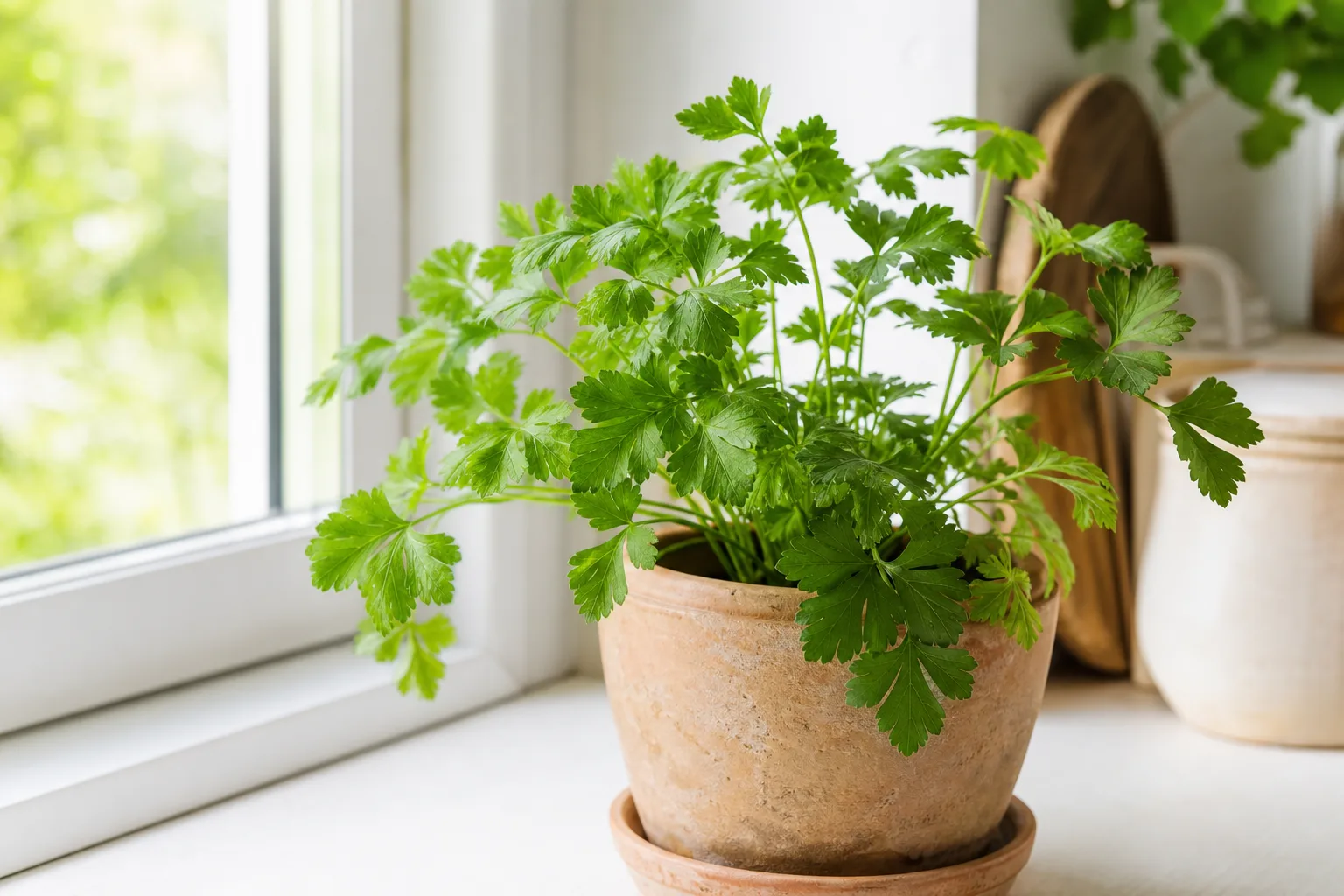
Curly parsley has tightly crinkled leaves and is often used as a garnish; flat-leaf or Italian parsley has broader leaves and a stronger flavor. Hamburg parsley is selected for its enlarged edible root as well as its foliage, so it needs more depth than a leaf-only variety. These forms belong to the same species, but the root type changes what you want from the planting. Purdue Extension distinguishes the main parsley forms, and UF/IFAS describes curly, Italian, and root parsley.
If you are growing parsley mostly for leaves, choose curly or flat-leaf seed based on taste and texture. For Hamburg parsley, use a deep, loose bed or container and avoid harvesting the main root until it has had time to size up.
Give Parsley Sun Without Letting It Overheat
Parsley grows in full sun or partial shade. In a cool spring, a sunny spot helps it make a compact, leafy rosette. In a hot or exposed position, a little afternoon shade can reduce heat stress and slow the pot from drying too quickly. RHS guidance recommends sun or partial shade, and BBC Gardeners’ World notes that parsley also grows well in part shade.
For indoor parsley, choose the brightest available window and rotate the pot occasionally so growth stays even. If stems stretch toward the glass or new leaves become sparse, improve the light before feeding more. Parsley grown in a dim room will not compensate for weak light by receiving extra fertilizer.
Build Moist, Fertile, Free-Draining Soil
Parsley prefers fertile soil that holds some moisture but does not stay waterlogged. In a garden bed, loosen compacted ground and work in mature organic matter if the soil is poor. Purdue’s production guidance gives a preferred soil pH range of about 5.3–7.3 and describes rich, moist soil with good drainage; Wisconsin Extension’s parsley profile also recommends fertile soil and emphasizes that the plant forms a taproot.
In a pot, use a quality multipurpose mix with drainage holes rather than dense garden soil. A mix that dries bone-dry in a day makes parsley difficult to maintain; one that stays saturated invites root decline. For more detail, see the Parsley soil guide.
Water by Checking the Root Zone
Keep the root zone evenly moist while parsley is actively growing, especially after sowing and during hot, dry weather. Water the soil rather than repeatedly wetting the leaves, then let excess drain away. The RHS growing guide says parsley needs moist but not waterlogged soil; the University of Delaware Extension guide likewise recommends regular moisture and good drainage.
Pots need more frequent checks than beds because a small volume of mix can dry quickly in sun or wind. Feel the top couple of centimetres: if they are beginning to dry, water thoroughly and empty the saucer. If leaves droop while the mix is still wet, do not add more water until you check drainage and the roots. The Parsley watering guide covers those checks in detail.
Start Parsley From Seed With Patience
Parsley seed often germinates slowly and unevenly, sometimes taking several weeks. Keep the seedbed moist while waiting, but do not flood it or keep it cold and sodden. Sow directly where the plant will grow when possible; that avoids a later move that can disturb its taproot. Purdue Extension explains parsley’s slow, erratic germination, while Gardeners’ World gives a practical sowing method and notes the long wait for seedlings.
If starting in cells or a small pot, sow a few seeds and thin the seedlings rather than pulling a large root mass apart later. A light overnight soak is sometimes used to soften the seed coat, but it is optional; consistent moisture and patience matter more. The Parsley propagation guide explains sowing and thinning step by step.
Grow Parsley in a Pot That Fits Its Roots
Choose a stable pot with drainage holes and enough depth for the parsley’s taproot. A wider container can support several plants, but leave room for airflow and for harvesting around the outside of each rosette. RHS recommends a container at least about 25 cm wide and deep for sowing parsley; adjust upward for Hamburg root parsley or if you want several plants in one vessel.
Place the pot where it receives good light and check it often during warm weather. Containers heat and dry faster than garden beds, especially on paving or against a bright wall. Savvy Gardening shares practical parsley container experience, while Gardening Know How also describes parsley in pots and beds.
Transplant Young Parsley With a Light Touch
Parsley’s taproot makes established plants awkward to move. Sow directly into a final pot or garden position when practical. If you must transplant a young seedling, move it while small, water the rootball first, and keep the roots intact. Set it at the same depth it was growing before and water gently to settle the surrounding mix.
Avoid dividing a mature parsley rosette or teasing apart a dense rootball. A supermarket pot may contain multiple seedlings crowded together; separating them can work while they are young, but mature roots are more likely to suffer. Wisconsin Extension notes parsley’s taproot and the value of careful transplanting. If a plant wilts after a move, give it bright shade and steady—not saturated—moisture while it recovers; see the Parsley repotting guide.
Feed Based on Where Parsley Grows
Parsley in a well-prepared garden bed often needs little additional feeding. Container plants have a smaller supply of nutrients, so a modest application of balanced liquid fertilizer during active growth can help when leaf production slows despite adequate light and moisture. Follow the product label and use the lower end of its directions for a culinary herb rather than applying a strong dose by habit.
The RHS recommends an organic-based, balanced liquid feed every few weeks during the growing season when container parsley needs a boost, while ground-grown plants generally do not need regular feeding. BBC Gardeners’ World also recommends only occasional general feed. Do not feed a wilted plant until you have checked for dry soil, waterlogging, or root stress. More on choosing and timing feed is in the Parsley fertilizer guide.
Harvest Outer Stems to Keep the Rosette Productive
Once a plant has several healthy stems, cut the outer ones close to the base with clean scissors. Leave the central growing point intact so new leaves can emerge. Regularly removing a few outside stems is more useful than repeatedly pinching only the tips. RHS recommends harvesting outer stems near the base, and Gardeners’ World explains that base-cut stems regrow.
As the plant sends up flower stalks in its second year, leaves become less abundant. If you want fresh leafy parsley, replace it with a young plant rather than cutting off every flower stalk and expecting the first-year rosette to return. The Parsley pruning guide covers routine harvest cuts and what to remove.
Adjust Care Through the Seasons
Parsley is most comfortable in cool, mild conditions. Sow or plant it when weather is moderate, keep seed and young plants evenly moist, and protect containers from strong afternoon heat. In cooler weather, growth slows; reduce watering only as the mix takes longer to dry, not according to a fixed winter calendar. NC State Extension lists parsley for sun to partial shade and notes its hardy biennial habit.
Where winters are mild, a first-year plant may continue producing leaves; where summers are very hot, a little shade and closer watering checks can help it stay usable. Do not mistake heat-related wilting at midday for a reason to keep the roots saturated overnight. The Parsley light and watering guides explain how to adjust those two parts together.
Spot Problems Before Changing the Routine
Yellow or weak leaves can result from normal aging, heat, low light, inconsistent water, or the plant entering its second year. Read the whole situation before changing fertilizer: check whether the mix is dry or wet, whether new growth is stretched, and whether the centre is sending up a flower stalk. A single old outer leaf is less concerning than widespread decline.
If the plant wilts, first check moisture and drainage. If the soil is dry, water deeply; if it is wet, improve drainage and wait before watering again. Parsley prefers moisture but not standing water. For specific soil decisions, use the Parsley soil guide; for drooping caused by moisture problems, start with the watering guide.
Avoid These Common Parsley-Care Mistakes
The most common setbacks are letting seed dry while it germinates, expecting fast emergence, repeatedly moving an established plant, and leaving a pot in standing water. Another easy mistake is growing parsley in too little light indoors, then trying to solve weak growth with fertilizer. Fix the growing condition first and give new leaves time to respond.
Do not assume every parsley type is grown for the same harvest: Hamburg parsley is chosen for its root, while curly and flat-leaf forms are grown mainly for leaves. Do not harvest every stem from a young plant, either. Leave enough foliage for the rosette to keep growing.
A Simple Parsley Care Rhythm
- At sowing: keep the seed mix evenly moist and wait several weeks before deciding germination failed.
- After establishment: give sun or partial shade, fertile soil, and steady moisture with good drainage.
- In a pot: check the mix more often in warm or windy weather and empty any standing saucer water.
- At harvest: cut a few outer stems near the base and leave the centre growing.
- As flowering starts: plan a replacement sowing if you want a continued supply of tender leaves.
Conclusion
Parsley grows best when its cool-season habit, moisture needs, and taproot are respected. Give it good light, rich but freely draining soil, and regular moisture without waterlogging. Sow directly when you can, handle seedlings gently, harvest from the outside, and start a new plant before the old one flowers if you want an uninterrupted supply. For a quick next step, choose the guide that matches the issue: light, watering, soil, fertilizer, repotting, propagation, or pruning.
When to use this page vs other Parsley guides
Use this overview to set the whole growing routine. Go to Parsley light for siting, shade, and indoor placement; watering for moisture checks; and soil for beds, potting mix, and drainage. The fertilizer guide covers feeding, while repotting and propagation explain moving or starting plants. Use pruning for harvest cuts and removing old or flowering stems.
Related Parsley guides
- Parsley light — choose a bright position and manage afternoon heat.
- Parsley watering — decide when the bed or pot needs water.
- Parsley soil — improve drainage while retaining useful moisture.
- Parsley fertilizer — feed a container without overdoing it.
- Parsley repotting — move young plants while protecting their taproot.
- Parsley propagation — sow and thin parsley seed.
- Parsley pruning — harvest outer stems and manage flowering growth.
How to care for Parsley?
When should you water Parsley?
Keep the soil evenly moist but well-drained. Water when the surface begins to dry, and do not let a container stand in water. Parsley can wilt in hot weather, so check pots and young plants regularly.
- Feel the top couple of centimetres of soil or potting mix. If it is beginning to dry - Keep the soil evenly moist but well-drained.
- water the root zone and let excess drain from the pot - Water when the surface begins to dry, and do not let a container stand in water.
- Drain excess water - Keep the soil evenly moist but well-drained.
What soil works best for Parsley?
Fertile, organic-rich soil that holds some moisture while draining freely; parsley prefers consistently moist conditions rather than the lean, dry mix used for Mediterranean woody herbs.
- Peat-free, multipurpose potting mix with added organic matter - Fertile, organic-rich soil that holds some moisture while draining freely; parsley prefers consistently moist conditions rather than the lean, dry mix used for Mediterranean woody herbs.
- Use a deeper container to accommodate the taproot - Fertile, organic-rich soil that holds some moisture while draining freely; parsley prefers consistently moist conditions rather than the lean, dry mix used for Mediterranean woody herbs.
- Keep the mix moisture-retentive but freely draining - Fertile, organic-rich soil that holds some moisture while draining freely; parsley prefers consistently moist conditions rather than the lean, dry mix used for Mediterranean woody herbs.
Grower notes for Parsley
Choose the parsley type for your kitchen
Curly-leaf parsley is often used as a garnish, while flat-leaf or Italian parsley has a stronger, sweeter flavor. Hamburg parsley is grown for its enlarged edible root as well as its leaves. These are forms of Petroselinum crispum, but a root type needs more room below the soil.
Be patient with parsley seed
Parsley seed germinates slowly and unevenly, sometimes taking several weeks. Start seed indoors before spring planting or sow directly once the soil can be worked; keep the seedbed evenly moist while you wait. If you buy seedlings, handle them gently because parsley has a taproot that resents disturbance.
Give the leaves sun without overheating them
Parsley grows in full sun or partial shade. In cooler weather, a sunny position supports sturdy leaf growth; in hot areas, give plants some afternoon shade because they can wilt in hot, humid conditions. A bright window or grow light helps an indoor plant keep producing through winter.
Keep moisture steady in rich, draining soil
Use fertile soil with organic matter and good drainage. Parsley prefers consistent moisture, so do not let a container dry hard between waterings, but empty any standing water from its saucer. A layer of mulch can slow soil drying outdoors.
Harvest from the outside of the rosette
Once the plant has enough foliage, snip the outer stems near the base and leave the centre to produce new leaves. Regular picking encourages fresh growth. Parsley usually flowers in its second year; the leaves become coarser as it shifts to flowering, so many gardeners sow a new plant each year.
Protect the taproot when choosing a pot
Parsley develops a long taproot and does not move easily once established. Choose a deeper pot with drainage holes and avoid repeatedly lifting or dividing the plant. If you grow a pot indoors, place it in the brightest available spot and check its moisture more often than an outdoor bed.
Is Parsley Safe for Pets?
ASPCA lists parsley (Petroselinum crispum) as toxic to cats, dogs, and horses because it contains furanocoumarins. Large amounts are needed to cause photosensitization, but keep pets from eating the plant and contact a veterinarian if an animal consumes a substantial amount or develops symptoms.
ASPCA lists garden parsley (Petroselinum crispum) as toxic to cats, dogs, and horses. Its page identifies furanocoumarins and photosensitization, including sunburn and dermatitis, and notes that large amounts are needed to cause this effect. Keep pets from eating the plant and seek veterinary advice after a substantial ingestion or if symptoms appear.
Watering Parsley
For Parsley, feel the top couple of centimetres of soil or potting mix. If it is beginning to dry, water the root zone and let excess drain from the pot. and water water outdoor plants during dry spells. Check containers more often in warm, bright weather and water thoroughly when the mix begins to dry at the surface. Parsley grows best in cool conditions. Check pots more often during warm weather; reduce watering as growth slows in cool months while keeping the root zone from drying out completely.
| Detail | Information |
|---|---|
| How often | Water outdoor plants during dry spells. Check containers more often in warm, bright weather and water thoroughly when the mix begins to dry at the surface. |
| How to check | Feel the top couple of centimetres of soil or potting mix. If it is beginning to dry, water the root zone and let excess drain from the pot. |
| Seasonal changes | Parsley grows best in cool conditions. Check pots more often during warm weather; reduce watering as growth slows in cool months while keeping the root zone from drying out completely. |
Signs of overwatering
- Potting mix remains saturated or water stands in the saucer
- Weak growth or stem rot in persistently wet soil
- Leaves decline while the root zone stays wet
Signs of underwatering
- Leaves wilt during a hot, dry spell
- The surface and root zone dry quickly in a container
Soil & potting for Parsley
Use a mix of Peat-free, multipurpose potting mix with added organic matter, Use a deeper container to accommodate the taproot, Keep the mix moisture-retentive but freely draining for Parsley. Provide good drainage without letting the soil become persistently dry. Use a container with drainage holes and avoid leaving its saucer full of water. Target soil pH around Approximately 5.3–7.3. Repot parsley has a taproot and dislikes disturbance. Sow it in its final container when practical; repot only if necessary and while the plant is young, keeping the rootball intact., ideally in spring, before warm weather and flowering stems develop.
| Detail | Information |
|---|---|
| Recommended mix | Peat-free, multipurpose potting mix with added organic matter, Use a deeper container to accommodate the taproot, Keep the mix moisture-retentive but freely draining |
| Drainage | Provide good drainage without letting the soil become persistently dry. Use a container with drainage holes and avoid leaving its saucer full of water. |
| Soil pH | Approximately 5.3–7.3 |
| Repotting frequency | Parsley has a taproot and dislikes disturbance. Sow it in its final container when practical; repot only if necessary and while the plant is young, keeping the rootball intact. |
| Best season to repot | Spring, before warm weather and flowering stems develop. |
Signs it needs repotting
- Roots fill the container or emerge from drainage holes
- Growth declines despite consistent moisture and light
- The plant is still young enough to move without disturbing a large taproot