Overwatering on Philodendron Lemon Lime: Causes, Checks &
Quick answer
Overwatering on Philodendron Lemon Lime usually shows up as limp, dull chartreuse leaves while the pot still feels heavy and wet. First, stop watering and let the top 3–5 cm dry before doing anything else.
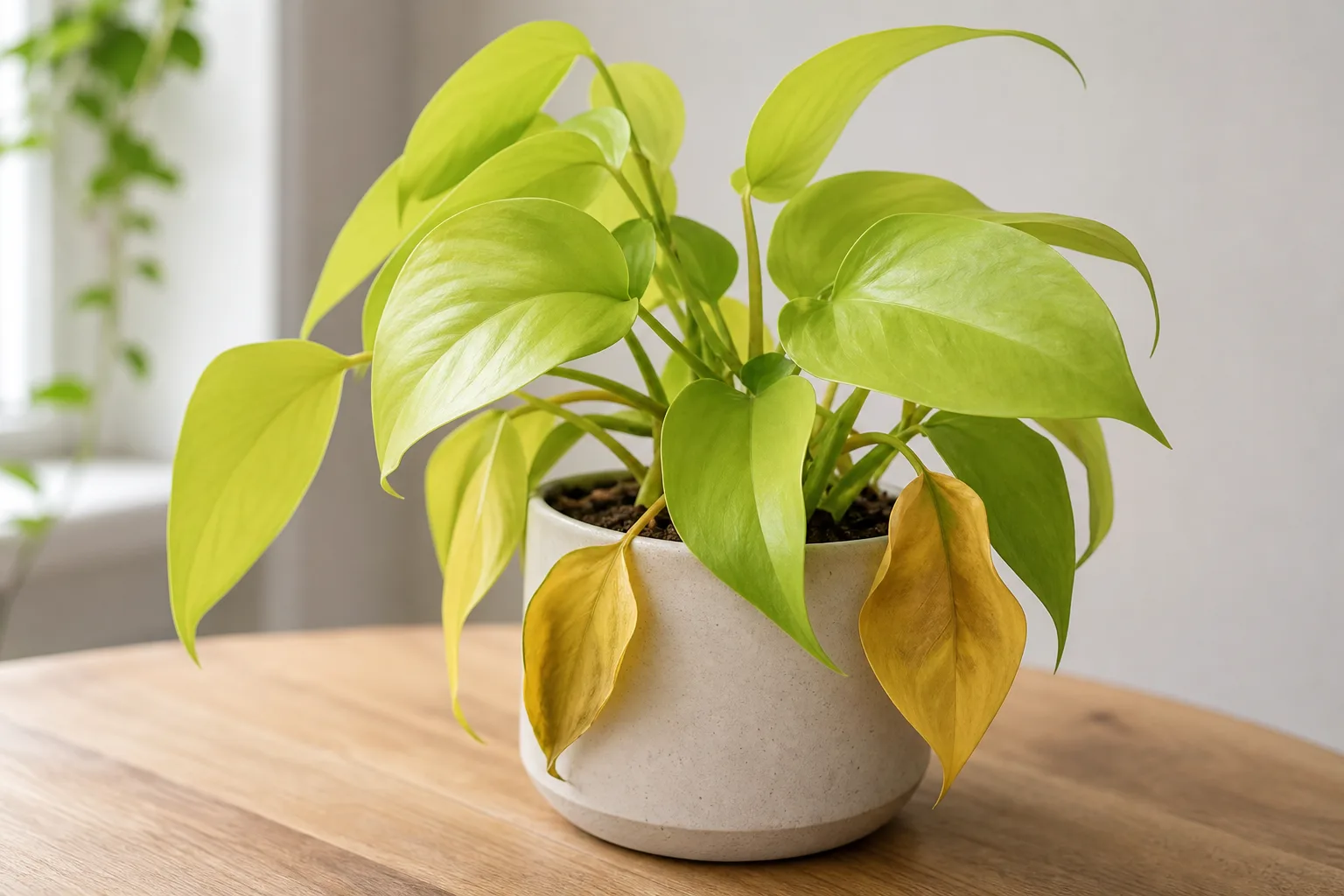
Overwatering on Philodendron Lemon Lime: Causes, Checks & Fixes
This guide covers overwatering on Philodendron Lemon Lime. See also the general Overwatering guide, watering, and light pages for this plant.
Overwatering on Philodendron Lemon Lime: Causes, Checks & Fixes
Quick answer
Overwatering on Philodendron Lemon Lime usually looks confusing at first: leaves droop and lose their bright chartreuse glow, so it can look thirsty, but the pot is still wet and heavy. First action: stop watering and let the top 3–5 cm dry before you add more.
Heartleaf philodendron types prefer soil that stays evenly moist but not saturated, and prolonged wetness can lead to root rot NC State Extension. This page covers early overwatering triage-confirming wet-soil stress and choosing the right first fix by severity. If you already have mushy roots, soft stem nodes, or a persistent sour smell, skip ahead to the full rescue workflow in /plants/philodendron-lemon-lime/root-rot/. For baseline watering rhythm, use /plants/philodendron-lemon-lime/watering/.
Overwatering vs underwatering vs root rot on Lemon Lime
The limp-leaf paradox is the main trap on this cultivar. Use this split before changing care:
| What you see | Pot / soil | Most likely cause | Where to go next |
|---|---|---|---|
| Dull chartreuse, limp vines | Heavy, damp 3–5 cm down | Overwatering stress | Stay on this page |
| Crispy edges, thin limp leaves | Light, dry throughout | Underwatering | /plants/philodendron-lemon-lime/underwatering/ |
| Fast yellowing, sour odor, soft nodes | Wet, may smell bad | Root rot progression | /plants/philodendron-lemon-lime/root-rot/ |
| Sudden collapse after a recent soak | Variable | Wilting from multiple causes | /plants/philodendron-lemon-lime/wilting/ |
Missouri Botanical Garden notes that wilting can occur from overwatering when roots are compromised, so wilt alone does not confirm thirst Missouri Botanical Garden. On Lemon Lime, chartreuse fade plus a heavy pot is the sharper tell than wilt by itself.
Why Philodendron Lemon Lime gets overwatered
The usual pattern is watering by calendar while the plant’s water use has changed. Lemon Lime can dry quickly in bright, warm growing conditions, then slow down sharply in dimmer or cooler periods. Clemson HGIC advises keeping soil evenly moist but never soggy, and warns that root rot follows poor drainage or overly frequent watering Clemson HGIC. Missouri Botanical Garden recommends reduced watering from fall into late winter Missouri Botanical Garden.
Common setup causes on this trailing cultivar:
- Cachepots and saucers that hold runoff after each drink
- Dense mixes with too little perlite or bark for a fast-growing vine
- Oversized pots that stay wet too long relative to root mass
- Dim rooms where growth and water uptake slow but the schedule does not
- Hanging baskets watered on the same weekly rhythm as summer, even as light drops in fall
Lemon Lime in a north-facing or interior corner is a frequent edge case: the top inch may look dry while the root zone below stays saturated because the plant is barely transpiring.
What overwatering looks like (early and worsening)
Early signs (mild)
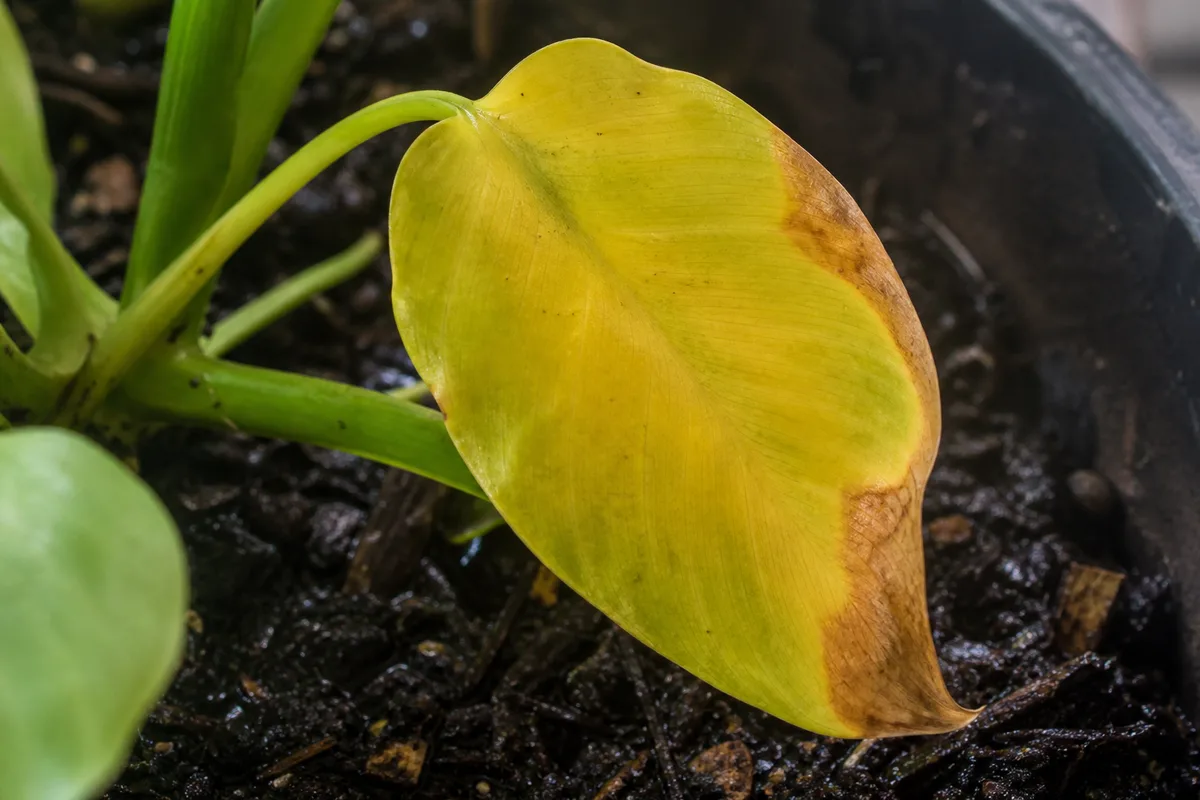
Overwatering symptoms on Philodendron Lemon Lime - compare with healthy tissue on the same plant.
- Leaves look flatter and less luminous chartreuse-not the crisp neon of healthy growth
- Vines feel soft and tired rather than springy
- Older leaves yellow first while soil remains damp below the surface
- Fungus gnats become more active around constantly damp mix Penn State Extension
Chartreuse fade vs thirst yellow: underwatering yellow often comes with dry, light pot weight and crispy leaf margins. Overwatering yellow tends to stay soft and limp, with wet soil and no crisp edge burn. When both look similar, pot weight and smell beat leaf color alone.
Worsening signs (moderate to severe)
- Sour or swampy odor from drainage holes Missouri Botanical Garden
- Stem softening when you press near nodes-especially where leaves meet the vine
- Fast yellowing or collapse even after water is withheld for several days
- New growth stalling or emerging pale and small
On Lemon Lime, node softness is a critical threshold. This vine roots easily at nodes, so decay can climb from wet soil into stem tissue faster than on thick-stemmed houseplants.
5-minute confirmation checklist
- Probe 3–5 cm deep. Damp and cool means do not water.
- Lift the pot. Heavy weight with limp leaves confirms saturation, not drought.
- Check drainage exit. Clogged holes or standing saucer water confirms a drainage trap.
- Smell near drainage holes. Sour odor suggests oxygen-poor, decaying root conditions.
- Press a node. Firm is reassuring; wet-soft means escalate today.
- Unpot only if moderate or severe signs are present. Healthy roots are firm and pale; damaged roots are mushy and dark.
First fix by severity (decision tree)
Use this branch before repotting, fertilizing, or pruning heavily.
START: Limp/dull Lemon Lime + wet soil
  │
  ├─ No odor, firm nodes, wet < 7 days
  │     → MILD: stop water, dry top 3–5 cm, improve airflow/light
  │
  ├─ Wet 7+ days OR yellowing spread OR gnat surge, still firm nodes
  │     → MODERATE: empty saucer, aerate surface, consider faster mix/repot
  │
  └─ Sour smell OR soft nodes OR mushy roots on check
        → SEVERE: unpot, trim rot, repot dry mix → root-rot guide
Mild - droopy leaves, wet soil, no odor, firm nodes
- Pause watering completely until the top 3–5 cm dries.
- Move to brighter indirect light and modest airflow without harsh direct sun Missouri Botanical Garden.
- Empty any saucer or cachepot water daily until weight drops.
- Resume watering only when the probe test reads dry at 3–5 cm.
Escalate to moderate if: soil stays wet beyond seven days, yellowing spreads to multiple leaves, or fungus gnats persist after dry-down starts.
Moderate - persistent wetness 7+ days, yellowing, gnat pressure, firm stems
- Remove all trapped runoff from saucer and decorative pot.
- Loosen only the top 2–3 cm of mix to improve evaporation-do not disturb roots unnecessarily.
- If the root ball still feels waterlogged after 48 hours of dry-down, repot into a faster-draining blend; see
/plants/philodendron-lemon-lime/soil/. - Review light placement via
/plants/philodendron-lemon-lime/light/if the plant sits in a dim corner.
Escalate to severe if: sour smell appears, any node feels soft, or yellowing accelerates after you stop watering.
Severe - sour odor, soft nodes, or mushy roots on inspection
- Unpot the same day. Trim clearly mushy roots with clean tools; keep healthy tissue only.
- Repot into fresh, airy mix in a clean pot with open drainage-do not water for several days after repot.
- Follow the full rescue sequence in
/plants/philodendron-lemon-lime/root-rot/. - If the base fails but upper nodes are firm, propagation may be the salvage path-see
/plants/philodendron-lemon-lime/propagation/.
What not to do
- Do not add more water because leaves are limp while soil is wet.
- Do not fertilize while roots are stressed and oxygen-starved.
- Do not up-pot to a larger container to “fix” overwatering-extra wet volume raises risk.
- Do not leave runoff sitting under the pot after watering.
- Do not assume yellow lower leaves always mean underwatering; Clemson HGIC lists overwatering among causes of lower-leaf yellowing on philodendrons Clemson HGIC.
- If pets may chew vines, keep trimmings and roots out of reach because philodendrons are toxic to cats and dogs ASPCA.
Recovery timeline: what to expect
Mild case example: A trailing Lemon Lime in a 15 cm pot was watered twice in one week during a cloudy stretch. Leaves dulled and drooped; soil stayed damp 4 cm down; no odor; nodes firm. After stopping water, emptying the cachepot, and moving to brighter indirect light, pot weight dropped within five days. New chartreuse tips appeared around day 10. Older yellowed leaves did not fully re-green.
| Timeframe | What improvement looks like | What still looks “wrong” |
|---|---|---|
| Days 1–3 | No further yellowing spread; soil drying toward 3–5 cm | Old leaves stay dull or limp |
| Days 7–14 | Firmer stems; first new growth tips | Damaged leaves may not regain neon color |
| Weeks 3–4 | Stable watering rhythm; reduced gnat activity | Some lower leaves may drop and not return |
If decline continues beyond two to three weeks despite corrected moisture, the issue is likely beyond simple overwatering. Review /plants/philodendron-lemon-lime/yellow-leaves/, /plants/philodendron-lemon-lime/wilting/, and the root rot guide.
How to prevent overwatering next time
Build your routine around soil dryness, not dates:
- Water thoroughly, then let excess drain fully
- Empty saucers and decorative pots promptly
- Wait for the top 3–5 cm to dry before watering again UF/IFAS Gardening Solutions
- Use a chunky, airy mix and a pot sized to the root mass
- Lengthen intervals in low-light or winter periods Missouri Botanical Garden
Your next step (by where you are now)
- Still diagnosing? Re-run the 5-minute checklist above before changing anything else.
- Mild wet soil, firm nodes? Stop water and track pot weight daily for one week.
- Wet a week or more? Move to moderate fixes and review soil and light guides.
- Sour smell or soft nodes? Open
/plants/philodendron-lemon-lime/root-rot/today-do not wait for full collapse.
Related Lemon Lime guides
/plants/philodendron-lemon-lime/- species hub and baseline care/plants/philodendron-lemon-lime/watering/- seasonal watering rhythm/plants/philodendron-lemon-lime/root-rot/- severe rescue when rot is confirmed/plants/philodendron-lemon-lime/underwatering/- limp leaves with a dry, light pot/plants/philodendron-lemon-lime/soil/- mix structure for faster dry-down/plants/philodendron-lemon-lime/fungus-gnats/- when gnats follow constant dampness