Spider Mites on Philodendron Melanochrysum: Causes, Checks
Quick answer
Spider mites on Philodendron Melanochrysum appear as fine stippling on velvet leaf undersides, bronzing, and silky webbing between petioles - often after dry, warm air. First step: isolate the plant and rinse all leaf undersides under lukewarm running water, then repeat every 3–5 days while you raise humidity.
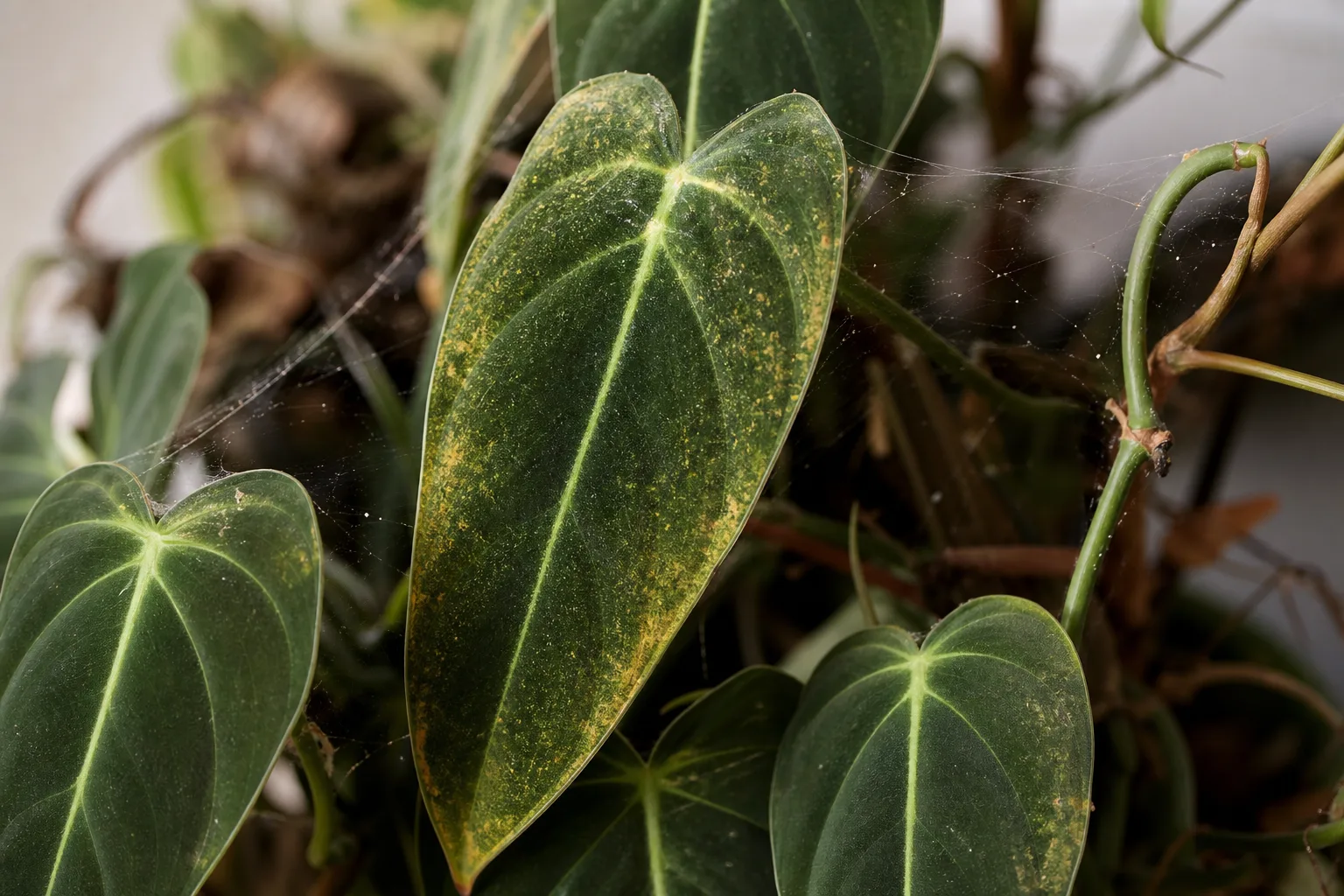
Spider Mites on Philodendron Melanochrysum: Causes, Checks & Fixes
This guide covers spider mites on Philodendron Melanochrysum. See also the general Spider Mites guide, watering, and light pages for this plant.
Spider Mites on Philodendron Melanochrysum: Causes, Checks & Fixes
Quick answer
Spider mites on Philodendron Melanochrysum appear as fine stippling on velvet leaf undersides, bronzing, and silky webbing between petioles - often after dry, warm air. First step: isolate the plant and rinse all leaf undersides under lukewarm running water, then repeat every 3–5 days while you raise humidity.
Spider mites are not insects - they are tiny arachnids that pierce individual leaf cells. On velvet melanochrysum, damage shows as sandy stippling that dulls the suede sheen long before obvious webbing appears. Dry winter air and heat vents create the exact conditions mites prefer, which is why Philodendron Melanochrysum overview can flare even when watering and light are otherwise correct.
Why Philodendron Melanochrysum gets spider mites
Spider mites thrive in warm, dry environments. Melanochrysum is often grown with high humidity for unfurling - but real setups frequently dip in winter when heating runs, grow lights add warmth without moisture, or fans increase airflow without humidification. That gap invites mites.
Philodendrons are listed among houseplants commonly affected by red spider mites. Velvet leaves are not more susceptible by chemistry alone, but the textured surface hides early colonies on undersides until stippling is widespread. Plants stressed by low humidity, irregular watering, or recent relocation are easier targets.
Mites also arrive on new purchases, cuttings, or plants summered outdoors then brought inside. WSU PestSense notes they can enter through open screens and spread plant to plant on contact or airflow.
What spider mites look like on Philodendron Melanochrysum
Watch for these signs together:
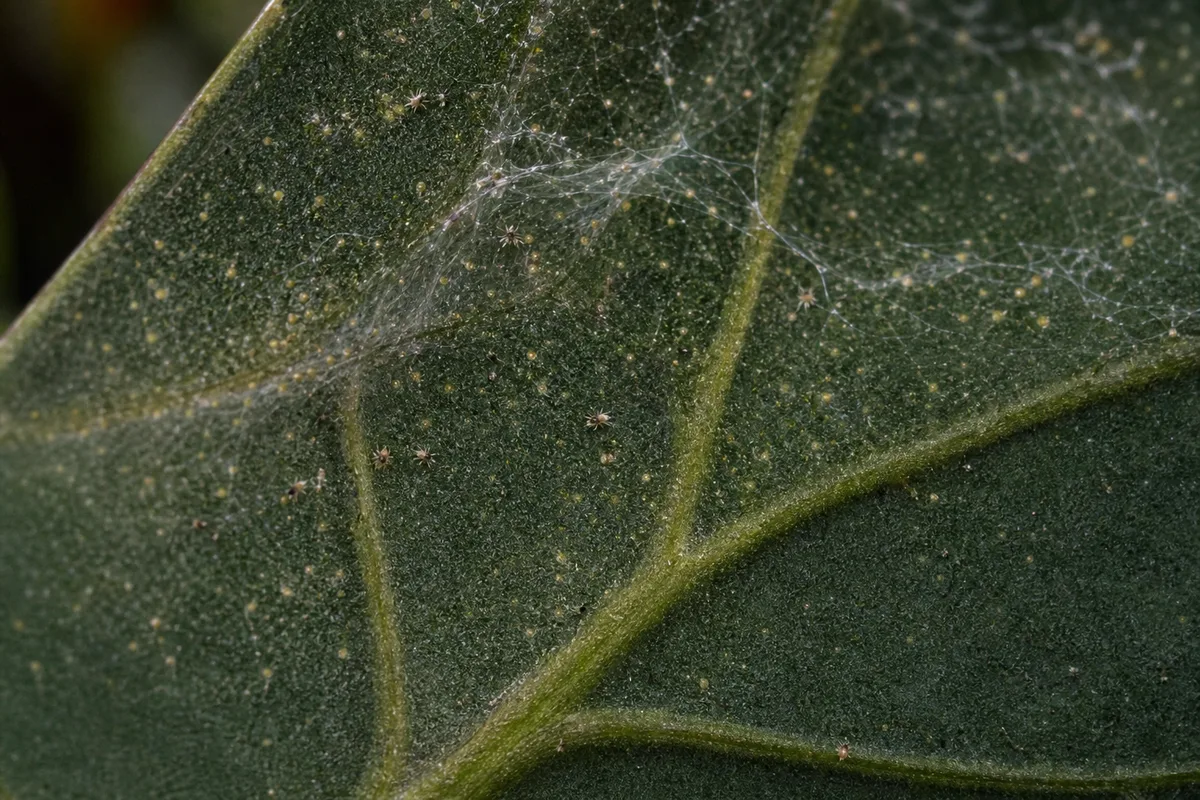
Spider Mites symptoms on Philodendron Melanochrysum - compare with healthy tissue on the same plant.
- Pale yellow or bronze stippling on leaf undersides, visible when you tilt velvet blades toward light
- Loss of suede sheen on patches of the upper surface
- Fine silk webbing between petiole bases, stem nodes, and leaf edges
- Tiny moving dots on white paper after the tap test
- New leaves emerging smaller or distorted when infestation hits the growing tip
- Overall grayish or dusty look on leaves that are not actually dusty
On melanochrysum, undersides are the inspection priority. Upper-surface bronzing on velvet can look like humidity damage - flip the leaf before treating humidity alone.
How to confirm the cause
- White-paper tap test - Hold white paper under a suspect leaf and tap firmly. Moving specks confirm mites; static dust does not walk.
- 10x check - Phone macro or hand lens on the underside reveals oval mites and round eggs along veins.
- Webbing search - Pull a leaf gently toward the stem; fine silk threads stretching between surfaces indicate active colonies.
- Neighbor scan - Inspect all aroids within two metres; shared infestations confirm pest, not cultural, cause.
- Environment check - Heat vents, south windows, and dry winter rooms support the mite hypothesis.
Lookalike symptoms to rule out
Low humidity causes edge crisping and torn cataphylls without stippling or webbing. Thrips leave silver scrape marks and black specks of frass, not fine silk. Powdery mildew is a white fungal film, not cell-level speckles. Hard-water spots wash off; mite stippling does not.
First fix for Philodendron Melanochrysum
Isolate the plant immediately and rinse every leaf surface - especially undersides - under a lukewarm shower or faucet spray. Mississippi State Extension notes that washing leaves with a forceful spray removes mites and is practical on manageable houseplants when repeated at 3–5 day intervals.
Wrap the pot in plastic to keep soil in place during rinsing. Let foliage dry in Philodendron Melanochrysum light guide, not direct sun while wet. Start a humidifier the same day; WSU PestSense recommends increasing humidity around plants to discourage mite reproduction - without overwatering the root zone.
Do not jump to heavy oils on the first day if you can rinse thoroughly instead. Make mechanical removal the first correction, then escalate if mites persist after two weeks.
Step-by-step recovery
Follow this two-week minimum cycle:
- Day 1 - Isolate, rinse undersides, boost humidity, inspect neighbors.
- Days 3–5 - Rinse again. If populations remain, apply insecticidal soap or horticultural oil labeled for spider mites, covering undersides completely.
- Repeat every 3–5 days for two full weeks to catch newly hatched mites - treatments do not kill all eggs in one pass.
- Monitor new growth - The next unfurling leaf should show no fresh stippling.
- End quarantine - Return the plant to the collection only after two weeks with no new webbing and a clean tap test.
UC IPM advises excellent underside coverage and avoiding oil or soap sprays on water-stressed plants or above 90°F. Test one melanochrysum leaf with any new product and wait 48 hours - velvet can mark more visibly than smooth philodendron leaves.
Recovery timeline
Light infestations often clear within two weeks of rinse-plus-humidity alone. Moderate cases needing soap or oil may require three to four treatment cycles over the same period. Stippled velvet tissue does not smooth out; judge by clean new leaves and absent tap-test mites.
Reinfestation from untreated neighbors is common - treat the shelf, not one pot.
What not to do
- Do not assume misting alone fixes an active infestation - it does not reach undersides reliably.
- Do not use systemic imidacloprid expecting mite control; Mississippi State Extension notes it does not control spider mites.
- Do not mix insecticidal soap and horticultural oil in the same bottle.
- Do not spray oils in direct sun or on wilted vines.
- Do not return the plant to the main collection after a single rinse.
- Do not wipe velvet blades aggressively with alcohol - test a small patch first; suede texture can discolor.
How to prevent spider mites next time
Run steady humidity near 60% during heating season, quarantine new plants for 14 days with at least two tap tests, and inspect melanochrysum undersides weekly. Keep plants off hot radiators and away from forced-air blasts.
When bringing outdoor plants inside, isolate for a month per WSU guidance. Mites are easier to prevent than to eradicate once webbing spans a velvet vine.
When to worry
Spider mites become high severity when:
- Webbing covers multiple leaves and the growing tip
- Several plants in the same room test positive
- New leaves abort or emerge heavily stippled
- Two full treatment weeks fail and tap tests still show movers
If chemical treatment on velvet leaves causes burn, fall back to rinse-only cycles at shorter intervals and keep humidity high. Severely defoliated vines with firm roots can recover from the apical bud - discard only if the growing tip is dead and mites remain on the stem.
Conclusion
Spider mites on Philodendron Melanochrysum exploit warm, dry air and hide on velvet undersides until stippling spreads. Confirm with the tap test and webbing; fix by isolating, rinsing undersides every 3–5 days for two weeks, raising humidity, and using soap or oil if needed with complete underside coverage. Prevent through quarantine, weekly underside checks, and steady humidity. Judge recovery on clean new growth - not on old stippled blades.
When to use this page vs other Philodendron Melanochrysum guides
- Philodendron Melanochrysum watering guide - Use for routine moisture checks before assuming spider mites is the main issue.
- Philodendron Melanochrysum problems hub - Browse all 10 common issues on this species.
- Leaf Drop on Philodendron Melanochrysum - Different entry point when symptoms overlap with spider mites.
- Slow Growth on Philodendron Melanochrysum - Different entry point when symptoms overlap with spider mites.