Philodendron Prince of Orange Pruning: When, How
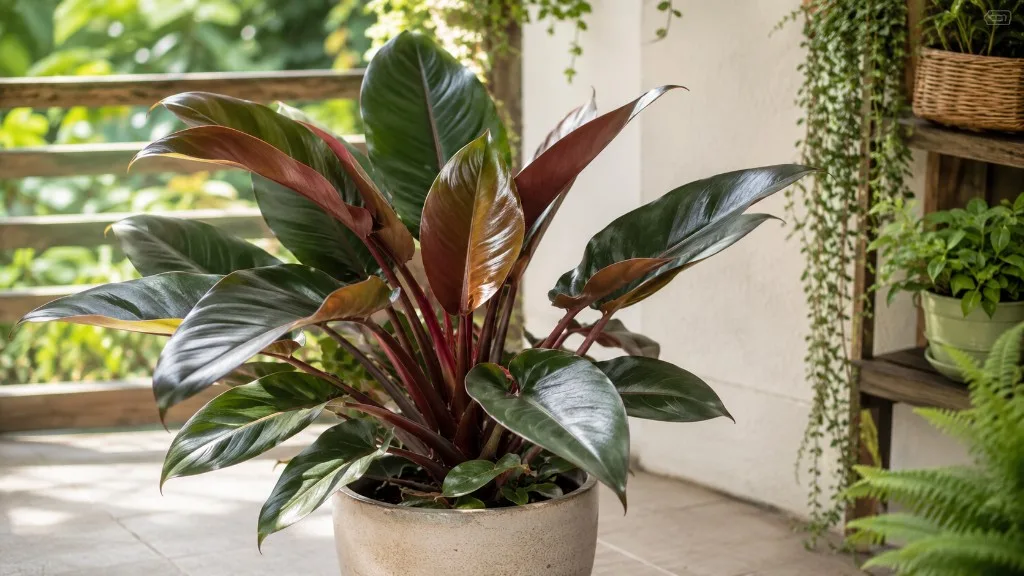
Philodendron Prince of Orange Pruning: When, How, and Mistakes to Avoid
Philodendron Prince of Orange Pruning: When, How, and Mistakes to Avoid
First, remove only fully yellow, brown, or soft leaves — trace each petiole to the crown and snip flush at the base with clean bypass pruners. Philodendron Prince of Orange (Philodendron erubescens ‘Prince of Orange’) is a self-heading cultivar grown for copper-orange new leaves that mature to deep green. For whole-plant context — light, watering, and color signals — see the Prince of Orange overview.
Quick Answer
Most Prince of Orange owners prune for hygiene and crown access, not vine management. Remove senescent lower leaves at the crown, trim stable brown tips on otherwise firm blades, and shorten a stretched petiole in spring if the rosette leans. NC State Extension describes ‘Prince of Orange’ as a non-vining, compact, bushy erubescens cultivar whose leaves emerge orange, transition to copper, and mature deep green — cuts follow crown logic, not trailing vine rules. RHS philodendron guidance notes that bushy philodendron types generally do not need training or support. Scissors tidy dead tissue; brighter indirect light preserves the orange new-leaf phase after any cut. When several leaves yellow while soil stays wet, fix watering before structural pruning.
What Pruning Does for Prince of Orange
Prince of Orange grows as an upright self-heading rosette — leaves emerge from a central crown and arch outward without climbing. New foliage opens bright orange or yellow, passes through a copper phase, and hardens to glossy deep green while stems stay reddish. Unlike vining philodendrons such as Pink Princess, Prince of Orange needs no moss pole and rarely needs shaping beyond hygiene, crown light exposure, or correcting a petiole that stretched toward weak light.
Pruning serves four practical jobs on Prince of Orange:
- Removes dead or diseased leaves that hold moisture and pests at the crown
- Opens the center so new orange-toned leaves receive light instead of sitting under older outer blades
- Shortens one stretched petiole after light improves, when the silhouette leans or internodes elongate
- Supports division at repot when multiple rooted crowns need size control
Pruning does not restore orange new-leaf color when light is too low. If the newest unfurling leaf opens green with no copper phase, improve placement per the light guide before expecting scissors to fix the show. Older leaves naturally turn greener with age — that is normal maturation, not a pruning failure.
What to Check Before You Cut
Walk through this checklist at the crown:
- Newest leaf color — the diagnostic leaf is always the newest unfurling one at the crown. Green-only new growth usually means light is too low; compare with light placement before cosmetic trimming.
- Leaf color and firmness — fully yellow or brown only, unless disease spots are spreading. Several blades declining at once often trace to moisture, not shear timing.
- Petiole base — mushy or black tissue at the crown needs gentle removal, not a tug that tears stem bark. Clemson HGIC notes that long petioles on self-heading philodendrons are brittle — support leaf weight when cutting.
- Crown center — active new leaves unfurling from the middle confirm the growing point is healthy. Never cut into this zone.
- Pot and roots — sour smell, persistent wet mix, or weekly re-yellowing after cuts means fix moisture first.
The ASPCA lists philodendron as toxic to cats and dogs. Wear gloves when cutting — calcium oxalate sap can irritate skin.
The First Cut to Make
After inspecting the crown, remove fully yellow, brown, collapsed, or pest-heavy leaves before considering outer leaf removal or stem shortening. Trace each petiole to where it meets the main stem and cut at the base in one clean motion — roughly flush with the crown, without gouging into green stem tissue.
Brown tips only: if the blade is otherwise firm and mostly green, trim the dead edge with scissors rather than removing the whole leaf. Prince of Orange leaves are large and costly to replace. When margins keep returning after edge trims, check humidity and watering rhythm before removing more tissue.
When to Prune Prince of Orange
Prince of Orange tolerates light cleanup year-round, but timing changes speed, not survival. Active-season cuts produce visible new leaves within two to four weeks; winter cuts may sit unchanged longer in cooler, dimmer homes.
Best season for shaping and outer leaf removal
Late spring through summer is the ideal window for removing outer spent leaves, shortening one stretched petiole, or dividing at repot. Daylight is increasing, the pot dries on a predictable rhythm, and new orange leaves are already unfurling. RHS philodendron guidance recommends spring repotting and division for overcrowded philodendrons — the same window suits structural pruning on self-heading types.
Early autumn works as a second option if your space stays warm and bright through winter.
Cuts that cannot wait
Some trimming should not wait for spring:
- Fully brown, dry, or mushy leaves — snip at the petiole base any time
- Heavily pest-infested sections — remove the worst leaves once you have a treatment plan for the rest
- Disease spots spreading on lower blades — cut affected leaves and sterilize blades between cuts
- Brittle petiole snapped by traffic — trim the torn stub cleanly at the crown
When to delay major pruning
Hold off on multi-leaf or stem cuts when:
- The plant was recently repotted within the last two to three weeks — see repotting timing
- You are recovering from root stress and leaves are still dropping — stabilize roots before removing substantial foliage
- The specimen is weak or recently recovered from pest damage — a light sanitation pass is enough until new growth stabilizes
- You are in late autumn or winter with low light unless you accept a slow response
- You want to fix dull or green-only new leaves — that is a light adjustment, not a pruning task
Where to Cut: Crown and Petiole Technique
Prince of Orange is self-heading, so cuts happen at the crown — where petioles meet the central stem — not along long vine internodes. Clemson HGIC lists ‘Prince of Orange’ as a compact grower that needs high light to maintain color and growth — open the crown after cleanup so new leaves receive that light.
Dead or yellow leaves: cut the petiole flush at the crown in one motion. Do not leave stubs that hold moisture.
Outer spent leaves blocking light: remove the lowest or outermost fully mature leaves at the same petiole base. Stop when the center receives filtered light — usually one to three outer leaves, not half the plant.
One stretched petiole: if a single stalk elongated toward a window, cut the petiole 5–8 mm above the highest viable node — the raised ring where a leaf attached. Improve light before or alongside the cut. Expect one modest replacement from the crown, not multiple side branches.
Never cut into the central growing point where new leaves emerge. That meristem is the plant’s only upward engine on a self-heading rosette.
Sterilize blades with rubbing alcohol between cuts when removing diseased or pest-damaged tissue. Iowa State University Extension notes that 70% isopropyl alcohol sanitizes metal pruning surfaces effectively for home use.
How Much You Can Safely Remove
Limit healthy leaf removal to about one-third of the plant per session under normal conditions. Lower leaves that are already fully yellow do not count toward that limit if the crown stays vigorous.
Prince of Orange replaces large blades slowly. Removing too many mature leaves at once stalls recovery and often pushes weak, pale new growth instead of firm orange-copper leaves. For severely crowded specimens, spread outer leaf removal across two spring or summer sessions spaced four to six weeks apart.
Pruning for Shape and Size Control
Prince of Orange naturally forms a compact upright rosette with leaves arching outward. RHS lists mature height and spread at roughly 0.5–1 metre indoors — modest by philodendron standards but still worth managing on a shelf or floor pot.
Size control usually means:
- Removing outer older leaves so the crown stays lit and compact
- Rotating the pot weekly to prevent one-sided stretch toward the brightest window
- Dividing at spring repot when multiple rooted crowns fill the pot — cleaner than repeated leaf stripping
Do not expect vine-like fill-in along a bare lower trunk. Self-heading philodendrons concentrate new growth at the crown. If lower stems look bare after years of outer leaf drop, division or accepting the natural rosette silhouette beats repeated crown cuts that thin the plant.
Using Pruned Material and Division
Division at repotting — separating sections with roots and several leaves each — is the reliable propagation path for Prince of Orange. Clemson HGIC lists division and offsets among standard philodendron propagation methods for clumping forms.
Tight self-heading crowns make single stem cuttings awkward compared with vining relatives. Full medium-specific steps live in the propagation guide. Keep divided sections in bright indirect light and hold fertilizer until new growth looks firm.
Aftercare and Recovery
After pruning, focus on conditions that support clean regrowth:
- Medium to bright indirect light — essential for orange new-leaf color; harsh direct sun scorches leaves
- Water when the top 3–5 cm of mix dries — hold fertilizer two to three weeks post-prune while wounds callus
- Moderate humidity (50–60%) — supports clean unfurling without stagnant damp foliage
NC State Extension notes this species prefers warm temperatures and high humidity indoors. Avoid stacking repotting, relocation, and heavy pruning on the same week.
During active growth, new crown leaves often appear within two to four weeks after light cleanup. One petiole shorten or spring division may take four to eight weeks before new growth looks firm. Autumn or winter pruning can double that timeline in cool dim rooms.
Signs Pruning Worked (or Went Too Far)
Pruning worked when:
- New orange or copper leaves unfurl from the crown within two to four weeks during active growth
- Yellowing stops once watering is corrected
- The rosette sits balanced without lean after outer leaf removal
- Divided sections push firm new petioles within four to eight weeks
Pruning went too far or was badly timed when:
- No new growth appears for six or more weeks during warm active season
- New leaves emerge smaller, thinner, or open green with no copper phase — usually a light problem, not a shear problem
- The plant wilts or yellows widely after removing more than one-third of foliage
- Continued leaf drop after cuts — pause and stabilize watering and light before removing more tissue
Mistakes to Avoid
- Pruning to fix green-only new leaves — improve light instead
- Cutting into the central growing point — destroys the only upward growth engine
- Removing too many mature leaves for symmetry — weak replacements and a thin crown
- Expecting vine-like branching from node cuts — self-heading habit limits side shoots
- Adding a moss pole expecting better orange color — upright habit does not climb; light drives color
- Cutting during active overwatering stress — yellow leaves return until roots recover
- Snapping brittle petioles by tugging — cut cleanly at the crown with pruners
- Skipping tool sanitation — sap and spores spread easily at the crown
- Handling cut material bare-handed around pets — sap is irritating and plant parts are toxic if chewed
Conclusion
Philodendron Prince of Orange pruning is crown-level maintenance for a self-heading color-forward rosette. Remove dead tissue first, open the center to light with modest outer leaf removal, shorten one stretched petiole only after light improves, and divide when the pot is genuinely crowded. Placement — not scissors — preserves the orange new-leaf show between sessions.
When to use this page vs other Philodendron Prince of Orange guides
- Philodendron Prince of Orange overview — Start here for whole-plant context before deep-diving this topic.
- Philodendron Prince of Orange light — Escalate here when new leaves open green with no copper phase.
- Philodendron Prince of Orange watering — Escalate here when yellowing persists after appropriate cuts.
- Philodendron Prince of Orange propagation — Escalate here when division at repot is the next step after size-control pruning.