Not Enough Light on Philodendron White Knight: Causes
Quick answer
Not enough light on Philodendron White Knight fades white variegation on new leaves, stretches stems, and slows growth. First step: move to bright indirect light-without hot direct sun on white sections-and add a grow light in dim winters.
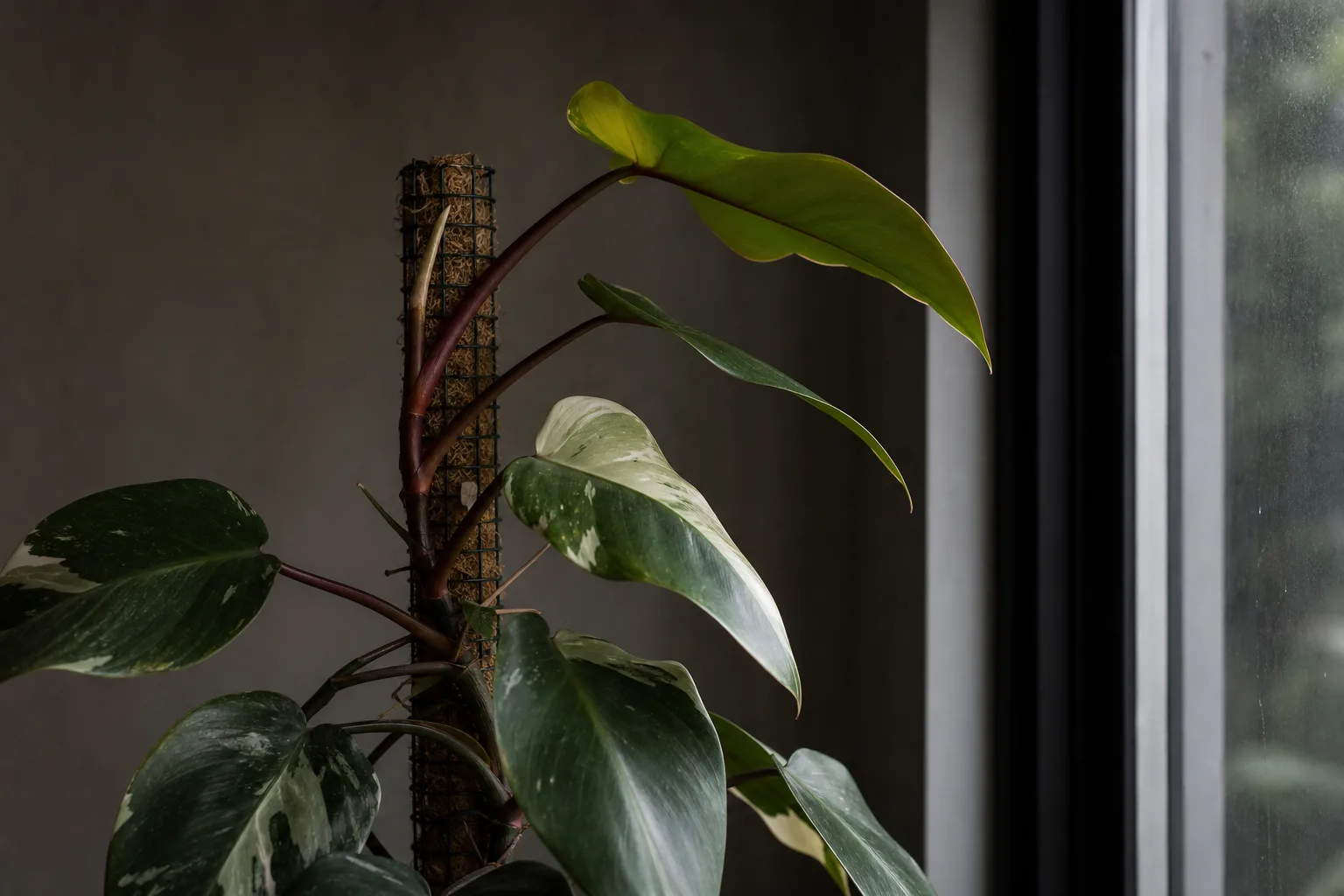
Not Enough Light on Philodendron White Knight: Causes, Checks & Fixes
This guide covers not enough light on Philodendron White Knight. See also the general Not Enough Light guide, watering, and light pages for this plant.
Not Enough Light on Philodendron White Knight: Causes, Checks & Fixes
Quick answer
Not enough light on Philodendron erubescens ‘White Knight’ shows up as fading white variegation on new leaves, long gaps between leaves on the moss pole, and a vine that leans toward the brightest spot-not sudden collapse. This climbing variegated cultivar needs bright filtered or partial-shade light indoors. White tissue has less chlorophyll than green sections, so White Knight needs more usable photons, not less, to hold the contrast collectors buy it for.
First step: move the plant to bright indirect light where the leaves-not just the room-receive several hours of indirect illumination daily. Protect white sections from hot direct sun, which can scorch pale tissue faster than green. Do not repot, fertilize, or add a moss pole on day one; photons fix the problem.
White Knight can stay upright and green in a dim corner while quietly losing variegation-survival is not success. Dim rooms also keep soil wet longer because low light reduces water use, which raises overwatering risk when you water on a bright-room schedule.
For stretch with long internodes and sparse vine on the pole, see leggy growth on White Knight-this page is the canonical low-light diagnostic; leggy growth is the etiolation deep dive.
What low light looks like on White Knight (vs. leggy growth)
Healthy White Knight on a moss pole shows burgundy stems, heart-shaped leaves with balanced green-and-white patterning, and a measured rhythm of new spears-not frozen months in the same spot. Each new leaf should carry visible white sections; the vine should feel supported, not sparse.
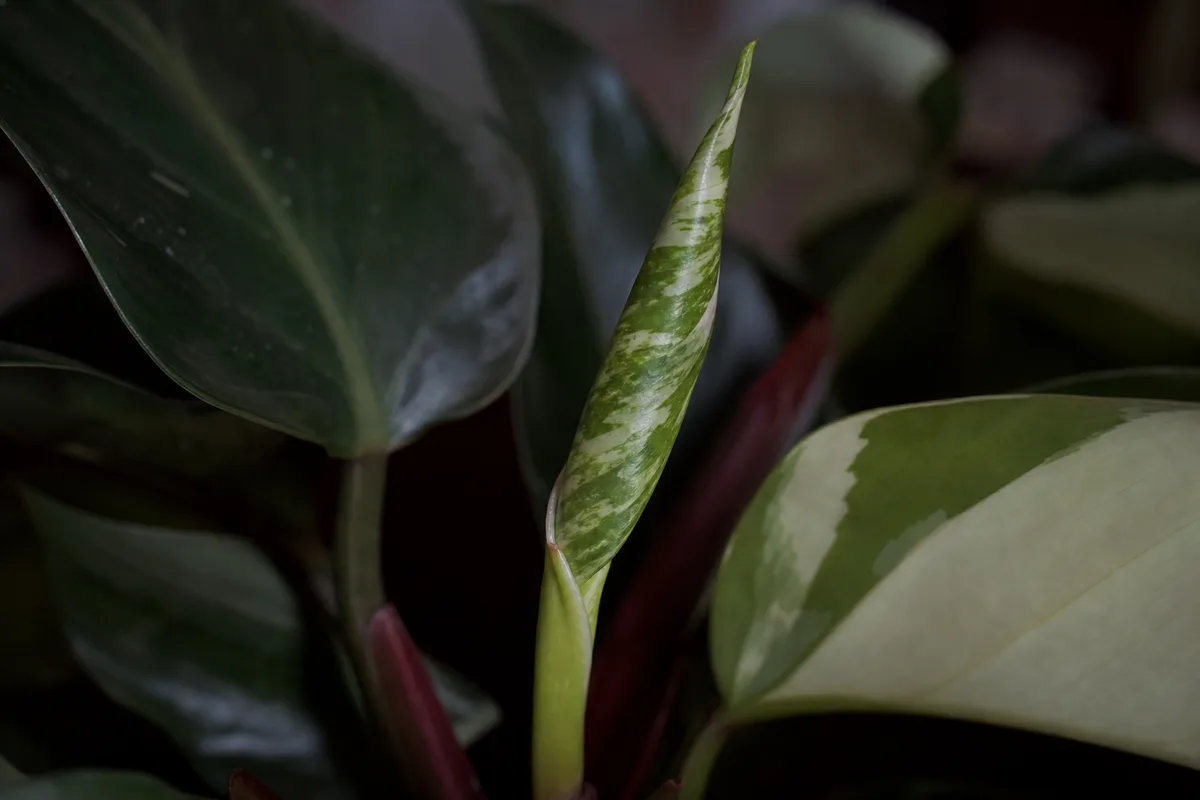
Not Enough Light symptoms on Philodendron White Knight - compare with healthy tissue on the same plant.
Low-light White Knight breaks that pattern:
- Fading or missing white on new leaves - Latest spears emerge mostly green or show thin, patchy white instead of bold contrast
- Long internodes on the moss pole - Wide gaps between leaves; the vine looks sparse despite correct watering
- Directional lean - Burgundy stems and new growth angle sharply toward a window or lamp
- Smaller new foliage - Recent leaves are narrower or shorter than mature ones lower on the pole
- Stalled or very slow new spears - No new leaves for many weeks during warm months while the plant otherwise looks alive
- Persistently wet soil - Mix stays heavy 10–14 days after watering because transpiration drops in shade
- Older leaves hang on while new ones stay small - The plant survives on old tissue while losing collector value on new growth
Unlike a solid-green heartleaf philodendron that tolerates back-shelf life, White Knight is sold for white variegation on a climbing habit. When white fades and spacing widens, insufficient light is the leading diagnosis-not a mysterious disease.
Routing: If your main worry is stretch and etiolation (long bare burgundy stem sections, pruning nodes, moss-pole support), read leggy growth. If your main worry is placement and variegation retention, stay on this page.
Why White Knight needs more light than solid-green philodendrons
White Knight is a climbing erubescens cultivar in the arum family. White and cream sections contain less chlorophyll than solid green tissue, so the plant needs more usable light to photosynthesize and hold its pattern. When photons are scarce, White Knight prioritizes survival over aesthetics: greener leaves, elongated stems toward the brightest source, and slower overall metabolism.
Direct sunlight should be avoided on white sections-they scorch easily-but deep shade causes the opposite failure: variegation fade, stretch toward light, and small leaves. That pairing on a burgundy-stemmed climber is a textbook light-stress signature.
Common White Knight–specific triggers include:
- Decor placement over light placement - Looks fine on a distant shelf but receives only ambient room glow, often below 100 foot-candles at leaf level
- North-facing rooms without supplementation - Fine for true low-light plants, marginal for variegated philodendrons
- Winter daylight drop - Shorter days reduce intensity even at the same window
- Moss pole keeping top growth in dim upper air - New leaves unfurl highest on the pole; if only the base sits near glass, the canopy may be light-starved
- Dirty glass, heavy sheers, or furniture blocking the window - Cuts usable light more than owners expect
- Nursery shade stock moved home without acclimation - Garden-center dim shelves produce green survival leaves; a sudden jump to harsh sun burns white tissue-bright filtered light with gradual adjustment is the target
Low light also slows water uptake. White Knight’s mix may stay wet longer in dim corners, which does not cause light stress directly but raises overwatering and root rot risk if you keep watering on a bright-room schedule.
Seven checks before you change anything else
Work through these in order:
- Newest leaf variegation - Inspect the last two or three spears. Steady white fade on each new leaf fits light stress better than pest stippling or one random pale leaf.
- Burgundy stem direction - Do petioles and the vine point toward a window or lamp? Strong directional lean confirms light seeking.
- Hand shadow test - Hold your hand between the window and the foliage at midday. A soft shadow with clear edges suggests adequate indirect light; a faint or absent shadow means too dim for variegated erubescens.
- Moss-pole height vs. window - Check light at the top leaf, not just the pot. Canopy leaves far from glass often fade first.
- Season check - Did symptoms start or worsen in late fall or winter? Seasonal intensity drop is common indoors.
- Soil dry-down speed - Pot still damp 10–14 days after watering in a dim spot supports low-light culture; pair any watering adjustment with brighter placement per our watering guide.
- Pest scan - Inspect leaf undersides for spider mites or mealybugs. Pests cause stippling and webbing, not classic faded variegation with wet slow-drying soil.
If new leaves show balanced white patterning, even spacing when rotated toward light, and the pot dries on a normal rhythm, White Knight is not light-starved-compare against when you bought it or healthy reference photos on our overview.
First fix: bright indirect light + moss pole + rotation
Move the plant to bright filtered light where leaves receive several hours of indirect illumination daily, and rotate the pot one quarter turn.
Good targets include an east-facing window with the moss pole 30–60 cm (12–24 in.) from glass, or several feet back from a south- or west-facing window with sheer curtain filter. White Knight wants partial shade to bright filtered light-not deep shade and not hot direct midday rays on pale leaf sections.
If the plant came from very dim conditions, increase light over 7–10 days rather than jumping straight into harsh sun. Sudden intense direct light can bleach or brown white sections. Rotate weekly so all sides of the vine develop evenly on the pole.
Do not fertilize, repot, or prune heavily on day one. Those steps do not replace photons and can stress a plant already compensating for shade.
Step-by-step recovery after the move
- Adjust watering to match new light - Brighter exposure dries the pot faster. Check the top 3–5 cm (1–2 in.) of mix before each drink instead of following an old calendar from the dim corner.
- Add supplemental light if windows are insufficient - In dark winter rooms or north-facing spaces, a full-spectrum grow lamp 30–60 cm (12–24 in.) above the canopy for 12–14 hours daily can stabilize variegation. Sixteen hours of light and eight hours of darkness work well for many indoor plants under artificial supplementation.
- Clean the window and clear obstructions - Remove grime, open sheers during daylight, and pull the pole closer to glass if safe from cold drafts and direct scorching sun.
- Prune only after new growth improves - When the next two leaves show better spacing and white contrast, trim the worst faded or stretched sections just above a node with visible white patterning. See our pruning guide and propagation guide for node selection.
- Hold fertilizer until growth stabilizes - After two weeks of improved leaves, feed lightly at half strength during active growth if the plant is otherwise healthy. Feeding a still-stressed White Knight in marginal light pushes soft tissue without fixing the root cause.
- Keep the moss pole - Unlike self-heading philodendrons, White Knight is a climber; the pole brings new leaves closer to your light source. Do not remove support expecting the vine to bush without photons.
Placement vignette
A White Knight on a living-room shelf 2.5 m (8 ft) from south glass often produces mostly green new leaves with 4–5 cm (1.5–2 in.) internodes over four weeks-the plant survives but loses white contrast. Moved to an east windowsill with the moss pole 45 cm (18 in.) from glass, the next two spears commonly show stronger white patterning and tighter spacing within about three weeks in warm active growth. Your room will differ; judge by new leaf quality, not calendar promises.
Recovery timeline and when to worry
Expect visible improvement on the next one or two leaves within two to four weeks after adequate light-stronger white contrast and tighter internodes are the signals that matter. Full visual recovery of the vine silhouette may take two to three months as new compact foliage replaces the pale stretched profile.
Old faded or fully green leaves do not revert. Leaves that opened mostly green stay that way even after conditions improve; judge success by new growth quality, not by old tissue reshaping itself.
Worsening signs: continued fade on every new leaf after four weeks in brighter light, yellowing lower leaves with persistently wet soil, or soft burgundy tissue at the soil line. Those point to overlapping water stress or advanced root issues-not light alone-and need root inspection per our root rot guide.
Low light alone is usually medium severity for aesthetics and growth. Escalate when yellow leaves stack up while soil stays wet in a dark corner-then light becomes urgent because rot risk rises.
Lookalike symptoms
| What you see | Likely cause | What to check | Where to read |
|---|---|---|---|
| Mostly green new leaves, long internodes, lean toward window | Low light / etiolation | Shadow test, newest spear variegation | This page; leggy growth |
| Yellow lower leaves, sour smell, wet mix 10+ days | Overwatering in dim corner | Moisture depth, root firmness | Overwatering |
| Limp leaves on already-wet soil | Root damage | Node softness, smell | Root rot |
| One stem fully green, others variegated | Chimeric reversion in shade | Light on that stem’s side; node white pattern | Pruning, propagation |
| Crispy brown tips, firm leaves, normal soil | Humidity / water quality | Air moisture, white edge burn | Low humidity |
| No new leaves but compact form, balanced variegation | Normal slow pace or cool rest | Light level, temperature, root health | Slow growth |
Mistakes to avoid
Do not move straight from a dark corner into direct south-window sun without acclimation; white variegation burns easily while green sections tolerate more.
Do not increase fertilizer to force white color; soft nitrogen growth in dim rooms makes stretch and fade worse.
Do not keep watering on the old schedule when brighter light dries the pot faster, or when dim light keeps soil wet-both extremes cause secondary stress.
Do not mistake survival for success - White Knight can stay green in low light while quietly losing the variegation you bought it for.
Do not assume a north window is enough without checking leaf response; variegated philodendron cultivars generally need brighter indirect conditions than solid-green heartleaf types.
Do not install a taller moss pole expecting the vine to climb into brightness without moving the whole setup closer to the window or adding a lamp.
Prevention, grow lights, and ongoing placement
Place White Knight where bright filtered light hits the leaves on the moss pole, not just where the pot looks good on camera. East windows and filtered south or west exposures match erubescens indoor cultural needs for a variegated climber.
Rotate the pole weekly so the vine does not one-sided stretch. Supplement winter windows with a grow lamp before fade and stretch start, not after the plant has already leaned.
For north-facing rooms or short winter days:
- Use a full-spectrum LED 30–60 cm (12–24 in.) above the top leaves
- Run 12–14 hours daily on a timer; allow at least 8 hours of darkness
- Watch for bleached or curled new leaves-raise the lamp 5–8 cm (2–3 in.) if white sections show burn
Match watering to how fast the pot dries in your light level-see our watering guide. The best plant long-term balances white variegation with steady growth, not maximum whiteness in weak light that cannot sustain it.
For ongoing window direction, distance, and seasonal adjustment, use our White Knight light guide.
Related White Knight guides
- Overview - burgundy stem ID, variegation biology, collector context
- Light guide - placement reference for windows and seasons
- Watering - dry-down rhythm after you fix placement
- Leggy growth - etiolation-specific pruning and moss-pole recovery
- Overwatering and root rot - when dim corners keep soil wet
- Propagation and pruning - node selection after light improves
Conclusion
Not enough light on Philodendron White Knight is the plant telling you it cannot hold white variegation or compact vine form in current placement. Confirm with green reversion on new spears, long internodes, and burgundy stems leaning toward the window; fix with bright filtered exposure, weekly rotation, and grow-light supplementation when windows fail. Judge recovery by the next two leaves-not by old green tissue turning white again. With adequate photons and adjusted watering, White Knight can look like the collector climber you bought, without heavy feed or repot cycles on day one.