Leggy Growth on Rose: Causes, Checks & Fixes
Quick answer
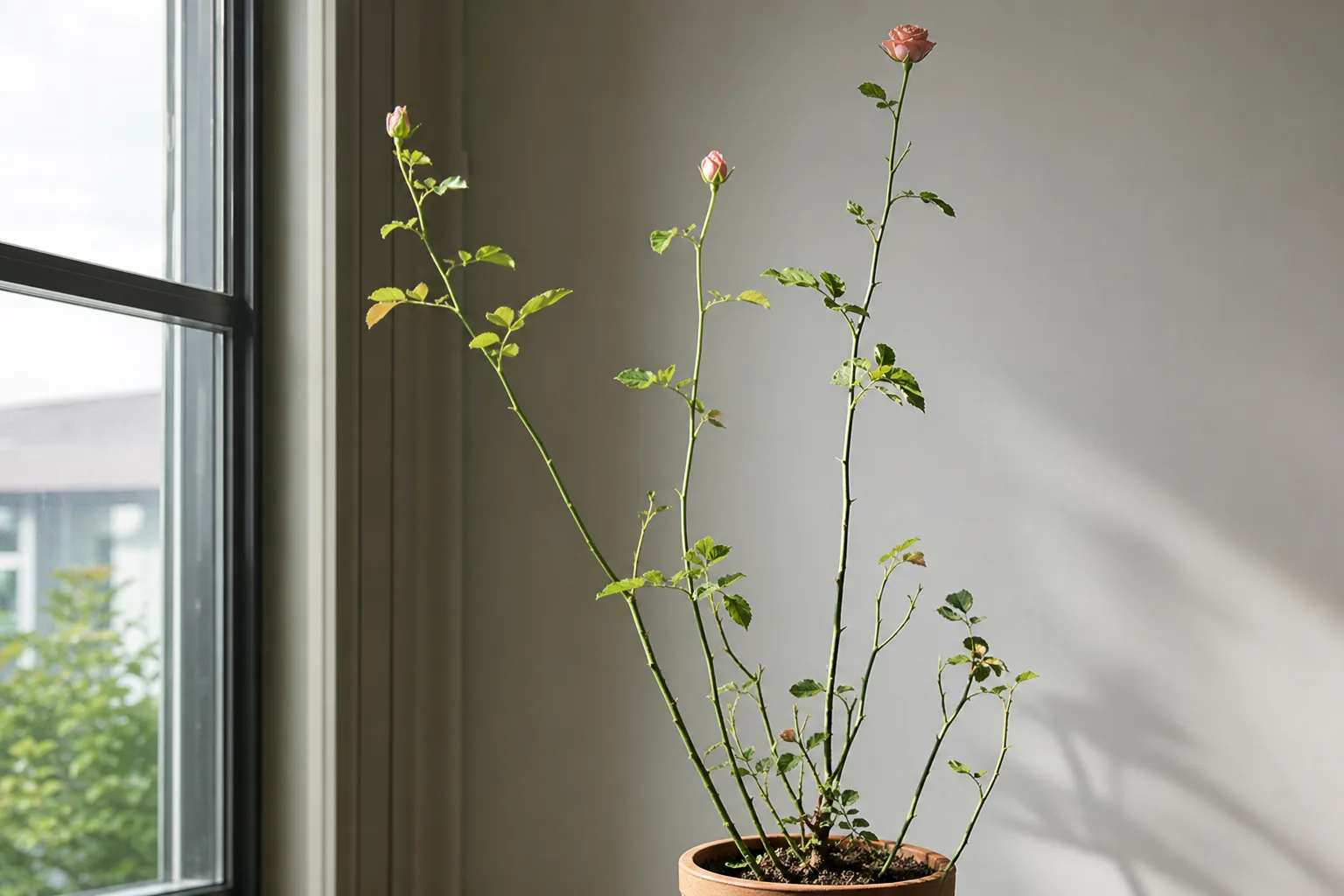
Leggy growth on Rose means long thin canes with wide leaf gaps and weak or missing flowers-usually from too little direct sun or skipped pruning. First step: move the container to the sunniest spot with six or more hours of direct sun daily.
Leggy Growth on Rose: Causes, Checks & Fixes
This guide covers leggy growth on Rose. See also the general Leggy Growth guide, watering, and light pages for this plant.
Leggy Growth on Rose: Causes, Checks & Fixes
Quick answer
Leggy growth on a rose is not vigorous health-it is the plant reaching for light or pushing weak upright wood because the bush lost its shape. Hybrid tea and floribunda roses in containers need full sun to build short, flower-bearing canes. When they sit in partial shade, bright-indoor light only, or a corner blocked by walls and furniture, stems elongate, leaves shrink, and buds either fail or sit alone at the tips of thin shoots.
First step: move the container to the sunniest available location with six or more hours of direct sun daily. Do not repot, double the fertilizer, or hard-prune everything on the same day. Once the plant is in adequate light, you can shorten the worst canes and deadhead to redirect energy-but light comes first.
Leggy growth vs. bloom failure: This page owns structural stretch-long bare canes, wide internodes, water shoots, and pruning-architecture recovery. If your main complaint is buds that never open or a bush that stopped flowering entirely, start with the no flowers guide. For placement, sun-hour counting, and grow-light specs, see not enough light on Rose and the rose light guide.
Original diagnostic photos (etiolated hybrid tea with wide internodes vs. compact bush after relocation; graft-union water shoot vs. rootstock sucker) are pending for a future update.
Leggy growth vs. not enough light vs. no flowers - which guide to use
| What you see most | Start here | Why |
|---|---|---|
| Long bare canes, wide internodes, water shoots, pruning recovery | This page (leggy growth) | Structural stretch and reshape workflow |
| Dim placement; counting direct sun hours; grow-light setup | Not enough light | Proactive light diagnosis |
| Window direction, morning vs. afternoon sun, shade-tolerant types | Rose light guide | Full placement reference |
| Buds never open; bush stopped blooming; hip redirect | No flowers | Bloom-stop causes |
| Purple-black leaf spots with defoliation on weak canes | Black spots | Disease weakening structure |
| Correct cut height, vase shape, deadheading technique | Rose pruning guide | Technique after light is fixed |
Both leggy growth and not-enough-light pages often apply to the same container rose. Fix placement when lean and internode stretch dominate; return here for water-shoot management, sucker removal, and outward-facing bud pruning once sun is adequate.
What leggy growth looks like on Rose
Leggy roses look sparse from a distance even when leaves are still green. The telltale signs are structural, not just cosmetic:
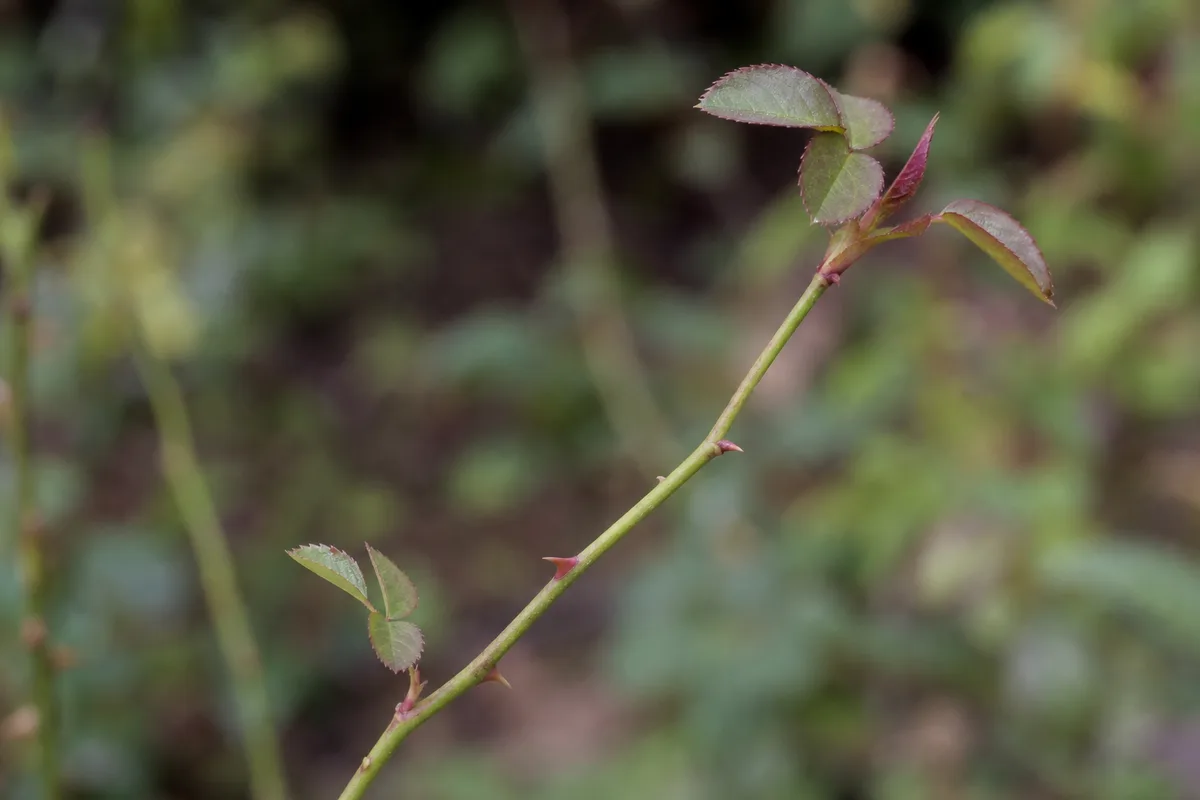
Leggy Growth symptoms on Rose - compare with healthy tissue on the same plant.
- Long internodes - wide gaps between leaf pairs on new or year-old canes, unlike the tight spacing on a well-lit bush
- Thin, soft shoots - pencil-thin or thinner stems that bend easily and carry small leaves
- Tip-heavy growth - leaves and any flowers clustered at cane ends while lower sections stay bare
- One-sided lean - the bush or individual canes angle sharply toward the brightest window, railing edge, or gap between buildings
- Towering water shoots - very thick upright canes erupting from the bud union or base, often overtopping the rest of the plant in autumn or after heavy feed
- Few or small flowers - buds absent, aborted, or tiny despite otherwise green foliage
On balcony and terrace roses, legginess often appears mid-season when a neighboring plant, awning, or shifting sun angle starts shading the pot for part of the day. Indoor roses show the same stretch within weeks-sometimes with pale leaves-but rarely produce meaningful blooms without supplemental lighting per the not-enough-light guide.
Why Rose gets leggy growth
Roses are sun-driven flowering shrubs. They can survive in less than ideal light, but they cannot maintain compact, bloom-heavy architecture without strong direct exposure.
Insufficient direct sunlight
This is the dominant cause on container roses. Roses should receive at least six hours of sun a day, with morning sun preferred over afternoon-only exposure because it dries foliage quickly. UF/IFAS notes roses need at least six hours of direct sunlight and perform best in full sun. In partial shade, repeat-flowering types produce fewer blooms, and internodes lengthen as the plant forages for photons. Bright indirect light indoors is not equivalent-etiolation continues even when leaves look superficially healthy.
Skipped or light pruning
Underpruning is a common reason roses become unproductive and unruly. Without annual shaping, old elongated canes persist, air circulation drops, and inner buds stay shaded by the outer shell of the bush. Extension guidance emphasizes that pruning opens the plant to light penetration and encourages vigorous replacement wood-both of which counter legginess. Full technique lives on the rose pruning guide.
Water shoots in the wrong context
Water shoots (basal breaks from the graft union) are valuable new structural canes on a healthy rose. On young or recently planted bushes, they may grow very tall before branching-that is normal. On an established plant, continually producing excessive tall water shoots can indicate insufficient sunlight or overfeeding, especially with nitrogen-heavy fertilizer that pushes soft upright growth the bush cannot support with available light.
Overfertilization in low light
Roses are heavy feeders in full sun, but excess nitrogen in shady or indoor conditions produces lush, weak stems with large gaps between leaves and few flowers. Shady conditions combined with too much fertilizer appear on extension problem lists as a reason for poor flowering and excessive lush growth. Match feeding to light per the rose fertilizer guide only after placement is corrected.
Uneven exposure and crowding
Roses crowded against walls, under eaves, or between taller pots develop directional stretch. The shaded side sheds lower leaves first, leaving a lopsided skeleton. Poor air movement in tight corners also worsens fungal pressure, which defoliates lower canes and makes the upper stretch more obvious-see black spots on Rose when purple lesions accompany bare lower wood.
How to confirm the cause
Work through these checks before you cut or feed:
- Sun-hour audit - Track how many hours of direct sun hit the pot, not just “bright” ambient light. Under six hours strongly supports a light diagnosis. Use a full day including morning and afternoon shifts as walls and seasons change. Placement detail is on the rose light guide.
- Side comparison - Inspect whether longest canes lean one direction. Strong asymmetry confirms uneven light; even stretch in a dim spot confirms general insufficiency.
- Cane origin - Trace tall shoots to their base. Canes from the bud union or graft are water shoots. Shoots from below the graft or from the soil on grafted roses are rootstock suckers and should be removed-they will not match your cultivar and can take over the plant.
- Pruning history - If the bush was not shaped last spring or summer, accumulated old wood may be leggy even after you fix light. Note whether problems began after a season without pruning.
- Feed and water review - Confirm you are not applying high-nitrogen fertilizer in shade. Check that base watering keeps soil evenly moist without chronic wetness-root stress can produce weak top growth, though stretch toward light is still the main legginess pattern.
- Rule out rosette lookalikes - Rose rosette disease causes clustered thin stems with excessive thorniness and distorted leaves-a different emergency. Simple legginess from low light does not produce witch’s-broom clustering or abnormal red stem proliferation.
If sun is adequate (six or more direct hours) and pruning was recent, investigate nutrient imbalance or root issues before assuming more light will help.
First fix for Rose
Relocate the container to the sunniest realistic spot with six or more hours of direct sun daily.
On a terrace, that usually means the outer rail, not the deep corner. For indoor roses, only a south- or west-facing sill with direct sun for much of the day qualifies-otherwise plan grow lights rather than expecting outdoor-grade bloom. Full-spectrum LED fixtures 30–45 cm above foliage for 12–16 hours daily can substitute when windows cannot deliver six direct hours; see grow-light placement on the not-enough-light guide.
Leave the plant in place for one to two weeks before major pruning so you can see where new buds break in improved light. Moving and hard-pruning simultaneously adds stress and makes it harder to judge recovery.
Step-by-step recovery
After light improves, work through these steps in order:
Shorten the worst elongated canes
Using clean secateurs, cut the longest weak canes back to an outward-facing bud, typically removing one-third to one-half of excessive length. Aim for an open vase shape that lets light reach inner buds. On hybrid teas, leaving strong canes at workable heights encourages lateral flowering wood-height targets by type are on the rose pruning guide.
Manage water shoots selectively
Keep healthy water shoots that will become future framework-especially on young bushes-but shorten ones that tower awkwardly above the rest. Stake fragile new basal breaks if wind snaps them; they break easily during rapid spring growth.
Deadhead and redirect energy
On repeat-flowering roses, remove spent blooms back to the first five-leaflet leaf with a healthy outward bud. Deadheading prevents the bush from pouring energy into hip formation on tired tip growth and encourages branching on well-lit wood.
Adjust feeding only after light is fixed
Resume rose-specific fertilizer during active growth once the plant sits in adequate sun and shows new breaks. Do not compensate for shade with extra nitrogen-that deepens soft leggy growth.
Improve airflow
Space pots so canes are not rubbing against walls or neighbors. Good air movement helps foliage dry and supports the denser habit you are trying to rebuild.
Recovery timeline
Leggy roses recover in phases, not overnight:
- Weeks 1–2 after relocation - New buds may swell on existing canes; lean may lessen as growth reorients
- Weeks 3–6 in active season - Fresh lateral shoots with tighter leaf spacing appear from pruning cuts
- Next bloom cycle - Flowers on new wood should be larger and better spaced if light and deadheading are consistent
- Old stretched sections - Remain long until you prune them out or they are gradually replaced by newer canes
Winter moves may show little visible change until the spring flush. Indoor roses without grow lights may not improve meaningfully until they go outdoors or receive supplemental lighting.
Lookalike symptoms
| Pattern | Likely cause | How to tell apart |
|---|---|---|
| Long canes, few flowers, lean toward light | Low light / etiolation | Improves after relocation; no witch’s-broom clustering |
| Very thick single cane from graft union | Water shoot | Same foliage as rest of plant; often after planting or heavy feed |
| Shoot from below graft or ground | Rootstock sucker | Different leaf or flower; remove at origin |
| Clustered thin stems, excess thorns, distorted leaves | Rose rosette disease | Abnormal proliferation; not fixed by light alone - see escalation below |
| Long arching canes on a climber | Untrained climbing habit | Normal for type; train horizontally per pruning guide rather than treat as shade etiolation |
When to escalate rose rosette disease
If the lookalike table points to rose rosette-not simple low-light stretch-act on disease, not placement. Oklahoma State Extension confirms there is no cure once a plant is infected; pruning symptomatic shoots alone is often ineffective because the virus can persist in roots and mites may remain on the plant.
Escalation steps:
- Compare suspect canes with healthy wood on the same cultivar-excessive pliable thorns, strapped thin leaves, and witch’s-broom clustering are diagnostic.
- Photograph symptoms and contact your local extension office for confirmation before destroying a valuable collection plant.
- If confirmed, remove the entire plant including the root ball immediately. Bag the plant before digging to contain mites; do not compost infected material.
- Monitor neighboring roses for months-mites spread on air currents between plants.
Simple legginess from shade never produces the abnormal thorn proliferation or clustered rosette shoots that define rose rosette.
Mistakes to avoid
- Pruning hard without adding sun - New growth will stretch again toward the brightest available direction
- Heavy nitrogen feed in shade - Produces more weak upright wood, not more roses
- Confusing suckers with water shoots - Removing good basal breaks weakens the bush; leaving suckers hijacks it
- Moving abruptly into harsh midday sun - Increase exposure over several days if the plant lived in deep shade to avoid scorch
- Expecting old internodes to shorten - Only new growth compacts; old bare stem stays unless pruned
- Ignoring wind on tall canes - Leggy bushes whip in storms and loosen container roots; shorten or stake before monsoon or winter winds
How to prevent leggy growth on Rose
Prevention is mostly placement and maintenance rhythm:
- Site roses only where six or more direct sun hours are realistic for most of the growing season-see the rose light guide before buying a decorative pot for a shaded corner
- Prune annually-spring is the main reset for most bush roses-to remove weak wood and open the center per the pruning guide
- Deadhead repeat-flowering cultivars through bloom season
- Rotate containers weekly on narrow balconies to keep growth even
- Match fertilizer to light: feed actively in full sun; hold back in partial shade
- Monitor shifting shade from new construction, growing trees, or seasonal sun angle changes
Roses tell you quickly when placement fails-first through flower count, then through cane architecture. Treat legginess as a light and structure problem before reaching for more fertilizer or a larger pot.
Related rose guides
- Rose light guide - six-hour rule, morning sun, indoor and balcony placement
- Not enough light on Rose - sun-hour audit and grow-light specs
- Rose pruning guide - vase shape, outward-facing buds, deadheading depth
- No flowers on Rose - when bloom failure is the main symptom
- Black spots on Rose - defoliation exposing leggy upper canes
- Rose overview - cultivar types and container culture context
Related tool
Use the Plant Problem Diagnosis Tool to narrow causes for leggy growth on this plant before changing multiple variables at once.