Distorted Leaves on Rosemary: Causes, Checks & Fixes
Quick answer
Twisted or cupped rosemary tips are a symptom, not a diagnosis. First inspect the newest shoots and leaf undersides for aphids, honeydew, stippling, or webbing. If you find no pest evidence, check recent spray or cold exposure and the root zone before changing care or applying a treatment.
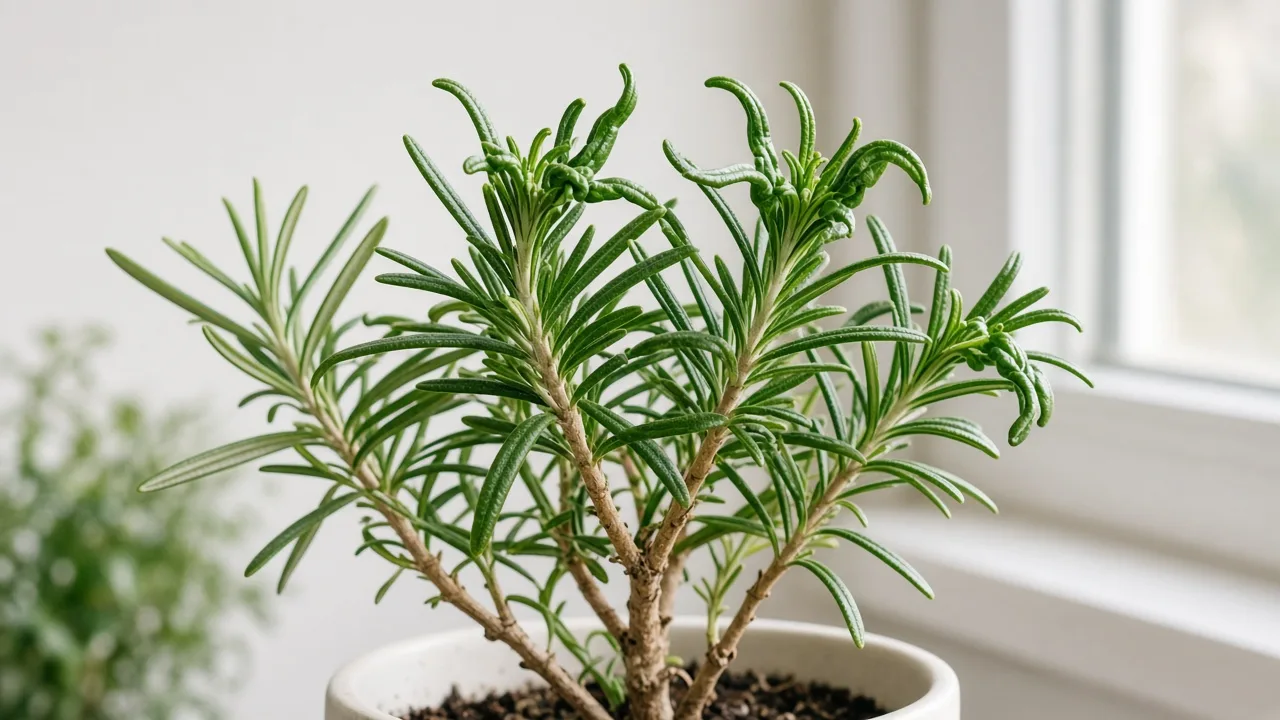
Distorted Leaves on Rosemary: Causes, Checks & Fixes
This guide covers distorted leaves on Rosemary. See also the general Distorted Leaves guide, watering, and light pages for this plant.
Distorted Leaves on Rosemary: Causes, Checks & Fixes
Quick answer
Start by inspecting rosemary’s newest tips rather than changing its watering, soil, light, and fertilizer all at once. Look for visible aphids, sticky residue, pale stippling, or fine webbing on the shoots and leaf undersides. If you find a colony, isolate a potted plant and remove the insects with a careful rinse; water can dislodge aphids. If you find no pest signs, check whether the affected growth emerged after a cold snap or nearby weed-killer application. Twisted rosemary leaves do not point to one cause on their own; Colorado State’s overview of distorted growth lists several possible causes. Use the distorted-leaves symptom guide for general pattern comparisons, then use this page to narrow the diagnosis to rosemary.
Rosemary has narrow, linear leaves with pale, woolly undersides and small flowers arranged around the stems. Because flowers form in whorls around the stem, check whether the rounded structures are flower buds or whether the leaf blades themselves are cupped or twisted before treating; see rosemary’s normal leaf and flower form. For the plant’s full profile and routine needs, see the Rosemary overview.
What distorted leaves look like on rosemary
Distortion is most convincing when a leaf is misshapen rather than merely angled: the new tip may be cupped, kinked, puckered, twisted, or held tightly together while older leaves on the same stem remain narrow and flat. Note whether one shoot, one side, or many branch tips are affected. A single damaged tip after handling is less informative than the same pattern repeated across several fresh shoots.
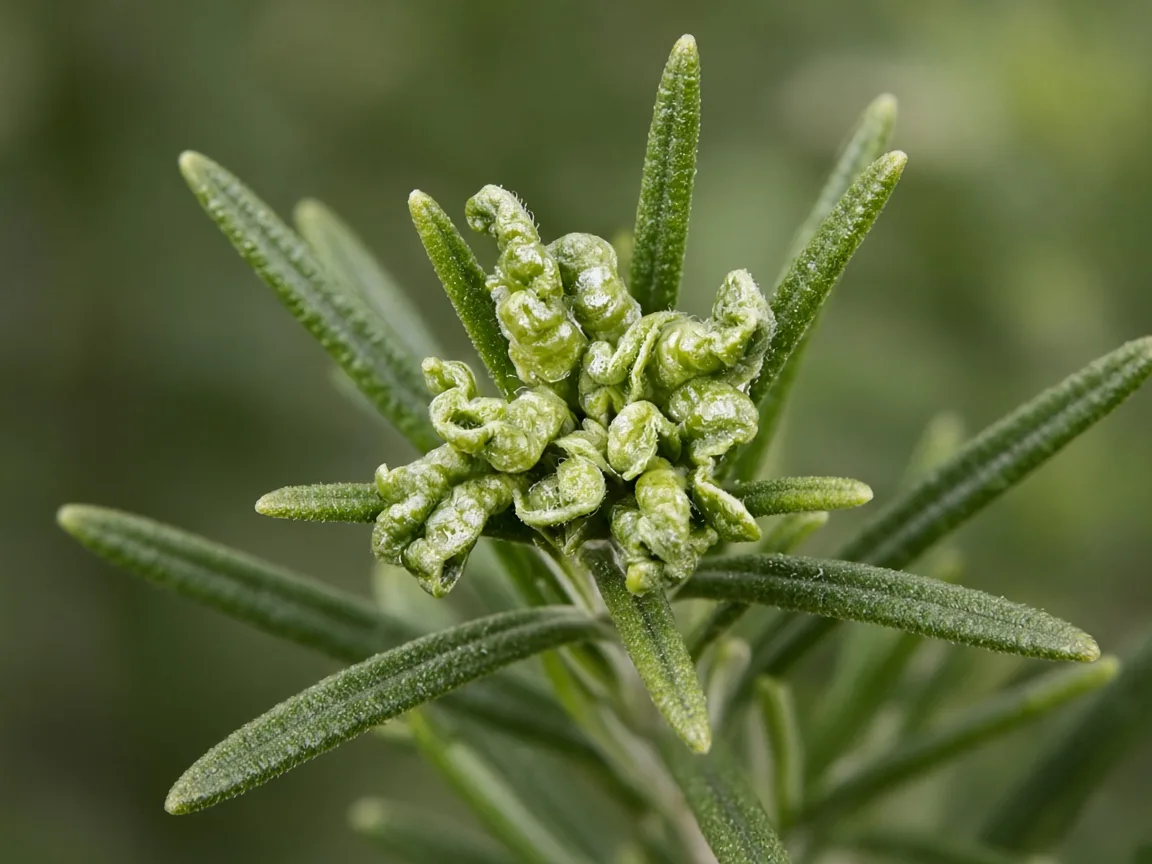
Compare the curled new tip with the flatter, narrow leaves lower on the same rosemary shoot.
Rosemary is generally considered relatively resistant to pests, but NC State’s rosemary pest list includes aphids, mealybugs, whiteflies, and spider mites, especially on indoor plants. That makes a close look at fresh growth worthwhile, but it does not mean that every distorted leaf is pest damage. The rosemary plant profile and its problem hub can help you compare other signs before deciding what to do.
First check: inspect the newest growth
Use bright light and a hand lens if you have one. Look first at the folded or curled tip, then turn over nearby leaves and check the soft stem joints. Aphids are visible without magnification and often gather in small colonies around growing tips; shed skins are one sign, and sticky honeydew is another, as described in The Spruce’s aphid guide. Ants can signal honeydew-producing insects, but they do not identify the pest by themselves; UC IPM describes this clue. Aphids can stunt shoots and curl leaves, though these effects vary by species.
Next, check for fine pale stippling or bronzing and delicate webbing, especially underneath leaves. UC IPM lists stippling and webbing as signs of spider mites; the mites are tiny and difficult to detect. Rosemary can host spider mites, as noted in NC State’s rosemary profile, but a few twisted leaves without stippling or webbing are not enough to confirm them. Compare with the Rosemary spider-mites guide before choosing any treatment. When a suspected mite or disease cannot be seen clearly, Colorado State’s diagnostic guidance says a tissue sample or laboratory may be needed.
Record the pattern before removing tissue: take one close photo of the affected tip and one wider photo showing the whole plant. Note when the distortion first appeared, whether it is limited to fresh growth, and any recent moves, pruning, temperature swings, or nearby lawn treatments. This short history is often more useful than a broad spray or an immediate repot.
Likely causes of distorted rosemary leaves
Aphids on tender tips
Aphids are a plausible cause when the newest leaves are curled and small insects cluster on the soft growth; UC IPM describes aphid-related curling among the signs that can occur. Sticky honeydew, shed skins, or ants strengthen that suspicion. Aphid species differ, and other look-alike causes can create similar distortion, so look for the insects as well as the leaf shape. If you confirm aphids, use the Rosemary aphids guide for a focused follow-up.
Mites or another tiny pest
Mites become more likely when fine speckling, bronzing, or webbing appears along with deformation; UC IPM lists these as spider-mite damage signs. Mites and some viruses may be too small to identify without a microscope or tissue analysis, as Colorado State explains. Do not treat the plant repeatedly based only on a guess; a fresh shoot sample can be more useful than stronger sprays, particularly if the rosemary is kept indoors or grown for cooking.
Herbicide drift or cold-damaged growth
If several shoot tips distorted at about the same time, think back to what happened while those leaves were unfolding. Herbicide drift can curl or cup the foliage of plants that were not the intended target, and cold weather can malform leaves emerging from buds. The timing may be more telling than the appearance: consider lawn or garden spraying nearby, wind, or an abrupt cold spell. Colorado State’s distorted-growth guide recommends diagnosing the cause before deciding whether to remove or treat affected growth.
When spray drift is plausible, do not add a second chemical in an attempt to correct the first injury. Keep the plant away from further exposure, document dates and weather, and watch the next healthy flush. If other plants in the same area show similar new-growth distortion, ask a local extension office for help identifying possible exposure.
Root stress is a separate check
Rosemary prefers sun and well-drained soil and tolerates dry conditions once established; NC State’s rosemary profile and The Spruce’s care guide also caution that wet conditions can contribute to decline. Distorted tips alone do not diagnose a root problem, because several causes can deform plant growth. Check the mix at root depth, confirm the container drains freely, and compare the pattern with the plant’s overall condition. The Rosemary watering guide, soil guide, and light guide explain the conditions this herb needs; use the root-rot guide if the root zone is persistently wet or the plant is declining more broadly. Do not increase watering just because a leaf is twisted.
Compare the pattern before treating
| What you see | What to check next |
|---|---|
| A few curled tips plus visible soft-bodied insects, shed skins, or sticky residue | Check carefully for aphids and follow the rosemary aphid guide if confirmed; aphids can cause curled growth. |
| Fine stippling or bronzing with delicate webbing | Inspect leaf undersides for spider mites; stippling and webbing are common signs. |
| Many new tips deforming at once, with no visible pests | Review recent cold exposure, lawn treatments, wind direction, and nearby affected plants; drift and cold can deform growth. |
| Distortion plus broader plant decline while the mix stays wet | Check the root zone and drainage; leaf shape alone is not enough to diagnose root rot. |
| Round clusters at the stem with otherwise narrow leaves | Compare the plant’s normal flower and leaf form before removing tissue. |
The safest first fix
If you find aphids, isolate a potted rosemary from nearby plants and rinse the affected shoot with a controlled stream of water, supporting the stem so it does not snap. Check again after the leaves dry and repeat inspection over the following days. A water rinse can dislodge aphids; assess progress by the next shoot rather than expecting older twisted tissue to straighten. Aphid monitoring guidance from UC IPM recommends regular checks and nonchemical removal when populations are limited. Avoid spraying an unconfirmed pest.
If you see stippling or webbing but cannot identify a mite, keep the rosemary separate from other indoor plants while you gather a clear close-up or contact a diagnostic service. If the timing instead fits cold or herbicide exposure, avoid pruning heavily or repotting just to remove the distorted leaves. Correct only a confirmed care issue, such as a pot that stays wet, and otherwise give the plant time to grow beyond the injury.
Recovery and what to avoid
Treat distorted tissue as a record of what happened while that leaf was forming. Judge the response by the next growth, not by whether an old curled leaf becomes flat. Use the next flush to judge whether the new tips are healthy; continued distortion is a reason to revisit the diagnosis. Colorado State notes that some plants outgrow cold and herbicide injury, so avoid promising a fixed number of days for recovery.
Do not fertilize to force misshapen leaves straight, flood the pot to “flush” a suspected spray, or combine pruning, repotting, and pesticide use on the same day. Those changes make it harder to tell which issue mattered and can add stress. Remove a badly affected tip only when it contains a confirmed pest colony or has died back; otherwise retain healthy stems while you monitor the next flush.
Preventing another flush of distorted leaves
Inspect rosemary tips when new growth is appearing, especially after bringing a container indoors or moving it outside. Keep the plant in a bright position with fast drainage, and water according to the mix rather than a fixed calendar; see rosemary’s growing needs. When checking aphids, turn over leaves and inspect stem joints; UC IPM’s rapid-growth monitoring guidance recommends more frequent checks because early colonies are easier to spot and remove.
Avoid exposing rosemary to lawn herbicides or drift from neighboring applications. If you prune or harvest, use clean tools and leave enough healthy foliage for the plant to keep growing. The Rosemary overview links its core care topics; check the watering and soil pages if the root zone repeatedly stays wet.
When to ask for a closer diagnosis
Contact a local cooperative extension office or plant clinic if the new leaves keep emerging deformed despite a careful pest check, the suspected pest is too small to identify, or several nearby plants show the same pattern. Share photos, when the symptoms began, recent weather, and any nearby lawn or garden treatments. Distortion may need lab testing; a clinic can help distinguish those cases from visible aphids, cold injury, or spray drift.
When to use this page vs other Rosemary guides
Use this guide when rosemary leaves are genuinely cupped, puckered, or twisted and you need to identify the cause. If you see an aphid colony, continue with Rosemary aphids; if stippling or webbing stands out, use Rosemary spider mites. If the plant is declining in wet soil, compare Rosemary root rot. For routine adjustments, use the watering, soil, and light guides instead of treating leaf distortion as a care diagnosis.
Related tool
Use the Plant Problem Diagnosis Tool to compare symptoms before changing several growing conditions at once.
Related Rosemary guides
- Rosemary overview — use for the plant’s growing habit and general care.
- Rosemary problem hub — use to compare other symptoms on the same plant.
- Rosemary aphids — use when visible aphids, honeydew, or shed skins are present.
- Rosemary spider mites — use when stippling or fine webbing accompanies the distortion.
- Rosemary root rot — use when persistent wetness and broader decline point below the soil line.