Water Hyacinth Care: Warm Water, Sun
Pontederia crassipes (synonym: Eichhornia crassipes)
Water hyacinth (Pontederia crassipes, formerly Eichhornia crassipes) grows fastest in warm, bright, nutrient-rich freshwater and spreads by daughter plants and seed. It is invasive or restricted in some places. Check current local rules before buying or growing it, keep any permitted culture fully contained, and never release it into natural waterways. It is generally a better fit for a lawful, managed warm-climate pond than a conventional indoor aquarium.
Water Hyacinth Care and Containment Guide
Start with wateringThe most common care mistake for Water HyacinthReview aquatic water care →Water Hyacinth care essentials
Light
Full sun to partial sun in a warm outdoor pond where cultivation is legal.
Water
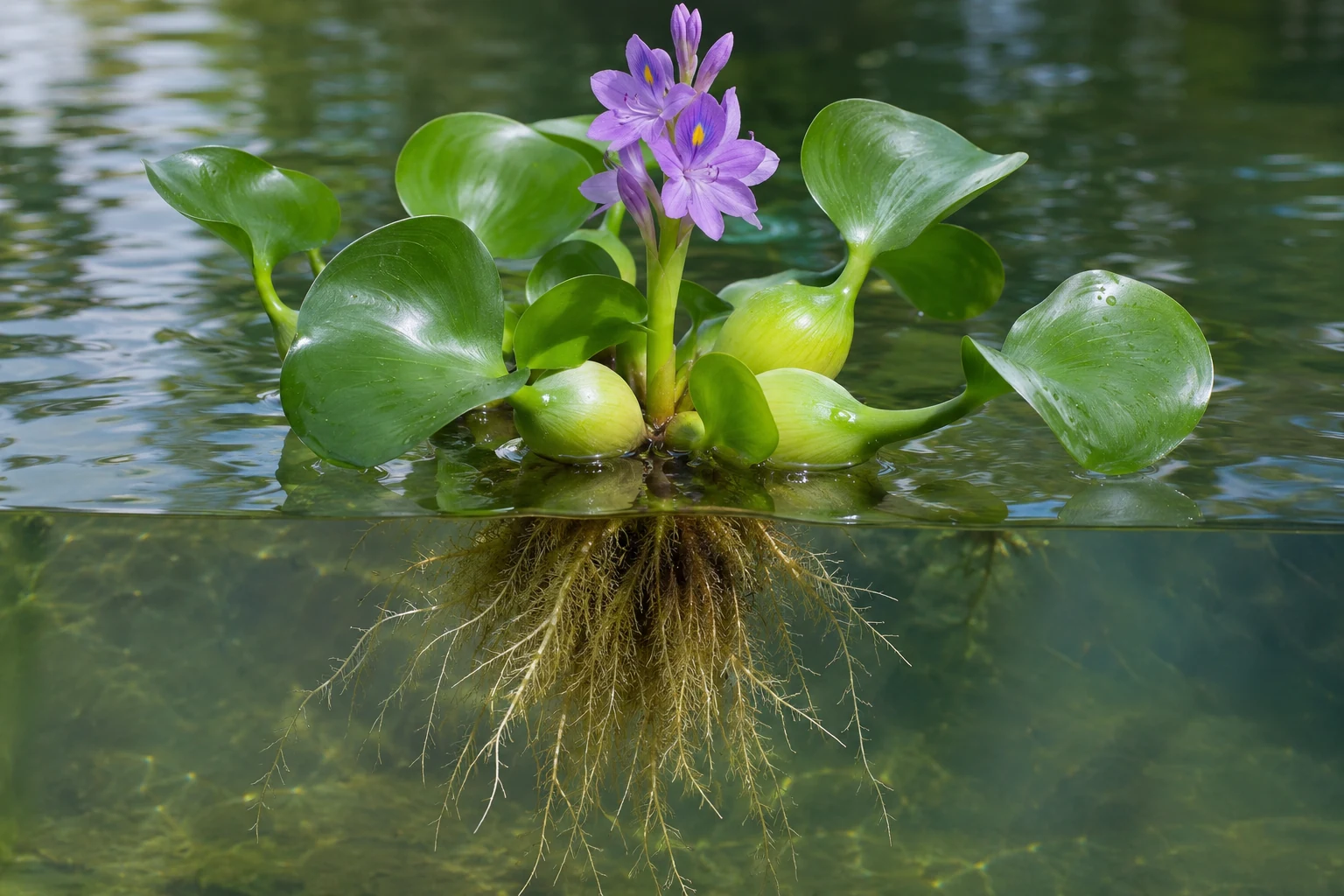
Keep it floating in clean freshwater; it is not a terrestrial plant and does not need watering by a calendar. Maintain enough water for the fibrous roots to remain submerged while the leaves stay above the surface. It is a freshwater species, not a saltwater plant.
Soil
No potting soil is needed. Water hyacinth floats freely, with fibrous roots hanging in the water column. Do not bury the crown or plant it in garden soil.
Humidity
Aquatic; roots remain submerged and leaves are exposed to open air.
Temperature
Warm water supports vigorous growth; Pond Academy gives about 25–30°C (77–86°F) as a practical growing range. Treat this as a warm-climate pond guide, not a universal aquarium target.
Fertilizer
No routine fertilizer is needed in nutrient-rich pond water.. It obtains nutrients from the water. If it is legally grown in a small contained vessel and shows a diagnosed deficiency, follow the aquatic-system product label; avoid dosing an open pond simply to make this fast-growing species grow faster.
About Water Hyacinth
Water Hyacinth is native to Amazon Basin and other parts of tropical South America, typically reaches Individual floating rosettes vary; stolons can quickly join them into extensive surface-covering mats. indoors, with very rapid in warm, nutrient-rich freshwater with good light. growth. Water Hyacinth has a free floating freshwater perennial. its buoyant leaf stalks keep the rosette at the surface while long fibrous roots hang in the water; it can multiply by stolons and also produces seed. growth habit and part of the Pontederiaceae family. It is also known as Common water hyacinth, Water orchid, and Eichhornia crassipes.
| Detail | Information |
|---|---|
| Also known as | Common water hyacinth, Water orchid, Eichhornia crassipes |
| Native region | Amazon Basin and other parts of tropical South America |
| Mature size | Individual floating rosettes vary; stolons can quickly join them into extensive surface-covering mats. |
| Growth rate | Very rapid in warm, nutrient-rich freshwater with good light. |
| Growth habit | Free Floating Freshwater Perennial. Its Buoyant Leaf Stalks Keep The Rosette At The Surface While Long Fibrous Roots Hang In The Water; It Can Multiply By Stolons And Also Produces Seed. |
| Scientific name | Pontederia crassipes (synonym: Eichhornia crassipes) |
| Family | Pontederiaceae |
How to care for Water Hyacinth?
How much light does Water Hyacinth need?
Full sun to partial sun in a warm outdoor pond where cultivation is legal.. Bright, open conditions. Partial sun in warm freshwater. direct sun
- Full sun to partial sun in a warm outdoor pond where cultivation is legal. - Full sun to partial sun in a warm outdoor pond where cultivation is legal..
- Bright, open conditions - Bright, open conditions.
- Partial sun in warm freshwater - Partial sun in warm freshwater.
- direct sun - direct sun.
When should you water Water Hyacinth?
Keep it floating in clean freshwater; it is not a terrestrial plant and does not need watering by a calendar. Maintain enough water for the fibrous roots to remain submerged while the leaves stay above the surface. It is a freshwater species, not a saltwater plant.
- Check that the roots remain submerged - Maintain enough water for the fibrous roots to remain submerged while the leaves stay above the surface.
- the leaves are not stranded above the water - Maintain enough water for the fibrous roots to remain submerged while the leaves stay above the surface.
- and the water stays fresh. In a pond - Maintain enough water for the fibrous roots to remain submerged while the leaves stay above the surface.
- also check that the plant has not spread into an uncontrolled mat or blocked water movement - Keep it floating in clean freshwater; it is not a terrestrial plant and does not need watering by a calendar.
- Drain excess water - Keep it floating in clean freshwater; it is not a terrestrial plant and does not need watering by a calendar.
What soil works best for Water Hyacinth?
No potting soil is needed. Water hyacinth floats freely, with fibrous roots hanging in the water column. Do not bury the crown or plant it in garden soil.
- Well-draining mix - Potting mix that lets water flow through quickly instead of staying soggy around the roots.
How to propagate Water Hyacinth?
Water hyacinth multiplies readily by daughter plants and can also produce seed. Do not share, transport, or intentionally propagate it until you have checked current local rules. Never release plants, seeds, or fragments into natural waterways or storm drains.
- Daughter plants develop on stolons from established rosettes. - Water hyacinth multiplies readily by daughter plants and can also produce seed.
- Seed is also produced - Water hyacinth multiplies readily by daughter plants and can also produce seed.
- viable plant material can spread beyond the intended growing area - Water hyacinth multiplies readily by daughter plants and can also produce seed.
Grower notes for Water Hyacinth
Check local rules before acquiring it
Water hyacinth is invasive or regulated in some jurisdictions, and rules vary by location. UF/IFAS lists it as a Florida prohibited aquatic plant and says cultivation, introduction, collection, and transport there require a permit. That Florida rule is not a universal legal statement: check current state, provincial, national, and local requirements before buying, transporting, or keeping it.
Treat containment as part of routine care
In warm nutrient-rich freshwater, daughter rosettes can rapidly form connected surface mats. Grow it only where permitted and in a system without an overflow or other escape route; inspect it often and remove surplus growth before it spreads. Never release it into a pond, canal, lake, stream, storm drain, or other natural waterway.
Use pond guidance for warm outdoor culture
Its floating habit suits warm-climate water gardens better than a rooted terrestrial bed. Pond Academy recommends full to partial sun and describes warm conditions around 25–30°C (77–86°F) for active growth. Cold and frost can damage it, so do not treat a seasonal outdoor pond plant as reliably hardy through winter.
Keep nutrition modest
The roots absorb nutrients directly from the water, and nutrient-rich conditions can make growth especially vigorous. Do not fertilize an open pond just to increase growth. If a permitted, contained specimen appears deficient, diagnose the water first and use only an aquatic product as labeled.
Aquarium use needs more control than a pond display
Water hyacinth floats at the surface rather than growing as a submerged aquascape plant. Inference from its rapid mat formation and documented shading of other vegetation: in a conventional indoor aquarium it can quickly cover the surface, shade submerged plants, or interfere with equipment. Consider it only in a large, open, fully contained system where local rules permit it and frequent removal is practical; never transfer aquarium plants or water outdoors.
Dispose of removed growth securely
Do not dump surplus rosettes, seeds, roots, or fragments into waterways or drains. Drying alone should not be treated as permission to discard it outdoors. Follow local invasive-plant disposal directions and prevent wash-off or fragments from reaching water.
Water Hyacinth pet safety
The sources reviewed did not verify a species-specific veterinary toxicity classification for water hyacinth. Do not offer it as food or assume it is safe for pets to chew; ask a veterinarian about an ingestion. Prevent pets from reaching open water containers where practical.
Pet toxicity for Pontederia crassipes was not established by the sources reviewed. This is not a safety clearance: do not feed the plant to animals, discourage chewing, and contact a veterinarian if a pet eats it.
Watering Water Hyacinth
For Water Hyacinth, check that the roots remain submerged, the leaves are not stranded above the water, and the water stays fresh. In a pond, also check that the plant has not spread into an uncontrolled mat or blocked water movement. and water continuous freshwater culture; monitor water level and water quality instead of using a watering schedule. Warm weather and nutrient-rich water can trigger very rapid growth. Growth slows in cool conditions, and frost can damage or kill the plant; remove it before it can escape a contained system.
| Detail | Information |
|---|---|
| How often | Continuous freshwater culture; monitor water level and water quality instead of using a watering schedule. |
| How to check | Check that the roots remain submerged, the leaves are not stranded above the water, and the water stays fresh. In a pond, also check that the plant has not spread into an uncontrolled mat or blocked water movement. |
| Seasonal changes | Warm weather and nutrient-rich water can trigger very rapid growth. Growth slows in cool conditions, and frost can damage or kill the plant; remove it before it can escape a contained system. |
Signs of overwatering
- Not applicable to a floating aquatic plant; foul or stagnant water indicates a water-quality problem, not a need to reduce watering.
Signs of underwatering
- Roots left hanging in air as the water level falls
- Leaves or roots drying after a rosette is stranded outside the water
Soil & potting for Water Hyacinth
Not applicable to free-floating aquatic culture; use a contained freshwater pond or vessel with no route for escape. Target soil pH around No species-specific pH target was verified in the sources reviewed. Maintain stable freshwater conditions appropriate to the pond or aquarium community. Repot not applicable; it is free-floating and has no pot., ideally in thin only where possession and cultivation are permitted, before warm-season growth becomes difficult to control.
| Detail | Information |
|---|---|
| Drainage | Not applicable to free-floating aquatic culture; use a contained freshwater pond or vessel with no route for escape. |
| Soil pH | No species-specific pH target was verified in the sources reviewed. Maintain stable freshwater conditions appropriate to the pond or aquarium community. |
| Repotting frequency | Not applicable; it is free-floating and has no pot. |
| Best season to repot | Thin only where possession and cultivation are permitted, before warm-season growth becomes difficult to control. |
Signs it needs repotting
- A lawful, contained pond has become crowded with connected rosettes.
- Floating growth is shading other plants or interfering with water movement.
Humidity & temperature for Water Hyacinth
Water Hyacinth prefers aquatic; roots remain submerged and leaves are exposed to open air. Keep temperatures around warm water supports vigorous growth; Pond Academy gives about 25–30°C (77–86°F) as a practical growing range. Treat this as a warm-climate pond guide, not a universal aquarium target. Avoid letting Water Hyacinth sit below Frost sensitive; do not rely on it surviving an outdoor freeze. This is a tropical and subtropical freshwater plant. In a cold-winter climate, do not assume it will overwinter outdoors. Indoor aquarium temperatures must remain compatible with the tank's animals and other plants, and aquarium use does not remove the need to check local restrictions.
| Detail | Information |
|---|---|
| Humidity | Aquatic; roots remain submerged and leaves are exposed to open air. |
| Ideal temperature | Warm water supports vigorous growth; Pond Academy gives about 25–30°C (77–86°F) as a practical growing range. Treat this as a warm-climate pond guide, not a universal aquarium target. |
| Minimum temperature | Frost sensitive; do not rely on it surviving an outdoor freeze. |
| Temperature notes | This is a tropical and subtropical freshwater plant. In a cold-winter climate, do not assume it will overwinter outdoors. Indoor aquarium temperatures must remain compatible with the tank's animals and other plants, and aquarium use does not remove the need to check local restrictions. |
Humidity tips
- Keep the plant floating rather than allowing it to dry on a shelf or aquarium lid.
Fertilizer & pruning for Water Hyacinth
Feed Water Hyacinth no routine fertilizer is needed in nutrient-rich pond water. using it obtains nutrients from the water. If it is legally grown in a small contained vessel and shows a diagnosed deficiency, follow the aquatic-system product label; avoid dosing an open pond simply to make this fast-growing species grow faster. The best feeding window is do not add nutrients to encourage growth; warm, nutrient-rich water can accelerate spread. Avoid adding terrestrial fertilizer to pond water. Extra nutrients can contribute to rapid water-hyacinth growth and water-quality problems.
| Detail | Information |
|---|---|
| Fertilizer schedule | No routine fertilizer is needed in nutrient-rich pond water. |
| Best season | Do not add nutrients to encourage growth; warm, nutrient-rich water can accelerate spread. |
| Fertilizer type | It obtains nutrients from the water. If it is legally grown in a small contained vessel and shows a diagnosed deficiency, follow the aquatic-system product label; avoid dosing an open pond simply to make this fast-growing species grow faster. |
| What to avoid | Avoid adding terrestrial fertilizer to pond water. Extra nutrients can contribute to rapid water-hyacinth growth and water-quality problems. |
Pruning
In locations where it is legal to keep, remove excess rosettes frequently and contain them so no plant, seed, or fragment can escape. Bag and dispose of removed material securely according to local guidance; never dump it in a ditch, stream, lake, storm drain, or compost pile that can wash into water.