Table of Contents
The Short Answer
Put just enough water in a pebble tray to sit below the top of the pebbles. The water should not touch the bottom of the plant pot, and the pot should never sit in standing water. That is the whole rule. If the tray is flooded high enough that the pot or its drainage holes stay wet, you have turned a humidity tray into a root-rot setup. Extension sources and plant-care guides are strikingly consistent on this point: the water belongs under the pot, not against it. (Nebraska Extension)
That direct answer matters because most people do not actually struggle with the idea of a pebble tray. They struggle with the water line. Too little water and the tray dries fast and does almost nothing. Too much water and the pot stays damp where it should stay airy. A pebble tray works best in that narrow middle: enough exposed water to evaporate, enough pebble height to keep roots out of trouble. (The Spruce)
What a Pebble Tray Actually Does
A pebble tray is a shallow tray filled with pebbles and a small amount of water. As that water evaporates, it can raise humidity in the immediate air around the plant. That “immediate” part is the key. A pebble tray is not a room humidifier. It creates a small local bump in moisture near the plant, which can help some humidity-loving houseplants, especially in dry indoor conditions. Nebraska Extension, Illinois Extension, Missouri Botanical Garden, and UNH Extension all describe pebble trays as a way to add local moisture, not as a whole-room fix. (Nebraska Extension)
That difference gets missed all the time. People expect a cheap tray of stones to solve the same problem as a proper humidifier. It will not. Horticulturist Justin Hancock says pebble trays can work, but the effect fades quickly as air circulates through the room, which makes them much more useful for small, low-growing plants than for larger tabletop or floor plants. UNH Extension makes a similar point in softer language: pebble trays can help a little, while a nearby humidifier delivers the biggest benefit. (Better Homes & Gardens)
The Correct Water Level
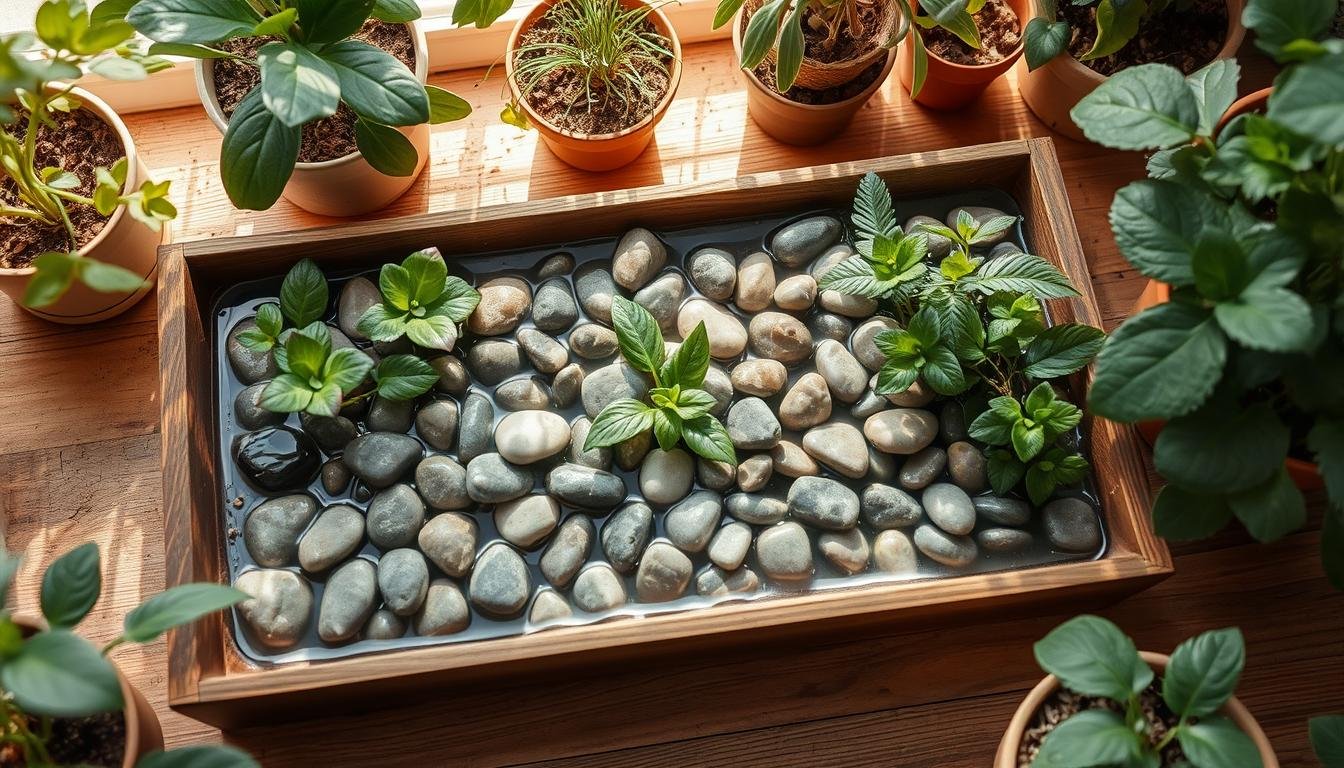
The correct water level is simple: fill the tray so the water comes to just below the top surface of the pebbles. You want enough exposed water to evaporate, but not so much that the pot base or drainage holes rest in it. Missouri Botanical Garden’s houseplant factsheet says the tray should be filled with enough water to reach just below the pebble surface. Nebraska Extension says the same thing in slightly different words: pour water among the stones while keeping it below the base of the container. (Missouri Botanical Garden)
A good mental picture helps here. Think of the pebbles as a raised platform, not as decoration floating in a saucer. The plant should sit on top of that platform. The water should hide lower down in the tray, where it can evaporate without wetting the pot. If the pebbles are barely visible because the water is sitting flush with the top, you are right on the edge. If water is pooling around the pot base, you have gone too far. (The Spruce)
Why the Water Must Stay Below the Pebbles
The reason is not cosmetic. It is about root health. When the bottom of a pot or its drainage holes sit in water, the potting mix can stay constantly wet. That shuts down the normal wet-dry rhythm that most houseplants rely on and increases the risk of root rot. Multiple sources say this outright. Illinois Extension warns that pots should not sit directly in water. Nebraska Extension says the plant should never sit in water because that keeps the soil constantly wet and can cause root rot. Missouri Botanical Garden gives the same warning. (Illinois Extension)
This is also why a pebble tray does not replace good watering habits. A plant with thirsty soil still needs proper watering from above or by your normal method. The tray is there to raise local humidity a bit, not to water the root ball by stealth. Treating it like a backup irrigation system is one of the fastest ways to create mushy roots, fungus gnats, or a plant that looks dehydrated and overwatered at the same time. (Country Living)
How Deep the Pebbles Should Be
The pebbles need enough depth to keep the pot safely above the water line. In practice, a tray that is about 1 to 2 inches deep with a solid layer of pebbles works well. Nebraska Extension recommends a tray or saucer one to two inches deep and slightly larger than the container. The Spruce and BHG both describe a broad, deep-enough tray with a full pebble layer so the plant can rest on top while the water remains underneath. (Nebraska Extension)
You do not need giant rocks. Medium pebbles, gravel, or glass marbles all work if they create stable height and airflow. What matters is that the pot does not wobble and does not sink low enough to touch water. Tiny decorative grit can be too shallow. Huge river stones can be awkward and unstable. The sweet spot is a clean, medium pebble layer that lifts the pot clearly above the wet zone. (The Spruce)
Tray Size Matters More Than Most People Think
If you want a pebble tray to do anything useful, tray width matters. A wider tray exposes more water surface area, which means more evaporation. Justin Hancock points out that pebble trays work best when the tray is wide and the plant is low-growing. The Spruce also recommends a tray several inches wider than the base of the pot, and Nebraska Extension suggests a tray slightly larger than the plant’s container by a couple of inches on each side. (Better Homes & Gardens)
This is where many DIY setups fail. Someone puts one tiny nursery pot on a tiny saucer with a handful of stones and expects jungle-level humidity. The physics are not on their side. More exposed water surface creates more evaporation. That does not mean you should flood the tray deeper. It means you should use a broader tray, keep the water at the correct level, and accept that the effect is still local and modest. (Better Homes & Gardens)
Which Plants Benefit Most From a Pebble Tray
A pebble tray makes the most sense for small, humidity-loving houseplants that sit close to the moisture source. Think plants that already prefer moderate to high humidity and show stress in dry homes, especially in winter when forced-air heating can drop indoor humidity hard. Illinois Extension notes that winter home humidity often falls below 30%, while the EPA recommends keeping indoor humidity between 30% and 50% for comfort and mold control. In that gap, some plants feel the dryness more than others. (Illinois Extension)
That said, not every crispy leaf tip is a humidity problem. Kimberly Moore and Justin Hancock both stress that many common houseplants adapt to ordinary indoor conditions, and poor watering, low light, drafts, or pests can push a plant over the edge faster than slightly dry air. A pebble tray is a support tool, not a cure-all. Use it where it fits, but diagnose the plant honestly before blaming humidity for everything. (Country Living)
Plants That Usually Respond Well
The best candidates are compact tropicals and other plants that appreciate higher ambient moisture near the leaves. BHG, citing Justin Hancock, specifically mentions creeping ficus, fittonia, hemigraphis, and selaginella as plants that can benefit. The Spruce also points to humidity-loving plants such as monstera, philodendron, prayer plants, and orchids. Missouri Botanical Garden notes that ferns and some orchids can resent low home humidity and may perform poorly when the air is too dry. (Better Homes & Gardens)
In practical terms, the plants that benefit most tend to be the ones that tell you quickly when the air is too dry: leaf edges crisp, new growth stalls, foliage curls, or delicate leaves lose that supple look. Calatheas, fittonias, selaginellas, many ferns, and some orchids are the usual suspects. A pebble tray will not turn a dry room into a greenhouse, but it can soften the edges of a dry-air problem for plants like these. (Better Homes & Gardens)
Plants That Usually Do Not Need One
Dry-air-tolerant plants usually do not care. Succulents, cacti, and many hardy foliage plants are poor candidates for extra humidity from a pebble tray. The Spruce explicitly says not to use a pebble tray with succulents because they prefer a dry environment. UNH Extension also notes that plants such as cacti and jade plants tolerate lower relative humidity than many tropical houseplants. (The Spruce)
There is also a practical downside here. Adding a humidity tray under a plant that already prefers lean, dry conditions can slow drying around the pot and surrounding air without offering much upside. That does not always kill the plant, but it solves a problem the plant did not have. If your snake plant, jade, haworthia, or cactus is happy on a dry windowsill, leave the spa treatment for something fussier. (Extension | University of New Hampshire)
How to Set Up a Pebble Tray Step by Step
Setting up a pebble tray is easy, but the details matter. Start with a waterproof tray or saucer that is wider than the pot and deep enough to hold a stable layer of pebbles. Add clean pebbles, gravel, or marbles in an even layer. Then pour in water until the level sits just below the top of the pebbles. Finally, place the pot on top and check from the side to confirm the pot base and drainage holes stay above the water line. This matches the setup described by Nebraska Extension, Missouri Botanical Garden, BHG, and The Spruce. (Nebraska Extension)
A few small upgrades make the setup better. Use clean stones so you are not introducing soil residue or algae from an old tray. Pick a tray wide enough that the plant sits with some exposed water surface around it rather than occupying the whole footprint. If the plant is in a nursery pot inside a decorative cachepot, be extra careful that hidden water is not already collecting inside the outer pot. The whole point is evaporation without saturation. (Better Homes & Gardens)
How Often to Refill the Water
There is no universal refill schedule because evaporation depends on tray size, temperature, airflow, and how dry your home is. The safest routine is to check the tray every few days and top it up when most of the water has evaporated, keeping the water level below the pebble tops each time. The Spruce says to check the water level regularly and refill as it evaporates, more often in hotter conditions. Nebraska Extension says to replenish as needed, and BHG says refill frequency depends on the tray size and how warm and dry the home is. (The Spruce)
In a dry winter home with forced-air heat, you may refill more often than in a mild, naturally humid room. That is normal. What you should not do is set a rigid calendar and pour blindly. A pebble tray is visual. Look at it. If the tray is bone dry, refill it. If it is already high and the water line is creeping toward the pot base, leave it alone. This is one of those plant chores that rewards two seconds of attention more than a fixed schedule. (Extension | University of New Hampshire)
Signs Your Pebble Tray Is Helping
A pebble tray does not give dramatic, overnight proof. What you are looking for is a small improvement in plant comfort, not a miracle. The most useful signs are slower crisping on leaf edges, less papery new growth, and a plant that seems less stressed during dry spells or winter heating. If you use a hygrometer close to the plant, you may also notice a small local humidity bump near the tray, even if the rest of the room stays the same. The Spruce recommends using a humidity meter around the plant if you want to measure the effect. (The Spruce)
You can also tell when it is not doing enough. If your calathea still looks wrecked, your fern keeps browning despite proper watering, and the room is extremely dry, the pebble tray may simply be outmatched. That is not failure. It just means you have crossed from “small local assist” territory into “this plant needs a more controlled environment” territory. UNH Extension and Justin Hancock both push readers toward humidifiers or enclosed growing setups when the need is higher. (Extension | University of New Hampshire)
Common Mistakes That Ruin the Setup
Most pebble tray mistakes are simple. People use a tray that is too small, add too much water, let the pot touch the water, forget to clean the tray, or assume the tray replaces proper watering and environmental control. Those errors either reduce the humidity effect or create new problems like soggy soil, algae, and fungus gnats. The risk is not that pebble trays are inherently bad. The risk is that a low-tech method looks foolproof when it is not. (Nebraska Extension)
The other mistake is overestimating what the tray can accomplish. Current ranking content splits here: many guides present pebble trays as helpful, while some experts argue the effect is limited enough that most plants will be fine without them. Both views can be true at the same time. Pebble trays are useful at the margin. They are not a substitute for matching the plant to your conditions. (Extension | University of New Hampshire)
Overfilling the Tray
Overfilling is the classic error. The water line creeps up until the pot base or drainage holes sit in moisture, and now the plant is effectively soaking from below all the time. That can keep the mix too wet, reduce root oxygen, and raise the odds of rot. The Spruce says directly that if the drainage hole touches water, the soil can remain wet and lead to root rot. Nebraska Extension and Illinois Extension say the same in plain terms. (The Spruce)
If you want a simple rule, use this one: you should always be able to see dry pebble tops above the water line. Not just damp-looking. Visibly above the water line. That tiny visual gap protects the whole system. It is the difference between a humidity tray and a standing-water problem. (Missouri Botanical Garden)
Using a Pebble Tray Instead of Watering Correctly
A pebble tray does not water the plant in any useful, reliable sense. Plants take up water primarily through their roots, and most houseplant success still comes down to correct watering, light, and avoiding chronic stress. Kimberly Moore points out that plants mainly absorb water through roots, not through leaf wetness, and Hancock notes that low humidity is often only one piece of a bigger stress picture. (Country Living)
This matters because people often respond to crispy leaves by throwing humidity hacks at the plant while ignoring dry soil, low light, cold drafts, or pests. Sometimes the plant does not need more atmospheric moisture at all. It needs a better watering rhythm or a better spot. Use the pebble tray as a support, not a distraction. If the basics are off, the tray will not save the plant. (Country Living)
Pebble Tray vs Humidifier
A pebble tray is cheap, silent, low-maintenance, and small in effect. A humidifier costs more, needs cleaning and refilling, but is much more reliable if you truly need to raise humidity around demanding plants. UNH Extension says a portable humidifier near the plants provides the most benefit, while pebble trays can help a little. Justin Hancock makes the same distinction: pebble trays may work for small, low plants, but for larger plants or drier homes, a humidifier is the better tool. (Extension | University of New Hampshire)
That is really the decision point. If you have one or two small humidity-loving plants and you want a simple, no-electricity method, a pebble tray is reasonable. If you are trying to keep a cluster of tropicals happy through a dry winter, or your hygrometer shows a chronically dry room, a humidifier gives you control that a tray cannot. EPA guidance for homes recommends keeping indoor humidity between 30% and 50%, and a humidifier is the more direct way to move an entire space into that zone when needed. (US EPA)
When a Pebble Tray Is Not Enough
Sometimes the best answer is not “add more water to the tray.” It is “use a different method.” If your room air is extremely dry, the plant is tall, the tray is small, or the species is especially humidity-sensitive, the tray’s local effect may be too weak to matter. That is why current expert-backed guidance often points to humidifiers, terrariums, cloches, or grouped plants as stronger options when a simple tray does not move the needle enough. UNH Extension mentions humidifiers, grouping, and terrariums. BHG also points readers toward humidifiers, grouping plants, cloches, and grow cabinets. (Extension | University of New Hampshire)
There is also a home-health limit to keep in mind. Higher humidity is not always better. EPA says indoor humidity should stay between 30% and 50%, and humidity above 60% can increase the likelihood of mold. So if you are trying to solve a plant problem by forcing the whole room into very damp conditions, step back. It is usually smarter to target the plant with a humidifier, enclosed setup, or better plant choice than to over-humidify the entire home. (US EPA)
Conclusion
The right amount of water in a pebble tray is just below the top of the pebbles. Not halfway up the pot. Not touching the drainage holes. Not pooling around the container. The pot should rest on dry pebble tops while the water sits lower in the tray and evaporates into the nearby air. That is the safe, repeatable setup described across extension sources, botanical guidance, and current plant-care experts. (Missouri Botanical Garden)
If you remember one thing, remember this: a pebble tray is a humidity tool, not a watering method. Use it for small, humidity-loving plants that need a modest local boost. Skip it for dry-loving plants. Refill it as needed, clean it occasionally, and do not expect it to replace a humidifier in a very dry room. Get the water line right, and the tray can be a simple, useful part of your plant care setup. Get it wrong, and it becomes a root-rot trap with decorative stones. (Extension | University of New Hampshire)
FAQs
Can the water touch the bottom of the pot?
No. The pot should sit on the pebbles, not in the water. If the base or drainage holes touch standing water, the potting mix can stay too wet and raise the risk of root rot. (Nebraska Extension)
How much water should I add when I refill a pebble tray?
Add only enough to bring the level back to just below the top of the pebbles. You are restoring the evaporation zone, not flooding the tray. A side view is the easiest way to check it. (Missouri Botanical Garden)
Do pebble trays actually work?
They can help a little, mainly by increasing humidity in the immediate area around the plant. They are most useful for small, low-growing, humidity-loving plants, and much less effective as a room-wide humidity solution. (Extension | University of New Hampshire)
Are pebble trays better than misting?
For steady local humidity, usually yes. Nebraska Extension says misting is not an effective solution because you would need to do it very frequently, and too much leaf wetness can increase disease risk. A pebble tray is still modest in effect, but it is more consistent than occasional misting. (Nebraska Extension)
Can I use a pebble tray for succulents or cacti?
Usually no. Succulents and cacti tend to prefer drier air, and several plant-care sources caution that pebble trays are better suited to tropical or humidity-loving plants than to drought-adapted ones. (The Spruce)