Table of Contents
Pebble Tray FAQs for Beginner Plant Parents
What a pebble tray actually is
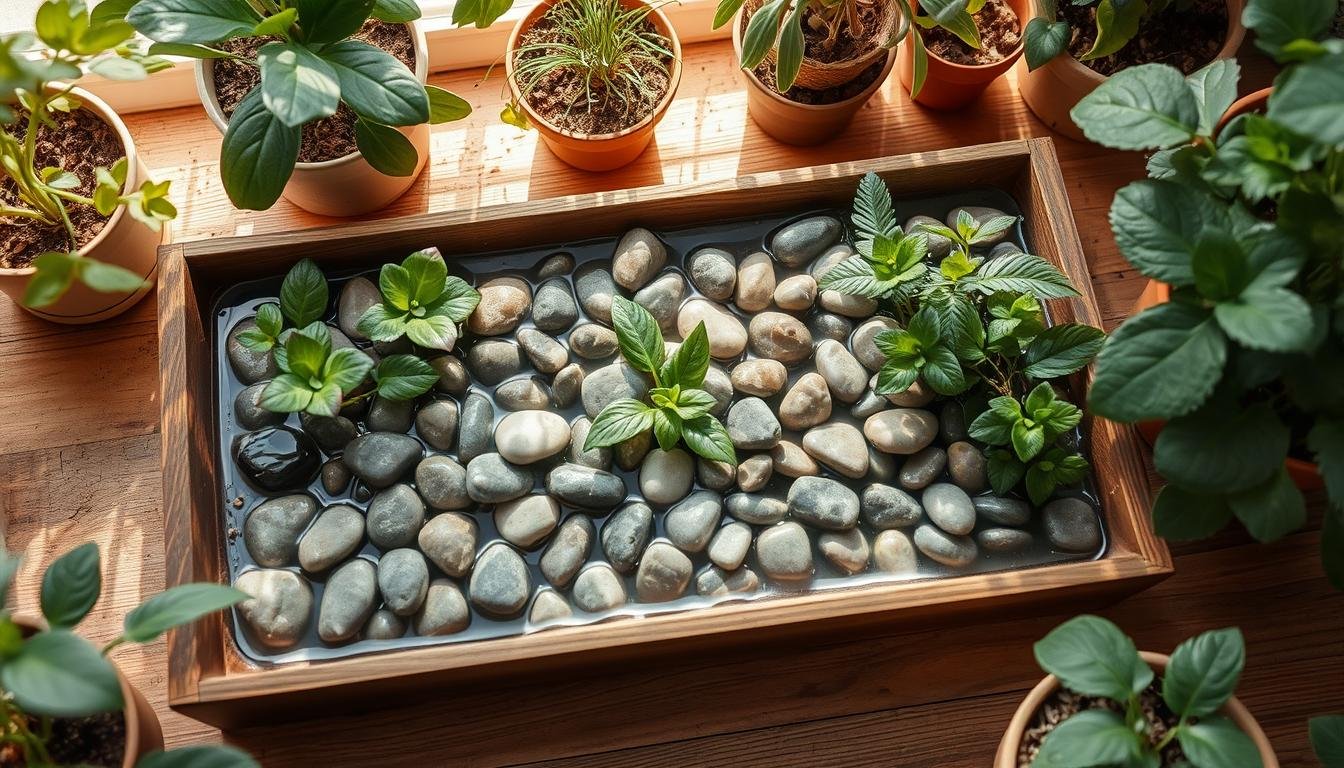
A pebble tray is a shallow tray or saucer filled with stones and a small amount of water, with the plant pot sitting on top of the stones rather than in the water. The idea is simple: as water evaporates, it adds a bit of moisture to the air immediately around the plant. Botanical and extension guidance describes it as a basic way to raise local humidity, not as a whole-room solution. Missouri Botanical Garden’s houseplant guide explains that the water should sit just below the pebble surface so it can evaporate without soaking the pot, and the University of Nebraska-Lincoln gives the same core instruction: keep the water below the container base. (Missouri Botanical Garden)
That distinction matters more than beginners think. A pebble tray is not a drainage fix, not a self-watering system, and not a shortcut for poor watering habits. It is a low-tech humidity tool that works by creating a tiny microclimate around the plant. If you treat it like a cure-all, it disappoints. If you treat it like a small, targeted humidity boost, it makes a lot more sense. (Extension | University of New Hampshire)
Do pebble trays actually work
Yes, pebble trays can work, but the useful answer is “a little, under the right conditions.” Multiple current sources agree on that middle ground. University of New Hampshire Extension says pebble trays can help “a little,” while Costa Farms and Better Homes & Gardens both note that the effect is most noticeable for smaller plants in a tight zone around the tray rather than across an entire room. (Extension | University of New Hampshire)
That is the honest version most beginners need. Pebble trays are not nonsense, but they are also not magic. If your home air is very dry, your room has strong airflow, or your plant sits high above a tiny tray, the effect gets diluted fast. Horticulturist Justin Hancock summed it up well: indoor air circulation disperses the added humidity, which is why tray size, plant size, and distance from the moist surface all matter. (Better Homes & Gardens)
Where pebble trays help most
Pebble trays make the most sense for small, low-growing, humidity-loving plants in dry indoor spaces, especially in winter when heating strips moisture from the air. They are also more useful when the tray is wide, when the plant sits close to the moisture source, and when several small plants are grouped together to build a stronger microclimate. Current expert guidance from Costa Farms and Better Homes & Gardens points in that direction, and extension advice supports combining humidity methods rather than expecting one small tray to do all the work. (Costa Farms)
This is why pebble trays often feel “good enough” for a compact fern on a shelf but underwhelming for a large monstera in an open-plan room. The tray is still evaporating water in both cases. The difference is scale. A small plant that sits close to a broad tray can actually sit inside that tiny humidity pocket. A larger plant spreads far beyond it. (Better Homes & Gardens)
Where pebble trays usually disappoint
They usually disappoint when people expect them to fix everything at once. If your room humidity is very low, a humidifier is the more effective tool for creating consistent moisture in the air. UNH Extension says portable humidifiers provide the most benefit, and Costa Farms makes the same point directly: a humidifier is the most effective way to raise humidity consistently, while pebble trays are a smaller-scale option. (Extension | University of New Hampshire)
They also disappoint when the real problem is not humidity. Brown tips can come from underwatering, fertilizer salt buildup, harsh sun, cold drafts, inconsistent watering, or spider mites. Penn State Extension notes that humidity is only one part of the houseplant environment, and Missouri Botanical Garden’s guide lists overwatering and underwatering among the most common causes of houseplant stress. If you skip diagnosis and blame every crispy edge on dry air, you can end up solving the wrong problem. (Penn State Extension)
Which plants usually benefit from a pebble tray
The best candidates are tropical houseplants and compact plants that naturally prefer more humidity. Current houseplant sources repeatedly mention ferns, orchids, philodendrons, prayer plants, calatheas, fittonia, creeping ficus, parlor palms, and peace lilies as plants that can benefit from a pebble tray, especially when indoor air is dry. Better Homes & Gardens highlights smaller plants like fittonia and creeping ficus, while The Spruce lists ferns, peace lilies, palms, monsteras, philodendrons, calatheas, prayer plants, and orchids among good matches. (Better Homes & Gardens)
The reason is not that these plants “need pebbles.” They need more moisture in the air than many homes provide, especially during the heating season. Missouri Botanical Garden says nearly all houseplants prefer around 50% humidity or more, and some indoor plants do even better at higher levels. The RHS also recommends high humidity for some tropicals, including around 60% or higher for certain plants. (Missouri Botanical Garden)
Plants that typically do not need a pebble tray include most succulents and cacti, which generally tolerate dry indoor air well. Missouri Botanical Garden specifically notes that most cacti and succulents handle the low humidity of the home just fine, though some jungle cacti are an exception and may appreciate moistened pebbles. That is a useful reminder that “houseplant” is not a care category. A fern and a snake plant do not want the same environment. (Missouri Botanical Garden)
Signs your plant might need more humidity
Low humidity often shows up first in the leaves. You may see brown or crispy edges, dry tips, curling, or limp foliage that does not match the plant’s usual look. Some current plant guides also point to stalled growth or leaves unfurling poorly in tropical species when indoor air is very dry. The Spruce mentions browning edges, curling leaves, and wilted foliage as signals that a humidity-loving plant may benefit from a tray, though those symptoms still need context. (The Spruce)
Context is the real skill here. A calathea with crisp margins in a heated room in January might genuinely be telling you the air is too dry. A pothos with yellowing leaves in a dim corner with wet soil is probably telling a different story. Symptoms overlap, so beginners do better when they pair observation with a hygrometer and a quick care check: Is the soil staying soaked? Is the plant near a heater? Is there a draft? Are there mites on the undersides of the leaves? A simple humidity reading helps separate guesswork from reality, and extension advice recommends monitoring indoor conditions rather than assuming. (Extension | University of New Hampshire)
How to set up a pebble tray correctly
The setup is easy, but small errors ruin the point. Use a shallow, waterproof tray that is wider than the plant pot. Add clean pebbles, gravel, or similar stones, then pour in water until the water level sits below the top of the stones and below the base of the pot. The pot should rest on the stones, not in standing water. That basic method is consistent across Missouri Botanical Garden, Nebraska Extension, Costa Farms, and current how-to guides. (Missouri Botanical Garden)
Tray size matters more than most people realize. Wider trays expose more water surface area, which means more evaporation. Flora Grubb notes that the wider the saucer, the more humidity it can add, and Costa Farms says pebble trays work best when the tray extends past the plant canopy, especially for smaller plants. That is why a tiny nursery saucer under a large plant usually does very little. (Flora Grubb Gardens Plant Nursery)
If you want the simplest working setup, follow this sequence:
- Pick a tray wider than the pot.
- Add enough pebbles to lift the pot above the waterline.
- Fill with water to just below the pot base.
- Place the plant where it already gets the right light.
- Refill as water evaporates and clean the tray regularly.
That gives you the benefit without turning the root zone into a swamp. It is simple, cheap, and beginner-safe when the water never touches the bottom of the pot. (Missouri Botanical Garden)
Common pebble tray mistakes beginners make
The biggest mistake is letting the pot sit directly in water. Once that happens, you are no longer raising humidity safely. You are creating a path to waterlogged soil and potentially root rot. Extension and botanical guidance are blunt on this point: the water should stay below the pot base, not wick into the root zone. (Missouri Botanical Garden)
The second mistake is using a tray that is too small. Beginners often grab the saucer that came with the pot, fill it with decorative stones, and expect results. The problem is physics. Less surface area means less evaporation, which means less humidity. A tray that barely extends beyond the pot does not create much of a humidity pocket at leaf level, especially for taller plants. (Flora Grubb Gardens Plant Nursery)
The third mistake is trying to use a pebble tray as a substitute for diagnosis. Crispy leaves do not automatically mean low humidity. The Spruce’s recent humidity-mistake coverage warns that increasing humidity can even distract from the real issue if pests, watering errors, or light problems are to blame. New plant parents get better results when they ask, “What changed in this plant’s environment?” instead of “What hack can I add?” (The Spruce)
Pebble tray vs humidifier vs misting
If you want the cleanest answer, here it is: a pebble tray is the cheapest and gentlest option, a humidifier is the strongest and most reliable, and misting is the least dependable for sustained humidity. UNH Extension says a portable humidifier near plants provides the most benefit. Costa Farms says the same thing in plainer terms: a humidifier is the most effective way to raise humidity consistently. (Extension | University of New Hampshire)
A pebble tray wins on simplicity. It is cheap, silent, and easy to maintain. It works best when you have one or two small humidity-loving plants and only need a modest boost. A humidifier wins when you have fussier tropicals, a noticeably dry room, or several plants grouped together. It costs more and needs cleaning, but it creates real environmental change rather than a tiny local effect. (Extension | University of New Hampshire)
Misting sounds appealing because it feels active, but expert coverage is less enthusiastic. The Spruce’s recent advice warns that misting does not raise humidity effectively for long and can create leaf issues on some plants. Compared with misting, a pebble tray at least adds moisture gradually over time instead of for a few minutes. Still, if your calathea is struggling in heated winter air, a humidifier usually beats both. (The Spruce)
Cleaning, refilling, and maintenance
A pebble tray is low maintenance, not no maintenance. Water evaporates, mineral residue builds up, dust lands in the tray, and stagnant moisture can get grimy if you ignore it. Several current sources recommend refilling regularly and cleaning the tray to keep it effective and hygienic. Better Homes & Gardens explicitly notes that regular refilling and cleaning are part of proper use. (Better Homes & Gardens)
How often should you refill it? There is no universal schedule because evaporation changes with season, heat, airflow, and tray size. In many homes, you will top it up every few days or whenever the water drops below a useful level. The practical rule is simple: keep water in the tray, keep it below the pot base, and do not let muck build up. If your home has hard water, you may also notice white mineral crust over time, which is a cue to rinse the tray and stones more often. (Homes and Gardens)
A good beginner routine is to check the tray every time you check soil moisture. That keeps the habit tied to plant care instead of turning it into another forgotten task. Once a month, empty the tray, rinse the stones, wipe the tray clean, and reset it. If you ever smell sour water or see algae, clean it sooner. That keeps the tray helpful instead of becoming a damp decoration you no longer trust.
How to tell if the tray is helping
The clearest way is to measure, not guess. A small hygrometer placed near the plant can show whether the tray is nudging local humidity upward. UNH Extension specifically recommends monitoring humidity levels with a sensor, which is smart advice because indoor conditions can swing more than beginners realize. (Extension | University of New Hampshire)
The second sign is behavioral rather than numerical. New leaves may emerge with less edge browning, foliage may stay softer instead of crisping at the margins, and a humidity-sensitive plant may stop looking stressed during dry spells. What you should not expect is a dramatic overnight transformation. Pebble trays are subtle. They are more about reducing stress at the margins than delivering a miracle turnaround. (The Spruce)
If nothing improves after a fair test, do not force the method. That usually means one of three things: the room is too dry for a tray to matter, the plant’s issue is not humidity, or the setup is too small to be effective. At that point, your next move is not a prettier tray. It is better diagnosis or a stronger humidity method.
When humidity is not the real issue
This is where beginners save themselves a lot of frustration. Houseplants often show similar stress symptoms for very different reasons. Missouri Botanical Garden’s guide lists overwatering as one of the most common problems and describes how too little water can also cause brown, brittle leaf margins. The same plant that looks “dry” may actually be suffering from soggy roots, cold drafts, bad light, or a pest flare-up. (Missouri Botanical Garden)
Spider mites deserve special mention because they thrive in hot, dry conditions and can mimic humidity stress with stippling, fading, and leaf decline. Penn State Extension and Missouri Botanical Garden both flag environmental stress and pests as common indoor plant problems. If a plant keeps declining despite your tray, inspect it closely. Look at the undersides of leaves, check the roots, review your watering pattern, and think about nearby heaters or vents. (Penn State Extension)
The beginner-friendly rule is this: use a pebble tray when the plant likes humidity, your air is somewhat dry, and the rest of the care picture already makes sense. Skip the tray when you are trying to compensate for the wrong light, the wrong soil moisture, the wrong plant choice for the room, or a hidden pest issue. A pebble tray is a support tool. It cannot rescue bad fundamentals.
Conclusion
A pebble tray is one of those plant-care tools that makes sense once you stop asking it to do too much. It can add a modest humidity boost around small, humidity-loving plants. It is cheap, quiet, beginner-friendly, and easy to test. It is also limited. In an airy room, under a large plant, or in seriously dry indoor conditions, a tray will not do what a humidifier can do. (Extension | University of New Hampshire)
That does not make pebble trays useless. It makes them specific. Use one when you want a simple microclimate, not a full environmental reset. Set it up correctly, keep the pot above the waterline, clean it regularly, and watch how your plant responds. That is the sweet spot for beginner plant parents: less myth, more observation, and better decisions based on what the plant is actually telling you.
FAQs
Do pebble trays work for all houseplants
No. Pebble trays work best for humidity-loving plants, especially smaller tropicals like fittonia, ferns, prayer plants, calatheas, orchids, and some philodendrons. Most cacti and many succulents do not need them because they tolerate dry indoor air well, though a few jungle cacti are an exception. (The Spruce)
How often should I refill a pebble tray
Refill it whenever the water level drops enough that evaporation slows down, which for many homes means every few days. Warm rooms, moving air, and wider trays can change the pace. The important rule is not the exact schedule. It is keeping some water in the tray while making sure the pot never sits in it. (Homes and Gardens)
Can I use LECA or decorative stones instead of pebbles
Yes, as long as the material is clean, stable, and holds the pot above the waterline. Some current guides note that clay pebbles can absorb and release moisture gradually, which may slightly extend the humidity effect. The exact stone matters less than the setup: waterproof tray, clean material, and no direct contact between pot and standing water. (treleaf)
Is a pebble tray enough for calatheas and ferns
Sometimes, but not always. If the plant is small and your room is only mildly dry, a tray may help enough to reduce stress. If your home has very dry heated air, a humidifier is usually the more reliable solution. Current extension and expert advice consistently rank humidifiers above pebble trays for meaningful humidity control. (Extension | University of New Hampshire)
Can a pebble tray attract mold or fungus gnats
It can get grimy if you neglect it, especially if water sits dirty for too long. That is why regular rinsing and fresh water matter. A clean tray is usually fine, but a neglected one can collect residue, algae, or stagnant water issues. If you already struggle with fungus gnats, focus first on soil moisture management, because overly wet potting mix is the bigger trigger than the tray itself. (Better Homes & Gardens)