Aerial Roots: What They Do and What to Do With Them
Learn why houseplants grow aerial roots, how climbing, support, and moisture roots differ, and when to leave, guide, bury, or trim them safely at home.

A root growing out of a stem can look like a problem when you expect roots to stay in a pot. On many houseplants, though, it is an ordinary part of how the plant climbs, braces itself, or collects moisture. The useful question is not simply whether a root is above the soil. It is what kind of plant produced it and what that root can do in your setup.
For most Monstera, pothos, and climbing philodendrons, you can leave an aerial root alone, guide it toward a support, tuck a flexible one into potting mix, or trim it if it is in the way. Orchids are a different case: their exposed roots are adapted to life outside soil, so do not apply a casual “cut it or bury it” rule to them. These five points will help you choose a low-risk response.
1. What Counts as an Aerial Root?
Aerial roots are defined by where they grow
An aerial root grows above the ground or potting medium, often from a stem, trunk, or branch. The word describes position, not a single job. Aerial roots can attach a vine to a support, grow down and help brace a large plant, or collect water in an epiphyte; what they do depends on the species and the structure of the root.
Aerial roots are also often adventitious roots: they arise from a stem or another non-root tissue rather than from the plant’s original seedling root system. They are real roots, with living growing regions, even when they look like brown cords or pale nubs. A mature root may be firm, rough, and slower-growing than a fresh tip, so color alone is not a reliable health test.
An exposed root on a houseplant is not necessarily a new kind of root. A pot-bound plant can have ordinary roots emerging through a drainage hole, and a soil root can become visible when mix washes away. Those roots are exposed, but the term “aerial root” is most useful when the plant regularly forms roots from stems or branches above the soil line.
Do not confuse a root with a node or a plantlet
On a climbing aroid, roots commonly emerge near nodes along the vine. A node is a point on the stem where a leaf, bud, or root can form; an aerial root is one structure that can emerge there. The node is part of the stem and carries the potential for new growth, while the root anchors or takes up resources.
This distinction prevents two common mistakes. A dangling root by itself is not usually a complete cutting, and a leafless node can still be more useful for propagation than a long root attached to no viable stem section. Spider-plant babies and other plantlets may arrive with small roots already attached, but those roots belong to a young plantlet; they are not the same structure or growth stage as a vine’s aerial roots.
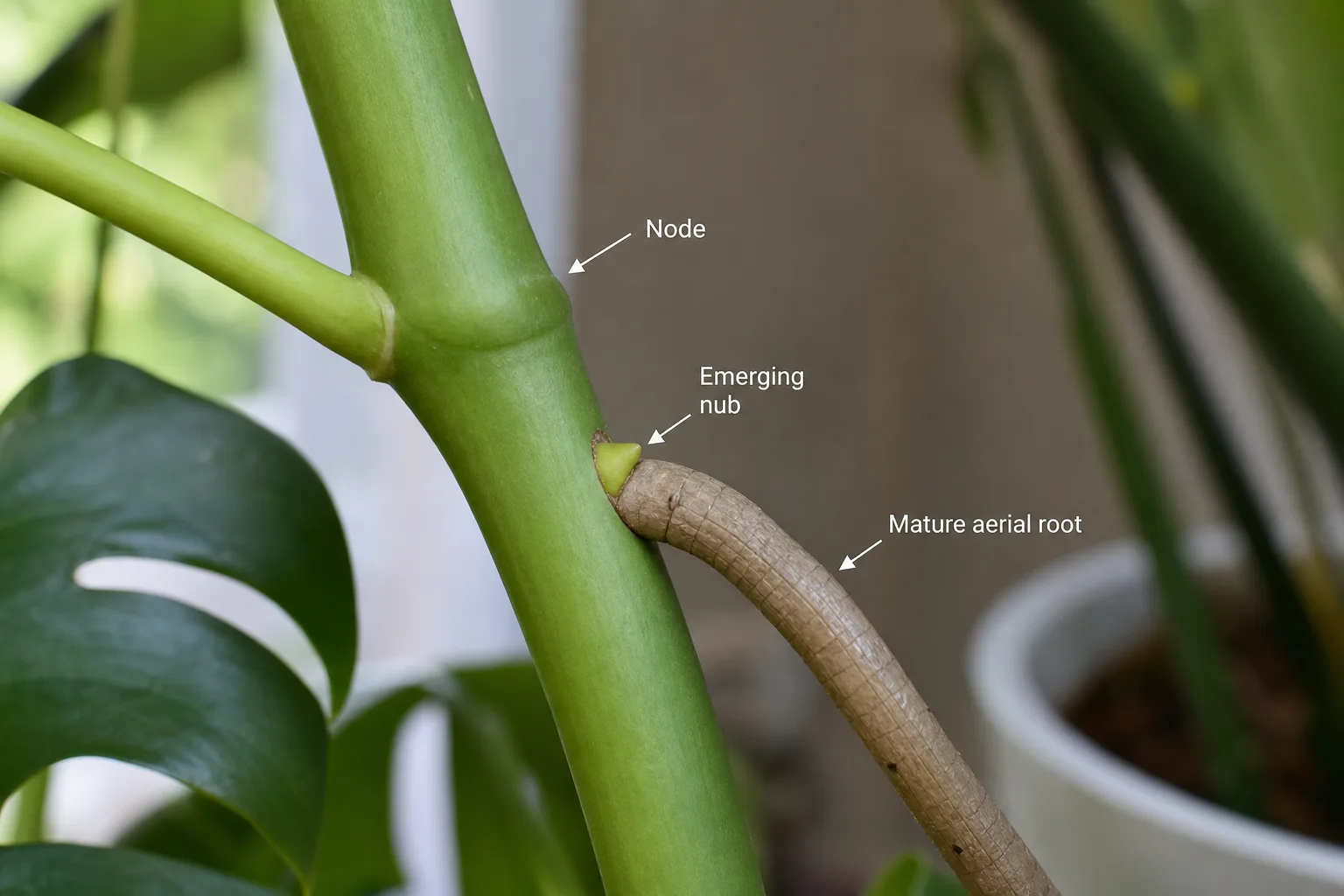
The node is a point on the stem; the nub and mature cord are aerial roots at different stages.
2. Why Plants Grow Roots Above the Soil
Climbing roots grip a surface
Many popular climbing houseplants evolved to grow up trunks, rock, or other rough surfaces. Monstera produces long roots along the vine that attach to nearby branches or tree trunks; Wisconsin Horticulture describes these roots and recommends a strong bark or moss-covered support indoors. (University of Wisconsin–Madison Extension)
In the home, an aerial root may point toward a wall, shelf, support, or open space. It is not reaching out to parasitize a neighboring plant. The root can help the vine hold itself upright and, when it reaches suitable damp material or soil, may continue growing there. The plant may still grow without a support, but the stem can sprawl, lean, or become awkward to manage.
Roots and stems work as a system: the stem carries leaves, while roots that grip a surface help hold the vine as it climbs. Aerial roots do not pull the plant upward like a motor. Instead, they give the climbing stem more contact and anchorage as new growth extends toward light.
Prop roots add a second support
Some plants produce roots that descend from branches or trunks until they reach soil. These are often called prop roots or support roots because they help hold up a wide or heavy canopy. Banyan figs are a familiar example: descending roots can thicken and become trunk-like supports over time. (The Huntington)
That function differs from a Monstera root reaching for a pole. A climbing root typically anchors a vine to a surface; a prop root can establish a new connection with the ground and help carry structural load. These roots are more common in trees and tropical landscapes than in a small windowsill plant, but they explain why “aerial root” does not mean “root that only hangs in the air.”
If you grow a vigorous tropical vine outdoors in a warm climate, the same root habit can be useful or inconvenient depending on the plant and location. Monstera can climb trees and structures when grown in warm landscapes, so UF/IFAS advises managing its growth and keeping it away from trees or structures where it is not wanted. (UF/IFAS Extension) In regions with cold winters, that outdoor behavior does not translate to year-round garden planting; many of these tropical houseplants must remain protected indoors.
Epiphyte roots gather moisture differently
An epiphyte grows on another plant or surface for support without taking food from that host. Many orchids live this way in nature, with roots exposed to air and brief rain rather than buried in soil. The outer layer of many epiphytic orchid roots, called velamen, rapidly takes up water and temporarily holds it as the root dries between wet periods. (UC Botanical Garden at Berkeley)
The important distinction is that aerial roots do not all drink water from ordinary indoor air. An orchid’s exposed roots have specialized tissues that intercept rain or water from mist and then transfer it inward; a Monstera’s long root is primarily part of a climbing and support strategy, though roots that reach damp moss or soil can contribute to uptake. Humid air alone is not a substitute for appropriate watering or a healthy root zone.
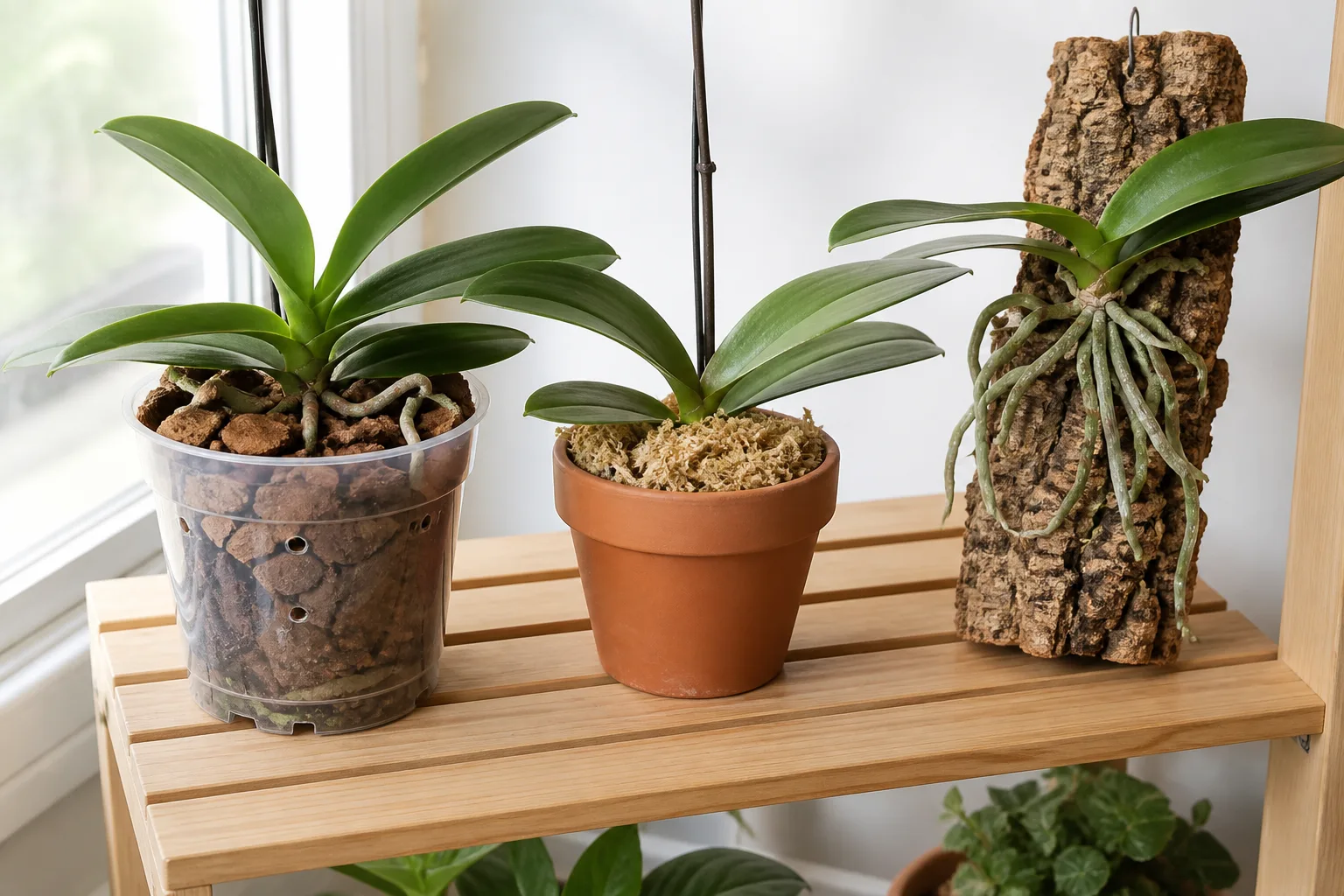
Orchid roots may be exposed, inside bark, or attached to a mount; their role and care differ from a climbing aroid’s roots.
3. Which Houseplants Commonly Grow Aerial Roots?
A quick species and function guide
Use the plant’s growth habit as your first clue. The table below describes common examples, but individual species and growing conditions vary.
| Plant or group | What the visible roots mainly do | Practical default |
|---|---|---|
| Monstera, climbing philodendron, pothos, Rhaphidophora, Scindapsus | Attach to a climbing surface; some roots can grow into damp moss or soil | Leave them, offer support, or guide flexible roots |
| Ficus and banyan figs | Some species form descending roots that may brace branches or trunks | Do not cut structural roots from a large landscape plant without assessing the plant |
| Epiphytic orchids such as Phalaenopsis | Anchor to a mount or medium; velamen helps intercept and hold water | Keep sound roots exposed or in a suitable airy medium; remove only dead or damaged portions |
| Some climbing hydrangeas and ivies | Short attachment roots or rootlets help stems cling to surfaces | Provide an appropriate support and protect walls or delicate finishes |
| Spider plant babies and other rooted plantlets | Roots belong to a small, already developing plant | Treat as a plantlet to root or pot, not as a loose aerial root |
University and horticultural sources describe Monstera as a climber whose aerial roots attach to nearby trunks and branches, and Iowa State Extension notes that philodendron roots can be left alone, trained to a trellis or moss pole, or guided into soil. (University of Wisconsin–Madison Extension; Iowa State University Extension and Outreach)
The table is a starting point, not a reason to identify a plant from roots alone. A cord growing from a vine node is a different clue from a root descending from a tree branch, and exposed orchid roots have different needs from an aroid climbing root. If you are unsure what plant you have, check its leaves, stem, and growth pattern before pruning or repotting.
4. What Aerial Roots Tell You About Plant Health
They do not diagnose a rootbound pot
Roots appearing above the mix do not, by themselves, mean the plant needs a larger pot. They may be normal for the species, and putting a climbing root under soil just to hide it can create more disturbance than benefit. Iowa State Extension says philodendron aerial roots can be left alone or directed into soil for support; UConn’s Monstera guidance similarly allows established aerial roots to be placed shallowly in mix while cautioning against burying growing tips. (Iowa State University Extension and Outreach; University of Connecticut Extension)
Check the root ball and the plant’s performance before deciding to repot. Roots circling densely around the inside of the pot, a root mass that dries unusually fast, water running straight through, or slowed growth during the active season are more useful clues than a few aerial roots. Even then, compare several signs: light, season, watering, and temperature can also slow growth.
Repot when the container is genuinely crowded or the mix has broken down, not because a root hangs over the rim. Choose a pot only modestly larger than the root ball and preserve the plant’s usual depth. For an aroid, you can tuck a flexible root into fresh mix if that helps support the vine, but do not bury stem nodes, soft growing tips, or large stretches of stem in wet soil.
They are not a humidity meter
A plant may grow more or longer roots when it is actively climbing or when a stem reaches into a new space, but aerial roots alone cannot tell you the room’s humidity or the plant’s water status. Their number and length vary by species, age, light, support, and growth conditions. A root that reaches out across a table is not automatically a sign of a crisis or a request to mist the leaves.
Judge plant health from the whole plant. Look for steady new growth appropriate to the season, firm stems, leaves that hold their shape, and roots that are not persistently soft or foul-smelling. With orchids, color can change as velamen wets and dries, so one glance at a silvery root cannot diagnose dehydration; inspect root firmness and the active tips as well. The American Orchid Society explains that orchid roots have a living tip and a functional outer velamen layer, and that healthy root color varies. (American Orchid Society)
Aerial roots can tell you something narrower: a climbing plant has stem tissue capable of producing roots, or an epiphyte is growing roots adapted to an exposed environment. That is useful natural history, not a substitute for checking the potting medium, light, watering, and root condition.
5. What to Do With Aerial Roots Indoors
Leave healthy, unobtrusive roots alone
If an aerial root is not blocking a walkway, catching on fabric, or pressing against a surface you need to protect, leaving it is a sound choice. The plant does not need every root tucked away to look tidy, and a healthy root hanging in open air is not a reason to water more often. Iowa State Extension explicitly lists doing nothing as an option for philodendron roots. (Iowa State University Extension and Outreach)
A root can become stiff as it matures. Avoid repeatedly bending or twisting it to fit a new layout; even roots that look dry on the outside may still be attached and functional. If it is headed toward a wall, move the plant or add a barrier before it adheres, since detaching roots later can lift paint, wallpaper, or delicate finishes.
Roots that reach a textured, damp support can attach; this is one option for a climbing aroid, not a requirement for every houseplant.
Train climbing roots without forcing them
A support is useful when you want a climbing plant to grow upward, keep its stem from sprawling, or stay clear of a shelf or wall. A moss pole offers a moist, textured surface that roots can enter; a coir pole or bare trellis offers structure but usually provides less moisture. Wisconsin Horticulture recommends a strong tree-bark or moss-covered support for Monstera roots, while a practical moss-pole walkthrough from Gardener’s Path explains how to place and secure a climbing plant to a support. (University of Wisconsin–Madison Extension; Gardener’s Path)
Set the pole behind the stem’s climbing side and anchor it firmly so the pot will not tip. Use soft plant ties around the stem, ideally near a node or internode, rather than tightening wire or a tie around a leaf stalk. The stem is the structure you are training; the leaf petioles need room to move and turn toward the light.
If a pliable aerial root is already near the support, guide its tip toward the surface and secure the stem loosely enough that it can rest against it. Do not pull a long, hardened root across the pot or force it flat against a pole. Train new roots as they emerge, one at a time, and accept that some may keep growing in another direction.
A moss pole only helps if you are prepared to maintain it. Check the pole itself rather than misting on a schedule: if the moss is dry and you want roots to grow into it, water it so it is evenly damp, then let excess water drain. Keep the potting mix’s watering rhythm separate; a damp pole is not a signal to saturate the root ball. For a lower-maintenance display, a trellis or stake plus soft stem ties can provide support without the added moisture care.
Guide suitable roots into soil
A long, flexible aerial root on a climbing aroid can be directed down toward the pot and lightly covered with mix. Once it contacts suitable medium, it may branch and add another anchoring point. Iowa State Extension says philodendron roots can be placed in soil to root in and support the plant, and UConn provides shallow placement guidance for established Monstera roots. (Iowa State University Extension and Outreach; University of Connecticut Extension)
Only do this when the root bends without cracking and the potting mix drains freely. Guide the tip gradually rather than folding the root at its base. Keep the stem node and any actively growing root tip at the surface; burying soft stem tissue in persistently wet mix invites decay. If the root is brittle, leave it suspended or add a support instead.
Do not apply this shortcut to every plant. Most orchid roots are adapted to open, airy conditions and the plant’s specific orchid medium; pushing them into ordinary dense houseplant soil can deprive them of the airflow and wet-dry pattern they need. For an epiphytic orchid, keep healthy roots in the potting medium recommended for that orchid or let them grow outside the pot.
When and how to trim unwanted roots
For many climbing aroids, trimming an aerial root that is in the way is optional. Iowa State Extension notes that philodendron aerial roots can be pruned with sharp pruners without harming the plant. A clean cut does not mean the root will grow back from the cut end, though a plant may produce new roots elsewhere as it continues growing. (Iowa State University Extension and Outreach)
First see if moving the pot, adding a support, or redirecting a flexible tip solves the problem. If you do trim, use clean, sharp scissors or bypass pruners, support the root, and cut it without nicking the stem or nearby node. A single unwanted root is a small pruning decision; removing many roots from a plant that is actively climbing a pole can reduce its anchorage and may require more support until it grows again.
Orchid guidance needs more nuance than “never cut” or “cut any exposed root.” Keep firm, living orchid roots even when they are silver, green, or growing outside the pot. If a root is hollow, mushy, or clearly dead, the American Orchid Society describes it as a candidate for removal; use a clean tool and avoid cutting active tips or sound roots just because they are untidy. (American Orchid Society)
For a large outdoor tree or banyan with substantial prop roots, do not use indoor houseplant pruning advice. Those roots may be helping support branches or the trunk, and a local arborist can assess structural roots before any removal. Tropical vines outdoors also need containment appropriate to the climate and site; UF/IFAS notes that Monstera can climb adjacent trees and structures in warm landscapes. (The Huntington; UF/IFAS Extension)
Propagation Depends on What Is Attached to the Root
Aerial roots can be helpful on a cutting, but they are not a universal shortcut to a new plant. To propagate most climbing aroids from a stem cutting, include a viable node with the cutting; the node contains the growth point, while an aerial root can provide an established root to guide into water or a suitable rooting medium. A detached root without a viable section of stem and node usually cannot produce a new vine.
Monstera can also be propagated by layering: encourage a section of stem with a node to root while it remains attached, then separate it after roots form. This is different from planting a loose aerial root. University of Wisconsin–Madison Extension describes stem cuttings, simple layering, and air layering as Monstera propagation methods, and UF/IFAS also lists stem cuttings among common methods. (University of Wisconsin–Madison Extension; UF/IFAS Extension)
Spider-plant babies are another distinct case. They are already small plantlets, so their own roots can help them establish when potted or rooted. That does not mean a stray aerial root from a pothos or Monstera can be separated and grown by itself. Before cutting anything for propagation, locate the stem node, check that the cutting includes healthy stem tissue, and choose a method suited to the plant.
Conclusion
Aerial roots are not one-size-fits-all signals. On climbing aroids they commonly help the stem attach and can be guided to a support or, if flexible, toward soil; on banyans and other large plants, descending roots may add structural support; on many epiphytic orchids, exposed roots are adapted to capture and hold water in an airy environment.
Start by identifying the plant and the root’s origin. If the root is healthy and not in your way, leave it. If you want a climber upright, secure the stem to a stable support and guide only pliable roots; if a root is unwanted, trim selectively with a clean tool when appropriate for that plant. An aerial root alone does not diagnose a crowded pot, poor humidity, or a need to change your watering routine.