How to Protect Your Home From Asian Needle Ants
Asian needle ants hide in mulch, leaf litter, and rotting wood. Get evidence-based steps for safer yard work, home prevention, and targeted control.

Asian needle ants (Brachyponera chinensis) are easy to underestimate. They are small, dark ants that often stay hidden in mulch, leaf litter, rotting wood, or damp soil, but a person can be stung by accidentally pressing one against bare skin while gardening. The species also displaces native ants and can enter buildings, so the best response combines personal protection, careful identification, habitat management, and targeted control.
The first rule is simple: do not reach into a suspected nest to confirm it. Put on protective clothing, photograph the ants from a safe distance, and contact a local Extension office or qualified pest professional if the identification affects what you plan to do. Several dark ants look similar, and an incorrect identification can lead to the wrong bait, the wrong pesticide, or an unnecessary attack on harmless native ants.
The safest first move: protect yourself and confirm the ant
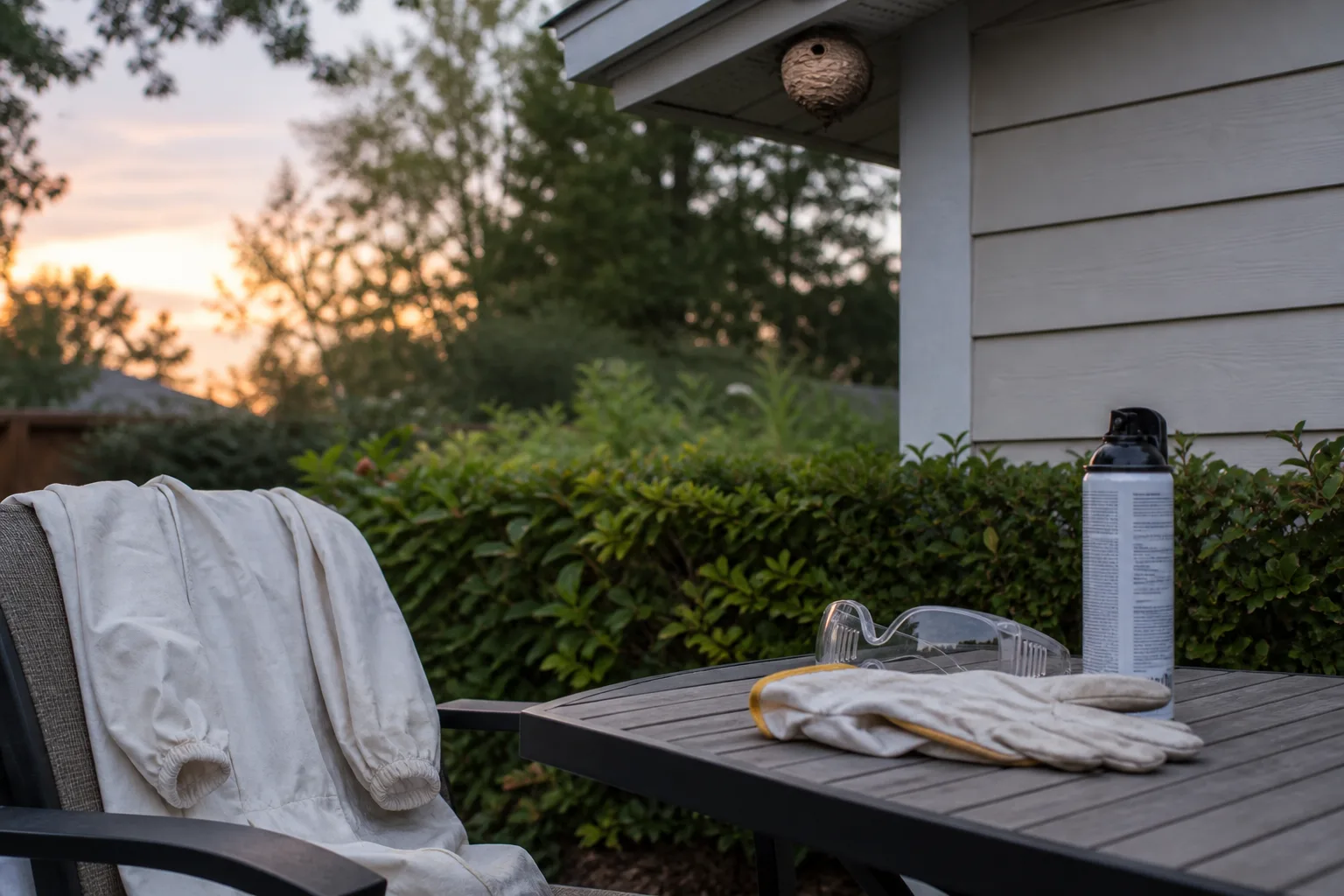
If you are about to move mulch, lift a rock, clear a log, or reach into a dark gap near a foundation, treat the area as potentially occupied until you have checked it without using your hands. Wear thick gloves, long sleeves, long pants, socks, and closed-toe shoes. Virginia Cooperative Extension specifically recommends that clothing combination for outdoor work in known Asian needle ant habitat, and NC State Extension likewise warns against bare-handed handling of mulch and debris.
What Asian needle ants look like
Workers are usually about 4 to 6.5 millimeters long—roughly one-fifth of an inch—with a slender, shiny dark-brown to black body. The legs, mouthparts, and antenna tips may look lighter brown or orange. A visible stinger and a long, narrow body can help distinguish them from some common ants, but color by itself is not enough for a reliable identification.
The USDA Forest Service fact sheet on Asian needle ants notes that other eastern ants can look similar. NC State describes a useful laboratory-style clue: these ants struggle to climb smooth glass, unlike many other ants. That does not make handling one a good home test. A clear photo, the location where it was found, and a local insect-identification service are safer and more useful than trying to trap a live ant with your fingers.
Asian needle ants are not the same as fire ants. They generally do not build the conspicuous soil mounds associated with fire ants, and they often try to flee rather than rush toward a person. That difference should not make you careless: an ant trapped in clothing or pressed by a hand can sting defensively.
Where they hide around homes
Look for the conditions that provide both moisture and cover: leaf litter, pine straw, heavy mulch, rotting logs, wood piles, stones, landscape timbers, bricks, pavers, loose soil, and crevices near sprinkler systems or pavement. Virginia Tech also lists lawns, potted plants, and areas under landscape materials as possible habitat. Around a house, the most important locations are shaded foundation edges, damp crawl-space approaches, firewood stacks, and garden beds that touch doors or walls.
An active colony may occupy several cooperating nests rather than one obvious mound. NC State describes Asian needle ant colonies as polydomous, meaning they can use multiple nests, and polygynous, meaning nests can contain multiple queens. That is why a single crushed nest or one brief spray may reduce visible activity without solving the wider problem.
Why this ant deserves a careful response
The concern is not that every ant in a yard is dangerous. The concern is the combination of a defensive sting, concealed nesting sites, indoor foraging, and pressure on native ants. A proportionate response protects people in the places they work and play while avoiding a broad insecticide campaign that damages the rest of the food web.
The sting is defensive—but can be medically serious
Most stings happen when someone places a hand on an ant or nest, moves an infested log or paver, or brushes an ant trapped against skin. If one lands on you, flick it away rather than brushing or crushing it against your body. Do not kneel, sit, or let children play directly on suspected nesting cover.
The sting can be sharply painful and may throb. In sensitive people, ant venom can trigger anaphylaxis, a life-threatening reaction. Watch for generalized hives, swelling away from the sting, throat tightness, hoarseness, coughing, wheezing, trouble breathing or swallowing, dizziness, fainting, vomiting, or a rapid worsening of symptoms. The American College of Allergy, Asthma & Immunology’s insect-sting guidance advises using prescribed epinephrine and seeking emergency care at the first sign of anaphylaxis; epinephrine is not a substitute for emergency evaluation.
If the reaction is limited to pain, redness, or swelling at the sting site, follow the person’s usual medical plan and seek advice if symptoms spread or worsen. Anyone with a history of serious insect-sting reactions should discuss an emergency plan and epinephrine with a clinician before doing yard work in an affected area. Children, older adults, and visitors may not know where a nest is, so keep suspected areas clearly off-limits until they are checked.
The ecological cost is bigger than a nuisance
Asian needle ants are invasive in the United States and can reduce native ant abundance and diversity. The USDA Forest Service explains that many native ants disperse seeds with nutritious elaiosomes attached, and that seed dispersal drops where Asian needle ants replace those species. Native ants can also help shape soil food webs and prey on other organisms.
That ecological role changes the control decision. If ants are only crossing a path away from the house, leave them alone and avoid turning the whole yard into a pesticide zone. If they are concentrated beside a door, entering a kitchen, or occupying a play area, use the smallest defensible treatment area and protect nearby non-target insects as much as the product label allows.
Reduce the places that bring ants toward your home
Prevention will not remove an established colony in nearby woods, but it can reduce the odds that a nest sits beside a door or that workers find an easy route indoors. Focus effort on the house perimeter and high-contact areas, not on eliminating every natural hiding place from the property.
Tidy the immediate foundation zone
Start with the one- to several-foot strip nearest the foundation, adjusting for your local drainage and landscaping needs. Rake heavy mulch, pine needles, and leaf litter back from doors, vents, and siding; move firewood and rotting boards away from the structure; replace damp or decaying landscape timbers; and correct leaking hose connections, downspouts, or irrigation lines. Keep mulch from touching siding, thresholds, and plant crowns.
Do not interpret this as a command to strip every bed bare. Leaf litter and downed wood are valuable habitat in a garden or woodland, and removing them everywhere can harm native insects and soil life. The useful compromise is to keep a managed, inspectable perimeter at the house and preserve habitat farther from walkways, doors, and children’s play areas.
Keep trash lids closed, clean food spills, remove fallen fruit, and avoid leaving pet food outdoors. Asian needle ants feed on termites and other small invertebrates, but they also scavenge sugary food and human trash. Removing those resources makes the foundation edge less rewarding and can make any properly labeled bait more likely to be found.
Close the routes into kitchens and living spaces
Repair loose screens, fit weatherstripping around doors, and caulk gaps where siding, pipes, utility lines, and thresholds meet the structure. Inspect window wells, crawl-space vents, and the underside of doors. These measures matter most during warm periods or seasonal flights, when winged reproductive ants may appear around buildings.
If ants are already indoors, do not automatically reach for a typical sugar-ant bait. Asian needle ants may accept sugar when it is available, but Extension sources describe protein feeding as more relevant and warn that their lack of ordinary pheromone trails can make standard baiting less reliable. Clean the area, remove food and moisture, follow the trail from a distance, and identify the ant before choosing a product.
A control plan that respects limited research
There is no single, universally validated homeowner protocol for Asian needle ants. NC State reports recruitment to protein-based insecticide baits, while Virginia Tech and Clemson both emphasize that research is limited and that this species does not recruit to food in the same fast trail-forming way as many common pest ants. That difference should shape expectations: think management and monitoring, not guaranteed eradication.
Map activity before you treat
Observe the area for several minutes without lifting cover or disturbing the ants. Note where activity is highest, whether workers are entering the house, and what shelter or food source sits nearby. Take photos of the ant, the location, and any nest cover. If the ants are on a foundation or in a wall void, contact a local Extension identification service or pest professional rather than dismantling the site yourself.
A treatment zone should be based on observed activity, not a guess that every dark, damp corner contains the pest. This reduces pesticide use, protects native ants, and gives you a way to tell whether the chosen treatment did anything. If the ants disappear for a day and return later, that is not proof that the entire colony is gone; several nests may be involved.
Use protein-based bait as a monitored trial
When the identification is credible and the label permits outdoor use at that location, a protein-based granular bait is the most evidence-aligned starting point. Use only a product whose current label names the target pest or permitted ant use, the application site, and the required precautions. Do not invent a recipe from pantry ingredients, scatter bait across a whole yard, or place it where children, pets, wildlife, or edible crops could contact it.
Place the bait only in the active zone and observe from a safe distance to see whether workers collect it. Follow the product label for placement, weather restrictions, protective equipment, and reapplication. NC State recommends checking treatment areas again after about three to four weeks and retreating only where activity continues, subject to label limits. Virginia Tech’s caution about slow recruitment is important here: a bait that works for a trail-forming house ant may not perform the same way for this species.
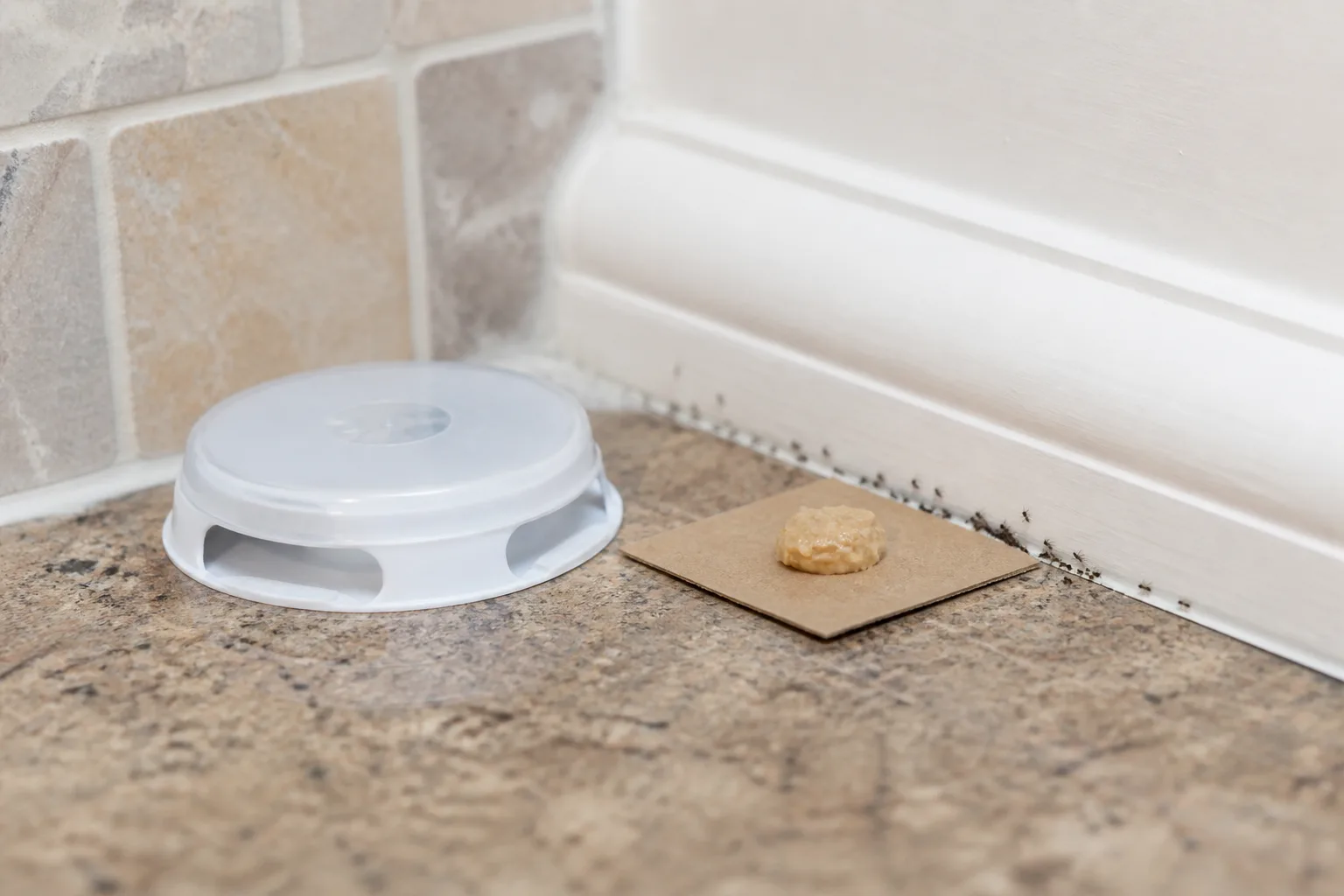
If there is no interest in the bait, do not keep adding more. Recheck the identification, remove competing food sources, ask your Extension office about local recommendations, or bring in a licensed professional. A bait that is ignored can become exposure for pets and non-target insects without improving control.
When direct treatment or a professional makes sense
Direct treatment may be reasonable when a nest is clearly located, the product is labeled for that site and pest, and the person applying it can work without putting hands into the nest. Moving a log, brick, or landscape timber can expose a large number of ants at once, so nest discovery is not a reason to rush into DIY treatment.
Call a qualified pest professional when ants repeatedly enter the home, appear in wall voids or crawl spaces, occupy a high-traffic play area, continue after careful exclusion and monitored baiting, or cannot be identified confidently. Ask how the company will protect non-target insects, what active ingredient and application site the label covers, and how follow-up will be monitored. In a sensitive household, professional help is also a reasonable first step rather than a last resort.
Never spray a pesticide simply because the label says it kills ants. The Virginia Cooperative Extension pesticide guidance explains that both natural and synthetic products can be hazardous, and that users must follow the label’s site, dose, protective-equipment, and environmental directions. If your state or municipality has additional rules, local Extension or the pesticide regulator can clarify them.
What not to use as a shortcut
The most common mistake is choosing a remedy because it is familiar rather than because it matches this ant’s behavior and the site’s safety requirements. Asian needle ants are not a generic “spray the trail” problem, and a visible reduction in workers does not prove the colony has been controlled.
Why common home remedies disappoint
- Vinegar, bleach, or dish soap: These may kill an ant on contact or alter a trail briefly, but they are not colony treatments. Spraying them on soil, siding, or plants can create damage without reaching nests or queens.
- Salt: Salt can injure roots and accumulate in soil. It is especially poor around beds, containers, and foundation plantings.
- Coffee grounds, cinnamon, citrus, or essential oils: Odors may change movement for a short time, but they do not provide dependable colony control. Concentrated oils can irritate skin and damage foliage.
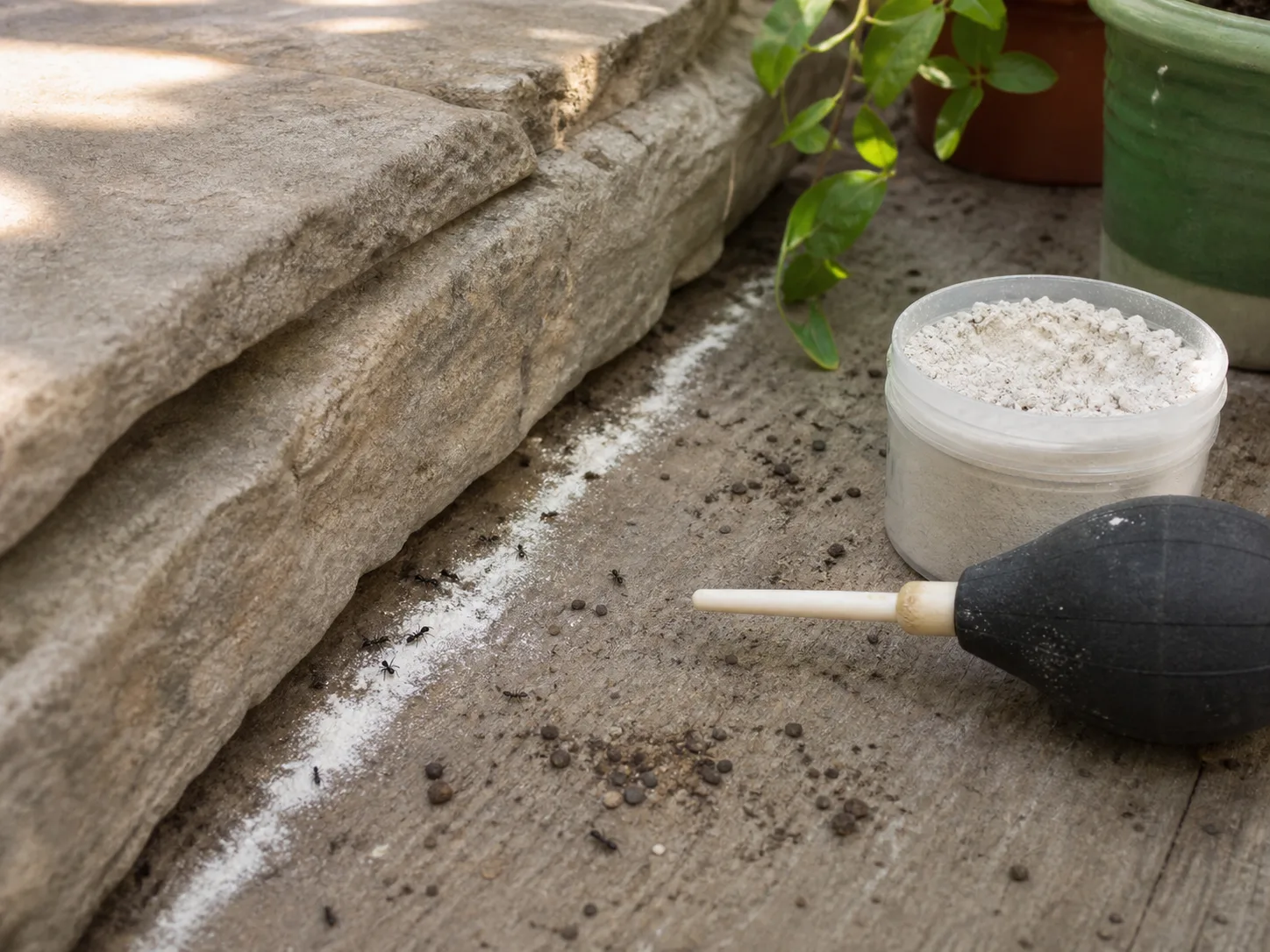
- Unlabeled powders and food-grade diatomaceous earth: A dry powder can lose its effect when wet, and airborne dust can irritate eyes and lungs. Do not assume a household or food-grade product is approved for the pest and application site.
- Boiling water: It can burn roots, kill soil organisms, and fail to penetrate a multi-nest colony. It is a poor trade for a planted bed or foundation border.
The broader rule is more useful than any list of remedies: identify the pest, remove the attractant or shelter you can safely remove, and use a labeled, targeted product only when the expected benefit outweighs the risks. “Natural” is not a synonym for harmless, and “strong” is not a synonym for effective.
What to do if someone is stung
Move away from the suspected nest and avoid brushing at additional ants trapped on clothing. If an ant is on the skin, flick it off. For a mild, localized reaction, basic comfort measures such as a cool compress may help, but follow the person’s medical plan and get advice if swelling becomes extensive, pain is severe, or symptoms are changing.
Treat breathing trouble, throat or tongue swelling, hoarseness, widespread hives, dizziness, fainting, vomiting, or symptoms affecting more than one body system as an emergency. Use a prescribed epinephrine auto-injector according to the person’s action plan and call emergency services; do not wait to see whether an antihistamine works. Even when symptoms improve, the ACAAI recommends immediate medical attention after a serious insect-sting reaction.
After the immediate risk has passed, record where the sting happened, what the insect looked like, and whether the area contained mulch, a log, a paver, or another nest cover. That information can help an Extension entomologist or pest professional identify the hazard without requiring another person to handle the nest.
Conclusion
Protecting your home from Asian needle ants starts with avoiding the sting, not with spraying the first ant you see. Wear protective clothing for risky yard work, keep hands out of dark nesting cover, confirm the species through a photo or local identification service, and manage the foundation perimeter so damp shelter, food, and easy entry routes are less available.
If control is necessary, treat observed activity as a focused management problem. A properly labeled protein-based bait may be worth a monitored trial, but limited research and multi-nest colonies mean that ignored bait, repeated activity, or uncertain identification are signals to stop improvising and get local help. The goal is a safer home and yard with less damage to people, native ants, and the rest of the garden ecosystem.



