Keep Bees Out of Hummingbird Feeders: 9 Humane Tips
Bees can drain hummingbird feeders fast. Use bee guards, saucer feeders, smarter nectar ratios, placement, and bee stations—9 humane fixes that protect hummers.
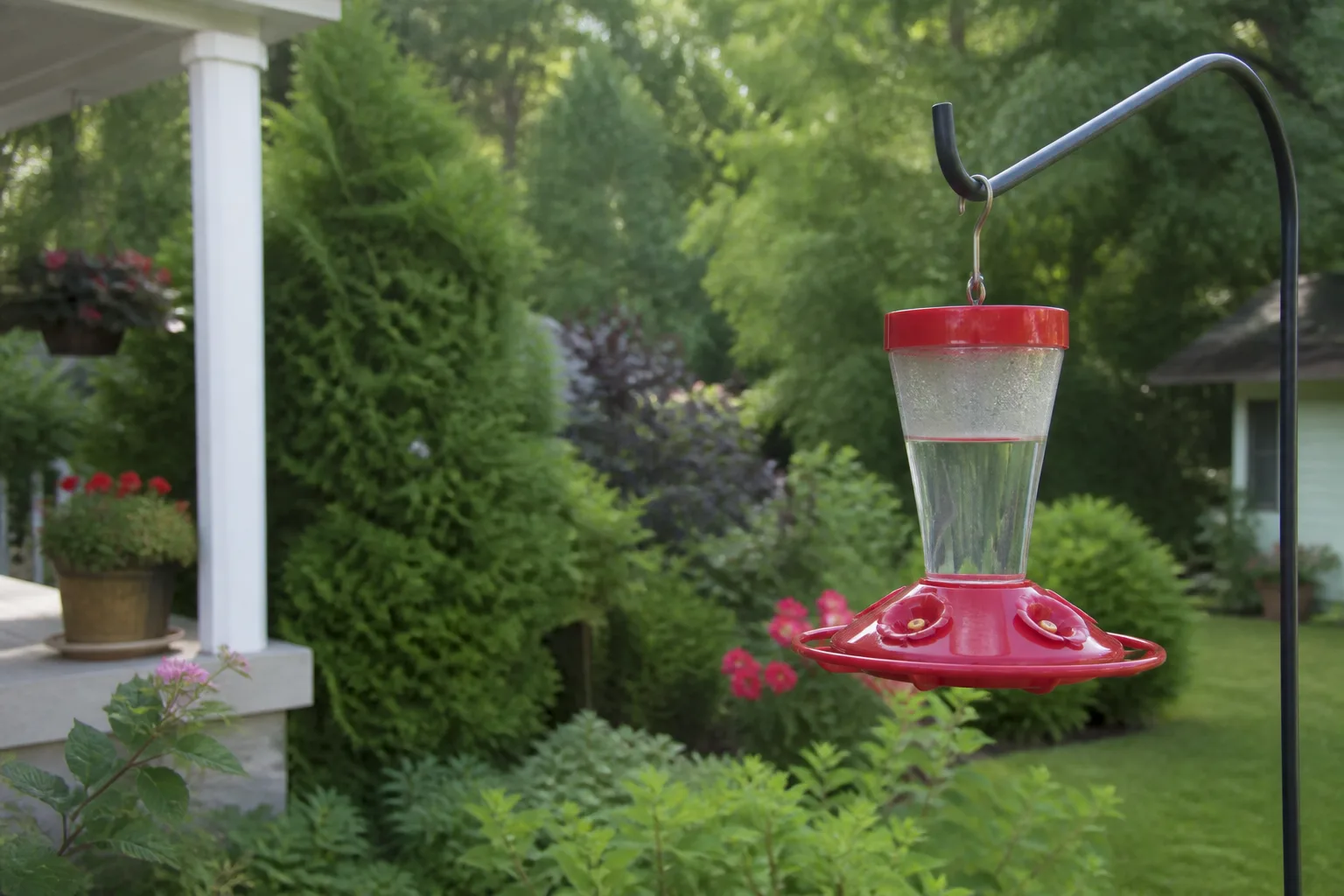
A hummingbird feeder that turns into a bee buffet is one of the most frustrating sights in a backyard bird setup. You hang the feeder to watch ruby-throated or Anna’s hummingbirds hover inches from the window, and within days yellow jackets or honeybees cover every port. The birds still want the sugar water, but they hesitate, dart away, or stop coming altogether while insects drain the reservoir flat.
The good news: you do not need pesticides, sticky traps, or anything that harms pollinators. Bees are doing exactly what evolution trained them to do—find concentrated sugar when flowers are scarce. Your job is to make the hummingbird feeder harder for insects to exploit while giving bees a legitimate alternative elsewhere. These nine humane solutions work best as a sequence, not as random one-off tricks.
Why Bees Swarm Hummingbird Feeders (and When It Gets Worst)
Hummingbird feeders hold artificial nectar: white granulated sugar dissolved in water, usually at roughly the same sweetness as many wildflowers. Bees and wasps need carbohydrate nectar for energy, and honeybees also collect pollen for protein (USGS). When natural blooms thin out—especially in late summer and early fall—a bright feeder in sun becomes a billboard for free calories.
Once one forager finds a leak, drip, or open port, it recruits others. Social insects communicate food locations efficiently, which is why a minor bee problem can explode into a swarm covering the feeder in a day or two. Yellow jackets are especially stubborn once they locate an easy source; they return until the reward disappears or you change the rules of access.
Bees, Wasps, and Yellow Jackets Are Not the Same Problem
All three show up at feeders, but they behave differently and respond slightly differently to fixes.
Honeybees are fuzzy, rounded, and usually docile at feeders unless stepped on. They prefer open nectar they can reach with a short tongue. Paper wasps are slender with a narrow waist and hang near ports without always crowding them. Yellow jackets are bright yellow-and-black, aggressive at food sources, and the insects most likely to bully hummingbirds off a feeder entirely. If your problem is mostly yellow jackets, prioritize bee guards, saucer-style feeders, and moving the feeder—wasps memorize locations fast.
Hummingbirds will sometimes feed beside a few bees, but dense clusters at every port change the math. Hummers have high metabolisms and need frequent meals; waiting out a wall of stinging insects costs them energy they cannot spare.
What Happens When Insects Take Over
When bees control every port, three problems stack up. First, hummingbirds get less food at the moment they need it most—during migration prep or hot weather when natural nectar is already limited. Second, insects track sugar onto the feeder body, which attracts more insects and grows mold faster in heat. Third, homeowners often reach for sprays out of frustration, which creates a worse outcome for birds, pets, and the pollinators the yard depends on.
Understanding that cycle matters because the fix is not “get rid of bees.” It is restore hummingbird access while redirecting bee traffic.
Start Here: A Humane Fix Order That Actually Works
Before you buy a new feeder or relocate everything, run through this order. It saves money and stops you from skipping the step that actually caused the swarm.
Step 1 — Clean and stop leaks. Wipe every drip, tighten caps, and replace cracked reservoirs. Sticky exterior sugar is often how bees find the feeder before they ever reach the ports.
Step 2 — Upgrade hardware. Saucer feeder plus bee guards beats almost any decorative tube feeder once bees have learned your yard.
Step 3 — Adjust nectar and color. Remove yellow accents, keep the standard 1:4 sugar ratio unless you deliberately test a slightly weaker mix, and never use honey or red dye.
Step 4 — Change placement and timing. Move the feeder away from flower beds, shift it every few weeks if needed, and refill during hummingbird-heavy windows.
Step 5 — Redirect bees. Add a separate bee station and bee-friendly flowers far from the hummingbird zone.
If you do only one thing from this list, do Step 1 plus bee guards. That combination solves more cases than any single gadget sold as a “wasp-proof” feeder.
Solution 1: Switch to a Saucer Feeder With Bee Guards
Feeder shape matters more than most packaging admits. Gravity-fed tube feeders keep nectar close to the opening at all times. Bees and wasps can lick the surface without contorting around a guard. Saucer-style (dish) feeders hold nectar below a cover with small ports. Hummingbirds reach in with long bills and tongues; most bees cannot bridge the gap when bee guards—small plastic mesh cages over each port—are installed.
Penn State Extension notes that bee guards are not foolproof because hummers splash sugar onto them, but they materially reduce bee access when you clean the feeder regularly (Penn State Extension). UF/IFAS Extension recommends feeders that ship with guards and points out that while hummingbirds may feed near a few bees, clusters keep them away (UF/IFAS Extension).
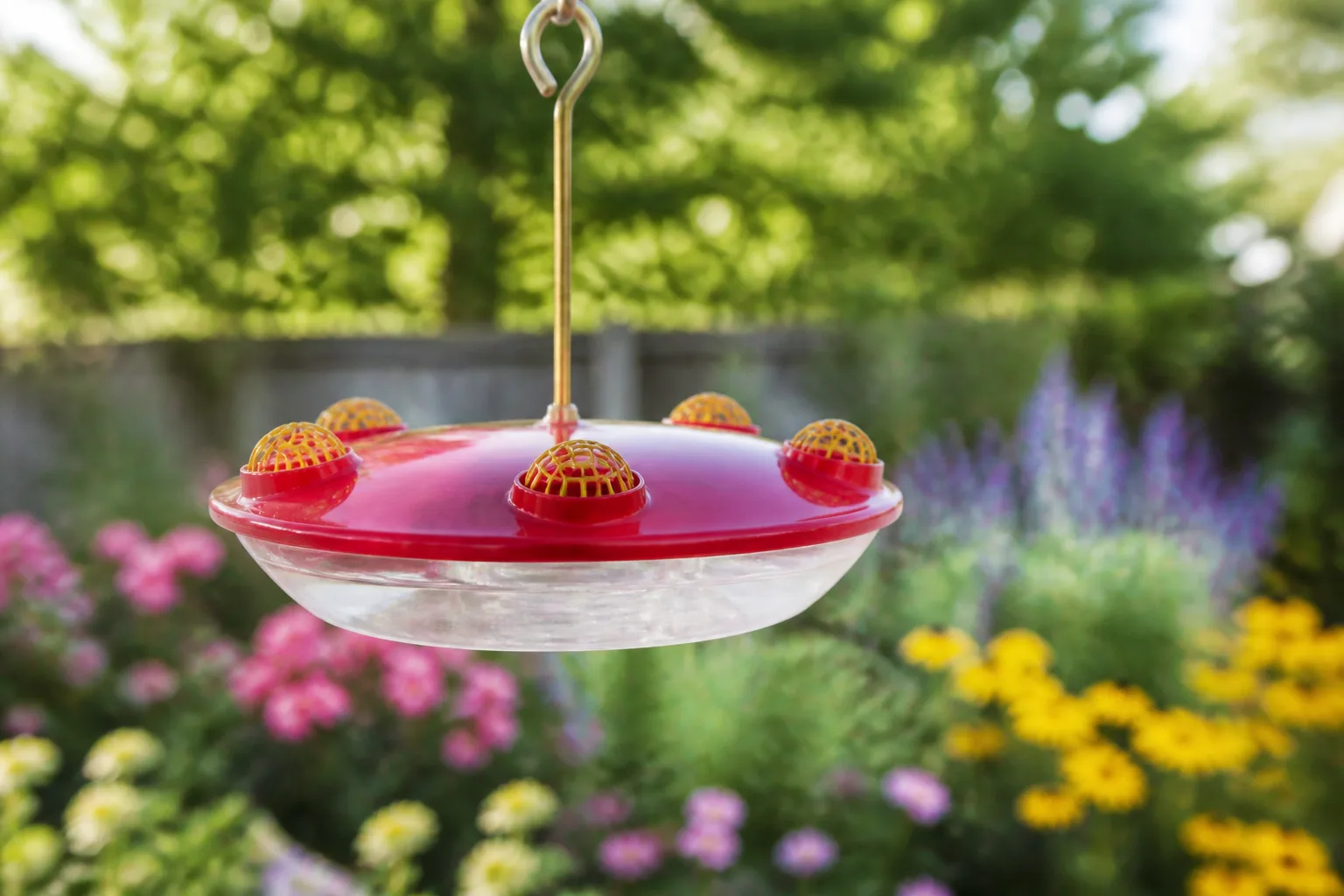
If your current feeder lacks guards, add commercial ones or make DIY guards from 8-mesh hardware cloth (eight holes per linear inch). Cut a small square, bend it into a cap over each port, and confirm hummers can still insert their bills. Replace guards that rust or warp—they stop working the moment bees can squeeze through a gap.
Solution 2: Remove Yellow and Upgrade to Red-Forward Feeders
Color is not decoration; it is a signal. Hummingbirds learn to associate red, orange, and pink tubular flowers with high-value nectar. Bee eyes see a different spectrum: they detect blue, purple, and yellow strongly, while red appears dull. Feeders with yellow bee-shaped accents or yellow flower ports essentially hang a welcome sign for insects.
Choose feeders that are red at the ports and body, not yellow. If you own a perfectly good feeder with yellow parts, paint or swap those pieces—many gardeners use red nail polish near openings when the base color is neutral (Penn State Extension). You do not need red dye in the sugar water; the feeder color does the attracting.
Avoid the myth that blue or purple feeders are “hummingbird colors.” They may look pretty at the garden center, but they also overlap with hues bees prefer. Red-forward hardware plus bee guards beats color debates every time.
Solution 3: Dial In Your Nectar Recipe
The standard hummingbird nectar recipe is 1 part white granulated sugar to 4 parts water, boiled briefly to dissolve sugar, then cooled completely before filling (UF/IFAS Extension). That ratio approximates wildflower nectar and gives hummingbirds the energy they need without risking fungal issues from overly rich mixes.
Some backyard birders test 1 part sugar to 5 parts water to make the solution slightly less rewarding for bees. That can help at the margin, but Penn State Extension warns that weaker solutions may be less attractive to hummingbirds, while stronger ones can harm them. Never push beyond 1:4 trying to please birds and starve bees—it backfires.
Never use honey in hummingbird feeders. Fermentation products can promote fatal fungal disease in hummingbirds (UF/IFAS Extension). Skip brown sugar, molasses, sugar substitutes, and commercial red dye. Plain white sugar and water is the entire recipe.
Solution 4: Clean Drips Before Bees Find Them
Bees find feeders with their senses and with each other’s help, but exterior sticky residue is the fastest invitation. Leaks from overfilled reservoirs, cracked threads, or tipping in wind coat the hanger and post with sugar. Ants arrive first; bees follow.
Take the feeder down every three to five days in cool weather and more often in hot summer heat when solution spoils quickly (UF/IFAS Extension). Disassemble it completely. Scrub ports and reservoirs with hot water and a small brush. Penn State Extension allows mild soap if rinsed thoroughly; UF/IFAS prefers hot water with white vinegar and advises against bleach that leaves harmful residues.
After refilling, wipe the outside dry. Check under the base where drips hide. A clean, dry exterior plus bee guards solves a surprising number of “sudden” bee invasions that were really slow leaks training the colony for weeks.
Solution 5: Move the Feeder (and When to Move It Again)
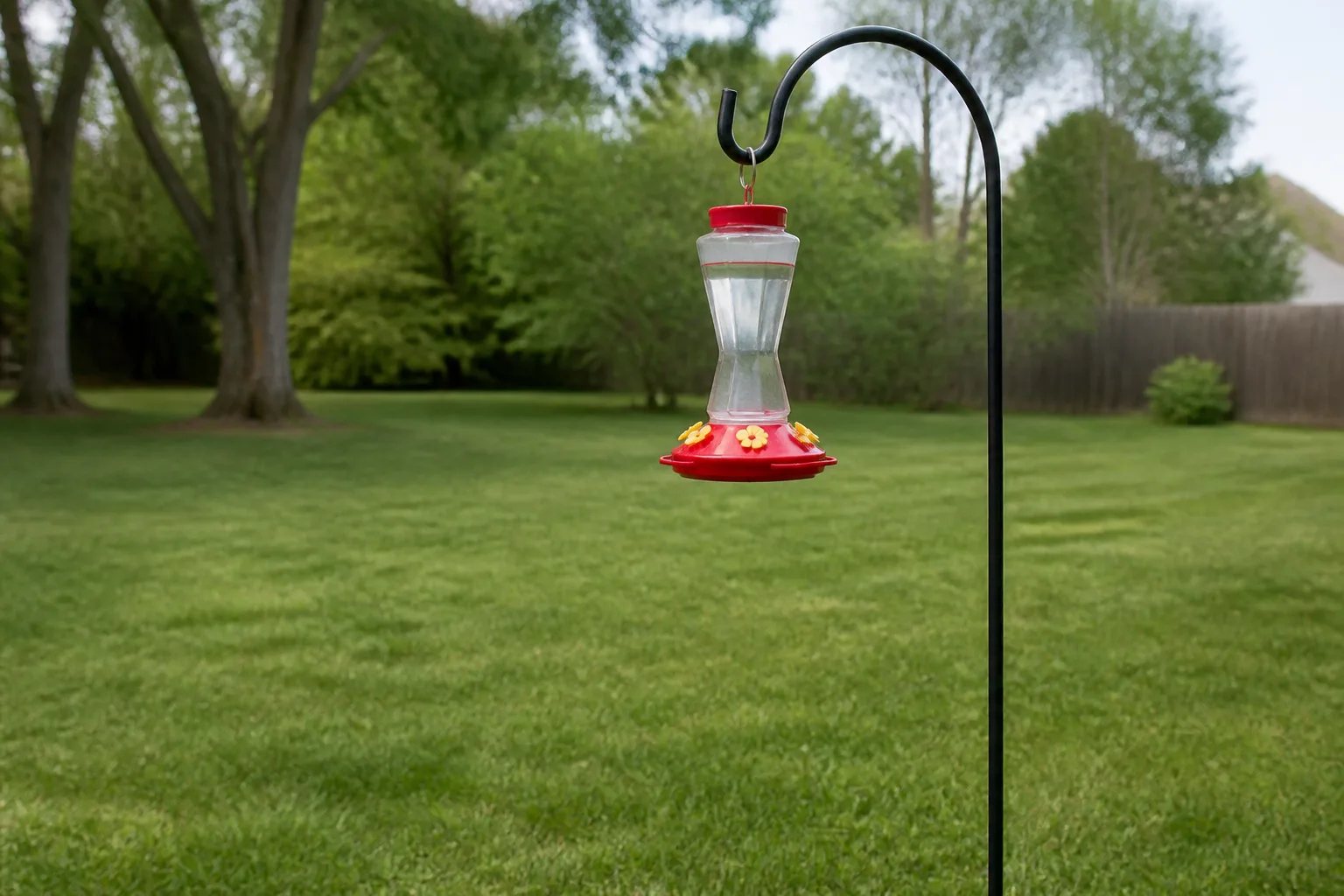
Bees and wasps memorize reliable food locations. Moving the hummingbird feeder even 10–20 feet can break the pattern while hummingbirds quickly re-find it by sight. Shift it to a new hook, branch, or pole segment every few weeks if pressure returns.
Choose moves that also change the insect flight path—not just a lateral scoot on the same porch rail. Hang it around a corner, on the front yard instead of the back, or closer to a window where you still enjoy viewing. Combine the move with a deep clean so old scent trails matter less.
If insects relocate with you instantly, the problem is usually leaks or open ports, not geography. Fix hardware before moving again.
Solution 6: Place Feeders Away From Flower Beds
It sounds counterintuitive because you want hummingbirds near flowers. But hummingbird feeders hanging inside bee-heavy flower beds inherit every forager already working the bed. Bee balm, zinnias, lavender, and butterfly weed pull in pollinators you want in the garden—they should not share a post with a sugar feeder.
Place hummingbird feeders in open viewing spots 10 feet or more from dense blooming beds when possible. UF/IFAS Extension suggests spacing multiple hummingbird feeders at least 10 feet apart so territorial hummers can coexist (UF/IFAS Extension); apply the same logic to distance from large pollinator patches.
Shade matters too. Full sun accelerates spoilage and makes sugar scent travel farther. Partial shade slows fermentation and can reduce midday bee activity while hummers still locate red ports.
Solution 7: Offer Bees Their Own Feeding Station
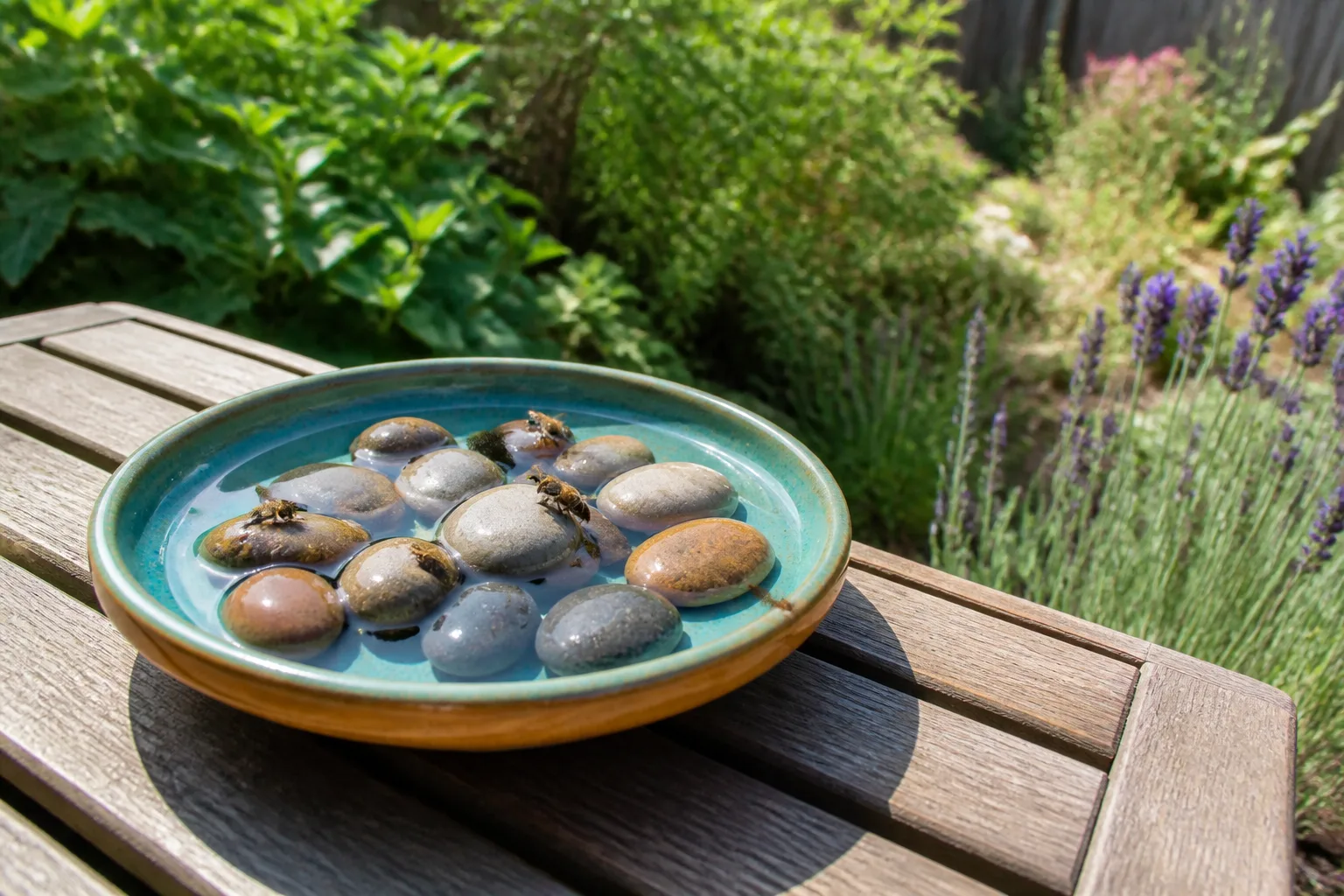
Redirecting beats battling. Set a bee feeding station—a shallow saucer with pebbles or marbles and a stronger sugar solution (roughly 1:1 sugar to water for bees only)—at least 6 to 10 feet away, farther if your yard allows. Stones give bees landing pads so they do not drown.
Refill the bee station regularly and keep it downwind or visually separated from hummingbird feeders so foragers do not treat both as one buffet line. The goal is not to feed bees indefinitely on sugar; it is to pull them off hummingbird ports during nectar dearth while your garden catches up with fall asters, goldenrod, or other late blooms.
This works best combined with Solution 8. Sugar alone without flowers keeps bees dependent on artificial sources.
Solution 8: Plant Nectar Flowers for Bees Elsewhere in the Yard
Long-term coexistence means giving bees real forage away from the hummingbird zone. Group bee-attracting annuals and perennials in a sunny bed on the opposite side of the yard from hummingbird feeders. Strong bee magnets include bee balm, zinnias, lavender, butterfly weed, and many native wildflowers.
Hummingbirds will still visit tubular red and orange blooms in their preferred bed while bees work the flat landing-pad flowers elsewhere. If you grow zinnias for cutting or color, keep those masses away from feeder posts. The same logic applies to herb patches heavy with blooming lavender or basil allowed to flower.
More nectar in the landscape reduces feeder pressure for both species over time, which is the most humane outcome of all.
Solution 9: Time Refills and Use Multiple Feeders for Hummingbirds
Bees are most active in warm midday sun. Refill hummingbird feeders in early morning or late evening when bee traffic is lower and hummers feed heavily at dawn and dusk. That timing gives birds a cleaner window without denying bees daytime foraging in the separate bee station.
If one dominant hummingbird guards a single feeder, add a second feeder out of sight of the first—again at least 10 feet apart (UF/IFAS Extension). More feeding stations for hummers mean less crowding at any one port, which helps birds slip in even when a few insects appear.
Track your local pattern for two weeks. Note when bees peak and when hummers succeed. Adjust refill schedule before buying a third feeder or moving the garden.
What Not to Do (Pesticides, Insecticides, and Risky Shortcuts)
Do not spray pesticides on or near hummingbird feeders. Insecticides kill bees and wasps but also contaminate sugar water and nearby flowers hummingbirds use. Even “bee-safe” marketing on garden sprays rarely accounts for sugar feeders where birds ingest residues directly.
Avoid insecticidal oils or sprays on ports meant to repel bees. Hummingbirds touch the same surfaces with bills and tongues. The risk is not worth a temporary drop in bee visits.
Use caution with petroleum jelly, cooking oil, or mineral oil on feeder exteriors. Penn State Extension mentions thin oil barriers on hanging wire and around ports to deter ants and bees (Penn State Extension). That can help in small amounts on metal hangers—not on perches birds touch—but never coat poles the way some people grease squirrel baffles. Grease on poles mats bird feathers and can poison clinging species; see our guide on why greasing bird feeder poles fails birds for the full picture.
Do not trap, smoke, or destroy bee colonies over a feeder conflict. Relocate your setup instead. If yellow jackets nest in a wall or ground hole near the feeder, address the nest safely with distance and professional help if needed—our wasp management guide covers deterrents that do not belong on hummingbird ports.
Conclusion
Bees at a hummingbird feeder are a seasonal, solvable logistics problem—not a reason to declare war on pollinators. Clean sticky leaks first, switch to a saucer feeder with bee guards, keep the nectar at a safe 1:4 ratio, and strip yellow accents that advertise to insects. Move feeders away from bee-heavy flower beds, refresh them on a smart schedule, and redirect persistent colonies with a separate bee station plus bee-friendly plantings elsewhere.
None of these nine humane solutions works perfectly alone. Together they restore hummingbird access while respecting the bees your garden still needs. Start with the fix order in this guide, watch the feeder for three days after each change, and adjust until the hummers—not the insects—own the ports again.