8 Best Hall Trees for Entryway Storage
Compare eight hall trees by footprint, hook height, bench weight limits, and shoe storage—with sizing rules, anchoring tips, and picks for narrow entryways and large households.
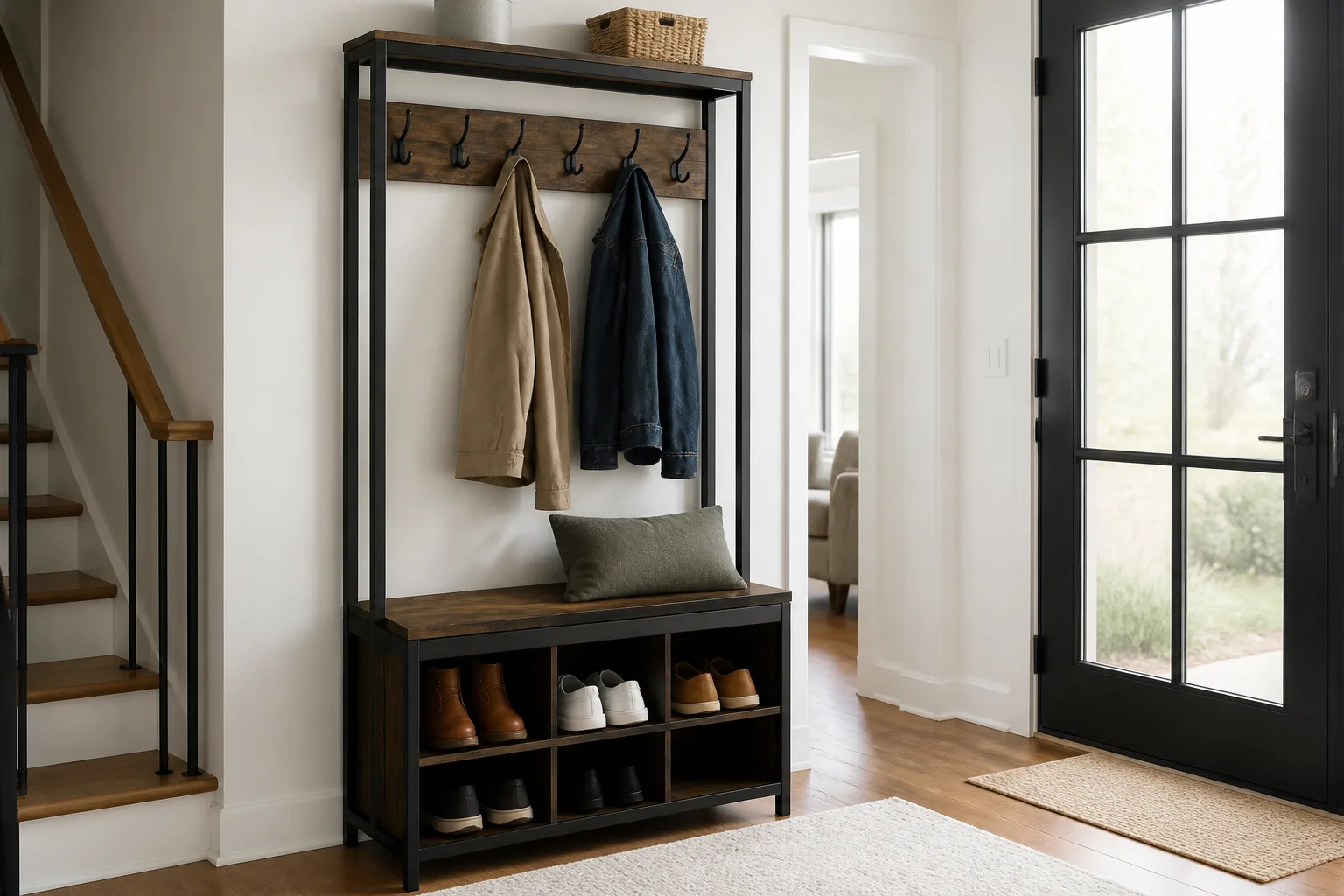
Coats on the dining chair. Shoes under the bench. Keys somewhere on the counter you will not find until tomorrow morning. A hall tree—part coat rack, part shoe station, sometimes bench and mirror—is the single piece of entryway furniture built to end that daily scavenger hunt. The wrong one blocks your front door, sags under winter gear, or looks fine in photos but fails the wet-boot test after a month.
The eight models below cover narrow apartments, corner foyers, design-forward mudrooms, and budget side-door setups. Read the sizing and hook-height rules first. Those two checks prevent more returns than any “best overall” label.
Quick Picks: Match the Hall Tree to Your Entryway
Street prices shift with sales; ranges reflect typical U.S. pricing in 2025–2026.
| Best for | Pick | Why it wins | Main compromise |
|---|---|---|---|
| Balanced all-around | Bon Augure Hall Tree | 400-lb capacity, side hooks, fast assembly | Awkward side cubbies |
| Elevated look | Sand & Stable Carmel | Beadboard panels, hidden shoe compartment | Hooks too low for long coats |
| Sit-and-shoe routine | Crosley Holbrook | Adult-plus-child bench, concealed cabinets | Thin bench cushion; coats drag |
| Multi-person homes | Gracie Oaks Wide | 76-inch width, drawers, wall-anchor kit | Long assembly |
| Lowest spend | Yaheetech Coat Rack | Adjustable hooks, ~$40–50 | Single-prong hooks; lighter build |
| Tight footprint | Walker Edison Industrial | 12.75-inch depth, mirror included | No anchor kit; open shoe shelf |
| Last look before leaving | Sand & Stable Lana | Sturdy 300-lb bench, closed shoe cabinet | Premium price; mirror can be blocked |
| Awkward corners | Crosley Seaside Corner | Corner-hugging shape, magnetic drawer | 5-lb hook limit |
If your entryway is really a 30-inch-wide corridor, skip straight to Best for Small Spaces and the measurement section before you fall for a 40-inch-wide bench unit.
Do You Actually Need a Hall Tree?
A hall tree makes sense when your entry door is the daily choke point for outerwear, footwear, bags, leashes, and keys—and those items currently land on floors, stairs, or furniture never meant to hold wet jackets. Garvee’s hall tree buying guide describes the core job well: bundle vertical coat storage, shoe cubbies, hooks, and sometimes seating into one footprint so the hallway stays walkable.
You can skip a purchased hall tree if you already have a mudroom closet with rod space at the right height, a built-in bench, and shoe storage that drains well. Wall hooks plus a slim shoe rack cost less and install faster in rentals where large furniture is impractical.
Hall Tree vs Coat Rack vs Wall Hooks
Wall hooks alone win when floor space is nearly zero and you only need to hang two or three items. They fail when shoes, bags, and umbrellas still pile up below them.
A freestanding coat rack (no bench or cubbies) suits guest coats in a spare room or a laundry mudroom where you never sit to tie shoes.
A hall tree earns its footprint when you need hooks plus shoe storage plus a landing surface in one vertical column. Bench models add the sit-down shoe routine families with kids rely on daily. The trade-off is depth: even slim units project 13–19 inches from the wall, and loaded coats add another 8–12 inches of visual bulk.
Measure Your Entryway Before You Buy
Professional organizer Audra George of Pretty Neat puts it plainly: you should not feel like you walk around your storage furniture every time you enter, but the piece still has to support the weight you hang on it. Measure before you shop—not after the box arrives.
Tape the footprint on the floor with painter’s tape using the manufacturer’s width × depth dimensions. Walk through with arms full of grocery bags. If your shoulder brushes the tape line, the unit is too deep for daily traffic.
Depth, Width, and Walkway Clearance
Depth (front to back) is the number most shoppers ignore. Budget hall trees start around 13 inches deep; bench models with cabinets often reach 18–19 inches. Add 8–12 inches mentally for coat bulk hanging off hooks.
Width ranges from 28 inches on compact racks to 76 inches on wide family units. Match width to hook count: one adult needs two hooks (wear + spare); add two hooks per additional daily outerwear user.
Walkway clearance: Leave at least 30–36 inches of clear path beside the hall tree in a narrow entry. In a generous foyer, 42 inches feels comfortable when two people pass with coats on.
Ceiling height: Most hall trees stand 69–74 inches tall. Confirm ceiling clearance if you hang long coats—the hem should not brush the floor when on hooks.
Hook Height and Long-Coat Clearance
Long wool coats and puffer jackets need hooks whose center sits roughly 66–72 inches from the floor. Many bench-style hall trees mount hooks lower so sleeves drag across the seat—exactly the complaint testers report on the Crosley Holbrook and Sand & Stable Carmel.
Decision rule: If your household wears knee-length or longer coats daily, prioritize tall hook placement or hook-free upper shelves with a separate wall rod nearby. If you mostly wear hip-length jackets, standard hall-tree hook height works fine.
Check listed hook weight capacity. Budget corner units may cap at 5 pounds per hook; family models often allow 10 pounds or more. Wet wool coats easily exceed five pounds—do not guess.
Materials, Finish, and Stability
Most hall trees combine MDF or engineered wood panels with metal frames or hardware. MDF keeps costs down and accepts paint-grade finishes; it swells if wet boots sit against unsealed edges for weeks. Solid or solid-wood accents (Sand & Stable Lana, Carmel) resist wobble better but still need care near moisture.
Professional organizer Barbara Brock recommends finishes that survive entry traffic: durable paint on wood or a strong acrylic coat over natural grain beats raw wood in a zone where wet umbrellas and salty boots appear all winter.
Metal frames (Bon Augure, Walker Edison, Yaheetech) tolerate daily loading well if feet include levelers or floor protectors. Look for a broad base wider than the upper cabinet—top-heavy units tip when kids pull on hanging backpacks.
Bench weight limits matter if adults sit daily: ratings from 215 to 400 pounds appear in this list. Treat the lower end as single-adult seating only.
Best Overall: Bon Augure Hall Tree with Shoe Storage
The Bon Augure Hall Tree balances industrial looks with everyday capacity better than anything else in this price band. Listed dimensions are 14.97 × 41.34 × 69.61 inches; the manufacturer cites a 400-pound overall weight capacity— unusually high for a sub-$200 flat-pack unit.
Double hooks on the back panel handle daily jackets; side hooks solve the overcrowding problem when every prong is taken—ideal for bags, dog leashes, and the one hoodie someone grabs every morning. An open top shelf works as a key-and-charger drop zone without digging through drawers.
Shoe storage sits below the bench in open cubbies that fit about six adult pairs in typical use. Side cubbies exist but testers find them an awkward size for standard fabric bins—treat them as misc slots, not primary shoe homes.
Assembly averages 45 minutes with two people; hardware and tools ship in the box. After six months of daily loading—including seasonal coats for two adults and gear for two dogs—the frame stayed square with no wall anchor, though anchoring is still wise if children climb benches.
Colors: rustic oak, dark gray oak, vintage oak. Compromise: side cubby proportions; back hooks crowd when fully loaded.
Typical street price: ~$170 at major retailers.
Best Design: Sand & Stable Carmel Hall Tree
If your entry is visible from the living room, the Sand & Stable Carmel trades industrial metal for beadboard panels that read farmhouse, coastal, or traditional depending on wall color. At 64.5 × 40 × 18.5 inches, it is wide enough for a family of four’s daily hooks without occupying a full wall.
Double-prong hooks sit side by side for better spacing than stacked singles. A drop-down bench compartment hides shoes or bins—deep enough that pairs slide toward the back and disappear unless you label zones inside.
Assembly is the pain point: hardware requires firm pressure to seat, and full build can take several hours. Once upright, the broad base resists wobble, and the bench edge remains comfortable for quick sits.
Hook height again struggles with long adult coats—they brush the bench. Colors: gray, white, black, navy. Typical price: ~$337.
Best with Bench: Crosley Holbrook Hall Tree
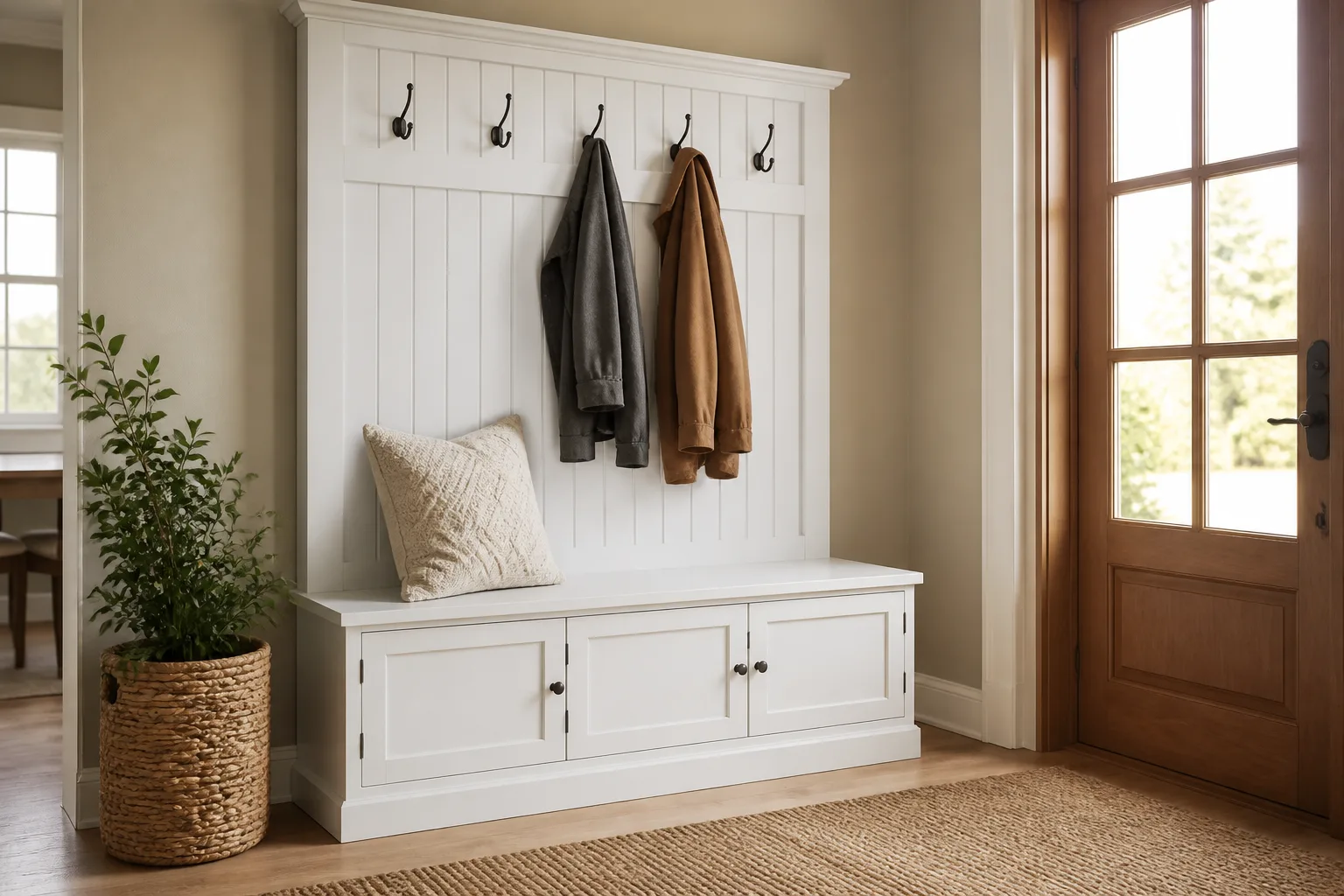
The Crosley Holbrook targets the sit-down shoe ritual. The bench comfortably seats one adult and one child simultaneously—exactly what you want when dressing toddlers or lacing boots. Upper molding and neutral seafoam blue or distressed white finishes feel more furniture-like than utilitarian metal racks.
Lower cabinet doors conceal muddy shoes or seasonal gear; an upper shelf holds baskets. Double-prong hooks stay sturdy under backpacks in testing.
Dimensions: 38 × 70 × 18 inches. Assembly runs a few hours with two people—more complex than Bon Augure because of cabinet doors.
Compromises: included bench cushion feels thin; hooks sit low enough that long coats drag across the seat. Typical price: ~$384 (also sold at Home Depot and Target under Crosley branding).
Best for Large Households: Gracie Oaks Wide Hall Tree
When six hooks are not enough, the Gracie Oaks Hall Tree With Bench And Storage spans 76 × 56 × 15.5 inches—essentially a mini mudroom wall. Two large drawers under the bench swallow shoes or off-season accessories; upper cubbies accept bins or display objects.
Six spaced hooks handle backpacks, heavy jackets, and hats simultaneously. A included wall-anchor kit addresses tip-over risk—important with a 215-pound bench limit and climbing kids.
Expect four-plus hours of assembly; recruit help. Similar Gracie Oaks units tested elsewhere required marathon builds—budget an afternoon, not a coffee break.
Colors: white, walnut. Typical price: ~$390.
Best Budget: Yaheetech Coat Rack
The Yaheetech 3-in-1 Coat Rack proves you do not need $300 to corral a side-door pile. At roughly 28.5 × 13 × 73 inches, it fits apartments where depth matters more than hidden shoe cabinets.
Adjustable hooks—even removable—let you customize spacing for coats, leashes, and backpacks. Open shoe storage under the bench holds about six adult pairs of daily footwear. A family of five (two adults, two school-age kids, one dog) used one near a side entry for six months without wobble; plastic feet protected floors.
Assembly solo in about an hour is realistic. Watch for occasional mislabeled screws in the hardware bag—verify lengths before tightening.
Compromises: single-prong hooks hold less than double-prong designs; structure is lighter than Bon Augure. Typical sale price: ~$40–50.
Best for Small Spaces: Walker Edison Industrial Hall Tree
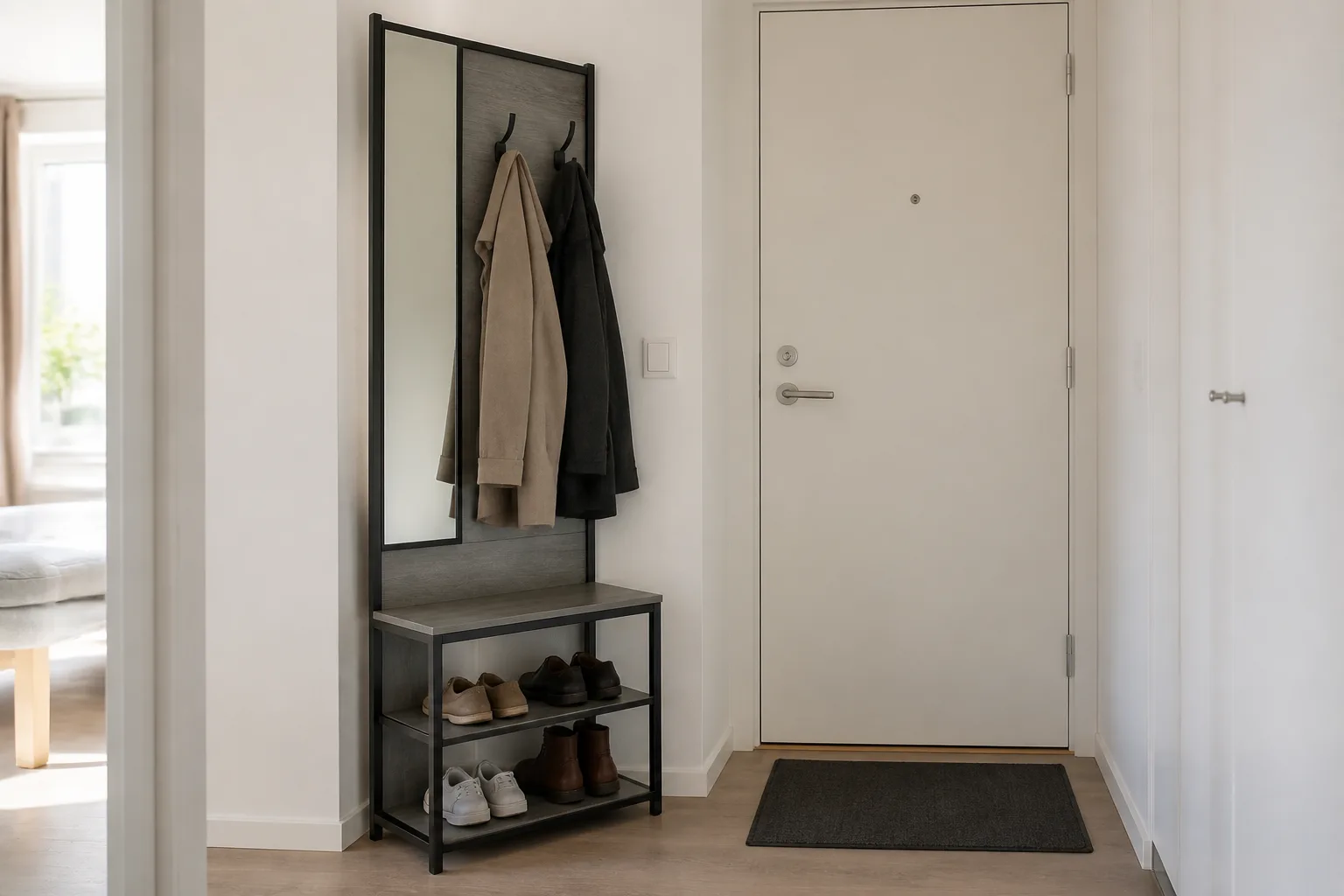
Short on square footage? The Walker Edison Industrial Storage Hall Tree with Mirror measures 70 × 35 × 12.75 inches—among the shallowest full-feature units widely available. Three hooks, two shelves, a mirror, and an open lower shelf replace a coat pile without eating the walkway.
Steel framing with grey-wash laminate reads modern industrial; it suits rental entries where you cannot install permanent mudroom build-ins. We have not long-term tested this exact SKU, but Walker Edison’s similar slim towers consistently score well for vertical storage in narrow halls.
Missing anchor kit is the main safety gap—buy anti-tip straps separately if kids or large dogs share the entry. No dedicated shoe rack; baskets on the lower shelf work better than loose pairs.
Typical price: ~$56 at Home Depot.
Best with Mirror: Sand & Stable Lana Hall Tree
The Sand & Stable Lana Hall Tree (74 × 45 × 19 inches) is the pick when you want a last glance before leaving. A centered mirror sits between four spaced hooks rated for heavy coats—though bulky jackets can visually cover the glass if you hang on every prong.
A 300-pound-capacity bench and closed cabinet underneath hide shoes better than open cubbies. Solid and manufactured wood construction feels more substantial than MDF budget racks.
Trade-offs: mirror height may not suit all users; premium ~$710 pricing; fewer open shelves than Carmel. Best for formal front entries where aesthetics matter as much as storage.
Best for Corners: Crosley Seaside Corner Hall Tree
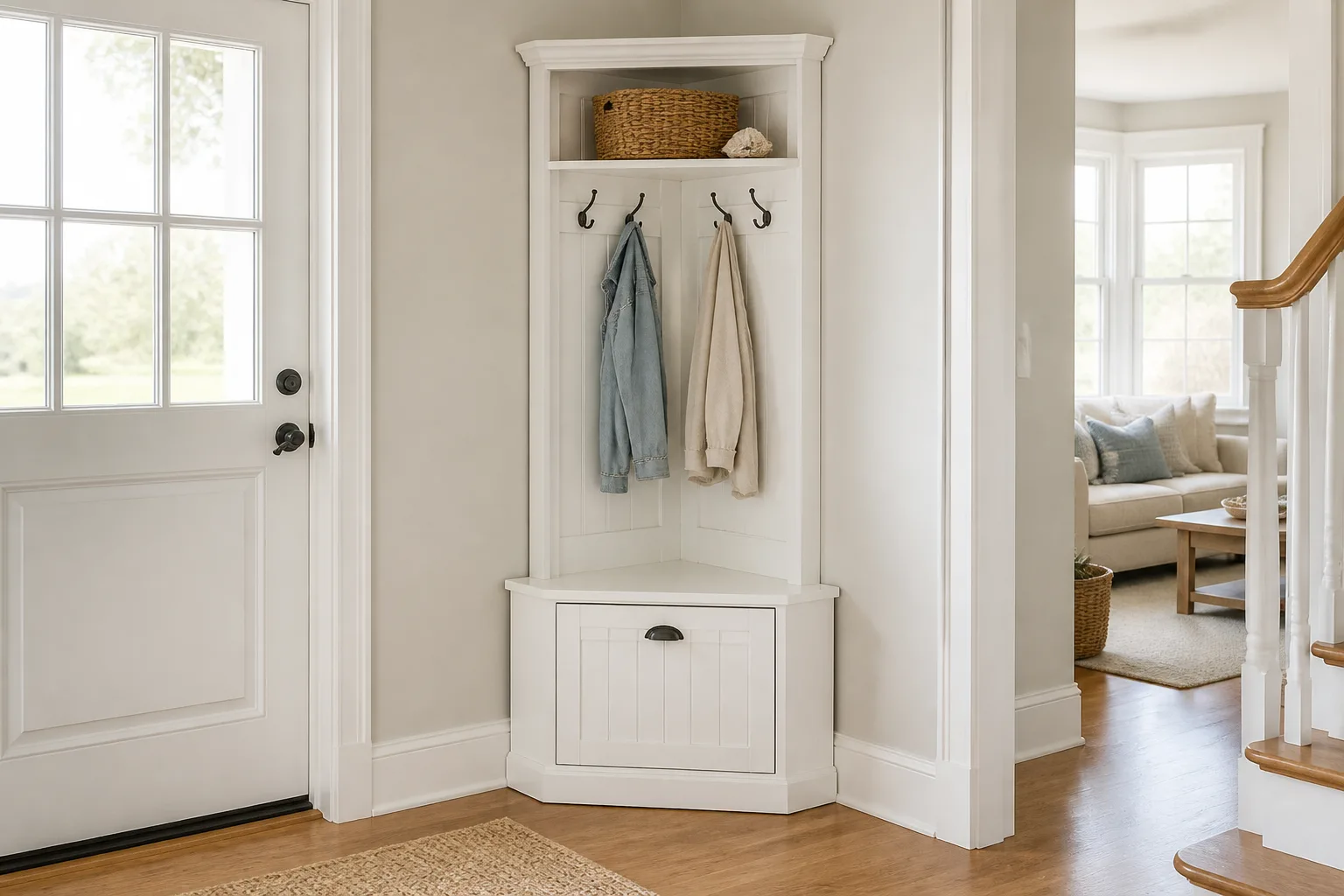
Corner entries waste usable space unless furniture hugs the angle. The Crosley Seaside Corner Hall Tree (33.5 × 20 × 70 inches) uses a symmetrical corner footprint with beadboard styling matching the Holbrook line.
A magnetic-closure drop-down cover hides the lower compartment; a removable shelf splits storage zones. Four double hooks suit solo occupants or couples more than a five-person coat load.
Critical spec: hooks support only ~5 pounds each—far below Gracie Oaks or Bon Augure. Hang light jackets and bags here; store heavy wet wool on wall anchors elsewhere.
Typical price: ~$342 across Amazon, Home Depot, and Target.
Build a Drop Zone That Stays Organized
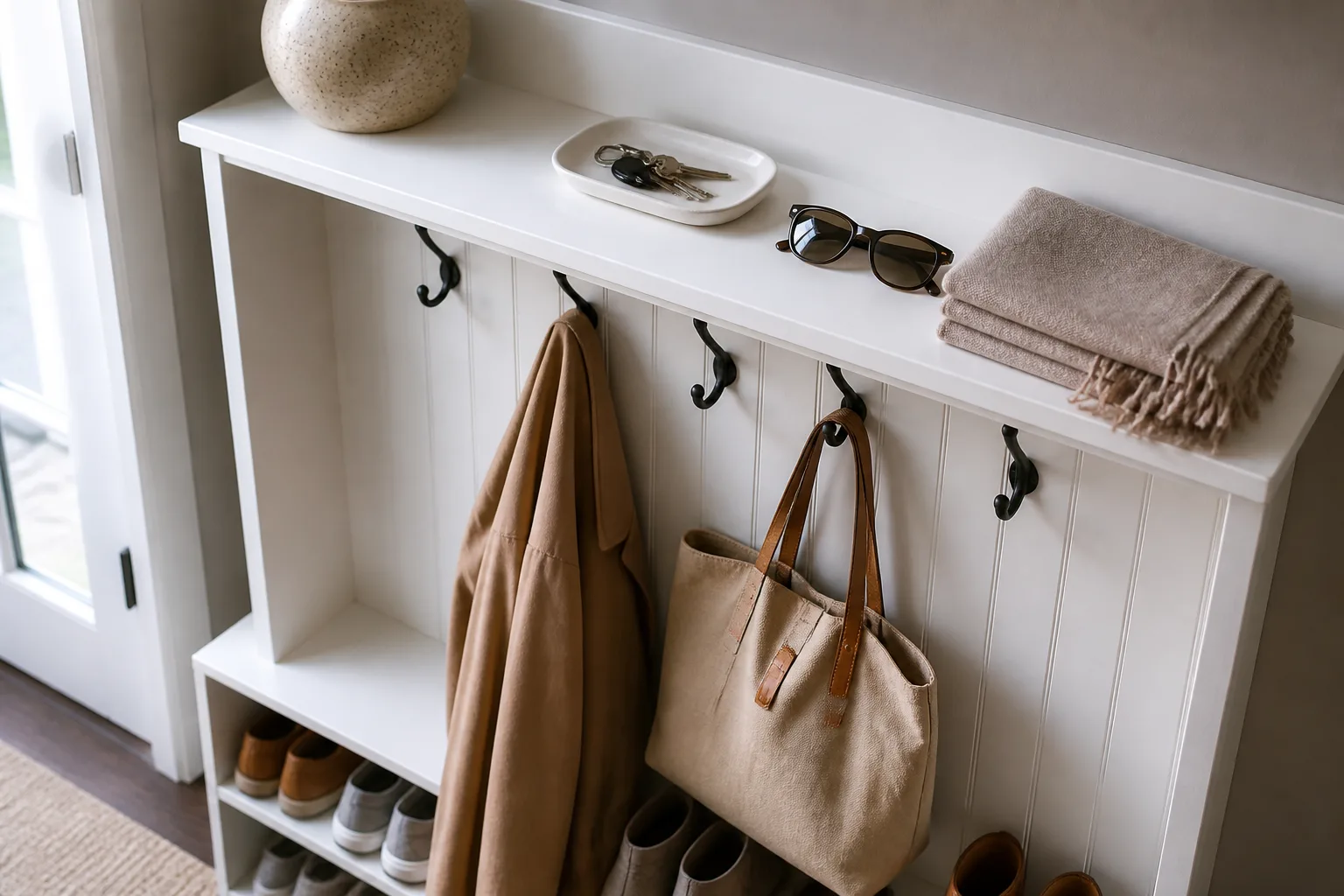
Buying the furniture is half the job. Garvee’s organization guide recommends treating the hall tree as a pickup and drop-off zone, not a closet replacement.
Assign hooks by person, not by item type—each household member gets two prongs for wear-now outerwear. Seasonal coats belong in bedroom closets; backup shoes in under-bed bins—not prime entry real estate.
Reserve the top shelf or a small tray for keys, sunglasses, and wallets. That single landing surface eliminates the morning key hunt more reliably than extra hooks.
Limit shoe cubbies to daily pairs—one or two per person. When cubbies overflow, shoes migrate to the floor and defeat the purpose.
Weekly reset: Friday evening, remove anything that was used once or less that week. Entry storage stays fast only when it stays small.
Assembly, Anchoring, and Safety
Most hall trees ship flat-packed. Plan 90 minutes with a helper as the median; wide cabinet models can exceed four hours. Clear the entry, lay out hardware sorted by step, and do not fully tighten cam bolts until the unit stands square.
The U.S. Consumer Product Safety Commission urges anchoring tall furniture to walls to prevent tip-over injuries—especially in homes with children. Top-heavy hall trees with benches and loaded hooks qualify even when they feel stable to an adult.
Use the included anchor kit when provided (Gracie Oaks). When missing (Walker Edison, some budget racks), add anti-tip straps rated for furniture, screwed into wall studs—not drywall alone. Never let children hang or swing from hook rails.
Place units on level floors; adjustable feet fix minor slopes. Keep swollen MDF away from direct puddle contact—use a boot tray beneath wet shoe storage in snow climates.
Conclusion
The Bon Augure Hall Tree remains the best default for most households: strong capacity, thoughtful side hooks, quick assembly, and an industrial look that survives daily abuse. Tight apartments should start with the Walker Edison slim tower or Yaheetech budget rack after taping out floor space. Design-forward entries earn the Sand & Stable Carmel; corner foyers the Crosley Seaside—provided you respect its low hook weight limit.
Measure depth and hook height before you click buy, anchor tall units if kids or pets share the space, and treat the hall tree as a daily drop zone—not a second closet. Do those three things and the right model will still look good six months after the unboxing photos.