9 Best LED Light Bulbs for Every Room and Fixture
Compare 9 LED light bulbs by lumens, color, CRI, dimming, fixture fit, and rated life to choose the right bulb for every room.
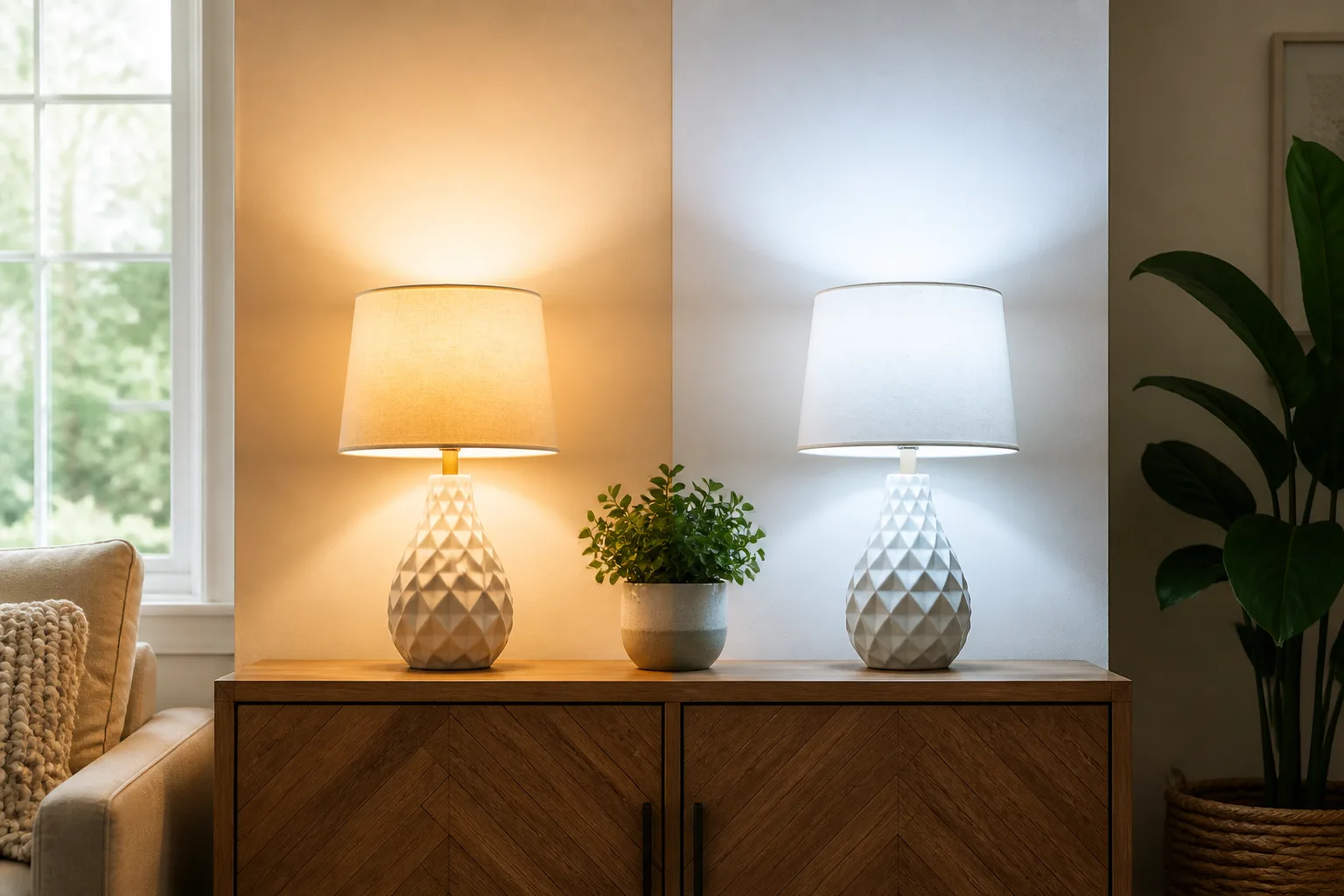
The best LED light bulb is not automatically the brightest one. A 1,600-lumen bulb can make a kitchen feel wonderfully clear and a bedside lamp feel like a small searchlight; a warm 400-lumen Edison bulb can make a bedroom inviting and leave a work surface too dim to use. The right choice depends on light output, color, color accuracy, fixture fit, and control compatibility working together.
This guide compares nine A19-style LED bulbs from the test set and turns the results into practical buying rules. The goal is not to crown one bulb for every socket. It is to help you choose a bulb that gives you enough light for the job, looks right in the room, dims cleanly if you need that, and survives the fixture you actually own.
The quick verdict: which LED bulb should you buy?
For a general-purpose lamp or open ceiling fixture, the Feit Electric OM60DM/930CA A19 is the safest all-round profile: 800 lumens, 3000K bright white, 8.8 watts, a standard E26 base, 90+ CRI, and dimming support. It gives enough light for reading and ordinary household tasks without the glare of a high-output bulb, and its 3000K color sits between cozy and crisp.
Choose the Philips Ultra Definition 60W-equivalent if you prefer warmer evening light with strong color rendering. Choose Luxrite’s 100W-equivalent A19 for a large kitchen, workshop, or open room where 1,600 lumens will actually be useful. For a bedroom, a bathroom vanity, an exposed decorative fixture, or a troublesome dimmer, the specialized picks below make more sense than the overall winner.
One important qualification: “reliable” is conditional. A bulb can have a long rated life and still fail early if it is installed in a sealed fixture without the required rating, placed on an incompatible dimmer, screwed into a poor socket, or exposed to moisture it was not designed to handle. Read the fixture notes before treating a product review as a guarantee.
How to compare LED bulbs without getting fooled by the box
Bulb packaging mixes measurements with marketing shorthand. Start with the numbers that describe performance, then use the style name—soft white, bright white, daylight, vintage, or natural—as a secondary clue. The Department of Energy’s LED basics and its guidance on purchasing energy-efficient light bulbs are useful reminders that an LED is best compared by the light it produces and the electricity it uses, not by its incandescent-equivalent label alone.
Lumens tell you brightness; watts tell you energy use
Lumens measure visible light output. Watts measure electrical power drawn. A familiar 60-watt incandescent produces roughly 800 lumens, which is why an LED package may say “60W equivalent” while the bulb itself uses only about 8 to 10 watts. The equivalence is a brightness reference, not a statement that the LED consumes 60 watts.
Use the lumen number to decide whether a bulb is bright enough. Use actual watts to compare energy use among bulbs that produce similar lumens. The practical ladder is simple: about 450 lumens is a 40W-equivalent class, 800 lumens is a 60W class, 1,100 lumens is a 75W class, and 1,600 lumens is a 100W class. Those are useful starting points, not room-lighting guarantees, because lampshades, ceiling height, wall color, and the number of fixtures all change the result.
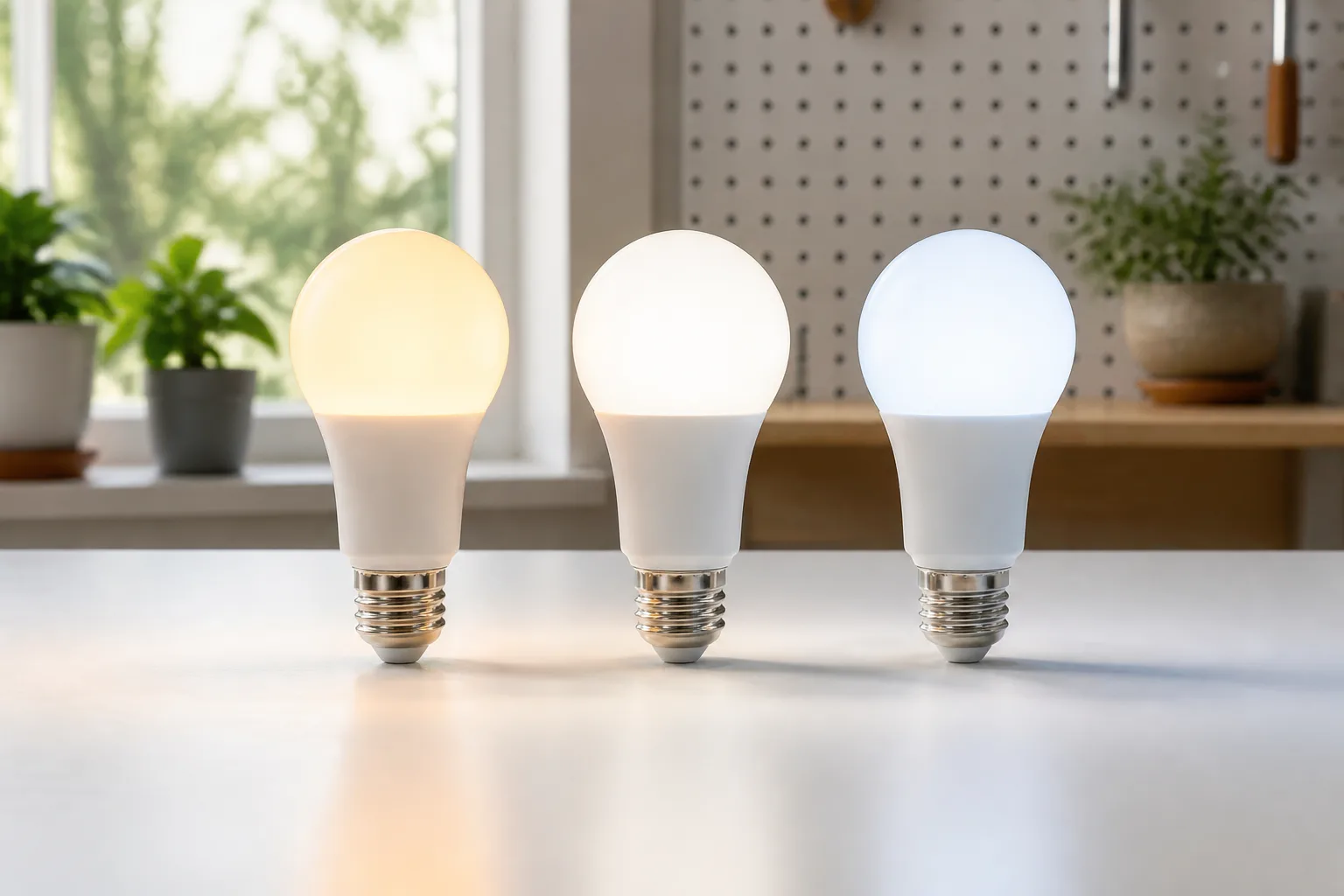
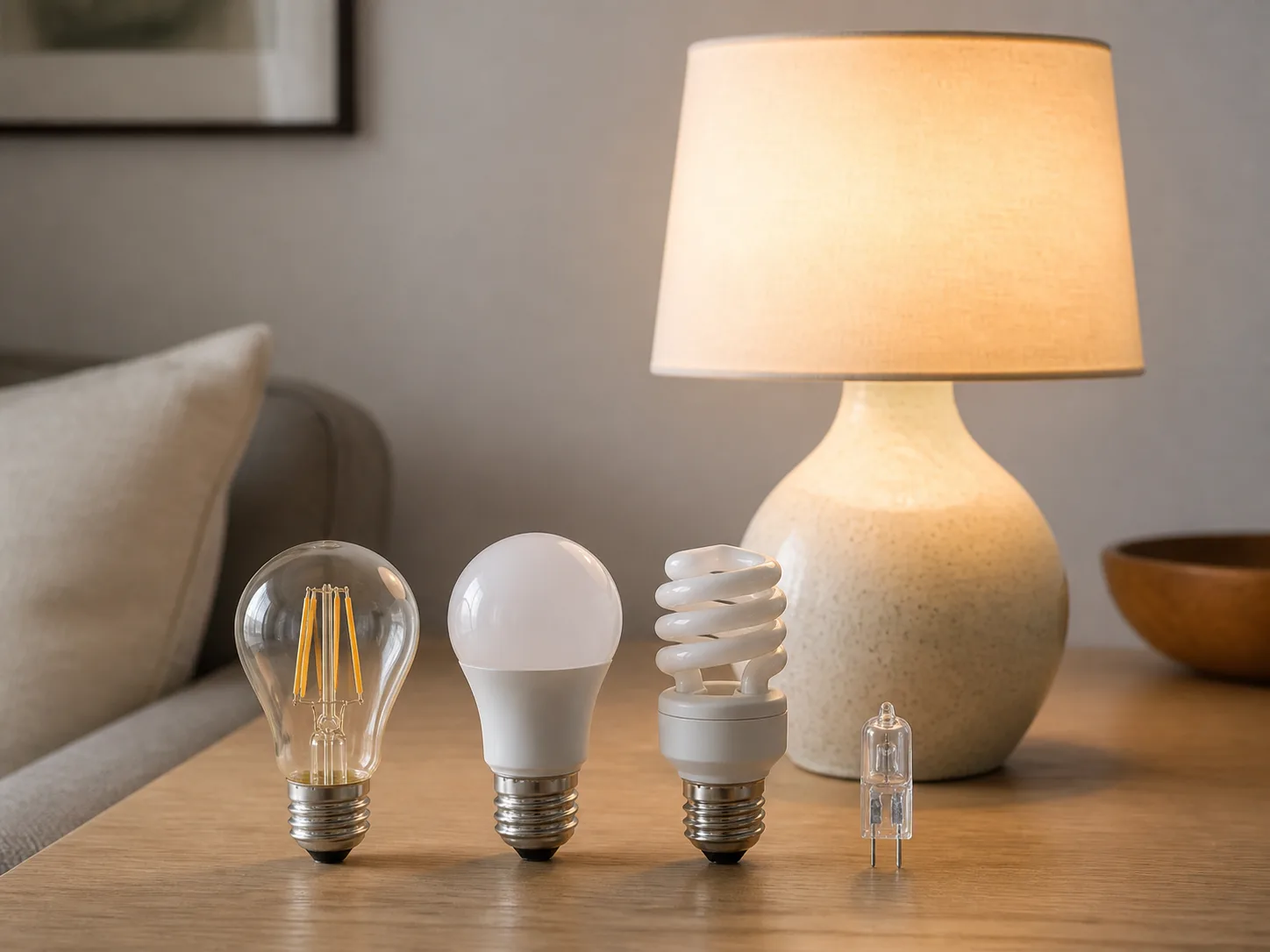
The comparison becomes clearer when you put the bulbs next to one another. An 800-lumen bulb is often comfortable in a table lamp, while a 1,600-lumen bulb may be better spread across a ceiling fixture or aimed at a worktop. A frosted globe spreads light differently from a clear filament bulb even when the lumen ratings match.
Color temperature and CRI change how a room looks
Color temperature, measured in Kelvin (K), describes the appearance of the light rather than its brightness. Lower numbers look warmer and more amber; higher numbers look cooler and more blue-white. A 2700K bulb usually feels cozy, 3000K feels warm but clearer, 3500K to 4000K feels neutral, and 5000K looks like crisp daylight.
The word “daylight” is not a promise that the bulb will make a room look natural. A low-CRI 5000K bulb can make whites feel cold and colors look flat. CRI, or color rendering index, estimates how faithfully a light reveals color compared with a reference source. CRI 80 is a workable baseline for ordinary lighting; 90 or higher is more useful for food, skin, clothing, paint, artwork, and any place where color decisions matter. It still does not tell you the whole spectral story, so treat CRI as a helpful comparison number, not a guarantee that every shade will look perfect.
The Lighting Facts label guidance from This Old House explains the useful division: lumens for brightness, watts for power, Kelvin for the light’s appearance, and rated life for the manufacturer’s estimate. Its guidance also notes that CRI may require a separate check on the manufacturer’s product page. The Lighting Facts overview from Bulbs.com is helpful for seeing how those measurements are presented together.
Match the bulb to the fixture before judging performance
A bulb can be excellent in an open table lamp and a poor choice in a sealed ceiling dome. Before comparing brands, read the old bulb and the fixture label, measure the available space, and identify the control. Four checks prevent most avoidable disappointments: base, shape, enclosure, and control.
Shape, base, enclosure, and damp-location ratings
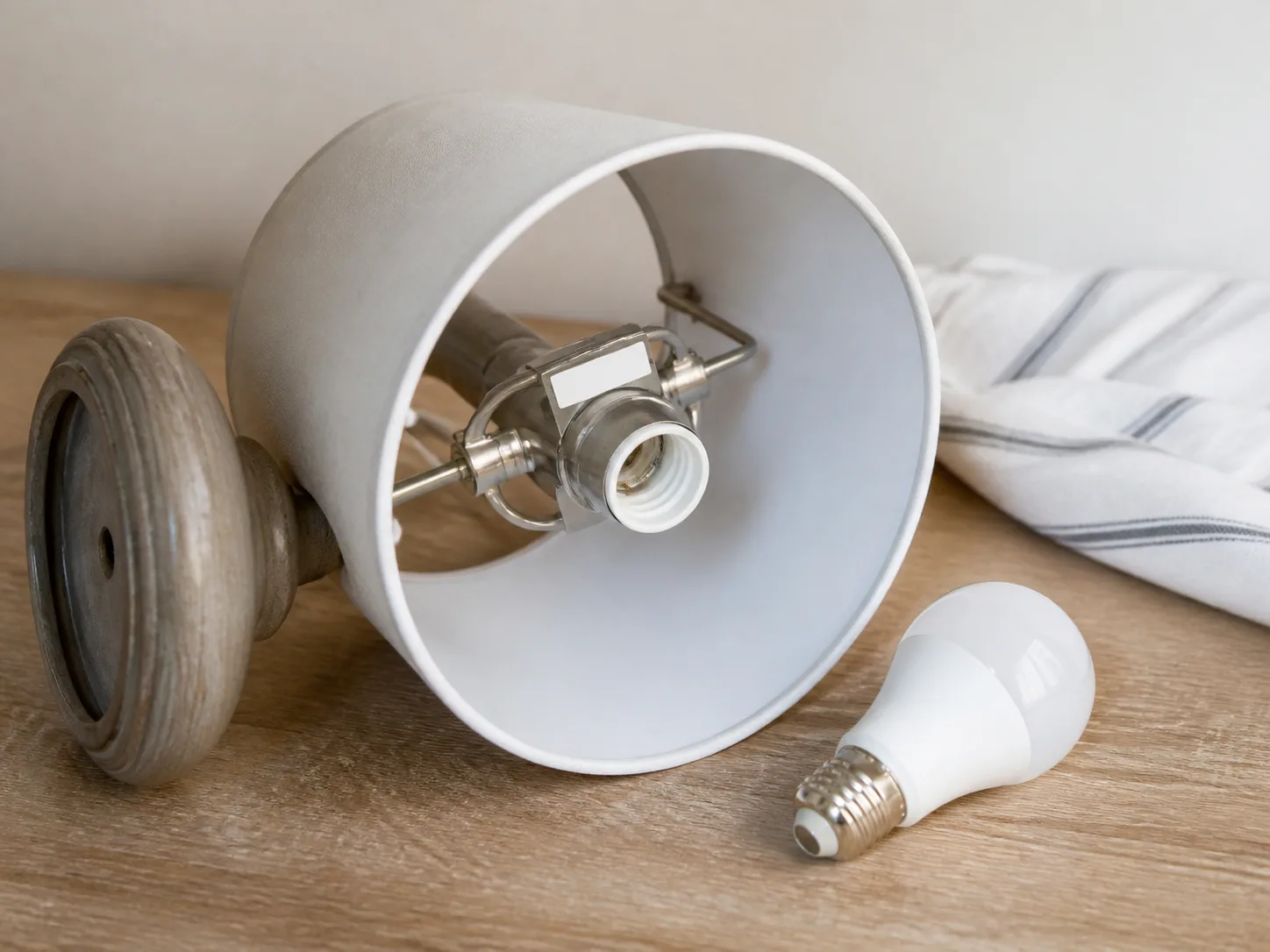
E26 describes the medium screw base used in many North American lamps. A19 describes the familiar pear-shaped bulb envelope. They are not interchangeable terms: E26 tells you how the bulb connects, while A19 tells you the bulb’s shape and approximate size. An A19 bulb with an E26 base is the common general-purpose combination, but a fixture may instead need a candelabra base, globe shape, reflector, tube, or a shorter A15 lamp.
Check for physical clearance before buying a high-output replacement. The bulb may fit the socket and still hit a shade, sit too close to a decorative cover, or leave too little room for the heat to escape. A bulb that is too large for the shade is not made safe by its LED label.
For a fully enclosed fixture, look for the exact phrase “suitable for enclosed fixtures” or equivalent manufacturer guidance. For a bathroom, covered porch, or other damp location, look for the fixture and bulb ratings that match that location. “LED” alone does not mean “safe everywhere.” In a wet location, the fixture rating and local electrical requirements take priority over a bulb’s marketing copy.
Dimming and flicker are a system problem
A bulb marked dimmable is only one half of a successful dimming setup. The dimmer must also be designed for LED loads, and the particular bulb and switch combination must behave well across the range. Older incandescent dimmers can produce buzzing, dropouts, flashing, or a narrow usable range because an LED draws much less power and its driver responds differently to the chopped waveform.
Test a new bulb at full brightness, halfway, and near the lowest setting. If it flickers only at the bottom, the low-end trim or minimum load may be the issue. If every bulb on the same dimmer flickers, suspect the dimmer or wiring before assuming several bulbs are defective. If one bulb flickers in an otherwise steady fixture, reseat it with the power off and compare it in a simple on/off lamp.
Do not put a non-dimmable LED on a dimmer as an experiment. The Family Handyman light-bulb guide is right to treat dimming as a buying decision, not a feature to assume after the fact. For a smart bulb, use a regular on/off switch or a control system the manufacturer lists as compatible; a wall dimmer and a smart bulb can end up trying to control the same driver twice.
How the nine bulbs were evaluated
The useful comparison fields are the ones that stay meaningful even as package designs and prices change: claimed lumens, actual wattage, color temperature, CRI when listed, dimming behavior, visible design, base and shape, fixture restrictions, and the job each bulb is best suited to. Brightness was considered both as a raw number and as a comfort question: can one bulb light a reading area, a counter, or a room without producing distracting glare?
Reliability was treated as a combination of construction and compatibility rather than a simple ranking of hour claims. A 25,000-hour rating is valuable, but the number describes a test condition and expected life, not a promise that the bulb will run for decades in a hot, sealed fixture. A bulb with a shorter rating but better enclosure fit can be the more reliable purchase.
That distinction is why the picks below are intentionally different. The brightest bulb is not the best bedroom bulb; the highest-CRI bulb is not necessarily the best value; and a decorative filament bulb should not be judged by the same standard as a kitchen workhorse.
Feit Electric A19 60W Equivalent: best overall
The Feit Electric OM60DM/930CA is the most balanced pick in this group. It produces 800 lumens at 3000K, uses 8.8 watts, has a standard E26 base, carries a 90+ CRI claim, and is dimmable. The frosted A19 shape spreads light evenly, so it works in a bedside lamp, a living-room table lamp, or an open ceiling fixture where you want one dependable color rather than a dramatic decorative effect.
Its 3000K light is the reason it works across several rooms. It is less amber than 2700K bulbs and less stark than many daylight bulbs, so it supports reading and ordinary kitchen cleanup without turning a relaxing room blue-white. It is also a sensible choice when the same pack needs to cover several sockets with different jobs.
The limitation is output. At 800 lumens, it is not the best choice for a large kitchen with one central socket, a workshop, or a room with dark walls and a high ceiling. Confirm the exact OM60DM/930CA package and its enclosure language before using it in a sealed fixture; product families often include similar-looking codes with different ratings.
Philips Ultra Definition: best value for warm, accurate light
The Philips Ultra Definition 60W-equivalent warm-glow bulb is a strong choice when the room should feel calm but colors should not look muddy. The tested profile is 800 lumens, 2700K, 8 watts, dimmable, and high CRI. Compared with the Feit, it uses slightly less power for the same nominal output and gives off a visibly warmer tone.
Use it in living rooms, bedrooms, reading lamps, and dining spaces where full-brightness light still needs to feel inviting. The warmth becomes especially useful after dark, when a cool ceiling bulb can make a room feel more like a utility space than a place to relax. It also works well in a shaded lamp because the frosted finish prevents the bright point of the LED from dominating the room.
This is not the first choice for detailed food preparation if the fixture is the only light source. The 2700K tone can read slightly orange beside daylight from a window, and 800 lumens may leave a broad counter underlit. In a kitchen, pair warm ambient bulbs with a separate task light rather than forcing one bulb to do both jobs.
Luxrite A19 100W Equivalent: brightest pick for task-heavy rooms
The Luxrite A19 100W-equivalent bulb is the raw-output winner in the group, with 1,600 lumens from 15 watts at 2700K and a standard E26 base. That amount of light is useful in a large kitchen, open hallway, garage, laundry room, or workshop where one socket needs to cover distance. It is dimmable and listed for enclosed fixtures in the tested profile, which makes it more versatile than many high-output bargain bulbs—but the fixture rating still needs to be confirmed on the exact package.
High output has a cost beyond energy use. In a table lamp, 1,600 lumens can feel glaring even when the bulb is technically safe. In a small room, the light may bounce off pale walls and feel overlit; in a dark room, it may be exactly what is needed. Use the dimmer or a shade to control comfort, and do not confuse a 100W-equivalent label with permission to exceed a fixture’s maximum wattage or physical limits.
Its CRI is listed at 80 in the comparison, which is adequate for general visibility but not as color-rich as the high-CRI options. Pick it for seeing the counter, stairs, tools, and floor clearly. Pick something else when matching paint, choosing clothing, applying makeup, or evaluating food color is the main task.
Sylvania TruWave Natural 75W Equivalent: best for large living rooms
The Sylvania TruWave Natural Series A19 is the room-filling option: 1,100 lumens, 2700K, 11 watts, dimmable, and designed to provide more output than a typical 60W-equivalent bulb while keeping a warm appearance. A single bulb can be useful in a floor lamp or a large living room fixture, but it can be too intense in a small lamp close to eye level.
This bulb makes sense when a living room needs more reach without switching to a visibly blue daylight color. It is also a good fit for a floor lamp behind a chair, where the extra output helps the light travel into the room. Dim it for conversation or television, then raise it for reading or cleaning.
The caveat is proportion. A bulb that feels wonderfully bright in a large room can create a hot spot behind a lampshade or glare from an exposed socket. If the fixture is close to a seating position, choose a frosted bulb or use the dimmer rather than assuming more lumens always improve comfort.
GE Relax 60W: best for dining and evening ambiance
The GE Relax 60W-equivalent LED is the soft, familiar choice for dining rooms and lamps. Its tested profile is 800 lumens, 2700K, 10 watts, dimmable, with a high-CRI emphasis. It gives food, wood, and warm paint colors a pleasant appearance and can transition from dinner brightness to a lower after-meal glow.
Choose it for chandeliers, pendants, and table lamps where the bulb will be viewed through a shade or diffuser. Its ordinary frosted appearance is a drawback in an exposed decorative fixture, but that same lack of visible filament keeps the light visually quiet under a shade.
This bulb is less useful as the only source in a large dining room. Several 800-lumen bulbs can work beautifully across a multi-light fixture; one lamp in a corner cannot replace balanced overhead and task lighting. If the room looks dim even at full brightness, add another light source before moving immediately to a harsher high-output bulb.
GE Reveal HD+ 40W: best for small bathrooms and vanities
The GE Reveal HD+ 40W-equivalent A19 is the low-output, color-focused pick for a small bathroom, vanity, desk lamp, or compact room. It produces about 350 lumens at 2850K, uses 5.5 watts, and is dimmable. The warm color and high-CRI positioning make it helpful for skin tones, clothing, and grooming without the cold appearance of many high-Kelvin bathroom bulbs.
The 350-lumen output is the critical limitation. One bulb is not enough for a wide vanity or a large bathroom unless several fixtures share the work. For even face lighting, place multiple compatible bulbs across the vanity or use a fixture designed for the space; increasing one bulb’s output can create a bright spot without fixing shadows.
Bathroom use also makes the fixture rating important. Moisture, steam, and enclosed glass can create a harsher environment than a dry table lamp. Match the bulb and fixture to the location, keep water away from electrical components, and follow the fixture manufacturer’s instructions.
Feit ST19 and Ascher Edison bulbs: best for bedrooms and exposed fixtures
The Feit Electric ST19 Vintage Edison and Ascher Dimmable Vintage Edison bulbs belong in the decorative category. Both use clear glass and exposed filament styling with a warm 2700K appearance, but the Feit profile is about 400 lumens while the Ascher profile is about 700 lumens. Both are dimmable and use the familiar E26 base.
The Feit ST19 works as a bedroom accent bulb, bedside lamp, or exposed socket where the glow is part of the decor. It is bright enough for nearby reading but not for lighting an entire room. The visible filament can cast a small shadow or create a bright point at eye level, so use it behind a shade, above eye level, or in a fixture designed for decorative bulbs.
The Ascher is the more functional Edison choice. At 700 lumens, it can support reading and provide broader ambient light while keeping the vintage look. It still falls short of the 800-lumen general-purpose class, so multiple fixtures may be needed. Its warm light is comfortable in a bedroom but not ideal for a craft table, makeup mirror, or detailed kitchen work.
Neither decorative bulb should be selected solely for its rated appearance. Check whether the clear glass is acceptable at the viewing angle, whether the fixture allows the bulb’s full size, and whether the dimmer behaves smoothly with filament-style LEDs. Decorative design solves an aesthetic problem; it does not remove the need to verify output and control compatibility.
Padmo Ludaz Half Chrome: best for glare control
The Padmo Ludaz Half Chrome is the niche pick for a lamp that feels too harsh. Its chrome-coated upper half directs more of the light downward and away from the viewer, producing about 350 lumens at 2700K from 4 watts. It is dimmable in the tested profile, but its directional design means it does not spread light like a standard omnidirectional A19.
Use it in a bedside or reading lamp when the primary problem is seeing the page without staring into the light source. It can make a low, cozy pool of light that feels more comfortable than an exposed frosted bulb. The trade-off is clear: it is not a room-filling bulb, and its directional beam can leave the surrounding space dark.
If dimming fails, first test the bulb on a simple on/off socket. If it works there but not on the dimmer, the control system is the likely mismatch. A glare-control bulb cannot correct a dimmer that is incompatible with its driver.
Room-by-room buying rules that prevent mismatches
Room labels are useful only after the task and fixture are clear. Use this quick guide as a starting point, then adjust for the number of sockets and the room’s surfaces.
| Room or job | Starting point | Why |
|---|---|---|
| Bedroom or bedside lamp | 400–800 lumens, 2700–3000K, dimmable | Warm, adjustable light is easier to live with near the bed. |
| Living room | 800–1,100 lumens per main bulb, 2700–3000K | Enough reach for reading and conversation without a blue cast. |
| Kitchen task area | 800–1,600 lumens, 3000–4000K, CRI 90 when color matters | More output and clearer neutral light help with prep and cleanup. |
| Dining room | 800 lumens per chandelier bulb, 2700–3000K, dimmable | Warm, high-quality light works for meals and lower evening levels. |
| Small bathroom or vanity | Several 350–800-lumen bulbs, about 2700–3500K, CRI 90+ | Multiple sources reduce shadows; CRI helps with skin and clothing color. |
| Garage or workshop | 1,100–1,600 lumens, 3500–5000K | Higher output and a neutral/cool appearance support detail work. |
These ranges describe bulb output, not a complete lighting design. A chandelier with six 800-lumen bulbs produces a very different room than a single 800-lumen table lamp. A dark shade can absorb light, a white ceiling can bounce it, and a clear filament bulb can create more glare than its lumen count suggests.
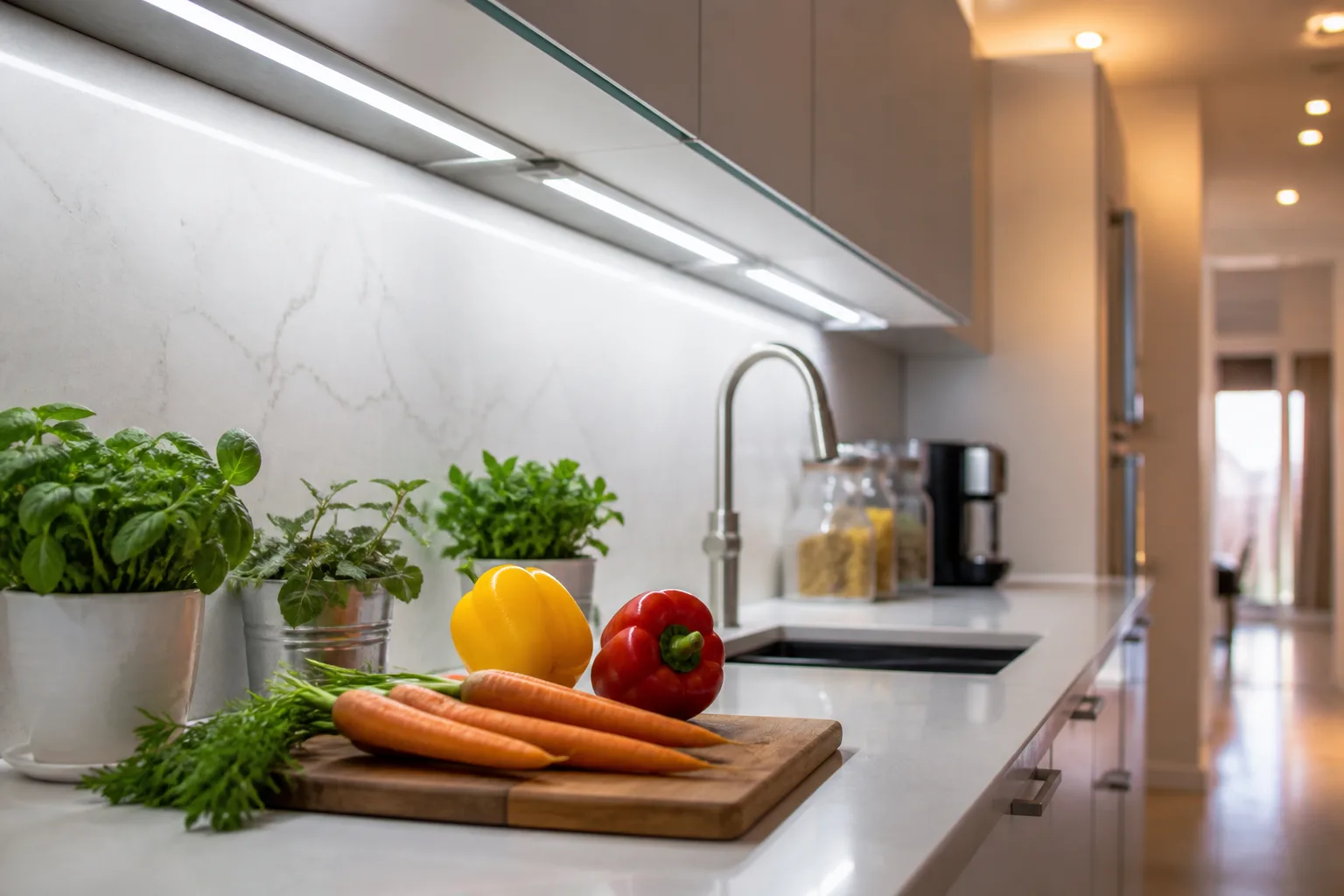
For a house with mixed uses, buying dimmable 800-lumen bulbs in one color family is often the simplest baseline. Use 2700K for warm living and sleeping spaces, 3000K for flexible general use, and 3500K–4000K for work areas when you want a cleaner neutral appearance. Avoid mixing visibly different temperatures in one small fixture unless the contrast is intentional.
What to do when a new LED bulb flickers, buzzes, or fails early
Start with the safest isolation test: turn the fixture off, let the bulb cool, and move it to a known-good open lamp with a regular on/off switch. If it runs steadily there, the original fixture, dimmer, enclosure, or socket is part of the problem. If it flickers in both places, the bulb may be defective or the circuit may need inspection.
Next, identify the pattern. Flicker only at low dimming levels points toward the dimmer’s low-end range or compatibility. Flicker in every bulb controlled by one dimmer points toward the switch, load, or wiring. Flicker after the bulb warms up points toward heat or an enclosure issue. A loose bulb, damaged socket, or poor contact can also cause intermittent behavior.
Do not open a fixture or touch a hot bulb to diagnose it. If you smell burning plastic, see scorch marks, melting, smoke, discoloration, or a damaged socket, stop using the fixture and have a qualified electrician inspect it. A bulb swap is appropriate for a compatibility problem; it is not a repair for unsafe wiring.
Finally, check the fine print. Confirm that the bulb is dimmable if a dimmer is present, enclosed-fixture rated if the globe traps heat, and rated for the location if moisture is possible. Use the ENERGY STAR product finder when certification matters, but still check the exact model number and fixture restrictions. Certification can support an efficiency decision; it does not make every bulb the right shape, color, or control match.
Conclusion
The best LED light bulbs are the ones that match the job instead of forcing one specification into every room. Start with lumens for brightness, actual watts for energy use, Kelvin for the room’s feel, CRI for color accuracy, and the fixture label for fit and safety. Then verify dimming, enclosure, and moisture compatibility before buying a multipack.
For most open lamps and ordinary ceiling fixtures, the Feit 800-lumen 3000K A19 is the most balanced starting point. Philips is better for warm, high-quality evening light; Luxrite is the high-output choice for large task areas; GE Reveal and Padmo solve specialized low-output or glare problems; and the Edison bulbs earn their place when appearance matters as much as illumination. That is the useful answer: choose the bulb that fits the room, the fixture, and the way you actually use the light.



