The 8 Best Wasp Sprays We’ve Found Online for You
The best wasp spray depends on the nest. Compare eight aerosol, foam, plant-oil, concentrate, and dust options, plus label-first safety and prevention advice.

The best wasp spray is the one that fits the nest you can actually see, the distance you can safely maintain, and the product label for that exact site. A long-range aerosol can be useful for an exposed nest under an eave, but it is a poor answer to a colony inside a wall, a nest below ground, or a bee colony that has been misidentified. Foam, liquid jet, plant-oil contact spray, concentrate, and dust each solve a different access problem.
This guide compares eight products and formats using current manufacturer information, then adds identification, prevention, and escalation advice from university and integrated-pest-management sources. Product formulas and labels can change, so treat the current label as the final authority. “Best” means best fit for a defined job, not guaranteed elimination.
Quick verdict: the best wasp spray depends on the job
| Situation | Start by considering | Why it fits | Important limit |
|---|---|---|---|
| Exposed paper nest under an eave | Spectracide Foaming Wasp & Hornet Killer | A water-based foam blankets the nest and reaches up to 20 feet according to the current product page. | Outdoor use only; it still requires a clear escape route and label-directed treatment. |
| Exposed nest where a liquid stream is easier to place | Raid Wasp & Hornet Killer 33 | The current label information gives it a 22-foot stream and directs users to soak the nest. | A stream can miss comb or drift; do not treat the range number as a safe-distance guarantee. |
| A nest that is difficult to reach from the ground | Hot Shot Wasp & Hornet Killer3 | Its product page lists a 27-foot range. | Wind, angle, obstructions, and the need to stand safely away still control whether the nest is reachable. |
| A label-authorized exposed nest where returning activity is a concern | Spectracide PRO Wasp & Hornet Killer | The manufacturer describes contact kill and returning-wasp activity for up to four weeks. | More residual activity does not make an unsafe nest safer or authorize indoor use. |
| Professional-style quick knockdown from a can | BASF PT Wasp-Freeze II | BASF describes a 15-foot product with quick knockdown and residual activity. | Use only with the current label and the experience to manage the site; do not infer permissions from the product name. |
| A few visible wasps or a small accessible target | EcoSMART Wasp & Hornet Killer | The plant-oil formula is intended for contact and lists peppermint oil as an active ingredient. | “Plant oil” is not a guarantee of low hazard, no staining, or nest elimination. |
| A broad-area, label-authorized pest-management job | Syngenta Demand CS | This professional concentrate uses lambda-cyhalothrin and is marketed for broad pest control with microcapsule technology. | It is not a direct nest-stream aerosol; mixing, application, and site permissions are label-specific. |
| A dry crack, void, or entry point authorized by the label | DeltaDust Insecticide | Dust can fit a dry, protected void where an aerosol stream cannot be placed. | Dust is not a universal open-nest treatment and can become airborne; follow the current label exactly. |
Foam, jet, dust, or concentrate: match the format to the nest
Foam is a visual-coverage tool. It expands over an exposed nest and can coat the outer surface and openings when the nest is accessible from a safe position. That makes it a logical format for an aerial nest under an eave, but not a reason to approach closer than the label allows. It may fail to reach a wall, ground cavity, or winding void.
A liquid jet is useful when you need a directed stream and can clearly see the nest. Its printed range describes a product test condition, not a promise that every droplet lands on the comb in a breeze. A stream still needs to saturate the nest as directed. Spraying individual flying wasps is a poor substitute for addressing the nest.
Plant-oil contact sprays have a narrower job. They may fit a visible individual insect or very small target when the label allows it, but contact activity is not colony control. The EcoSMART product page lists peppermint oil and qualifies use around children and pets with “when used as directed”; it is not a large-nest treatment.
Concentrates and dusts are different again. A concentrate such as Demand CS is mixed and applied under a detailed label, so it belongs with a site-specific perimeter or void treatment—not as a casual aerosol alternative. Dust can work in a dry crack or protected void only when the label authorizes the pest and site. Do not substitute it for an open nest or puff unidentified powder near people, pets, food, air intakes, or water.
“Residual” needs context. A manufacturer may describe activity after an application, but duration depends on the product, surface, weather, exposure, dose, and pest; it does not prove a hidden colony is gone. The U.S. Environmental Protection Agency’s pesticide-safety guidance gives the essential rule: read and follow the label, including precautions and disposal instructions.
Identify what you are dealing with before you spray
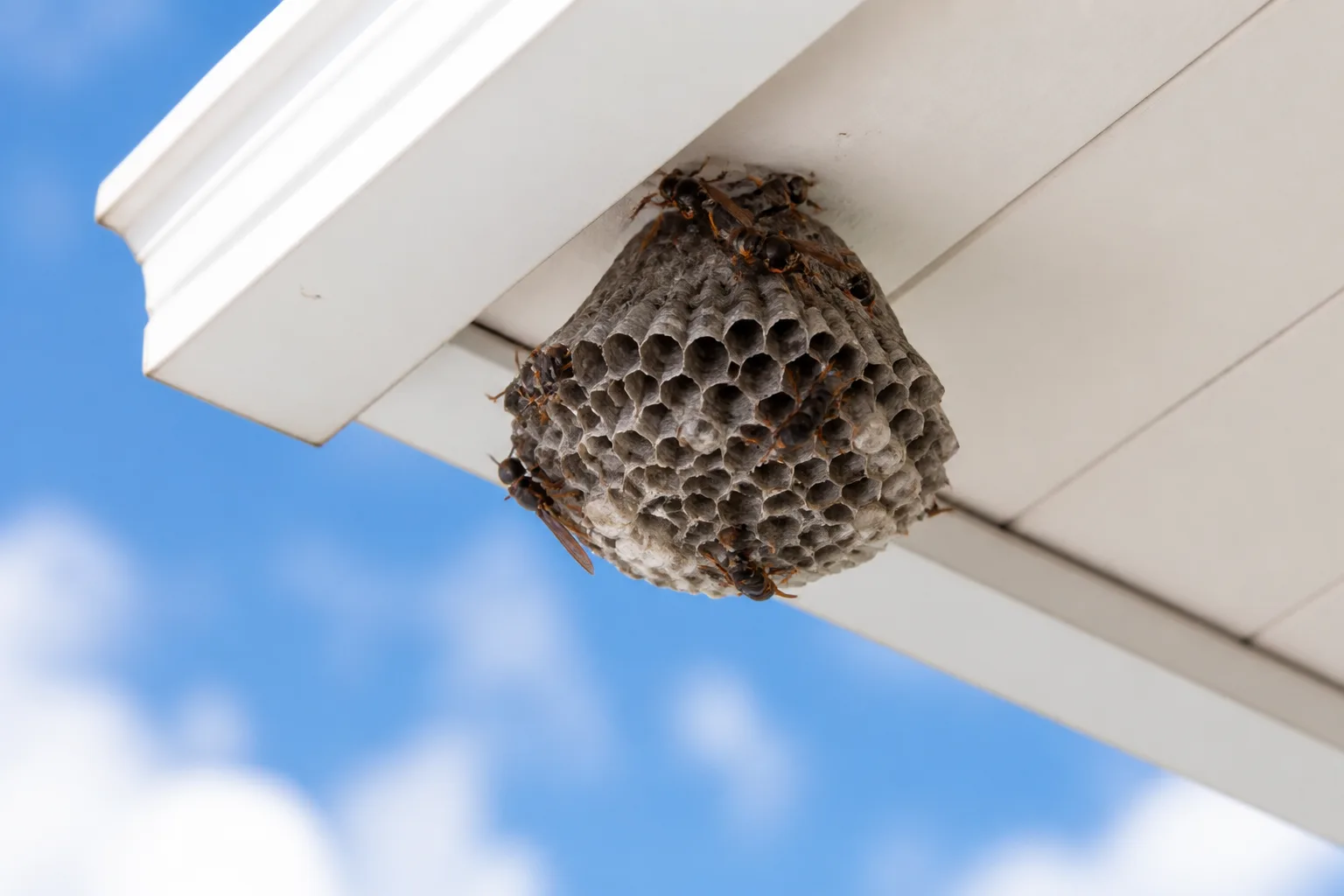
The insect and the nest are both clues. The UC Integrated Pest Management guide to yellowjackets and other social wasps notes that yellowjackets may nest in ground holes, wall cavities, and enclosed gray-paper aerial nests, while paper wasps build open-cell nests. A visible nest is not necessarily a safe treatment target. Stand back and observe the entrance, flight path, and nearby traffic.
Yellowjackets: the hidden-nest problem
Yellowjackets are difficult because the colony may be below soil, under a deck, inside a wall, or behind a small opening. The University of Minnesota Extension’s identification guide describes their ground and structural nesting habits from spring into fall. Workers also scavenge uncovered drinks, meat, pet food, trash, and fallen fruit.
Do not assume that spraying the entrance reaches the colony. UC IPM explains that a ground nest may extend away from the opening and that aerosol treatment can be hazardous even with quick knockdown. For a ground nest, wall void, attic, or nest with more than one entrance, professional treatment is usually safer.
Paper wasps and mud daubers: exposed nests are different
Paper wasps have slender waists and build small, open-comb nests under eaves, railings, porch ceilings, and other sheltered surfaces. They prey on caterpillars and other insects and are generally less defensive than yellowjackets when undisturbed. Mud daubers are solitary, thread-waisted wasps that make mud cells rather than large social colonies.
If a small paper-wasp nest is away from doors, seating, play areas, and pets, leaving it alone can be sensible. If it is in a high-traffic spot, an exposed-nest foam or jet may fit better than a concentrate or dust—only if the label permits it and you can maintain distance. The University of Minnesota Extension overview of beneficial wasps reminds us that not every wasp needs killing.
Honey bees: stop and identify
Honey bees are hairier and less sharply yellow-and-black than yellowjackets, and a colony may occupy a cavity rather than build a paper nest. Bees are valuable pollinators, so do not spray an uncertain insect. The UC IPM guide to bee and wasp stings provides identification and sting-risk context, but a distant phone photo may not be enough.
If the insects appear bee-like, if you see a steady stream entering a wall or tree, or if you cannot safely identify the nest, pause and contact a beekeeper or qualified pest professional. A wasp aerosol is not an appropriate default for a honey-bee colony, and treating first can make rescue or removal more difficult.
The 8 best wasp sprays
These picks are organized by use case rather than by an invented laboratory ranking. I looked for a clear product identity, current manufacturer information, a defined delivery format, and a useful distinction from the other options. Verify the exact can, active ingredients, use site, and directions at purchase because registrations and formulas can change by product version and region.
Spectracide Foaming Wasp & Hornet Killer: best overall for exposed nests
This is a broadly useful starting point for an exposed aerial nest when a homeowner can treat from a stable position with a clear retreat. Spectracide describes its foaming wasp and hornet killer as a water-based, blanketing foam with a reach of up to 20 feet. The product information lists prallethrin and cypermethrin and directs users to treat the nest, not chase individual insects.
The foam makes coverage easier to see on an exposed paper nest and can coat openings instead of producing only a narrow stream. The product is for outdoor use, the area must remain undisturbed for the label’s waiting period, and spray should not run into drains or waterways. Test siding when directed, keep people and pets away, and do not use it for an inaccessible nest.
Best for: A visible aerial nest under an eave, porch roof, or similar outdoor shelter.
Trade-off: Foam coverage does not solve a ground, wall, attic, or ladder-access problem.
Raid Wasp & Hornet Killer 33: best liquid jet
Raid’s Wasp & Hornet Killer 33 product page lists a reach of up to 22 feet and directs users to wet the nest thoroughly. The liquid jet fits a clearly visible nest when a stream gives you a better line from a planned safe position. The product information lists prallethrin and cypermethrin, but the exact can and local label control.
The advantage over foam is the directed stream, not guaranteed colony control. A breeze, steep angle, siding, or foliage can reduce coverage. The product is for outdoor use and carries edible-crop, food-contact, aquatic, and surface precautions. Lower-activity timing does not make a nest harmless; stay out of the flight path and never stand beneath it.
Best for: A plainly exposed nest where a liquid stream is easier to aim than expanding foam.
Trade-off: A narrow jet offers less visual coverage and still requires complete nest treatment as directed.
Hot Shot Wasp & Hornet Killer3: best maximum reach
When reach is the deciding factor, Hot Shot’s Wasp & Hornet Killer product information lists a 27-foot spray range. That can help with a high eave or roofline if the user can maintain a stable stance, clear retreat, and label conditions. Its product information lists prallethrin and lambda-cyhalothrin.
Range is a convenience metric, not a safety rating. Wind can move spray, distance can weaken the stream, and an apparently reachable nest may still require standing under an overhang or near an exit. The product is for outdoor use with reentry and fish, water, surface, people, pet, food, and plant precautions. If it requires a ladder, roof, or awkward reach, choose professional help.
Best for: A visible, elevated outdoor nest that can be treated from ground level without stepping into the flight path.
Trade-off: The longest printed range cannot compensate for wind, poor access, or a hidden nest.
Spectracide PRO Wasp & Hornet Killer: best residual aerosol
Spectracide PRO Wasp & Hornet Killer is the pick for readers specifically comparing an exposed-nest aerosol with a returning-wasp claim. Spectracide lists a reach of up to 20 feet, contact kill, and activity against returning wasps for up to four weeks. The current product information lists tetramethrin, permethrin, and piperonyl butoxide.
That residual claim can matter at a busy outdoor structure, but it is not a reason to spray more often or use extra product. Site, weather, surface, runoff, and waiting directions still apply, and the product page does not make an outdoor aerosol an indoor solution. Do not choose it solely because “PRO” sounds stronger.
Best for: An accessible outdoor nest where labeled residual activity is part of the comparison.
Trade-off: Residual activity is surface- and condition-dependent and does not guarantee hidden-colony elimination.
BASF PT Wasp-Freeze II: best quick professional aerosol
BASF’s PT Wasp-Freeze II page describes a professional product with a 15-foot reach, quick knockdown, and residual activity. It represents a professional-style aerosol for a trained or label-literate user who understands drift, reentry, and the difference between a visible nest and structural infestation.
The shorter reach is not necessarily a weakness if the target is near enough to cover from a controlled position. Do not infer indoor permission, nest coverage, or residual duration from the product name or a retailer listing. Obtain the current label and safety data sheet, and leave wall voids, attics, ground nests, ladders, and large colonies to a professional.
Best for: Experienced users comparing a professional quick-knockdown aerosol for a label-authorized accessible target.
Trade-off: Professional positioning raises the importance of exact label compliance; it is not a shortcut for difficult access.
EcoSMART Wasp & Hornet Killer: best plant-oil option for spot contact
EcoSMART’s Wasp & Hornet Killer page lists peppermint oil as an active ingredient and describes a fast contact product for wasps and hornets. It is a sensible plant-oil option for a few visible insects or a small, accessible target, not a “natural” substitute for a high-risk nest treatment.
The label matters as much as the ingredient story. Oils and solvents can affect surfaces, the spray should not be directed at people, pets, food, or water, and contact activity does not create a lasting barrier or guarantee an empty nest. EcoSMART’s statement about children and pets is qualified by “when used as directed”; keep them out of the treatment area and follow normal retreat and reentry rules.
Best for: Limited spot contact when the target is visible, accessible, and covered by the current label.
Trade-off: Plant-derived does not mean hazard-free, stain-proof, residual, or suitable for a large colony.
Syngenta Demand CS: best broad-area concentrate for experienced users
Syngenta’s Demand CS page presents Demand CS as a professional microencapsulated concentrate containing lambda-cyhalothrin. The manufacturer markets it for more than 30 pests and describes residual performance up to 90 days under appropriate conditions. Wasps and hornets appear among its labeled pest uses, but application depends on the current federal, state, and site-specific label.
This is not for someone who sees a nest and wants to point a can at it. It is a broad-area or targeted professional format requiring accurate measuring, compatible equipment, correct site selection, and protection of people, pets, plants, food, drains, and waterways. I am not giving a generic dilution rate because the pest, site, formulation, and jurisdiction control it. If you cannot follow the current label, choose a ready-to-use product or licensed professional.
Best for: Experienced users or professionals handling a label-authorized broad-area or structural pest-management job.
Trade-off: Concentrate adds mixing and application risk and is easy to misuse as a direct nest spray.
DeltaDust Insecticide: best for labeled cracks and voids
DeltaDust represents a dry-treatment format for a narrow use case. Envu’s current DeltaDust product page provides professional context and links to the label and safety data. Dust may fit a dry crack, crevice, or protected void only when the current label authorizes the exact pest, site, and method. It is not an exposed-nest answer.
The advantage is placement in a dry, sheltered entry point where liquid would not remain, but dust can drift, become airborne, contaminate an occupied area, or remain where children, pets, wildlife, or air movement can disturb it. Never blow unidentified dust into a nest opening, use it in a food area, or treat a wall cavity without understanding where it may travel. If the void is inside a home or the colony is defensive, have a professional inspect it.
Best for: A current-label-authorized dry crack, crevice, or void treatment.
Trade-off: It is the least forgiving option here and is not an open-aerial-nest shortcut.
How to use wasp spray with a safety-first sequence

Treat the label as part of the product, not fine print to skim after the can is open. The EPA’s consumer pesticide-safety guidance and manufacturer labels agree on the core habits: identify the pest and site, follow every direction, keep people and animals away, and prevent spray or runoff from reaching food, drains, water, or non-target plants. Waiting period, protective equipment, distance, and weather restrictions vary by brand.
Use this sequence for an accessible, label-authorized outdoor target:
- Confirm the target and plan the exit. Identify a wasp nest rather than a bee colony, locate the entrance and flight path, and decide where you will retreat. If you cannot see the full target, or it is inside a wall, attic, roof, tree cavity, or ground hole, stop and reassess.
- Clear the area. Bring children and pets inside, move food and dishes, close nearby doors and windows, and keep anyone from entering the treatment zone before the label allows.
- Check the conditions. Follow timing, wind, rain, temperature, and distance restrictions. Many aerosol labels recommend early morning or evening, but UC IPM’s wasp guidance warns that wasps can still be dangerous at night. Never stand below an eave nest or between the nest and its entrance.
- Use the label-directed protection and amount. Wear the required protection, keep the can upright if directed, and do not combine pesticides or add household ingredients. More spray is not safer.
- Treat the nest or entry exactly as directed. Aim at the nest, not flying insects. Keep the applicator at the stated distance, avoid drains and waterways, and stop if spray drifts toward you, a neighbor, vehicle, plant, or home opening.
- Leave immediately and respect reentry. Do not inspect, knock down the nest, sweep residue, or let pets investigate until the label allows reentry. If it specifies 24 hours, use 24 hours.
- Reassess from a distance. Returning foragers do not prove failure, and a quiet entrance does not prove a structural colony is gone. If activity continues, do not layer on applications; re-read the label and call a professional.
If a spray “did not work,” access may be the problem. The stream may not have reached the comb, the colony may be in a void, the visible insects may be foragers from another nest, or the product may promise only contact activity. Do not increase the dose, drill into a wall, seal an active entrance, or switch formats at random. Document the location from a safe distance and ask a professional to identify the colony.
When to call a professional or leave the nest alone
Call a qualified pest professional when the nest is large, hidden, underground, inside a wall or attic, attached to a roofline, above a ladder, near electrical equipment, beside a door or play area, or where you cannot keep people and pets away. Professional help is also right for a history of severe sting reactions, several nests, or uncertain bee identification. A professional can locate the colony instead of treating only visible traffic.
Do not spray a nest simply because it exists. The BBC Gardeners’ World guidance on deterring wasps notes that social wasps are predators and pollinators, their annual nests naturally change through the season, and insecticide can affect wildlife and persist in soil. A small exposed paper-wasp nest at the far end of a garden may be better left undisturbed. The calculation changes when the nest is beside a path, door, eating area, or children’s play space.
If the nest is in a wall or roof, do not seal the entrance while the colony is active; trapped wasps can redirect into living spaces. If a bee colony is involved, seek a beekeeper or bee-removal specialist. Trouble breathing, mouth or throat swelling, dizziness, or other severe sting-reaction signs require emergency medical help.
Lower wasp pressure without spraying

Start with food management. Keep drinks and food covered outdoors, wipe up sweet spills, close trash and recycling lids, remove pet bowls promptly, and pick up fallen or overripe fruit. These habits target the scavenging behavior that keeps yellowjackets around patios. Gardening Know How emphasizes sanitation, covered food, closed bins, and early attention to nesting sites.
Inspect eaves, porch ceilings, sheds, play structures, wall penetrations, and ground-level openings in spring, before a small nest becomes a larger colony. Repair screens and gaps, but do not close an active entry until the colony has been handled. Remove sheltered clutter only when doing so will not disturb an active nest.
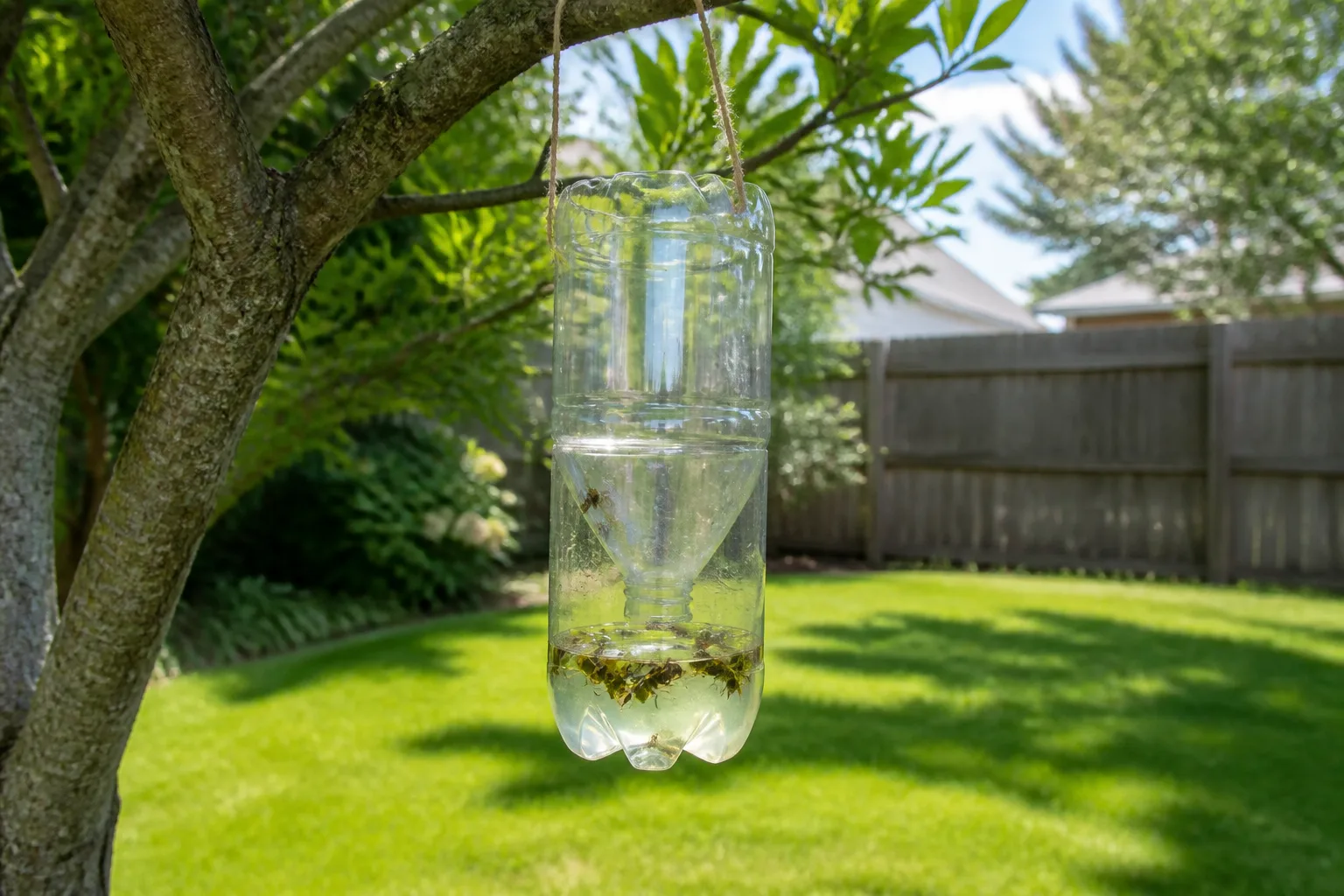
Traps can reduce foraging yellowjackets in a defined area, but they do not reliably eliminate a nest. UC IPM recommends placing them at the edge of the protected area, away from patios and gathering spots. They are a localized tool and, in some settings, an early-season queen trap—not proof that the colony is gone.
Decoy nests are limited. A paper bag or commercial dummy nest may discourage some aerial nest-builders, but it does not repel every species and does nothing for ground-nesting yellowjackets. If you try one, place it before nesting begins and treat it as an experiment, not a pesticide substitute. Harvesting ripe fruit promptly can reduce visitors but does not remove a nearby colony.
Finally, preserve useful wasps when they are not creating a hazard. Solitary wasps and many social wasps help control caterpillars, aphids, and other insects, and pollinators are part of a functioning garden. A deliberate “leave it alone” decision is often the most effective low-risk choice for a nest that is distant from people and pets.
Conclusion: choose the smallest effective intervention
For an exposed aerial nest that must be treated, Spectracide Foaming Wasp & Hornet Killer is the most balanced starting point because its foam gives visible coverage. Choose Raid Wasp & Hornet Killer 33 or Hot Shot when a directed stream or extra reach fits a stable, ground-level setup. Choose Spectracide PRO when its current residual claim is relevant, not because “PRO” sounds reassuring.
EcoSMART is best kept to limited plant-oil contact work, while Demand CS and DeltaDust belong to label-specific, experienced, or professional applications. BASF PT Wasp-Freeze II is for an accessible, authorized target, not a hidden or elevated nest. For every product, start with identification, distance, an escape route, and a label that authorizes the exact pest and site.
If the colony is in the ground, wall, attic, roof, tree cavity, or another place you cannot reach safely, put the can down and call a professional. If the nest is small and away from traffic, leaving it alone while reducing food attractants may be better. The smallest effective intervention protects people, pets, pollinators, and waterways while solving the actual problem.