Can You Fertilize and Overseed at the Same Time?
Can you fertilize and overseed at the same time? Learn when same-day application works, when it can burn seedlings, and how to time watering and follow-up feeding.
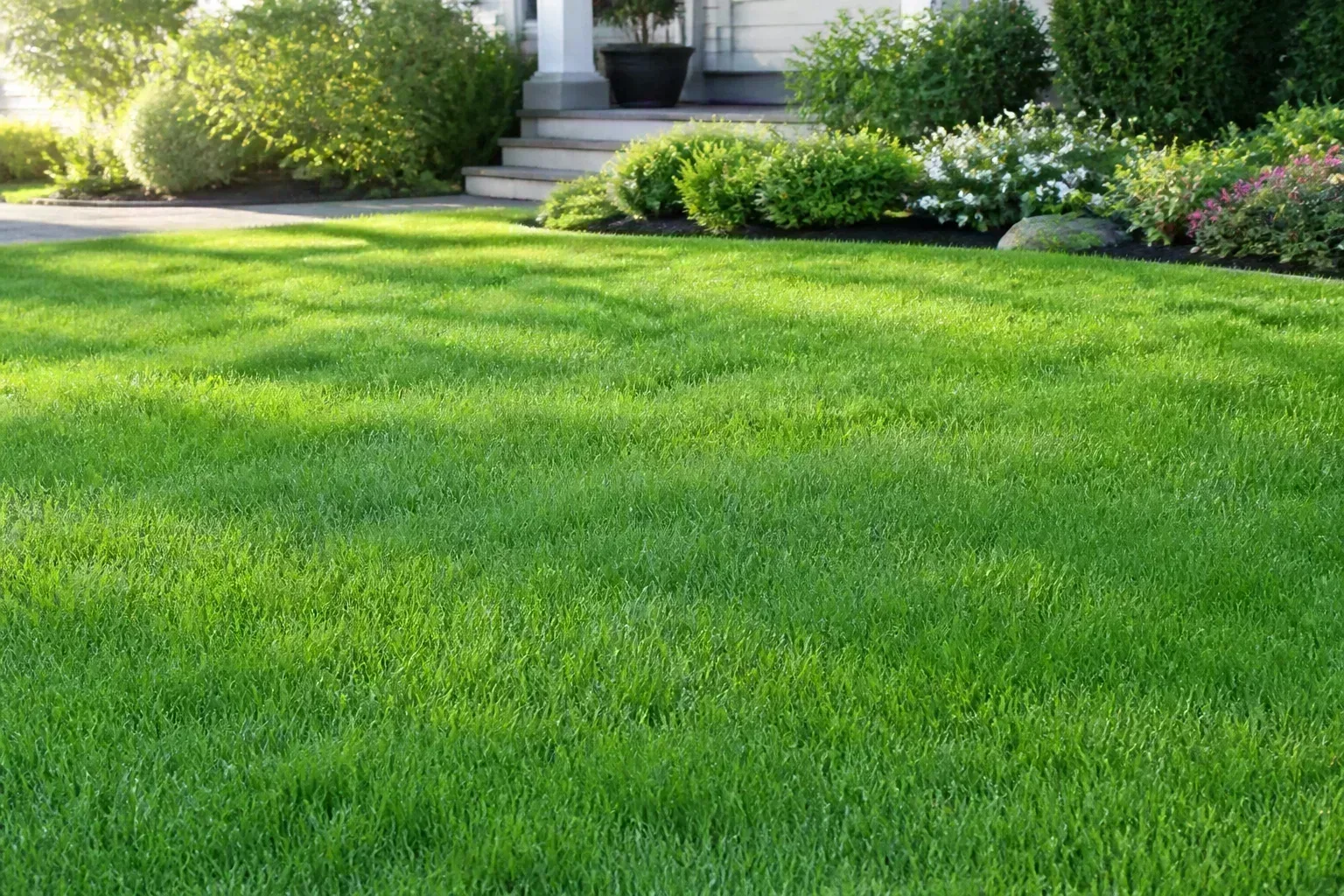
If you are overseeding a thin lawn, you may be tempted to put grass seed in the spreader, grab a bag of fertilizer, and finish both jobs in one pass. The answer is conditional: you can sometimes fertilize and overseed on the same day, but the fertilizer must fit the seeding stage, the grass must be actively growing, and the label must allow that use.
The risky shortcut is applying a routine, high-nitrogen lawn feed over fresh seed because the bag promises a greener lawn. Tender seedlings have tiny roots, limited reserves, and much less tolerance for a concentrated dose than established turf. A safe plan treats the seedbed, emerging seedlings, and mature grass as three overlapping but different jobs.
The short answer: yes, but not with just any fertilizer
For a cool-season lawn in a favorable seeding window, a starter fertilizer labeled for seeding or overseeding can be applied close to the time you sow. “Close” may mean just before or just after seeding, depending on the product label and the way you are distributing it. Penn State Extension describes starter fertilizer as a seeding-window input and warns that more than 1.5 pounds of actual nitrogen per 1,000 square feet can burn young turf and damage establishment. Read the label’s rate, analysis, and use directions rather than copying a spreader setting from a different product.
That does not make every starter fertilizer a good choice for every existing lawn. Some overseeded lawns already have adequate phosphorus and potassium, and some regions restrict phosphorus applications unless a soil test or other condition justifies them. Penn State Extension says a soil test is the way to determine phosphate and potash needs; NC State Extension likewise recommends testing every two to three years for lime, phosphorus, and potassium.
The practical rule is simple: same day is possible with a compatible starter product; same day with ordinary maintenance fertilizer is usually a poor gamble. If you cannot identify the grass, check the analysis, confirm the label use, or keep the soil adequately moist, delay the feeding and focus on seed-to-soil contact and irrigation first.
Why seed and established turf pull in different directions
Established grass has a functioning root system and a leaf canopy that can absorb and use nutrients quickly. It may benefit from a measured nitrogen application during its natural growth period, especially after summer stress in a cool-season lawn. New seedlings are different: their first priority is developing roots and a crown, not producing a flush of soft green blades.
Excess soluble fertilizer raises the concentration of salts around a seed or young root. If the surrounding soil is dry, water can move away from the root rather than into it, intensifying stress. The visible result may be scorched tips, stalled emergence, thin rows, or a lawn that greens unevenly because the spreader overlapped in some areas.
Nitrogen is not “bad” for seedlings. It is a matter of amount, release speed, placement, and timing. Phosphate and potash are also not automatic cures. A starter analysis is a tool for a seeding situation, not permission to add nutrients the soil already has in abundance. The goal is enough available nutrition for establishment without forcing the old turf to outgrow the seedlings or creating runoff.
Decide which lawn you have before you schedule anything
Identify the dominant grass before choosing a date. Common cool-season grasses include Kentucky bluegrass, tall fescue, fine fescue, and perennial ryegrass. They grow best in moderate temperatures, usually making late summer and early fall the strongest overseeding window in areas with cold winters. Common warm-season grasses include bermudagrass, zoysiagrass, centipedegrass, and St. Augustinegrass; these grow most strongly in warm weather and often recover through spreading rather than repeated overseeding.
This distinction matters because a calendar date that is excellent for tall fescue may be too late for bermudagrass, while a nitrogen application that helps an actively growing warm-season lawn can be badly timed for grass approaching winter dormancy. If you inherited the lawn and are unsure, look at old seed bags, ask the installer, compare leaf texture and growth habit, or take a sample to a local extension office before making a whole-yard decision.
Cool-season lawns: fall is usually the main window
Late summer and early fall work well because the soil can remain warm enough for germination while air temperatures become less stressful. Penn State Extension notes that fall-seeded turf gets cool growing time before its first period of summer heat, and its lawn-management calendar lists early fall as a strong overseeding period. The exact date still depends on your first frost, soil moisture, shade, and the species in the seed blend.
Aim to finish early enough for roots to develop before persistent freezing weather. Kentucky bluegrass can take longer to establish than perennial ryegrass, and a mix containing several species should be managed for the slowest important component rather than the first green hairs you see. If heat or drought is still stressing the old lawn, wait for recovery; newly sown seed cannot compensate for a site that repeatedly dries at the surface.
Warm-season lawns: a different calendar and often a different repair
Warm-season turf generally needs active summer growth to establish from seed, sprigs, plugs, or sod. NC State Extension lists bermudagrass and zoysiagrass among warm-season grasses and notes that many cultivars are better established vegetatively; St. Augustinegrass is not established from seed in the same way as a seeded cool-season lawn. A thin warm-season lawn may need correction of shade, compaction, mowing height, irrigation, or fertility before you reach for an overseeding mix.
Do not automatically apply cool-season “winterizer” fertilizer to a warm-season lawn in late fall. NC State Extension specifically cautions against late-fall or winter nitrogen for warm-season grasses because it can increase winter injury. In a transition climate, follow your state extension guidance and the grass cultivar’s needs rather than treating the entire property as if it were a northern lawn.
When same-day overseeding and fertilizing makes sense
Same-day application is most defensible when four conditions line up: the seed is appropriate for the existing turf and season, the product is explicitly intended for seeding or new turf, the soil is moist but not saturated, and you can water according to the product directions. A starter fertilizer can be applied immediately before or after seed in a prepared area, but do not assume that “starter” means “use at any rate.” Calculate the amount of actual nitrogen and stay within the label range.
For example, if a 10-pound bag is labeled 20-10-10, the first number means 20 percent nitrogen by weight. That bag contains 2 pounds of actual nitrogen. If your label rate would put 0.5 pound of actual nitrogen on 1,000 square feet, the 10-pound bag covers 4,000 square feet at that rate. The spreader setting is only a starting point; calibrate on a measured area because products flow differently.
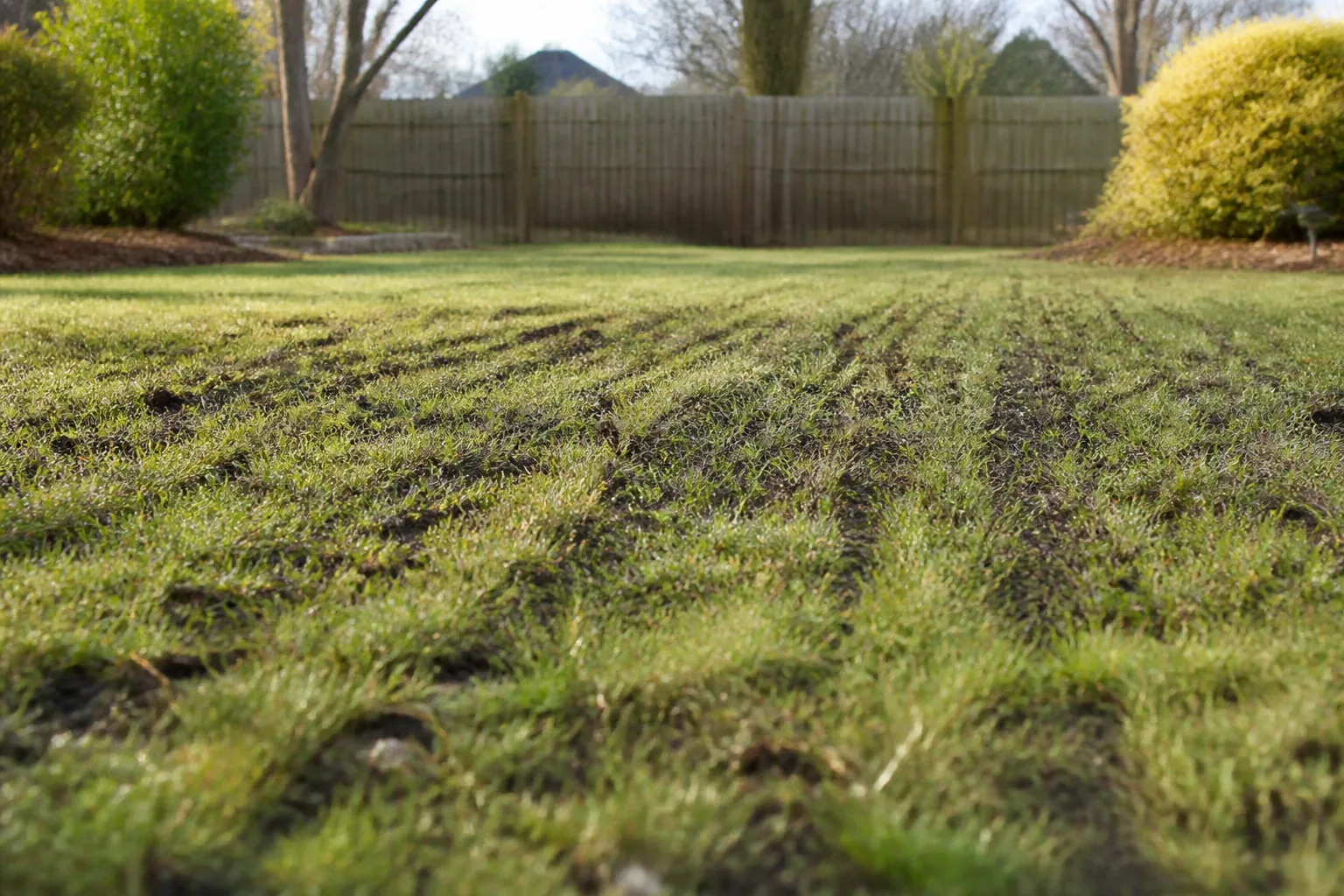
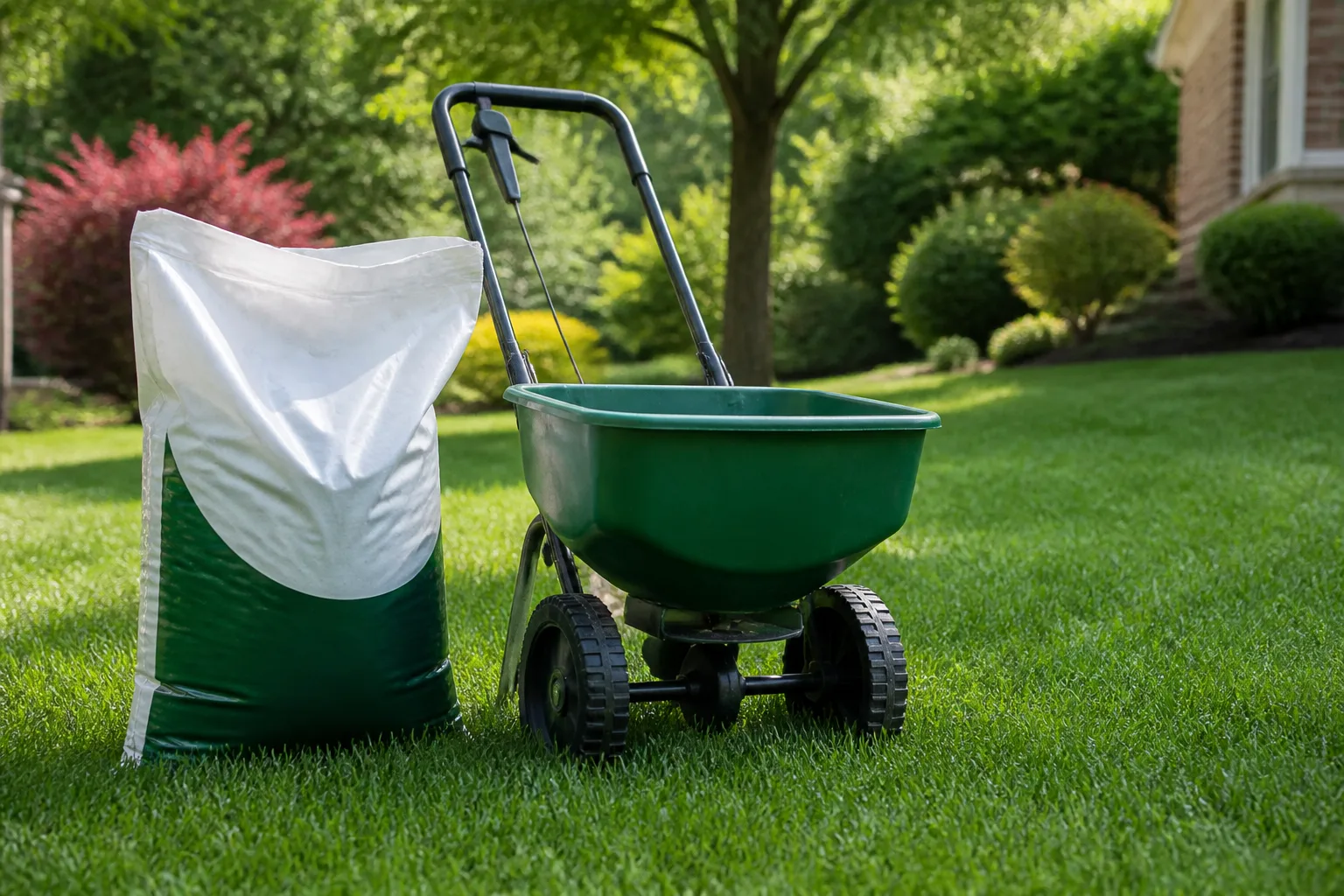
Applying seed and starter fertilizer as separate passes is usually easier to control than mixing them in the hopper. Spread half the seed in one direction and the other half at a right angle, then do the same with fertilizer if the label and your equipment support that approach. A split pass reduces stripes and overlaps, which are common places for salt and nitrogen to concentrate.
When fertilizer should wait
Postpone fertilizer when the turf is brown from drought, wilted in the afternoon, heat-stressed, dormant, or sitting in waterlogged soil. Fertilizer is not a rehydration treatment. Water the root zone appropriately and wait until the grass resumes active growth; Farmers’ Almanac also advises waiting when a fall lawn remains unusually hot, dry, or severely stressed.
Delay if heavy rain is likely to move granules off the lawn, if the soil is frozen, or if you cannot irrigate a newly seeded surface. Runoff wastes the product and can carry nutrients into waterways. Applying extra fertilizer because the forecast is uncertain is not insurance; it is an avoidable rate error.
Be especially cautious with weed-and-feed products. A pre-emergent herbicide is designed to create a barrier that stops seeds from emerging, so it can work against your grass seed. Some products have narrow exceptions for specific grasses or seeding situations, but those are label questions, not general lawn rules. Broadleaf post-emergent herbicides can also injure young turf, and their required waiting periods vary. Read the label before seeding, and if you cannot verify compatibility, separate the projects.
The reliable order of operations for an overseeding project
The best sequence protects the seed before it tries to make the old lawn greener. Penn State Extension emphasizes that overseeded seed needs soil contact and room to germinate; BBC Gardeners’ World Magazine likewise describes autumn renovation as a sequence of scarifying or aerating, top-dressing when needed, and then adding seed. The work below is a general framework, not a substitute for your seed and fertilizer labels.
Prepare the canopy and soil surface
Mow the existing lawn at the normal height or slightly lower if your grass and local recommendations allow it, but do not scalp drought-stressed turf. Remove leaves and heavy clippings. If thatch is thick and spongy, address it only when the grass is actively growing and able to recover; a thin, normal thatch layer does not need to be stripped away just because you are overseeding.
Core-aerate compacted sections when the soil is moist enough to pull plugs without becoming mud. Use a true core aerator rather than a solid spike tool if compaction is the problem. A soil test is worth doing before adding lime, phosphorus, or potassium, particularly if you have fertilized regularly or are working near a water-sensitive area.
Spread seed evenly and protect contact
Choose seed that matches the lawn’s sun, shade, traffic, drainage, and climate. Do not increase the rate just to make a thin lawn look fuller on the day of sowing; excessive density creates competition for light, water, and nutrients. Follow the bag’s overseeding rate and use a spreader calibrated on a small measured patch.
Seed needs to reach the soil, not perch on a mat of leaves or thatch. Light raking, core holes, slit seeding, or a thin top-dressing can improve contact. If you top-dress, spread a fine, weed-free material lightly enough that existing grass remains visible. Gardeners’ World advises spreading top dressing evenly, working it into hollows, and avoiding foot traffic until the turf grows through; its overseeding guidance places seed after top-dressing rather than burying seed under a heavy layer.
Apply the right fertilizer at the right rate
If a soil test identifies a need and the product label permits use during seeding, apply starter fertilizer as its own measured pass. Otherwise, sow seed first and reserve regular maintenance fertilizer for the point when the new grass is established. Water the surface immediately only as deeply and frequently as needed to activate the product and keep seed moist; never use a strong irrigation stream that uncovers seed or piles granules in low spots.
How to choose a starter fertilizer without overfeeding
Start with the N-P-K analysis, but do not shop by the biggest middle number. The first number is total nitrogen, the second is phosphate, and the third is potash. Penn State Extension gives examples of starter analyses such as 10-10-10, 16-8-8, and 20-10-10, and recommends a seeding-window application of roughly 0.5 to 1 pound of actual nitrogen per 1,000 square feet, with higher amounts risking burn.
That guidance is not a universal prescription. Soil phosphorus rules differ by state and watershed, and a lawn with high phosphorus does not need a high-phosphorus product simply because seed is involved. If the test shows phosphorus and potassium are sufficient, choose a product and rate that meet the actual need, or skip fertilizer during seeding. Ask your extension office about local restrictions when the label is unclear.
Release speed matters too. Quick-release nitrogen can be useful in an active seeding window, but it also creates a sharper mistake if you overlap passes or apply to dry soil. Slow-release nitrogen feeds more gradually and is often useful for routine established-turf maintenance, yet it is not automatically the best starter because seedlings may need available nutrients sooner. Match the release pattern to the label, soil, weather, and grass—not to the color of the bag.
Watering: the step that decides whether both inputs work
Fresh seed must stay consistently moist at the surface while it germinates. That usually means light, frequent irrigation rather than one weekly soak that leaves the top layer dry for hours. NC State Extension advises keeping the upper 1.5 inches moist during establishment, often requiring light watering two or three times a day for 7 to 21 days, then watering less often and more deeply as roots develop.
Use a gentle spray, check the soil with a fingertip, and adjust for sun, wind, shade, clay, sand, slope, and rainfall. The right interval is the one that keeps the seedbed from repeatedly drying without creating puddles or algae-like surface conditions. A timer can help, but a timer cannot see runoff; short cycles are often better on clay or a slope.
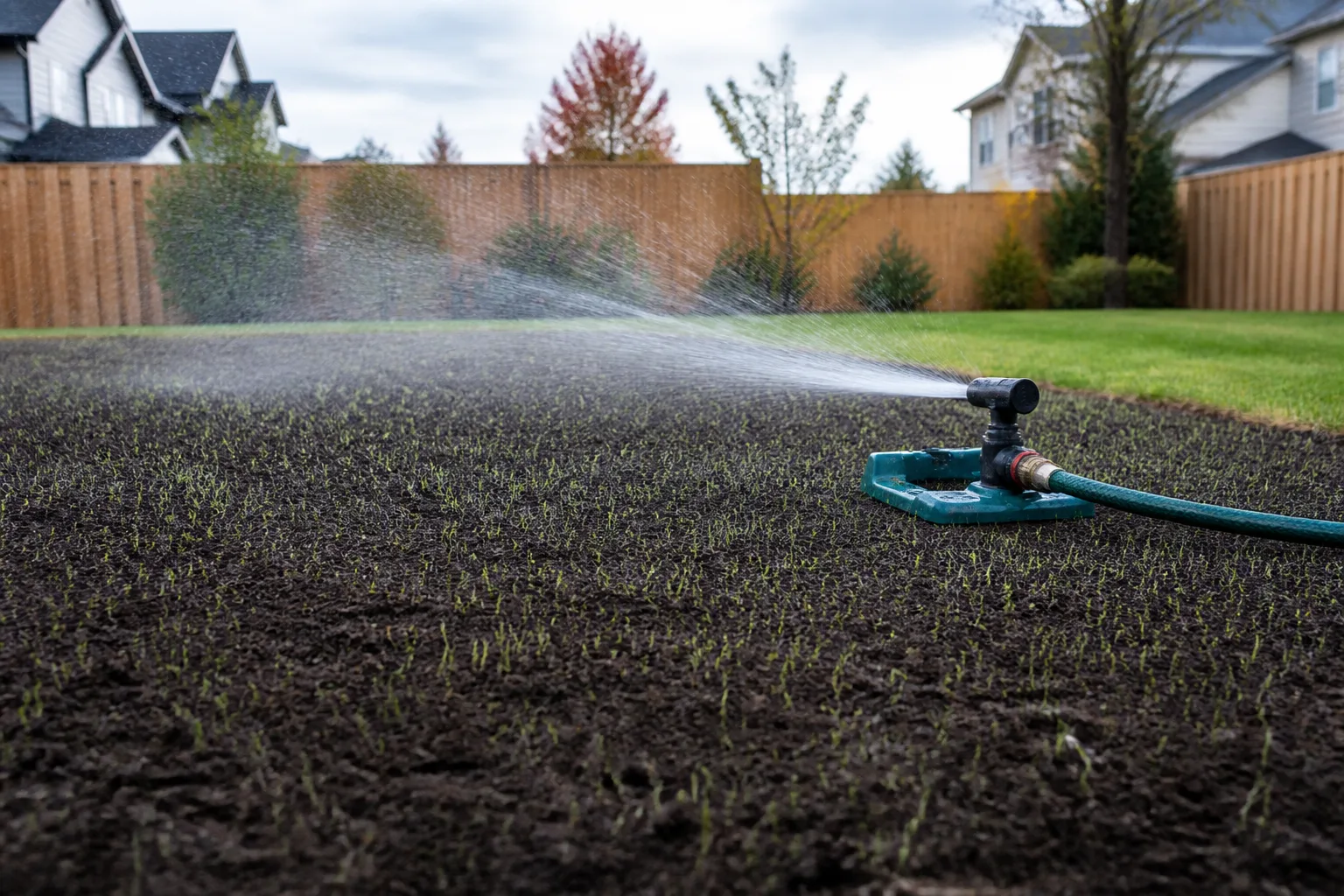
After most seed has emerged, gradually lengthen the interval and reduce the frequency. Once the lawn has been mowed several times and roots are reaching deeper, transition toward the watering pattern appropriate for the established grass. NC State’s established-lawn guidance uses deep watering to a 6- to 8-inch soil depth as a general goal, but sandy soils, clay, slopes, rainfall, and local water limits require adjustment.
Mowing and traffic while seedlings establish
Keep people, pets, and equipment off the seeded area as much as practical during germination. A single necessary crossing will not automatically ruin the project, but repeated traffic can move seed, compact wet soil, and snap young seedlings. Mark the area if children or delivery workers routinely cut across it.
Do not wait for a perfect carpet before mowing. New grass becomes easier to manage when you mow at the correct trigger for the species and remove no more than about one-third of the leaf height at a time. NC State Extension considers a lawn established after it has been mowed three times, a useful practical milestone for deciding when to resume normal traffic and routine care. Use a sharp blade and mow when the foliage and soil are dry enough to avoid tearing and ruts.
What to do if you already applied regular fertilizer
Do not panic, and do not add another product to “balance” the first one. Find the bag, record the analysis, calculate the area treated, note the spreader setting and time, and check whether the fertilizer was quick-release, slow-release, or combined with herbicide. Those details tell you more than the word “fertilizer.”
If the application was at the label rate on moist, actively growing turf and no herbicide conflicts with seeding, the next step may simply be to wait and monitor. If you overlapped heavily, applied to dry or heat-stressed grass, or used a weed-preventer, do not immediately sow valuable seed. Water according to the label and local conditions, avoid another fertilizer application, and contact your county extension office or the product manufacturer for product-specific instructions.
Watch for uniform emergence, dark green stripes, straw-colored tips, crusted granules, and runoff at the edge of the lawn. A few thin spots can be reseeded after conditions stabilize. Widespread scorch, persistent wilt, or a suspected herbicide injury deserves a local diagnosis because product ingredients and rates determine the remedy.
A practical eight-week follow-up plan
Use the calendar as a reminder, not as the decision-maker. A workable plan for a cool-season overseeding project looks like this:
- Day 0: Mow, remove debris, aerate or rake only where needed, spread seed, and apply a compatible starter product if justified. Begin gentle irrigation.
- Days 1–14: Keep the seedbed evenly moist. Do not add more fertilizer because you cannot see seedlings yet. Protect the area from unnecessary traffic.
- Weeks 2–4: As seedlings appear, continue moisture while watching for washouts, crusting, birds, and bare strips. Reduce watering frequency only when the new grass can tolerate a slightly longer interval.
- Weeks 3–6: Begin mowing when the new grass reaches the appropriate height. Use a sharp blade and the one-third rule. Avoid blanket herbicides unless the label specifically allows use at that stage.
- Weeks 6–8: Judge establishment by repeated mowing, rooted seedlings, and steady growth—not by a single green flush. Recheck the soil test and the fertilizer label before resuming a regular feed.
The exact “regular fertilizer” date is therefore not a fixed eight-week promise. Fast perennial ryegrass may look established sooner than Kentucky bluegrass, while cool weather, shade, drought, and a late seeding date slow every species. The safest trigger is a growing stand that has survived several mowings and is no longer relying on a constantly wet surface.
Common mistakes that make a thin lawn thinner
The first mistake is fertilizing a stressed lawn because the homeowner wants fast color. Nitrogen can produce top growth while roots, moisture, and disease resistance remain the real limiting factors. The second is treating “starter fertilizer” as a product category with one universal formula; label directions, soil tests, and local phosphorus rules still control the decision.
The third is applying pre-emergent weed control in the same window as grass seed without confirming an exception. A weed barrier that works beautifully on an established lawn can also block the seed you paid to grow. The fourth is skipping soil contact and trying to compensate with extra seed or fertilizer. Seed stranded above the soil dries out; seed buried too deeply may not emerge.
Finally, do not overwater after the first green shoots appear, mow wet ground, or keep the surface wet for weeks because one species in the blend is slower. The lawn should transition from a germination routine to an established-turf routine in stages. Better timing and even application usually beat higher rates and more products.
Conclusion
You can fertilize and overseed at the same time, but the safe answer is not “yes” or “no” in isolation. Use a compatible starter fertilizer only when the grass type, seeding window, soil test, moisture, product label, and local rules support it. A routine high-nitrogen lawn feed, a weed-and-feed product, or any fertilizer applied to hot, dry, dormant, frozen, or waterlogged turf can backfire.
Prepare the surface, create seed-to-soil contact, spread accurately, water gently and consistently, and wait to resume regular feeding until the new grass is genuinely established. If you make the decision by plant stage instead of by a calendar date or a greener-is-better impulse, both the old turf and the new seedlings have a better chance to share the lawn rather than compete for the same small window of care.