How to Grow Canadian Hemlock Trees: Planting and Care
Choose the right Canadian hemlock for your space, plant it at the right depth, and learn how to water, prune, and scout for woolly adelgid.
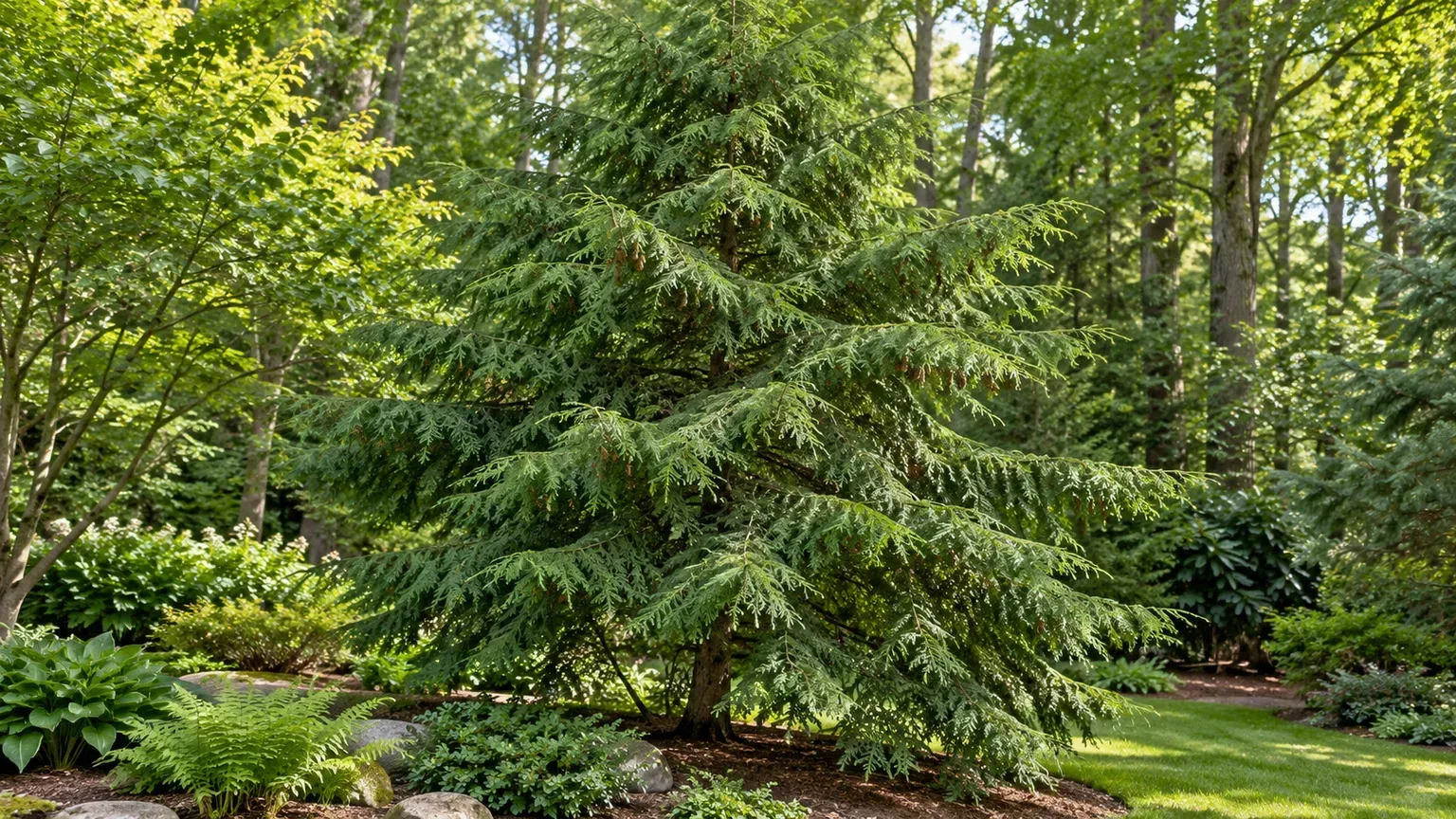
Canadian hemlock, also called eastern hemlock (Tsuga canadensis), is one of the few large evergreens that can add a deep green screen to a shady yard. It is a long-lived native conifer with soft, finely layered foliage and a graceful, often drooping leader. Those strengths come with two nonnegotiable design constraints: the ordinary species becomes a substantial tree, and it performs best where the root zone stays cool and evenly moist without becoming waterlogged.
Before you buy one, decide whether you want a full-size specimen, an informal screen, a clipped hedge, or a compact cultivar. Then look at your summers, drainage, wind exposure, deer pressure, and local hemlock woolly adelgid reports. If those factors fit, planting depth and steady establishment care matter more than fertilizer or a rigid weekly watering schedule.
Is Canadian Hemlock Right for Your Site?
Choose Canadian hemlock when you have a cool or moderate summer climate, some shade or a way to keep the soil from drying, and enough room for the selected plant’s mature width. A standard tree is not a narrow privacy column: typical landscape references give the species a mature height of about 40 to 70 feet and a spread around 25 to 35 feet. A young nursery tree can look modest for years, so mark the eventual canopy on the ground before you settle on a spot. The University of Kentucky Cooperative Extension and North Carolina State Extension describe the species’ large mature size and landscape uses.
This is a good candidate for a woodland edge, north or east side of a building, sheltered lawn, or broad border where its lower branches can remain intact. It is a poor choice beside a foundation, under overhead wires, in a narrow strip between pavement and a fence, or in a hot reflected-heat pocket that dries out every summer. If the space is small, start with a truly compact named cultivar instead of planning to hold a full-size tree at shrub height by repeated cutting.
Pest risk is part of the purchase decision, especially in the eastern United States. Hemlock woolly adelgid has caused serious damage in parts of the native range, and keeping a landscape tree may involve regular scouting and, in some places, professional treatment. Virginia Cooperative Extension at Virginia Tech recommends weighing that ongoing management cost before planting. Check your state or provincial extension service’s current pest map and local advice rather than assuming every region has the same risk.
Identify Tsuga canadensis Before Buying
“Canadian,” “Canada,” and “eastern” hemlock are common names for the same species, Tsuga canadensis. It is a conifer in the pine family, native to eastern North America. Its needles are short and flat, arranged in two loose ranks along the twig; the underside has two pale bands, and small brown cones hang from the branchlets. The fine horizontal sprays and drooping branch tips give the crown a softer outline than a typical spruce or fir. See the identification notes from North Carolina State Extension and the USDA Forest Service.
The shared word “hemlock” causes a safety misunderstanding. Poison hemlock (Conium maculatum) is a poisonous flowering herb in the carrot family, not a conifer and not a close relative of Tsuga canadensis. Confirm the botanical name on the nursery label; don’t identify a plant or make a safety decision from the common name alone. The North Carolina Extension plant profile for poison hemlock treats that species separately. For pets, the ASPCA’s Canada hemlock listing identifies Tsuga canadensis as non-toxic to dogs, cats, and horses; prevent chewing anyway, since any plant material can upset an animal’s stomach and a mistaken identification changes the advice.
Choose the Right Form: Species Tree or Cultivar
The straight species works best when you can give it room to become a large specimen or screen. Its dense, fine-textured foliage stays attractive through the year, and its naturally layered branches provide privacy without shearing. A full-size tree is often a better choice for a large property than for a formal hedge near a walkway: it can be allowed to grow naturally and needs less frequent shaping.
Cultivars change the scale or silhouette, not the basic moisture preference or pest exposure. ‘Gentsch White’ is a compact, rounded form with pale new growth; ‘Jeddeloh’ forms a low mound with a hollow-looking center; ‘Pendula’ and ‘Sargentii’ are weeping forms whose final footprint depends on staking and training. The Morton Arboretum lists mature dimensions for ‘Gentsch White’ and ‘Jeddeloh’, while the Royal Horticultural Society describes the species’ overall habit and cultivation needs.
Do not shop by cultivar name alone. Different references and nurseries may describe a cultivar’s height at different ages, and a weeping plant’s eventual height depends partly on how it is trained. Ask for the cultivar’s expected height and width at 10 years, its mature spread, light preference, and whether the plant is grafted on a standard. Keep its label and plan the planting location around the nursery’s dimensions, not the height of the specimen in a small pot. A dwarf cultivar can suit a rock garden or foundation bed; the ordinary species cannot be made reliably miniature by pruning.
Find the Cool, Moist Planting Site
The best site balances light, moisture, drainage, and protection. Eastern hemlock tolerates a wider range of light than most conifers, but a cool, sheltered position makes its moisture needs easier to meet. It naturally occurs in moist woods, ravines, and slopes; in a home landscape, emulate the stable soil moisture rather than copying the forest’s deep shade while leaving the roots dry. The USDA Forest Service species account describes its moist-to-very-moist habitats and well-drained soils.
Light: shade tolerant, not drought tolerant
Canadian hemlock can grow in full sun, part shade, or shade, but “shade tolerant” does not mean “happy in hot, dry shade.” In a cool region with reliable soil moisture, a sunny site may be workable. In warmer areas or where summers are dry, protect the tree from afternoon sun, reflected heat, and drying wind; an east-facing or lightly shaded site usually puts less pressure on the roots. A heavily shaded young tree can also establish, but expect slower growth and avoid sudden exposure if surrounding vegetation is removed.
The site can become harsher after planting. A tree sheltered by neighboring shrubs may be exposed if those plants are removed, a fence comes down, or nearby construction opens the canopy. Do not clear around an established hemlock without considering the hotter and windier microclimate that follows. UC Statewide IPM’s hemlock guide notes the tree’s need for summer humidity, regular water, and protection from hot sun and wind; local climate determines how strongly those limits show up in a yard.
Soil: moist, aerated, and drainable
Aim for soil that holds moisture but drains after rain. Loam, sandy loam, and humus-rich soil are often suitable; compacted ground that stays saturated is not. The Forest Service notes that eastern hemlock grows in a range of textures, as long as the site remains moist and well drained. Some nursery references favor acidic soil, but pH is not a reason to add sulfur automatically: the species tolerates a broader range, including slightly alkaline conditions, when other site needs are met.
Test drainage before planting in a low spot or dense clay. If water remains in the hole long after surrounding ground has drained, choose a different location or a plant adapted to wet soil. Do not try to “fix” a poorly draining site by filling a deep planting hole with compost; the amended pocket can hold water while the surrounding soil remains compact. Likewise, do not dig in a large dose of manure or fertilizer. Improve a broad planting area only when a soil test or local extension advice indicates a specific need.
When to Plant and What to Buy
Plant in early spring once the soil can be worked or in early fall while the soil is still warm enough for roots to begin settling in. Avoid the hottest part of summer, frozen ground, and periods when you cannot keep the root ball from drying. The best date varies with local frost timing and heat: in a cold region, spring can give a new tree a full season before winter; in a milder climate, fall can reduce heat stress. University of Maryland Extension’s tree-planting guidance explains how to assess planting depth, root flare, and establishment.
Choose a nursery tree with a sound root ball, a straight leader if you want a specimen, and no dead or broken branches. If it is container-grown, slide it partly out of the pot and look for firm roots, not a dense circling mat. A root-bound tree can sometimes be corrected at planting, but severe girdling or a badly tangled root system is a reason to select another plant. Keep the root ball moist between purchase and planting, and carry it by the container or root ball rather than pulling on the trunk.
Before checkout, verify the botanical name, cultivar, expected size, and any local pest warning. Ask whether the plant is locally grown and whether it was recently treated for pests. If you want a hedge, price not only the plants but also the years of watering and the pruning labor; a row of slow-growing trees will not give instant privacy. If regular HWA scouting or treatment would be unacceptable, compare other locally adapted evergreens before you plant.
Plant the Root Ball at the Correct Depth
A tree that is planted too deeply may decline even when its leaves look healthy at first. The root flare—the place where the trunk widens and the first major roots emerge—should finish at or just above the surrounding grade. Nursery soil sometimes covers this flare, so remove excess soil from the top of the root ball until you can see the first structural roots. University of Maryland Extension explains why a buried flare and mulch piled against the trunk can restrict oxygen and promote later problems.
Use this sequence for a container or balled-and-burlapped tree:
- Water the root ball before planting so it is evenly moist.
- Dig a hole two to three times as wide as the root ball, but no deeper than the distance from the exposed root flare to its base. Keep the bottom firm so the tree does not settle lower later.
- Set the tree upright with the flare visible at grade. If roots circle the outside, gently loosen them; cut a few circling roots if needed rather than leaving them wrapped around the trunk.
- Backfill with the excavated soil. Water as you fill to settle soil into voids, but do not stomp it compact.
- Spread a shallow mulch layer across the root zone, leaving the trunk and flare uncovered.
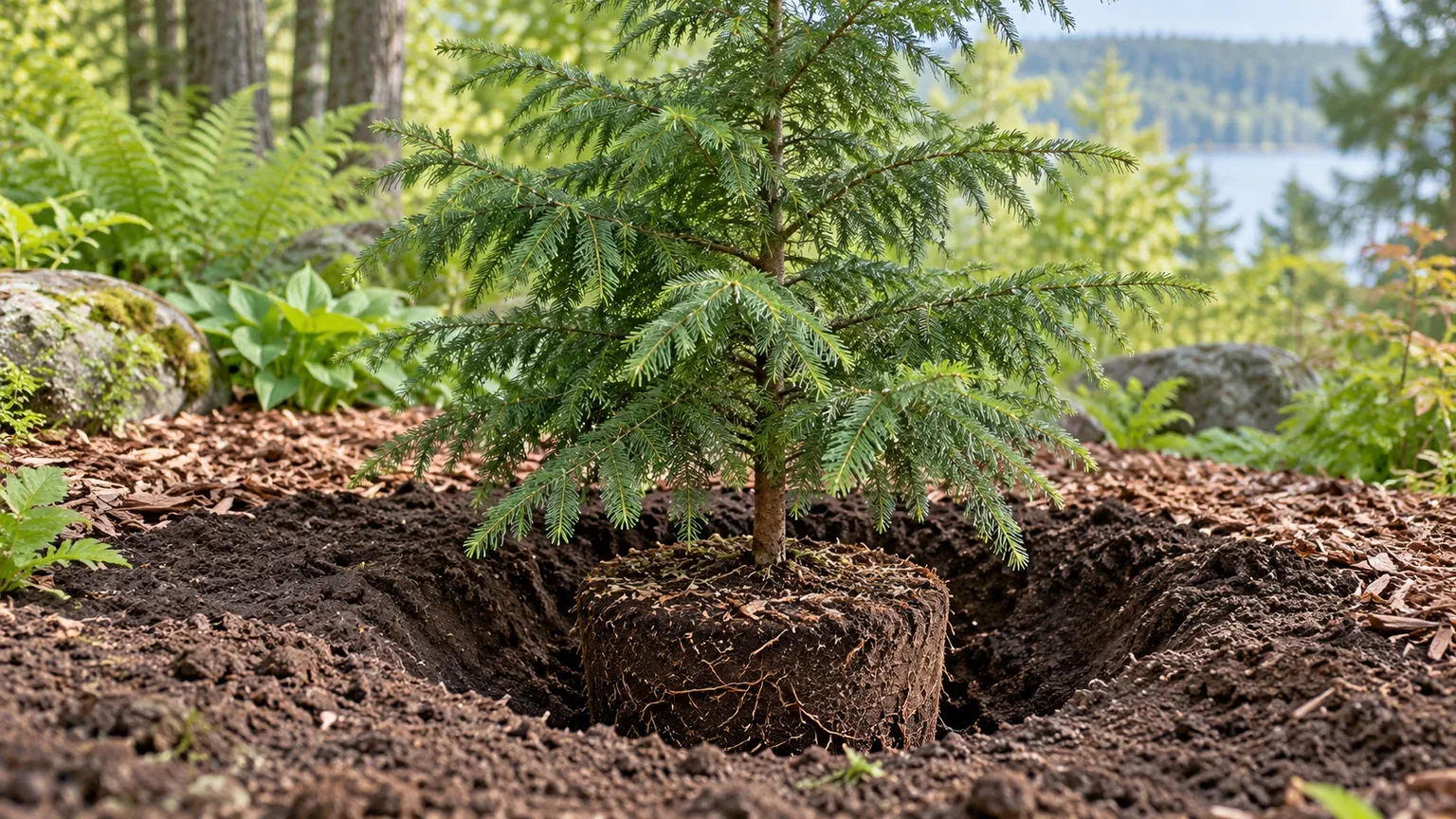
Do not improve the hole by making it deeper, adding a fertilizer spike, or placing loose compost under the roots. The root ball must rest on firm soil at the right height. If you cannot find the flare because the trunk is buried under nursery mix, expose it before lowering the tree; guessing at depth can leave the same problem you were trying to avoid. For a large balled tree, ask the nursery or an arborist to handle the lifting and wrapping safely.
Watering the first two seasons
Water slowly enough that the root ball and nearby soil become moist, then check again rather than assuming a fixed number of minutes is right for every tree. The top of the root ball can dry faster than the surrounding ground, especially for a container-grown hemlock. Probe a few inches down near the edge of the root ball; if it is still damp, wait. If it is dry, soak the root zone and check that water is entering the soil rather than running off compacted ground.
During the first two growing seasons, inspect moisture more often during hot or windy weather and after a week with little useful rain. The goal is consistent moisture, not constant saturation. A soggy root ball, standing water, or sour-smelling soil points to drainage trouble, not a need to add more water. Gradually widen the watered area as roots extend beyond the nursery ball, and keep mulch over that expanding zone. University of Maryland Extension recommends checking several inches below the mulch and warns that overwatering can deprive roots of oxygen.
Settle In: Watering Mature Trees
Once established, a Canadian hemlock still benefits from water during a prolonged dry spell. It is more vulnerable to drought than many landscape conifers, and the first visible sign may be dull or bronzed foliage, tip dieback, or a thinning crown. If the ground is dry several inches below the mulch, water slowly across the root zone—roughly from the trunk outward toward and somewhat beyond the dripline—rather than wetting foliage or pouring water at the trunk. Tree roots extend well past the visible canopy, so a small ring immediately at the base is not the whole target area.
Use rainfall, soil texture, heat, and the tree’s condition to choose timing. Sandy soil may need attention sooner than a moisture-retentive loam; clay may remain wet even after the surface looks dry. During a dry summer, one deep soak when the root zone has dried is more useful than frequent shallow splashes that wet only the surface. If you use irrigation, adjust it after checking the soil instead of setting a permanent weekly timer.
Mulch helps conserve water, moderate soil temperature, and reduce competition from lawn grass. Spread a broad, modest layer over as much of the root area as practical, but keep mulch a few inches back from the trunk. Avoid “mulch volcanoes,” landscape fabric that prevents organic matter from replenishing the soil, and routine cultivation under the canopy that can cut shallow feeder roots. These steps matter most during establishment and dry periods; a mature tree in a suitable site does not need to be babied every week.
Fertilizer and Soil Amendments: Usually Skip Them
A healthy hemlock growing in suitable soil rarely needs routine fertilizer. New trees need to rebuild roots before producing a flush of top growth, and adding nitrogen without a diagnosis can push tender shoots instead of solving the actual cause of weak growth. Virginia Cooperative Extension also cautions against unnecessary fertilizer around adelgid-prone trees because excess nitrogen can encourage the tender growth that supports the pest.
If growth is poor, first check planting depth, moisture, drainage, root disturbance, light, and pests. Compare the tree’s current needles and branch tips with the previous year before deciding that it has a nutrient deficiency. A soil test can show whether pH or a nutrient needs correction; follow its recommendation for the full root area rather than scattering a general-purpose 10-10-10 fertilizer around the trunk. Compost or shredded leaf mulch on the surface is a gentler way to maintain organic matter when the soil needs it, but it is not a cure for standing water or drought.
Do not fertilize a newly planted hemlock automatically just because a label calls it an evergreen. Nor should yellow needles trigger fertilizer by themselves. Yellowing can follow drought, root injury, poor drainage, salt exposure, winter wind, or insect pressure. Diagnose the pattern before treating; if the whole crown is losing color or large limbs are dying, contact an extension office or certified arborist rather than adding nutrients by guesswork.
Prune for Shape and Hedge Density
A specimen Canadian hemlock needs little routine pruning. Let its natural pyramidal outline and lower branches develop; remove dead, broken, rubbing, or diseased wood with clean cuts at the branch collar. Do not top the leader just to make a mature tree fit a space. Topping destroys the natural outline and can leave the tree with a poor substitute leader. If it will eventually interfere with a roof, power line, or view, choose another tree or hire a qualified arborist to evaluate the structure before it becomes a crisis.
A hemlock can be clipped into a hedge, but hedge maintenance is an ongoing design choice. Start light, with small trims that preserve green foliage behind the cut. Avoid cutting back into bare old wood and assuming it will fill in evenly; the response can be slow or irregular. Prune when the season’s soft growth has extended and firmed, and stop early enough in your local climate that new growth can harden before cold weather. Timing advice differs by region and purpose: Fine Gardening discusses trimming hedges in late summer or early fall, while the Royal Horticultural Society notes that the species generally needs no pruning. Use local frost timing and how much growth you plan to remove to settle the date.
Do not shear every side into a flat wall. A slightly wider base lets lower branches retain light, so the screen is less likely to become thin near the ground. Remove only a small amount at a time; if the hedge is already oversized, make a gradual plan with a tree professional rather than cutting through the green exterior in one severe pass.
Hedge layout and spacing
Plan the row from the plant’s expected spread, not a universal spacing chart. A full-size eastern hemlock may eventually spread 25 to 35 feet; small cultivars can stay only a few feet wide. Use the nursery’s mature dimensions to choose whether plants should meet as individual crowns, overlap lightly into a screen, or remain separated. If you want a tall clipped hedge, decide its final height and width before planting because repeated height control takes more work than a looser natural screen.
Leave enough room for air circulation, maintenance access, and the tree’s root zone. Avoid packing full-size species trees tightly against a fence or property line because their branches and roots will outgrow a narrow slot. Mark each center point, stake the row, and look at it from inside and outside the property before digging. For a short hedge or foundation planting, compare a compact cultivar with a smaller evergreen shrub; pruning is not a substitute for buying the right scale.
Monitor for Hemlock Woolly Adelgid
Hemlock woolly adelgid (HWA, Adelges tsugae) is a tiny invasive sap-feeding insect that can weaken and kill eastern hemlock. The clearest sign is a small white, cottony or woolly mass at the base of a needle on the underside of a twig. Inspect several inner and lower branches, especially in late winter through spring when the pale wax stands out against dark needles. Do not confuse a single spider web or cottony material elsewhere on the tree with an adelgid infestation; location at the needle bases is the important clue.
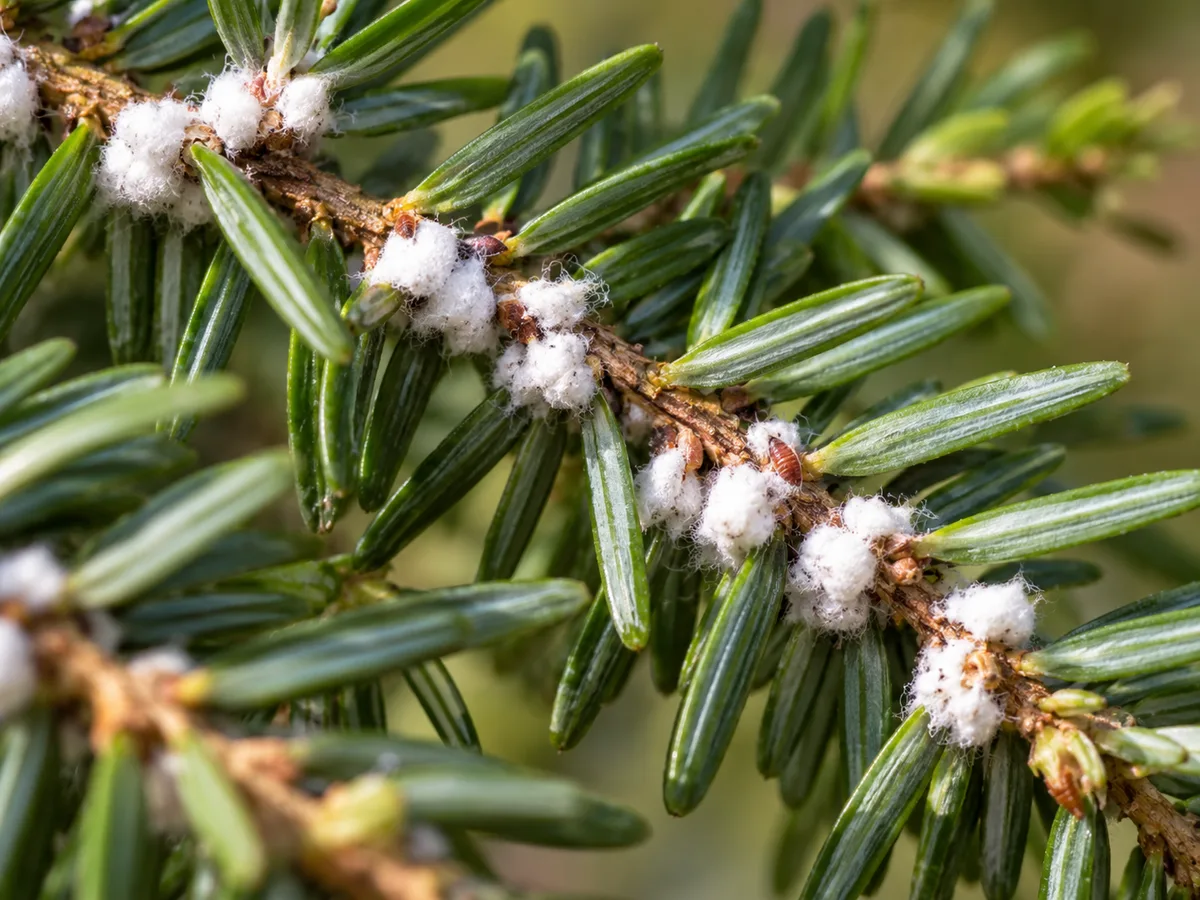
The white wax can remain on a twig after insects are dead, so its presence alone does not tell you whether a treatment is needed or whether a past treatment worked. Virginia Tech’s hemlock woolly adelgid fact sheet explains the life cycle and characteristic cottony masses. Penn State Extension’s current HWA guidance also cautions that the waxy sacs can persist and describes regional damage. Check local timing and identify live insects before treating.
What to look for and when to call
Once or twice a year, inspect twigs with a hand lens or take clear close-up photos for your extension office. Look for cottony sacs at needle bases, needle yellowing or gray-green color, shortened new growth, and dieback that begins on lower branches. Also check for elongated scale on the underside of needles and for spider-mite stippling; several pests and environmental stresses can look similar at a distance. Compare a suspect branch with healthy growth elsewhere on the same tree.
If you find likely HWA, confirm the identification with your state or provincial extension service and ask what products and application windows are currently appropriate for your tree’s size and location. Horticultural oils and systemic products are used in some landscapes, but full coverage, tree size, pollinator timing, proximity to water, local registration, and label directions all matter. Do not mix or apply an insecticide based on an old online rate. A large tree, an infestation high in the canopy, or a tree beside a stream or well is a job for a qualified arborist or licensed applicator. If the tree is severely declining, ask whether treatment has a reasonable chance of preserving it before investing in repeated applications.
Prevent Deer Damage and Diagnose Browning
Canadian hemlock is not reliably deer-proof. Deer browse the foliage, and young trees can lose their terminal leader or several years of growth if browsing repeats. If deer are common, place a sturdy cage around the whole young plant with enough room for the branches to expand, and check that the barrier has not rubbed or become trapped in the foliage. A short trunk guard protects bark but does not stop deer from eating the crown. Repellents may reduce light browsing, but they need reapplication and are not dependable when animals are hungry. The USDA Forest Service documents deer browsing on eastern hemlock; a recent Michigan State University Extension response specifically warns that deer may eat young landscape hemlocks.
When foliage browns, look at where the change begins before you water or spray. Browning on the sunny or windward side after a hot or exposed period suggests heat, drought, or winter desiccation; brown roots or persistent wetness point toward drainage trouble. White woolly masses at needle bases raise concern for HWA, while bronzing and fine stippling may indicate mites. Older interior needles can shed as the tree renews foliage, but current-year tip growth, a branch, or an entire side of the crown turning brown deserves closer attention.
Check soil moisture several inches down at more than one point, inspect the undersides of twigs, and note whether the damage is limited to old inner needles or affects new tips. Also consider recent changes: trenching, paving, lawn herbicide, road salt, downspouts, construction, or removal of a windbreak. A tree that turns brown after a severe drought may not recover just because the soil is wet again. If browning spreads quickly, roots are exposed, the leader dies, or large branches are dropping, have an arborist assess the tree before making major cuts.
Grow from Seed, Cuttings, or in a Container?
You can propagate eastern hemlock, but buying a correctly identified nursery tree or cultivar is usually the sensible route for a home landscape. Seedlings grow slowly and may not match a named cultivar. Collect cones as they mature and begin to open in fall, then keep the seed from drying out. The USDA Forest Service’s silvics account notes that seed needs a period of chilling and has variable viability; North Carolina State Extension recommends moist chilling before sowing. Sow more than one seed, keep the medium evenly moist rather than saturated, and protect emerging seedlings from drying sun and competition. Expect a long wait before a seedling becomes a landscape-size tree.
Semi-ripe cuttings taken in late summer or early fall can root under controlled conditions, but success is less predictable without humidity control, clean tools, and patience. The RHS species guide recognizes both seed and late-season cuttings as propagation options. Take cuttings only from a plant you have permission to propagate, label the cultivar, and understand that a cutting from a grafted or unusual specimen may root slowly or fail. If you need a particular habit or color, purchase the named cultivar instead of hoping a seed reproduces it.
The species is not a practical permanent container tree. A pot restricts the root system, dries faster than garden soil, and cannot accommodate a 40- to 70-foot tree. A dwarf cultivar may spend time in a large nursery pot, but it still needs a long-term planting plan and consistent moisture. Bonsai is a specialist exception that requires root pruning, winter protection matched to the climate, and frequent watering; it is not a low-maintenance way to keep a landscape hemlock small.
Conclusion
Canadian hemlock is a strong choice for a spacious, cool, moisture-retentive site where shade-tolerant evergreen structure is useful. Give the full species its mature footprint, or choose a verified dwarf cultivar for a smaller garden. Plant with the root flare at grade, protect the root ball from drying while it establishes, and avoid fertilizer unless a soil test identifies a need.
After establishment, care is mostly observation: water during long dry spells, preserve a broad mulch ring, prune lightly if you want a hedge, protect young trees from browsing, and scout for woolly adelgid. If the site is hot and dry, stays waterlogged, or sits in a high-risk pest area where you cannot monitor the tree, another evergreen may be a better fit.



