Cat Tunnel Christmas Tree Skirt: Safe Setup Guide
Learn how to use a cat tunnel Christmas tree skirt, secure the tree, protect cords and ornaments, and know when a tunnel is not enough.

If your cat treats the Christmas tree as a climbing wall, toy basket, and emergency lookout all at once, a cat tunnel Christmas tree skirt is an appealing idea. It places a soft, enclosed play space at the exact spot your cat already wants to investigate instead of asking you to win a daily argument with a curious animal.
The important distinction is that a tunnel is redirection, not a safety device. It may satisfy a cat who wants to hide, pounce, or patrol at floor level, but it cannot stop a determined climber, stabilize a weak stand, or make tinsel and loose electrical cords safe. The best results come from combining the tunnel with a secure tree, low-risk decorations, protected wires, and supervision.
The short answer: a tunnel can redirect, not guarantee
A cat tunnel tree skirt is worth trying when your cat enjoys fabric caves, chasing through tunnels, batting at small toys, or resting under furniture. The circular design gives the cat a defined route around the base of the tree, while openings and hanging toys make the space more interesting than a plain piece of fabric.
It is less promising for a cat whose main goal is height. If your cat ignores floor toys and heads straight for the top branches, the tunnel should be one layer of a larger plan, not the only intervention. A gate, a closed room, a smaller tree, or no accessible tree may be the safer choice.
Think of the product as a holiday version of an enrichment station. You are giving the cat a legal place to investigate while removing the most dangerous invitations from the tree itself. That change in the environment is more realistic than expecting a cat to understand that ordinary play behavior is suddenly forbidden for one month.
Why cats treat Christmas trees like playgrounds
A new tree changes the room’s height, scent, texture, and traffic pattern. Real branches smell different from the rest of the home, artificial branches create a dense thicket, and dangling ornaments move whenever a cat touches them. From a cat’s perspective, the tree combines cover, movement, elevated footing, and objects that react to a paw swipe.
The tree base is attractive for a different reason: it creates a dark, sheltered pocket. A cat may be seeking privacy rather than trying to destroy your decorations. A hiding place can be useful enrichment, but its location beside a loaded tree also puts the cat close to needles, wires, glass, and anything that falls from the branches.
That is why the right question is not simply, “How do I keep my cat away?” Ask instead, “Which part of the tree is meeting a need, and can I meet that need somewhere safer?” A tunnel addresses ground-level hiding and chase. A cat tree or window perch addresses height. A wand session addresses stalking and pouncing. Often you need two outlets, not one.
What a tunnel tree skirt actually changes
The tunnel changes the base from an empty gap into a predictable destination. A cat can enter, circle, pause, and leave without needing to push through lower branches. If the tunnel has a peekaboo opening or a soft hanging toy, it also gives you a way to start play away from the ornaments.
There is a sound welfare reason to value that enclosed space. In a study of 43 shelter cats, hiding enrichment was associated with lower stress, more approach behavior, and more relaxed behavior than an open bed. The study was conducted in a shelter, not a decorated living room, so it does not prove that a tree skirt will prevent climbing; it does support the broader idea that a cat benefits from having an effective place to hide. The Animal Welfare study is useful evidence for the enrichment principle, not a product endorsement.
The tunnel also changes your response. Instead of repeatedly lifting your cat out of the tree, you can toss a toy through the tunnel, reward a pause inside it, and make the safe option part of the holiday routine. That lowers the chance that every interaction with the tree becomes an exciting chase game.
Check these safety basics before adding the skirt
Before buying or unfolding a tunnel, inspect the whole tree setup. A soft product at the base can hide the stand, catch loose needles, or make it harder to notice that the tree is wobbling. Keep the tunnel clear of the tree’s moving parts and make sure the cat can exit from more than one direction.
Use this order of operations:
- Choose the most stable location and stand you can manage.
- Anchor the tree if a cat could climb, leap, or bump it.
- Remove tinsel, ribbon, fragile glass, exposed hooks, and chewable hanging pieces.
- Route and protect every cord, light wire, and battery pack.
- Place the tunnel and test whether it stays flat and open.
- Decorate only after the cat has had time to investigate the bare tree.
The Humane Society of Huron Valley recommends creating a safe, cat-friendly space near the tree with beds, toys, and feeding puzzles. A tunnel can fill part of that role, but it should sit inside a wider safety plan rather than disguise a risky base. Its Christmas-tree guidance is especially helpful for pairing a safe outlet with anchoring and decoration changes.
Anchor the tree before you invite play
A tunnel can make the base more attractive, and a cat may sprint through it or use the openings to launch a chase. Stabilize the tree before encouraging any activity around it. Use a sturdy stand on a level surface, keep the tree away from furniture that acts as a launch pad, and tether the upper portion to a wall when the location and wall hardware allow it.

The tether should prevent a tip, not restrain the cat. Keep the line taut enough to limit movement while avoiding loops at paw or neck height. Follow the stand and wall-anchor hardware instructions, and check the connection after the first few days because a tree can shift as branches settle.
If you cannot anchor the tree without damaging the wall, choose the most stable smaller tree available and keep it in a room that can be closed. A short tree still needs a solid base; “small” reduces the consequences of a fall but does not remove the risk.
Remove the decorations cats can swallow or break
A tunnel does not make lower branches safe for ornaments. Shiny, dangling objects are easy for a cat to bat, drag, or bite, and a broken ornament can cut paws or create sharp pieces that are tempting to investigate. Use soft, wooden, or sturdy plastic decorations on the lower half, and reserve fragile or sentimental ornaments for a higher, less reachable area.

Skip tinsel and loose ribbon. String-like decorations can be swallowed and become a dangerous linear obstruction, and a cat pulling on a strand may also tug the tree. PetMD explains the intestinal-blockage risk of tinsel and the electrical risk of chewed light cords in its Christmas-tree safety guidance for cats. Those are not aesthetic concerns; they are reasons to remove the decoration entirely.
Use secure fasteners rather than thin metal hooks that can fall to the floor. Check for small bells, beads, sequins, and detachable parts that could come loose. If your cat mouths everything, a mostly undecorated tree with ornaments displayed elsewhere is a responsible design choice, not a failure of holiday spirit.
Keep cords, lights, and batteries out of reach
Route light strings toward the trunk and push them into the branches so they are harder to reach. Cover the cord from the tree to the outlet with a pet-resistant protector or a physical barrier, and inspect it daily for tooth marks. Unplug lights whenever the room is unattended if your cat has shown any interest in chewing wires.
Do not leave loose battery packs, remote controls, or button batteries beneath the tree. A tunnel’s openings can make a battery-powered toy convenient to play with, but the battery housing must stay closed and inaccessible. If a toy is cracked, frayed, or shedding a small part, retire it immediately.
PETA’s cat-proofing advice recommends keeping lights toward the tree’s center, protecting the plug-end cord, and removing lights if a cat chews them. A tunnel is a distraction; it is not permission to leave a known chewing hazard within reach.
Put the tunnel down before the ornaments go up
Introduce the cat tunnel Christmas tree skirt while the tree is still bare. Lay it flat, open every exit, and let your cat inspect it without pressure. Some cats walk through immediately; others need the tunnel to sit in a familiar room for a day before it becomes interesting.
Avoid pushing your cat inside or blocking an exit to create a photo. Forced exposure can make the tunnel feel like a trap, especially for a timid cat or a multi-cat household where another pet may guard the opening. Let the cat choose when to enter and leave.
Once the tunnel is being used calmly, place it around the tree base but not over the stand, water reservoir, or power connections. Leave a clear gap so you can see the stand and clean fallen needles. If the fabric bunches under a leg of the stand or slides on a smooth floor, it is not ready to use there.
Turn the skirt into a real enrichment station
The tunnel works best when it offers more than a hiding hole. Put a scratcher or cardboard pad nearby, rotate one or two safe toys, and schedule a short wand-play session before the cat’s usual high-energy period. A small puzzle feeder can make the area rewarding, but keep food away from tree water, fallen needles, and electrical connections.
Use the tunnel’s two entrances to create movement without tying a toy to the tree. Roll a lightweight ball through it, drag a wand past one opening, or hide a few pieces of the cat’s normal food in a puzzle toy beside it. Stop the game while the cat is still interested; the goal is to make the station reliably pleasant, not frantic.
For cats that crave height, place a stable cat tree, shelf, or window perch in the same room but not close enough to become a launch platform. A tunnel and a perch meet different needs. Modern Cat’s holiday guidance quotes a cat expert describing trees as appealing because they offer novelty, climbing, hiding, scratching, and play, then recommends giving those instincts a safer outlet. That enrichment approach is more useful than trying to suppress every natural behavior at once.
Redirect in a way cats understand
When your cat approaches the tree, do not turn the moment into a loud chase. Call the cat away, move a toy through the tunnel, or begin a short play sequence at the safe station. When the cat chooses the tunnel, scratcher, or perch, offer calm praise or a small food reward.
The timing matters more than the volume of the reward. Reinforce the choice within a few seconds so the cat can connect the reward with the safe location. If you only reward the cat after it has climbed halfway up the tree and you carry it down, the entire climb may become the most stimulating part of the routine.
Repeat the same response every time. One family member allowing the tunnel to become a wrestling ring while another uses it as a quiet bed makes the rule unpredictable. Keep the alternative fun, keep the tree boring, and use a gate or closed door when you cannot supervise rather than relying on training alone.
Read the first 48 hours honestly
Watch the cat’s behavior after the tunnel is placed under the tree. The setup is working when the cat spends time resting, passing through, or playing at floor level without pulling branches, chewing cords, or striking ornaments. A little investigation is normal; escalating activity is useful information.
Remove or reposition the tunnel if your cat uses its openings as a springboard into the lower branches. You can place it several feet away, orient the openings away from the tree, remove hanging toys that increase arousal, or switch to a quiet bed and a separate play session. The goal is not to prove that the product works in its original position.
Also watch the fabric. Loose threads, ripped seams, exposed wire, and detached bells are reasons to stop using it. Washable fabric is helpful, but follow the care instructions and dry it fully before returning it to the tree area. A damp or heavily furred tunnel can smell attractive to one cat and unpleasant to another.
Match the setup to your cat’s play style
For a cat who loves hide-and-seek, choose a tunnel with two unobstructed exits and enough width for the cat to turn around. For a large cat or a pair of cats, check the internal dimensions and avoid a narrow tunnel that forces one cat to corner another. A tunnel with a crinkle sound may excite a young cat but annoy a noise-sensitive senior.
Kittens need closer supervision because they are more likely to chew fabric, climb the tree, and swallow small pieces. Older cats may prefer a low, padded bed with an easy step-in opening rather than a flexible tube. A nervous cat should have an additional quiet hiding spot away from the tree so the tunnel is an option, not the only refuge during a busy holiday gathering.
Consider your own routine too. If you cannot inspect the tunnel, tree, and cords each day, pick a simpler setup. The most attractive tunnel is not the right choice if its hanging toys, seams, or collapsible frame create more maintenance than you can reliably provide.
Real or artificial tree: what changes
Artificial trees remove the need to manage fallen needles and a water reservoir, but they are not automatically cat-safe. Plastic or aluminum pieces can still be chewed, flocking can be irritating or unsafe if ingested, and the tree can still tip. Choose a stable model without loose decorative material and keep the tunnel away from any exposed support parts.
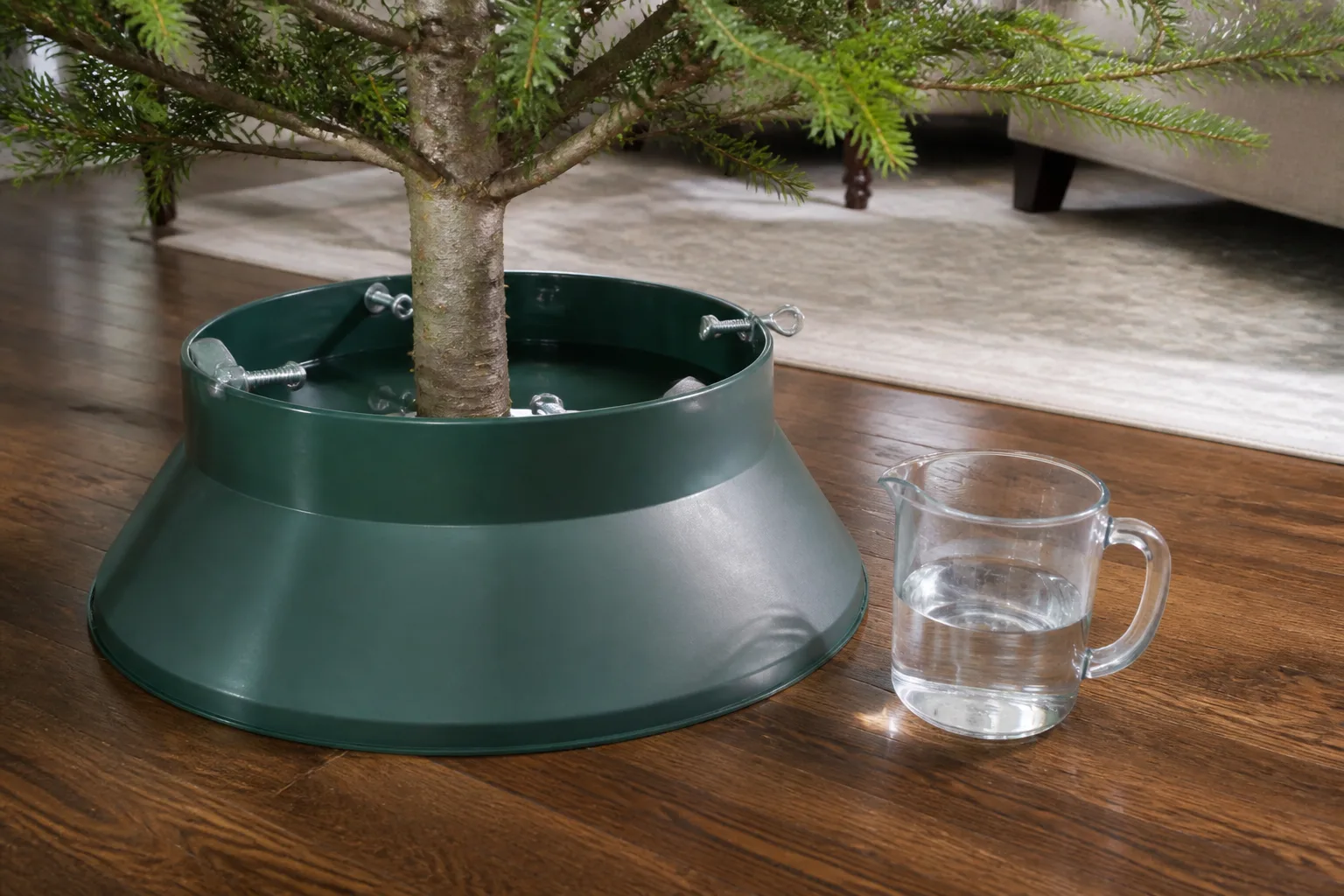
Real trees add two management tasks: fallen needles and water. Sweep needles promptly, cover or block the water reservoir, and do not add fertilizer, preservatives, sugar substitutes, or other products unless a veterinarian confirms they are safe for your cat. Daily Paws notes that tree additives can contain ingredients that are harmful to pets and recommends preventing access to the water; its cat-proofing guide also covers stable stands and decoration placement.
The PetMD guidance above notes that fir, spruce, and pine needles can irritate the mouth and digestive tract, and that larger ingestion can create a serious obstruction risk. If your cat eats needles, tinsel, ribbon, or a piece of an ornament, contact your veterinarian or a pet poison service for advice instead of waiting for symptoms.
Holiday plants deserve the same caution. Keep lilies, mistletoe, holly, and other plants away from cats, and verify every seasonal plant against the ASPCA toxic and non-toxic plant list for cats. A cat tunnel cannot compensate for a poisonous plant placed beside the tree.
Set nighttime and unsupervised rules
The tunnel is most useful when you can see how your cat uses it. At night, during a party, or whenever you leave home, close the tree room or use a barrier that your cat cannot jump over. Turn off lights and keep the tree inaccessible if your cat has a history of chewing or climbing.
Do not assume a calm first evening predicts the whole season. Holiday visitors, wrapped gifts, moved furniture, and new scents can restart the investigation. Keep the tunnel available, but keep your fallback plan available too: a closed door, a gate, or a temporary tree-free room.
If you use gifts beneath the tree, skip loose ribbon, dangling bows, and edible treats that your cat can open. Presents can turn a previously unreachable lower branch into a launch step. Place fragile gifts elsewhere until the cat’s behavior is predictable.
Know when a tunnel is not enough
Stop treating the tunnel as the solution if your cat repeatedly climbs, bites, swallows, or topples things despite redirection. It is also not enough when the tree cannot be anchored, the cat has a strong history of cord chewing, or another pet blocks the tunnel exit.
Use a gate or closed room when there is a genuine injury risk. Remove the tree if the cat continues to ingest needles, water additives, tinsel, or branches. Contact a veterinarian promptly for suspected ingestion, electrical injury, breathing trouble, burns, vomiting, repeated swallowing motions, or signs of pain.
Behavior changes can have a medical cause, especially if a usually settled cat becomes unusually restless, vocal, or destructive. The holiday setup may be the trigger, but it is not always the whole explanation. A qualified veterinary professional can help distinguish normal novelty-seeking from a health or anxiety problem.
Use the tunnel after the holidays
One advantage of a neutral-colored tunnel is that it does not need to disappear when the tree does. Clean it, inspect every seam, and store it dry in a breathable container. Keep it in the cat’s normal rotation with a scratcher, bed, and other toys so it remains familiar rather than becoming a once-a-year novelty.
After the decorations are gone, you can reshape a flexible tunnel into a short passage or a bed if the design allows it. Follow the product’s instructions and remove any middle piece or connector that is not firmly attached. Check the fabric each time you change the shape; folds and tension can expose a frame or create a weak seam.
The bigger lesson carries into other seasonal changes. When a cat is drawn to a new object, identify whether the attraction is height, hiding, movement, scent, texture, or attention. Provide a safer version of that feature, then remove the specific hazards rather than relying on a single deterrent.
Conclusion: give your cat a safer holiday job
A cat tunnel Christmas tree skirt can be a clever part of a cat-safe holiday setup because it turns the tree’s base into an approved place to hide and play. It is most likely to help when you introduce it before decorating, make it rewarding, and pair it with another outlet for cats that want height or intense chase.
Anchor the tree, skip tinsel and loose ribbon, protect cords, cover real-tree water, remove fallen needles, and supervise the first days closely. If the tunnel becomes a launch pad or your cat remains fixated on the tree, change the layout or block access. The win is not a perfectly untouched tree; it is a holiday room where your cat has a safer job and fewer ways to get hurt.