Ceramic Christmas Trees: The Nostalgic Decor Trend
Ceramic Christmas trees are back. Learn the history, choose vintage or new, match the size and color to your room, and use lighted trees safely.
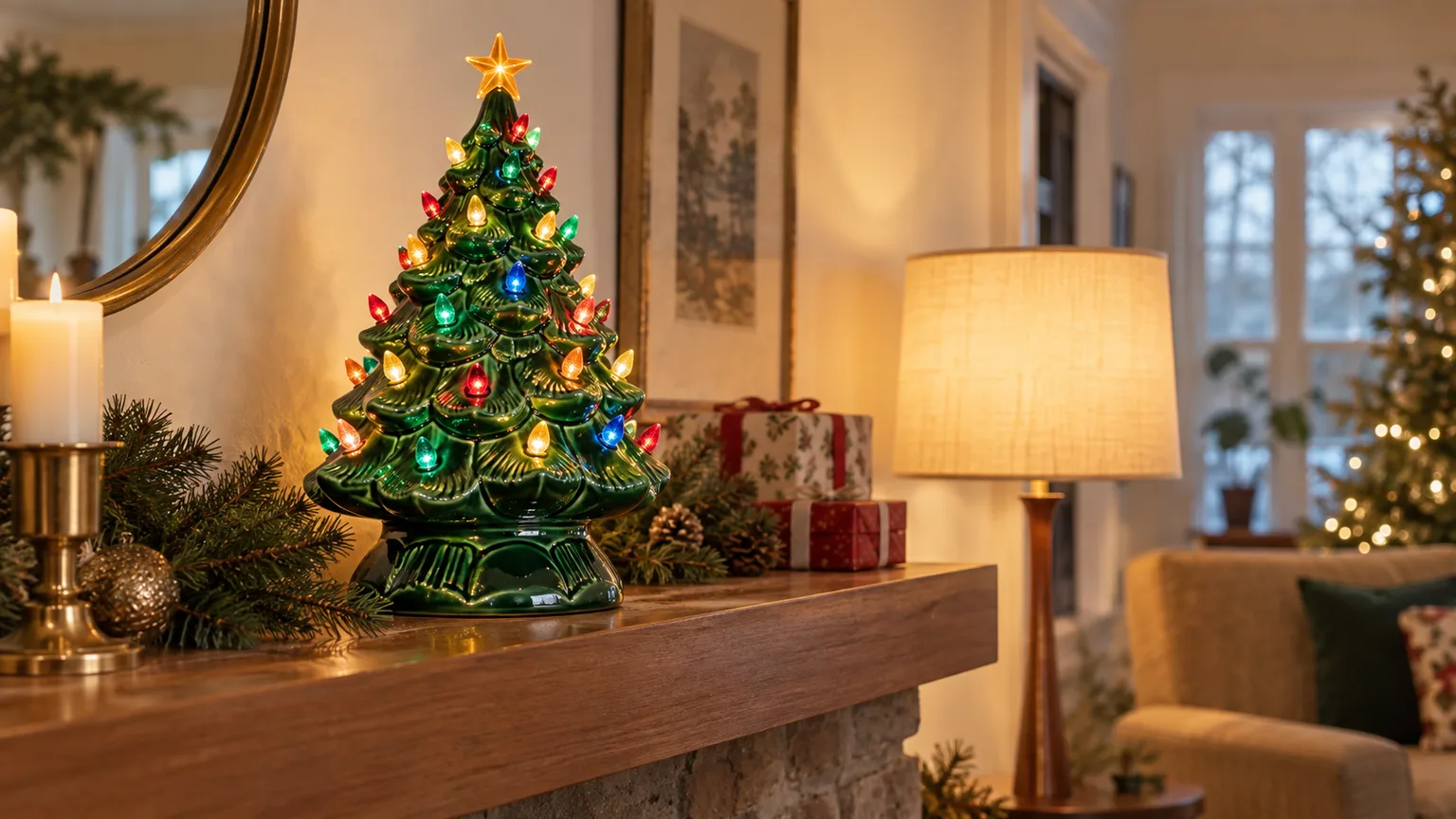
A ceramic Christmas tree is a little holiday time machine: glazed pottery, jewel-like bulbs, and a star topper that can make a room feel instantly more familiar. The best versions do more than repeat a retro look. They give you a small, durable focal point for a mantel, console, windowsill, or dining table without requiring a full-size tree.
The practical distinction matters, though. A vintage tree may have wonderful glaze variation and family history but uncertain wiring. A new tree offers more predictable parts and finishes, while a handmade tree may give you the most personal color and shape. Choose the object first, then decide where it belongs, how it should glow, and how you will protect it when the season ends.
Why ceramic Christmas trees are back
Ceramic Christmas trees are back because they sit at the intersection of two strong decorating impulses: nostalgia and small-scale living. They look festive without taking over a room, and their built-in glow means they can act as both a sculpture and a light source. That makes them useful in an apartment, a home with a large main tree, or a space where you want one more holiday moment without another tangled strand of lights.
The renewed interest is not just a vague memory of “something Grandma had.” Better Homes & Gardens describes the form as a 1960s and 1970s staple and reported that searches for ceramic Christmas trees had risen substantially over the previous decade in its updated trend coverage. CBC News also documented a contemporary ceramic maker whose rainbow of trees drew repeat customers and seasonal demand. Those reports point to a real revival, but they do not mean every old tree is rare or every new one is a collectible.
A short history of the classic shape
The American Ceramic Society traces ceramic Christmas trees to handcrafted examples that appeared as early as the 1940s, followed by a wider spread of mold-made versions in the 1960s and 1970s. Its history also notes the importance of Atlantic Mold Company’s A-64 design, associated with a 1958 copyright, and explains how craft classes made it possible for people to cast, fire, glaze, and light their own trees.
That background explains the look people recognize today. Early and handmade trees could have individually placed bulbs, while later lighting changes made it possible for one internal bulb to illuminate the colored plastic lights from inside the ceramic shell. The silhouette stayed simple, but the making process allowed endless variation in glaze, glitter, bulb color, topper, and size.
The craft story is still alive. In its CBC News profile, ceramic artist Edna Meisner described a process that includes filling molds, cleaning and drying the clay, firing it in a kiln, and waiting for the kiln to cool before opening it. A handmade tree is not disposable seasonal filler; it is a small piece of pottery whose imperfections may be part of its appeal.
Decide which kind of ceramic tree you want
Before comparing colors, decide how much uncertainty and maintenance you are comfortable with. There are three useful categories: vintage, newly manufactured, and handmade contemporary. None is automatically better; they simply solve different decorating problems.
Vintage trees: character with more uncertainty
A vintage ceramic Christmas tree is the choice when the story matters as much as the shape. Look for a glaze you genuinely like, a stable base, a complete or replaceable star, and bulb openings that are not chipped around the edges. Ask for clear photos of the underside, cord, plug, light socket, and any maker’s mark before buying online.
Treat a vintage electrical assembly as an inspection project, not a bonus. A ceramic body can survive decades while its cord, socket, insulation, or plug ages in less visible ways. If the wiring is brittle, cracked, hot to the touch, loose, or visibly modified, keep the tree unplugged until a qualified repair professional has assessed it—or use the tree as an unlit object.
Do not buy a vintage tree solely because a date or mold number sounds old. The American Ceramic Society explains that a date connected with a mold design may not tell you when a particular finished tree was made. Condition, completeness, maker, provenance, and actual buyer demand matter more than a single number stamped into the ceramic.
New trees: predictable finishes and lighting
A new ceramic Christmas tree is usually the better fit when you want the classic silhouette but need a dependable, easy-to-understand display. You can choose the height, finish, bulb palette, cord length, and power method before the tree arrives. Some current versions are glossy green with multicolor bulbs; others use white, pastel, metallic, or glittered finishes for a quieter room.
Read the product instructions rather than assuming every new tree is built the same way. Check whether the bulbs are removable, whether replacements are included or available, whether the light source is LED or incandescent, and whether the item is rated for indoor use only. A battery-operated tree can solve a cord problem on a shelf, but it still needs a stable base and a battery compartment kept dry and intact.
Handmade trees: the personal-story option.
Handmade trees sit between inherited vintage decor and predictable retail decor. The glaze may be one-of-a-kind, the color may be custom, and the piece may carry a story about a local potter or a holiday market. CBC’s profile of a long-running ceramic maker is a good reminder that modern handmade trees can be made through the same mold, kiln, and finishing steps that gave older trees their character.
Ask the maker how the lights are installed and what happens if a bulb or cord fails. Also check the base diameter and total height instead of relying on a photo. Handmade pottery can vary from one piece to the next, so a tree that looks compact in a listing may need more shelf depth than you expect.
Match the tree size to the room
Measure the place where the tree will live before you fall for the tallest or most elaborate version. Record three dimensions: the usable width, the depth from the front edge to the wall or window, and the height below shelves, mirrors, cabinets, or artwork. Then leave space for the cord to reach an outlet without crossing a walkway or being pinched.
Tabletop and windowsill scale
Small trees are the most versatile. A compact piece can sit on a bookshelf, a kitchen counter that is away from splashes, a bedroom dresser, or a broad windowsill. Use a tray under the base if the surface is delicate, and keep the tree far enough from the glass that the cord does not get trapped when the window is opened or closed.
For a tiny room, choose one tree with a strong silhouette instead of several miniatures scattered across every surface. A small tree also works well as a nightlight-like accent, but do not let the cozy glow encourage you to leave an uncertain vintage cord running while you sleep. Turn it off and unplug it when you leave the room unless the manufacturer provides a safe, purpose-built timer or automatic shutoff.
Mantel and console scale
A mantel or console gives a ceramic tree enough visual space to feel intentional. The tree can be the tallest element in a small arrangement, with greenery, a shallow bowl, or a few ornaments kept lower and farther from the plug. If the tree sits on a mantel, confirm that its base is stable and that no part of the cord rests against a hot surface or runs behind a fireplace opening.
On a console, use the wall behind the piece as breathing room. One large tree looks polished when its base is visible; two trees can work if they are different heights and the rest of the surface stays quiet. Avoid placing a fragile ceramic piece where a door, curtain, pet, or passing shoulder can knock it down.
Choose a color and lighting style
The tree’s color and bulbs determine whether it reads as a family heirloom, a modern accent, or a playful collectible. Start with the colors already in the room, then choose whether you want the lights to blend with them or deliberately interrupt them.
Classic green with multicolor bulbs
Glossy green with red, yellow, blue, and green bulbs is the unmistakable vintage combination. It works best when the surrounding decor is restrained: natural evergreen, brass, wood, red ribbon, or a few ornaments are enough. If you surround it with every other bright holiday color, the tree can lose the visual authority that makes its simple shape so charming.
Use the multicolor bulbs as the accent and repeat only one or two of those colors nearby. A red ribbon on a gift or a blue glass ornament on the opposite side of the mantel can make the display feel connected without turning it into a themed set.
White, pastel, metallic, and warm-white versions.
White ceramic trees are easier to blend into a modern room, especially when paired with warm-white bulbs, wood, linen, or greenery. Pastel trees—pink, pale blue, or soft mint—can bring back the playful side of the tradition without requiring a fully retro interior. Metallic or glittered finishes are more reflective, so give them space away from competing shiny objects.
Warm-white lighting makes a tree feel candlelike, while multicolor lighting makes it more animated and nostalgic. Neither is universally right. In a calm bedroom or neutral dining room, warm white may be easier to live with; in a family room where the goal is cheerful color, multicolor bulbs are part of the point.
Build a display that feels collected, not cluttered
The easiest way to make a ceramic tree look current is to give it a clear job. Let it be a focal point, make it one member of a small group, or lower it into a centerpiece that leaves room for people and food. The mistake is not using too much nostalgia; it is making the tree compete with too many unrelated objects.
One tree as a focal point
Put one tree on a clean surface and add only one supporting texture. A sprig of evergreen, a brass candlestick kept unlit, a stack of vintage-looking books, or a shallow wooden tray can provide enough context. The tree should remain visible from the main approach to the room, with its cord routed behind the display rather than looped across the front.
This formula is ideal for a small apartment or a home that already has a full-size Christmas tree. The ceramic tree supplies a second holiday glow in a location the large tree cannot reach, such as an entry console, kitchen shelf, or home office.
A group of three
Three trees create a miniature forest, but they need variation. Combine one tall tree with two shorter trees, or repeat the shape in three finishes—green, white, and pink—while keeping the surrounding props nearly identical. The group should have a visual center and enough empty space between bases that each tree can be dusted, unplugged, and lifted without knocking its neighbor.
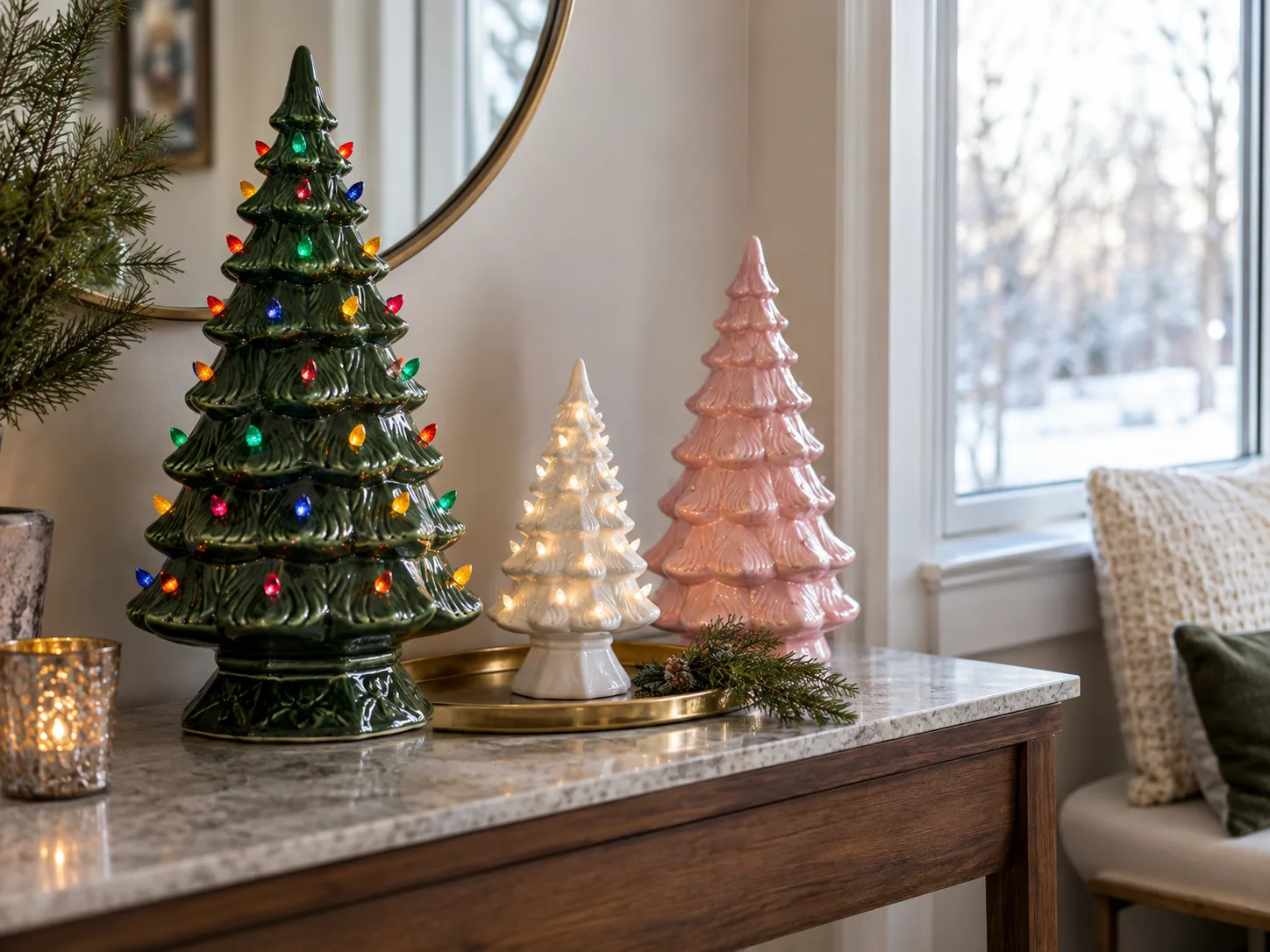
Use a tray only when it helps you move the display safely. A heavy ceramic group can become awkward if the tray flexes or if you have to carry it by one edge. If the trees have separate cords, plug them into a safe setup rather than bundling several damaged or unknown cords together behind the scene.
A low holiday centerpiece
A ceramic tree can anchor a dining table if it is low enough to preserve conversation and far enough from the table edge to avoid a sleeve or serving dish. Place the tree on a stable tray, then ring it with a small amount of greenery or pinecones. Keep the decoration loose around the base so the switch, cord, and plug remain accessible.
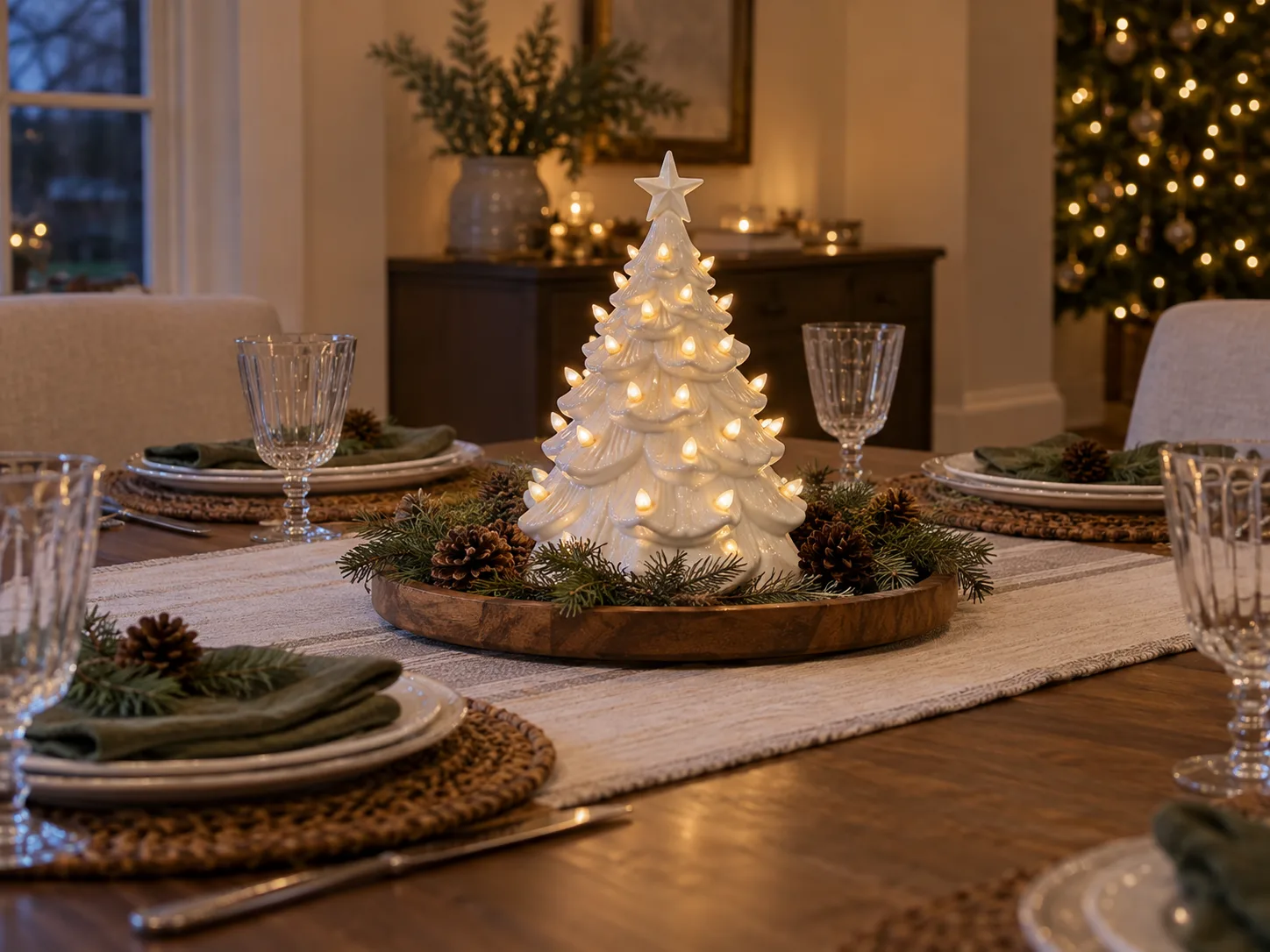
Test the display from a seated position before dinner. If you cannot see the person across from you, move the tree to a sideboard or choose a shorter version. Avoid open flames around any lighted tree, and keep dry greenery, paper accents, and fabric napkins away from hot bulbs and electrical parts.
Check wiring and placement before plugging it in
The most important care step is also the least glamorous: inspect the electrical parts before you enjoy the glow. The National Fire Protection Association reports that electrical distribution or lighting equipment is involved in a substantial share of home Christmas-tree fires, and it emphasizes the role of heat sources and lighting in holiday fire risk. A small ceramic tree is not the same as a full-size tree, but its cord and light source still deserve attention.
Indoor and outdoor safety boundaries
For an indoor tree, inspect the cord, plug, socket, switch, and bulb openings. Do not use a piece with cracked insulation, loose connections, exposed wire, a scorched plug, or a socket that wobbles. The Electrical Safety Foundation International recommends inspecting electrical decorations, avoiding overloaded outlets, protecting cords from damage, looking for a certification label from an independent testing laboratory such as UL, CSA, or ETL, and turning decorations off and unplugging them when leaving or sleeping.
Keep the tree away from fireplaces, radiators, stovetops, heat vents, and candles. Never run a cord under a rug, through a closing door or window, or beneath a heavy piece of furniture. If a bulb or adapter becomes unusually hot, smells hot, flickers, or trips the circuit, unplug it and stop troubleshooting by guesswork.
Outdoor use is a separate category, not a casual extension of indoor decorating. Use a ceramic tree outside only when the product is explicitly rated for outdoor or wet-location use, the power components match that rating, and the outlet has appropriate GFCI protection. NFPA advises inspecting outdoor lighting for damaged sockets and cracked cord covers and notes that outdoor receptacles require GFCI protection; if the listing says indoor use only, keep it indoors.
Store the tree so it can glow again next year
Storage is where many ceramic trees are saved or lost. Turn the tree off, unplug it, and let the light source cool before moving it. Remove loose bulbs or the topper if the design allows, wrap each part separately in acid-free tissue or soft packing paper, and fill empty space in the box so the tree cannot shift when it is carried.
Do not store the tree in a damp basement, an unheated shed, or an attic that swings from freezing to extreme heat if you have a better option. Ceramic can chip when it knocks against another object, and moisture can be especially unkind to cardboard packaging, metal parts, and older electrical assemblies. Label the box with the tree’s parts and any replacement-bulb information so you are not guessing next November.
When you unpack it, check the base, glaze, topper, cord, plug, and light sockets before plugging it in. Dust the ceramic with a soft, dry cloth; do not soak a lighted tree or allow water to run into sockets, seams, switches, or the underside. A few minutes of inspection each season protects the part of the tradition you actually want to keep.
When a ceramic Christmas tree is the right purchase
Buy one when you want a contained seasonal focal point, enjoy a little visual personality, or have a family connection to the form. It is especially useful when a full-size tree would crowd the room, when you want holiday color on a mantel or console, or when you like decorations that can return to the same place every year.
Choose vintage if provenance and patina are more important than certainty. Choose new if you want to select the finish and lighting with fewer unknowns. Choose handmade if the maker’s process and the small differences in glaze are part of what you are buying. If you are drawn mainly by resale potential, slow down: prices vary widely, and a nostalgic object is not automatically a valuable one.
Before paying, run this short decision check:
- Fit: Can the base sit flat with room for the cord and a safe reach to the outlet?
- Use: Will the tree live indoors, or is the exact product rated for the outdoor conditions you have?
- Light: Are the bulb type, replacements, switch, and power source clear?
- Condition: Are the ceramic, topper, plug, socket, and cord free from damage?
- Style: Does the color support your existing room, or are you intentionally choosing contrast?
- Future: Can you pack every part safely and find replacements next season?
Conclusion
Ceramic Christmas trees feel current because they are more than a retro object. They are compact, expressive, and genuinely useful in the places where a full-size tree cannot go. Their history in craft studios and family homes gives them emotional weight, while today’s range of colors, finishes, and sizes makes the tradition easy to adapt.
Start with the tree that fits your room and your tolerance for uncertainty. Give it one clear visual job, inspect the electrical parts before plugging it in, keep heat and moisture away, and store it like pottery rather than disposable decor. Done that way, the glow is not just nostalgic—it is a small seasonal ritual you can safely bring back year after year.