Catalpa Tree Care: Planting, Pruning, and Growing Guide
Catalpas are tough but large, messy, and sometimes brittle. Match the species to your climate and get practical planting and care advice.
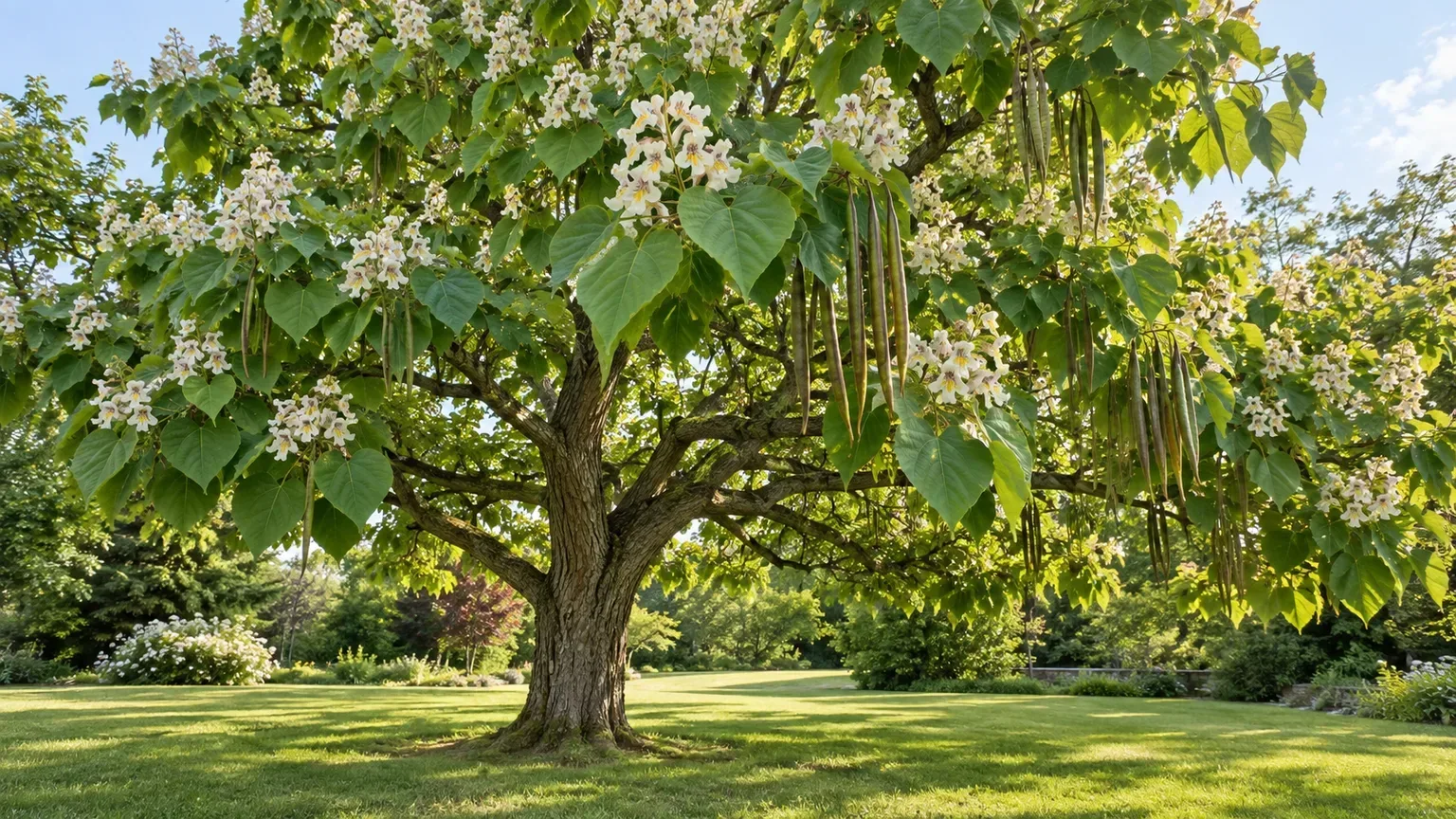
A catalpa can turn a sunny lawn into a generous patch of shade, with immense heart-shaped leaves and upright clusters of white, speckled flowers in late spring or early summer. Then come the long, cigar-like seed pods, a carpet of leaves, and—some years—a crop of hungry caterpillars. The tree is adaptable, but it is not a tidy fit for every yard.
Good catalpa care starts before planting: identify the species, check how large it gets in your region, and decide whether you can live with the litter and occasional branch loss. After that, give a young tree room, water it consistently while it establishes, and prune early to encourage a sound framework. An older catalpa often needs little routine attention, but “tough” does not mean immune to drought, poor siting, or repeated defoliation.
Is a catalpa the right tree for your yard?
Northern catalpa (Catalpa speciosa) and southern catalpa (C. bignonioides) are commonly grown as shade or ornamental trees. Northern catalpa is usually described as reaching roughly 40 to 60 feet tall with a 20- to 40-foot spread; it can be larger in favorable conditions. Princeton’s municipal forestry profile gives a similar 40- to 70-foot height and 30- to 40-foot spread, a useful reminder to plan for the full crown, not the lower end of a nursery tag (Town of Princeton Urban Forestry). Local growth varies with species, climate, soil, and care, so use the mature dimensions on the plant tag as a minimum planning guide rather than expecting a young nursery tree’s size to stay put. Oregon State University Landscape Plants lists northern catalpa as a broad, coarse-textured tree and notes that it is short-lived relative to many long-lived shade trees, with around 50 years considered above average.
That scale makes catalpa a better choice for an open lawn, park-like garden, or spacious edge than for a narrow foundation bed. Its canopy can shade a broad area, but limbs may be brittle, and wind or ice can break branches. The large leaves and persistent pods also create seasonal cleanup. Avoid planting where branches will hang over a roof, cars, a frequently used sidewalk, or overhead utilities. A mature tree planted too close to a house is an expensive problem to solve; a smaller tree species is usually the better choice if you have to keep pruning catalpa back to fit.
Catalpa can be valuable in a wildlife garden. Bees visit its flowers, and catalpa sphinx moth caterpillars feed on its leaves. Those caterpillars are not automatically a sign that the tree is failing; they are part of the food web. If you want an immaculate, insect-free canopy, however, catalpa may frustrate you. If you value shade and native wildlife and have room for natural form, those same characteristics can be an advantage.
Identify your catalpa species
“Catalpa” can refer to several related trees, not one uniform plant. Before applying a hardiness-zone recommendation or expecting a particular flower color, read the botanical name on the label. If you inherited the tree, compare leaves, flowers, pods, and local planting history, then ask a county extension office or certified arborist when a confident identification matters.
Northern and southern catalpa are not interchangeable
Northern catalpa (Catalpa speciosa) is native to parts of the central and eastern United States and is the hardier of the two common U.S. species in the NC State Extension Plant Toolbox. It bears large leaves and white flowers marked with yellow and purple, typically blooming in late spring to early summer. Its seed pods are long and narrow; they may hang on into winter. Regional guides give slightly different mature dimensions because site and climate change growth, so plan for a large tree rather than relying on the low end of a range.
Southern catalpa (C. bignonioides) is native to the southeastern United States. It shares the general shape and showy white flowers, but the two species are not identical. NC State notes that crushed southern catalpa foliage has an unpleasant odor, while northern catalpa leaves have a greener smell; flower markings and seed-wing shape also differ. Those details can help with identification, but a nursery label or regional tree guide is more reliable than one leaf alone.
Hardiness information should follow the species, not the common name. Northern catalpa is listed as hardy to USDA Zone 4 by Oregon State University. Do not assume that the more cold-sensitive southern species or a less common species has the same winter tolerance. In a region outside the tree’s native range, confirm both winter hardiness and whether it reseeds or naturalizes locally before planting.
Chinese catalpa and other species
Chinese catalpa (C. ovata) is another ornamental species, with pale yellow flowers rather than the white flowers typical of the two common North American species. Haitian catalpa (C. longissima) is sometimes listed in garden references and is adapted to warmer climates. Not every species is widely available, and labels can be imprecise; if flowers, climate tolerance, or mature size are important to your decision, verify the Latin name with the seller.
Choose a site with room for the mature canopy
Select the location for the tree it will become, not the small potted specimen you bring home. Allow room for a broad, irregular crown and for the trunk and limbs to thicken. Keep it well away from power lines, buildings, narrow driveways, underground utilities, and pavement where fallen pods or leaves would be a chronic nuisance. Catalpa has a reputation for self-seeding in suitable conditions. If seedlings would be unwelcome in nearby beds or natural areas, remove seed pods before they open and pull young volunteers while they are small.
The tree tolerates a surprisingly broad range of soil textures and moisture once established, but that adaptability should not be mistaken for an ability to thrive in any site. A location that stays waterlogged, has compacted construction fill, or bakes dry through a long hot season can limit root development. Choose a site with enough soil volume, decent drainage, and sun; a low area that drains after rain can work, while a basin that remains saturated for days may not.
Consider nearby mature trees, too. Catalpa’s coarse leaves cast substantial shade, which can suppress sun-loving lawn or border plants beneath it. Roots will occupy soil around the tree as the crown expands. Keep the trunk flare visible and avoid planning a formal, shallow-rooted bed that requires frequent digging around the base.
Planting a catalpa tree
In most regions, plant in spring or fall when the ground is workable and temperatures are mild. Spring planting gives roots a growing season before winter; fall planting avoids summer heat but should leave enough time for roots to settle before the ground freezes. In hot-summer areas, avoid transplanting during heat waves. For container-grown trees, follow your regional extension guidance and nursery label if the local climate or soil changes the usual timing.
Planting steps for a young tree
- Call the utility-locating service before digging, then choose a spot with the mature tree’s canopy in mind.
- Water the container tree before planting. Slide it out carefully and loosen only circling roots; avoid pulling or lifting it by the trunk.
- Dig a hole two to three times as wide as the root ball and no deeper than the root ball. In heavy soil, keep the bottom firm so the tree will not settle below grade.
- Find the root flare—the widened base where the trunk transitions into major roots. Set it at or slightly above surrounding grade. Remove excess soil or circling roots obscuring the flare.
- Backfill with the excavated soil. Do not create a pocket of rich potting mix or add fertilizer to the hole; roots need to grow outward into native soil.
- Water slowly to settle soil around the roots, then apply a broad, shallow mulch ring. Keep mulch several inches away from the trunk.
- Stake only if the root ball rocks or the site is windy. Use flexible ties, allow slight trunk movement, and remove supports after the tree is stable—usually by the next growing season.
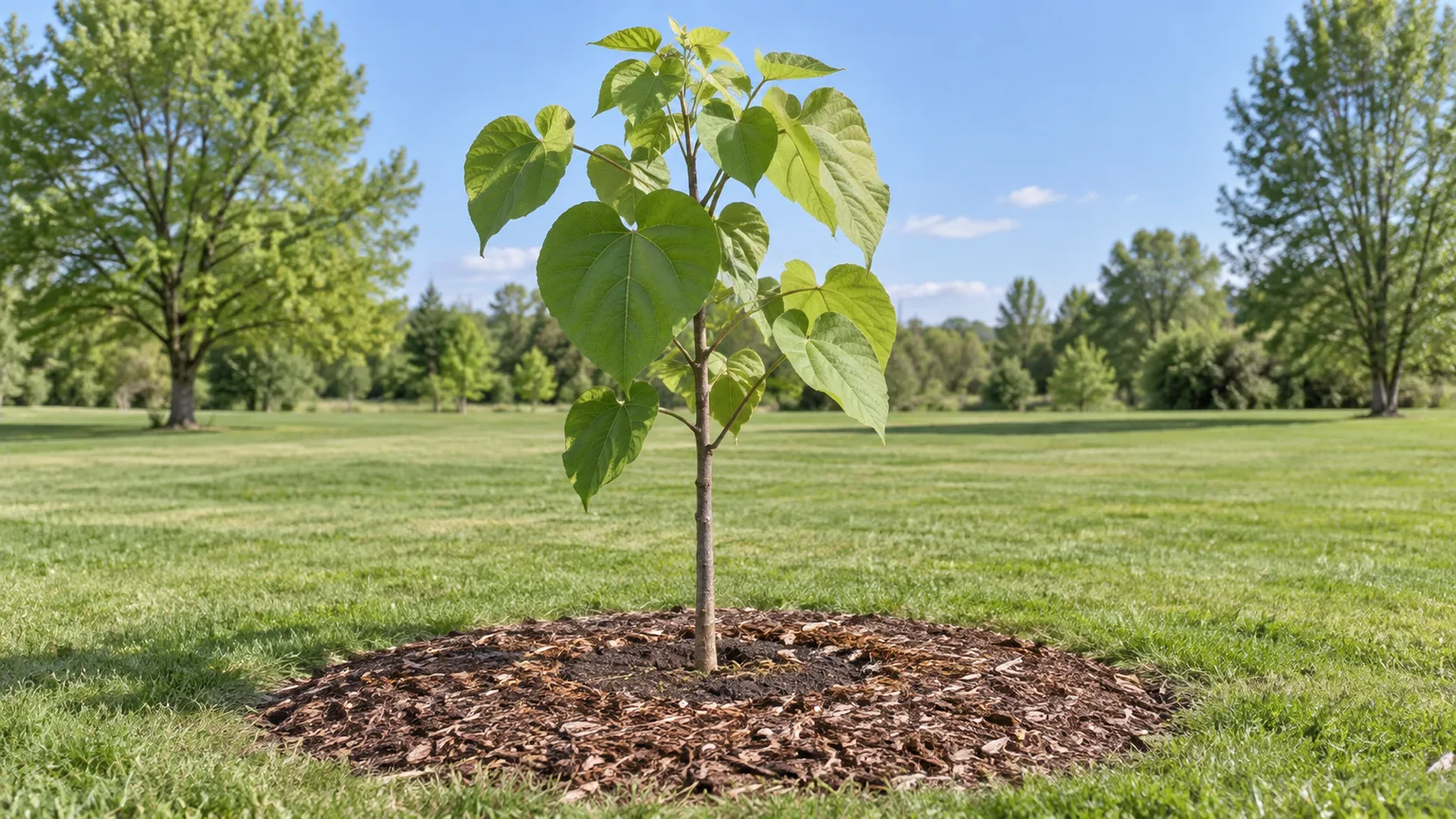
Watering is part of planting, not a step to postpone until leaves droop. A new tree has a small root system inside a wide landscape; during its first growing season, check moisture regularly both in the original root ball and in the soil just outside it. The planting image above shows why open space matters: a young tree may look small, but the site must accommodate its future crown.
Sun, soil, and climate
Give catalpa full sun for its strongest growth and best flowering; light partial shade is generally tolerated. A tree growing in deep shade may develop a thinner canopy and produce fewer flowers. More sun does not correct a cramped or drought-prone site, so evaluate light together with soil volume and water availability.
Catalpa is not fussy about soil type. Oregon State University describes northern catalpa as tolerant of varied soils, including wet, dry, and alkaline conditions, while preferring deep, moist, fertile soil. NC State similarly notes that northern catalpa can cope with difficult dry or moist sites. The practical distinction is between tolerating an imperfect site after establishment and establishing well in it. A young tree in compacted, very dry soil still needs attentive watering, and roots in chronically saturated ground may struggle even if the species can handle periodic flooding.
Test drainage before planting. After a substantial rain, check whether water remains pooled in the planting area into the next day. If it does, improve the site with a raised planting area or choose a species suited to prolonged wetness rather than burying catalpa’s root ball in a hole that acts like a bathtub. In sandy soil, incorporate organic matter across a broad bed if practical; avoid amending only the planting hole, which can discourage roots from exploring surrounding soil.
Hardiness is only one piece of climate fit. A tree that survives winter may still be stressed by a very hot, dry summer, reflected heat from pavement, or persistent drought. In marginal climates, protect the root zone with mulch and keep young plants watered through dry spells. A local extension office or municipal tree list can tell you whether catalpa performs well in your region and whether the species is considered native, naturalized, or undesirable there.
Watering by age and weather
Water a newly planted catalpa deeply enough to moisten the full root ball and nearby soil, then let the surface begin to dry before watering again. Frequency depends on rainfall, temperature, wind, soil texture, and planting season; a fixed weekly schedule can overwater clay or underwater sand. Check with a finger, trowel, or soil probe rather than judging from the surface alone. If the root ball is dry while adjacent ground is damp, target water to the original root ball as well as the surrounding soil.
For the first growing season, inspect moisture every few days during hot or dry weather and water when the root zone is drying. Continue into the second season if the tree is still putting down roots or if conditions are unusually dry. Slow soaking encourages water to penetrate rather than run off. A soaker hose or drip line can help, but move it outward as the tree grows; roots extend beyond the trunk’s drip line over time. White Flower Farm’s catalpa growing guide likewise emphasizes checking a new planting closely and watering thoroughly, while Gardening Know How recommends regular watering until establishment; both stress that an established tree needs less frequent irrigation (White Flower Farm, Gardening Know How). Treat those schedules as starting points, not universal rules: rain, soil texture, wind, and heat determine when the root ball actually needs water.
Once established, a catalpa usually needs less supplemental irrigation than it did when young. Still water during a prolonged drought, especially if the tree is near pavement, in sandy soil, or showing early stress. Do not use leaf drop as the only signal: some foliage loss can be seasonal or caused by pests, while drought injury may appear first as wilting, scorched edges, or premature yellowing. Check soil moisture before deciding.
Avoid keeping the root zone constantly wet. Overwatering and poor drainage deprive roots of oxygen and can contribute to decline. If leaves yellow while soil is soggy, pause irrigation and investigate drainage rather than adding fertilizer or more water. Water at the base when possible, especially during humid weather, to limit long periods of wet foliage.
Mulch and fertilizer: less is usually more
Spread a 2- to 3-inch layer of organic mulch over the root zone, extending it outward as the tree grows. Keep mulch at least 3 inches away from the trunk so bark remains dry and the root flare stays visible. A mulch ring reduces competition from turf, moderates soil temperature, and slows evaporation. It does not need to be a tall “mulch volcano”; piling material against the trunk can hold moisture where it causes decay or hides damage.
Do not automatically fertilize a newly planted catalpa. A high-nitrogen boost is not a substitute for adequate water, good planting depth, or enough root space, and unnecessary fertilizer can push rapid, weak growth or wash into waterways. If growth is poor after the tree has had time to establish, first check moisture, root flare, soil compaction, pests, and competition from grass. A soil test can identify a genuine nutrient deficiency and guide an appropriate amendment.
If a test or local arborist recommends fertilizer, follow the product label and apply only what is indicated for the soil and tree size. Keep fertilizer off the trunk and avoid late-season feeding that encourages tender growth before cold weather. In a healthy lawn, routine lawn fertilizer may already reach the tree’s root zone; additional feeding may be unnecessary.
Prune for structure while the tree is young
Young catalpas benefit from selective structural pruning because a good framework is easier to guide before branches become large. Prune to establish one central leader when the species and tree form support that shape, remove competing leaders, and address branches that cross, rub, or emerge at weak, narrow angles. Do not strip the lower trunk in one session simply to make mowing easier; removing too much live canopy can stress a young tree and reduce trunk development.
For small corrective cuts, remove dead, damaged, or diseased branches when you notice them, provided the work is safe and weather is not creating disease risk in your region. For routine shaping, late winter or early spring while the tree is dormant makes branch structure easy to see. If you want to preserve this season’s flowers, avoid pruning healthy branches before bloom: catalpa flowers form on new growth, and heavy pruning may remove potential flowering wood or change the canopy. Exact timing depends on the goal, not a single calendar date.
Use sharp, clean tools and cut just outside the branch collar—the slightly swollen area where a branch joins the trunk or parent limb. Do not cut flush to the trunk and do not leave a long stub. For a heavy branch, use the three-cut method to prevent bark from tearing: make an undercut a short distance out from the collar, cut through from above farther out, then remove the remaining stub just outside the collar. If the branch is large, high, near a structure, or under tension, hire an insured arborist. Catalpa’s brittle wood makes climbing and overhead pruning a poor DIY project.
Avoid topping. Repeatedly shortening the crown creates weakly attached shoots and more future pruning, rather than making a large tree safely small. If the mature canopy is already in conflict with a building or wires, get a professional assessment; removal and replacement with a smaller species may be safer and less expensive over time.
Flowers, pods, and seasonal cleanup
Catalpa’s flowers grow in upright clusters and are most noticeable on mature trees with enough sunlight. Northern catalpa typically flowers in late spring to early summer, but age, climate, shade, weather, and growing conditions all affect bloom. A young tree can take several years to flower; no bloom in the first few seasons is not necessarily a care failure. Excess nitrogen, deep shade, or repeated heavy pruning can also reduce flowering.
After flowering, long narrow pods develop. They are attractive on the tree and a defining feature, but they persist and eventually drop. Large leaves also fall in autumn, sometimes after turning yellow and then darkening. Plan cleanup where it matters: keep a path, drain, or gutter clear, but leaves in a naturalized bed can be left as mulch if they are not diseased and do not smother smaller plants. Fallen pods can be raked or collected before they become slippery on hard surfaces.
If volunteer seedlings are a concern, remove pods before they split and scatter their winged seeds. Pull seedlings promptly after rain while roots are small. Do not plant catalpa near a sensitive natural area without checking local guidance; a tree can be non-invasive in one region and seed freely in another. Municipal forestry or extension resources are more useful for that local question than a broad national label.
Catalpa sphinx caterpillars and other problems
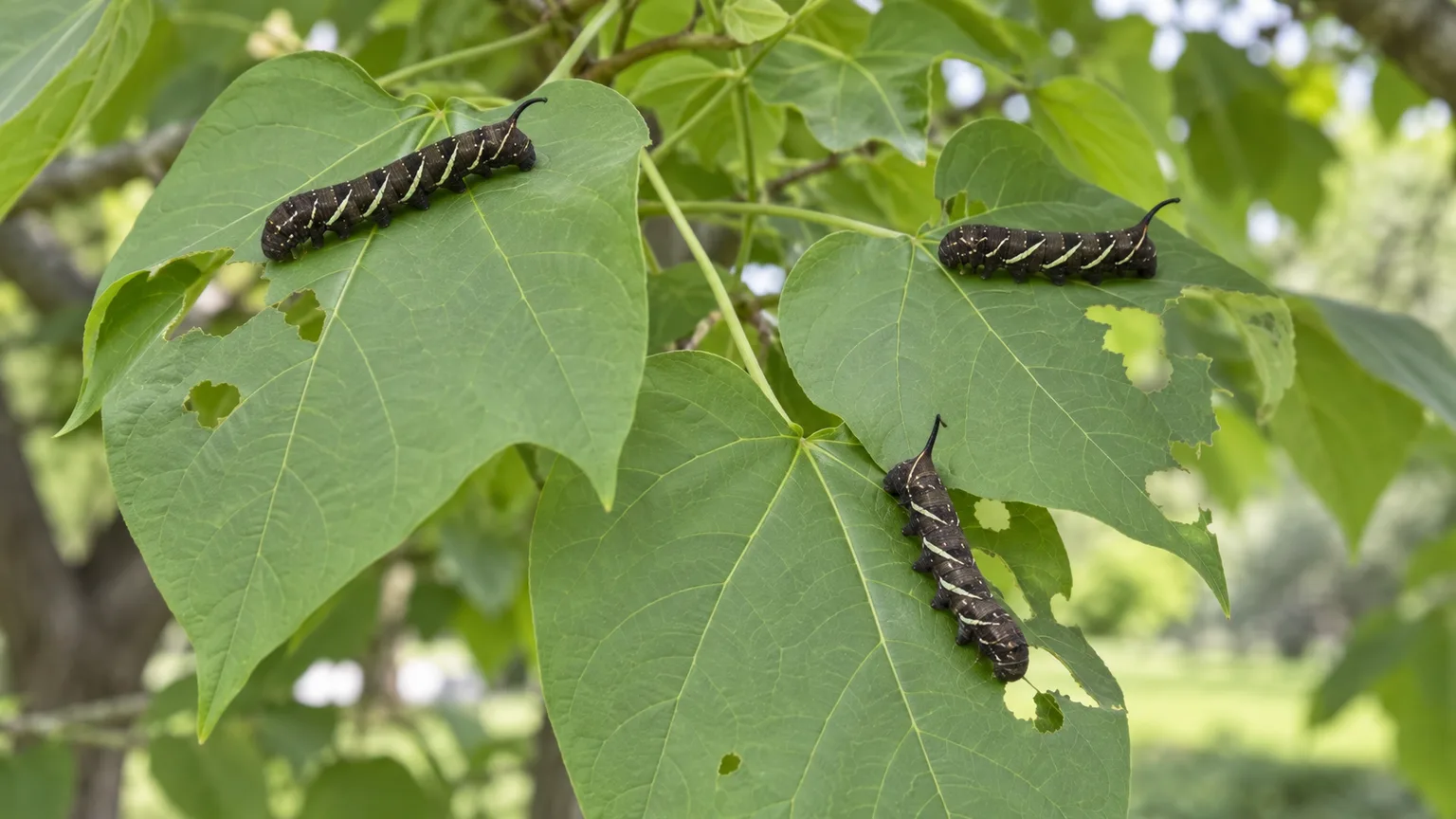
The catalpa sphinx moth lays clusters of eggs on catalpa leaves. Its striped hornworm-like larvae—often called catalpa worms—feed on catalpa foliage. Penn State Extension describes them as native caterpillars that sometimes outbreak and defoliate trees, while natural enemies such as parasitoid wasps can help regulate populations. In a healthy mature tree, one episode of leaf loss is often less serious than it looks; the tree may produce another flush of leaves if defoliation occurs early enough.
When to tolerate defoliation and when to intervene
If a few caterpillars are feeding and the tree is otherwise healthy, observation is usually the right first response. Do not spray simply because caterpillars are present. Broad-spectrum insecticides can kill predators and parasitoids, interfere with the natural checks on the pest, and harm pollinators or other beneficial insects. Caterpillars with small white cocoons attached to them may be parasitized; leave them in place so beneficial wasps can emerge.
Intervene only when there is substantial, repeated defoliation, especially on a young or already stressed tree, or when a small tree is losing most of its leaves. Inspect the undersides of leaves for egg masses and remove them by hand where reachable. On a small tree, prune out a localized cluster of young larvae or handpick them while wearing gloves. Penn State Extension describes Bacillus thuringiensis (Bt) as a targeted option for small, actively feeding caterpillars; use it only if needed, select a product labeled for the site and pest, and follow all label directions. Do not treat large trees from a ladder or with improvised sprays.
If catalpa is repeatedly defoliated or appears to decline, look beyond the caterpillars. Drought, root injury, poor drainage, trunk damage, and disease can reduce the tree’s ability to recover. Penn State notes that repeated outbreaks over multiple seasons can harm a stressed tree. Restore basic growing conditions first and consult an extension office or arborist if dieback continues.
Other potential problems include leaf spot, powdery mildew, twig blight, and verticillium wilt. Many spots on leaves are cosmetic, particularly late in the growing season. Rake and discard severely diseased fallen foliage, water at soil level, and improve airflow by avoiding unnecessary crowding. Do not diagnose a wilt disease from yellow leaves alone: drought, saturated soil, root injury, and natural leaf aging can look similar. A plant diagnostic lab can identify an important disease before you remove a mature shade tree.
Propagate catalpa from seed
Catalpa is commonly propagated from seed, though seedlings may not match the parent exactly in size, form, or flowering. Gather mature dry pods after they have turned brown, and collect the winged seeds as the pod opens. Keep them dry and cool until planting. Follow local native-plant guidance if the species is not native where you live; avoid distributing seed where seedlings could spread into natural areas. Gardening Know How also notes that fallen catalpa seed can germinate freely in suitable regions, so pod cleanup is useful when you want to limit volunteers (Gardening Know How).
Start seeds in spring in a container of well-drained seed-starting mix. Sow shallowly, cover lightly, and keep the medium evenly moist rather than waterlogged. Place the pot in bright light and a warm location. Germination can be variable, so label the pot and give it time before discarding it. When seedlings are large enough to handle, pot them separately and grow them on until they are sturdy enough for outdoor conditions. Harden them off over several days before transplanting, then protect the young trunk from lawn equipment and animal damage.
Direct sowing outdoors is possible after frost danger has passed, but it makes the seed harder to monitor and exposes tiny seedlings to weeds and drought. A small pot gives you better control of moisture. If you want a particular cultivar or predictable form, buy a properly identified nursery tree rather than relying on seed; a seedling grown from an ornamental selection may not come true to type.
Common catalpa growing problems
The tree is growing slowly. Check whether it receives adequate light, whether the root flare is buried, and whether lawn or compacted soil competes with roots. A newly planted tree may spend energy establishing roots before putting on much top growth. Do not respond with heavy fertilizer until a soil test points to a need.
There are no flowers. A young catalpa may not be mature enough to bloom. Deep shade, excessive nitrogen, or hard pruning can also limit flowers. Confirm the species and give the tree time; moving a mature catalpa is rarely practical.
Leaves wilt or scorch in summer. Check soil moisture within the root ball and beyond it. If the ground is dry, water slowly and deeply. If it is saturated, improve drainage and pause irrigation. Heat, root injury, and pests can also cause symptoms, so inspect the whole tree rather than treating one leaf as a diagnosis.
Branches break. Catalpa wood is brittle, so inspect after strong winds, heavy snow, or ice. Keep people clear of a hanging or cracked limb. A professional can identify whether a damaged branch can be safely removed and whether the tree needs structural work.
Pods or leaves are making the site messy. Rake hard surfaces regularly, clear drains, and remove pods before they open if seedlings are unwanted. If cleanup remains more work than the shade and flowers are worth, replacement with a smaller, cleaner tree may be a more sustainable solution than constant pruning.
Conclusion
Catalpa is an adaptable shade tree with a distinctive season of flowers, huge leaves, and long seed pods—but its size, brittle wood, and litter should shape your decision before you plant. Confirm which species you have, choose a spacious site with enough sun and soil volume, and pay close attention to moisture while the root system establishes. Mulch without touching the trunk, use soil-test results instead of automatic fertilizer, and guide young branches with selective pruning.
Once established, catalpa is often a low-maintenance tree. Expect some cleanup, accept that native caterpillars may occasionally eat leaves, and step in only when a young or repeatedly stressed tree needs help. With the right place and realistic expectations, its dramatic canopy can be a lasting source of shade and habitat.