Carpenter Bee vs. Bumble Bee Differences
Carpenter bee vs. bumble bee: compare the abdomen, nest site, flight behavior, and sting risk so you can identify a visitor and choose a sensible next step.
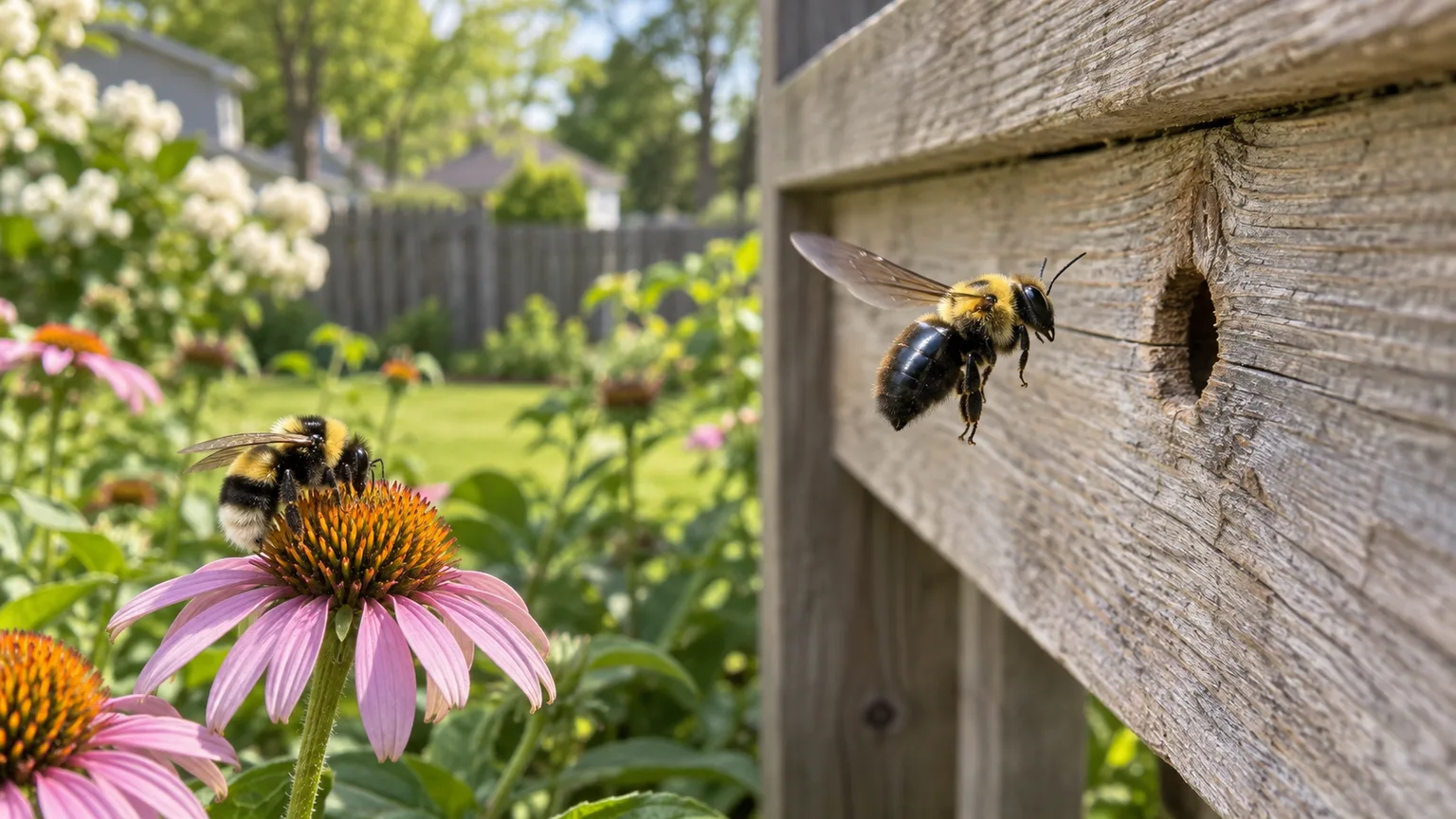
Large, black-and-yellow bees can look alike in flight, but two clues usually separate a carpenter bee from a bumble bee: the carpenter bee’s abdomen is smooth and glossy, while a bumble bee’s abdomen is covered in dense hair; carpenter bees excavate tunnels in wood, while bumble bees build a social nest in a protected cavity. Neither a loud buzz nor a bee’s size is enough to identify it.
That distinction is useful when you spot a bee near a deck, porch, flower bed, or hole in the ground. A carpenter bee may be using exposed wood as a nest site, but a bumble bee typically poses no risk to the structure. Both are pollinators, and either can sting under the right circumstances, so the sensible first move is to watch from a safe distance rather than swat, plug, or spray based on a quick guess.
Carpenter bee vs. bumble bee at a glance
If the bee is resting on a flower or wood, examine the abdomen from the side or above. A shiny, nearly hairless black abdomen points toward a carpenter bee; a fuzzy, often banded abdomen points toward a bumble bee. Then use the setting as a second check: a fresh, round entrance hole in wood supports carpenter bee activity, while repeated traffic into a ground-level or other sheltered cavity suggests a bumble bee nest.
The distinction is not “black bee versus yellow bee.” Both groups can have dark bodies and pale thorax hairs, and several carpenter bee species have colorful or metallic-looking bodies. The abdomen’s surface and the nest evidence are more dependable than a distant impression of color. Penn State Extension describes the smooth, shiny top of a carpenter bee’s abdomen and the fully hairy abdomen of a bumble bee as the most useful visible contrast.
Compare the two bees by the clues that matter
| Clue | Carpenter bee | Bumble bee |
|---|---|---|
| Body surface | Fuzzy thorax; upper abdomen usually smooth and shiny | Dense hair covers the abdomen as well as the thorax |
| Typical nest | A tunnel or gallery excavated in wood | A colony in a protected cavity, often underground but not always |
| Social life | Females provision separate brood galleries; several may use nearby holes | A queen starts a colony with workers and later reproductive bees |
| Common yard sign | Bee at a clean round wood opening; sometimes fresh shavings or staining | Repeated traffic to one low or sheltered entrance; workers also visit flowers |
| Sting clue | Males cannot sting; females can sting but are generally reluctant | Females can sting and may defend a disturbed colony |
| Wood risk | Can excavate and reuse wood galleries over time | Does not bore into wood to build its colony |
Think of these as a pattern-matching guide, not a species key. A bee on a flower does not reveal where it nests, and a bee hovering by a porch does not prove there is a wood gallery. If the stakes are low, “likely carpenter bee” or “likely bumble bee” is often enough; if the next step would involve disturbing a nest or treating a structure, get a more confident identification first.
Look closely at the abdomen, not just the stripes
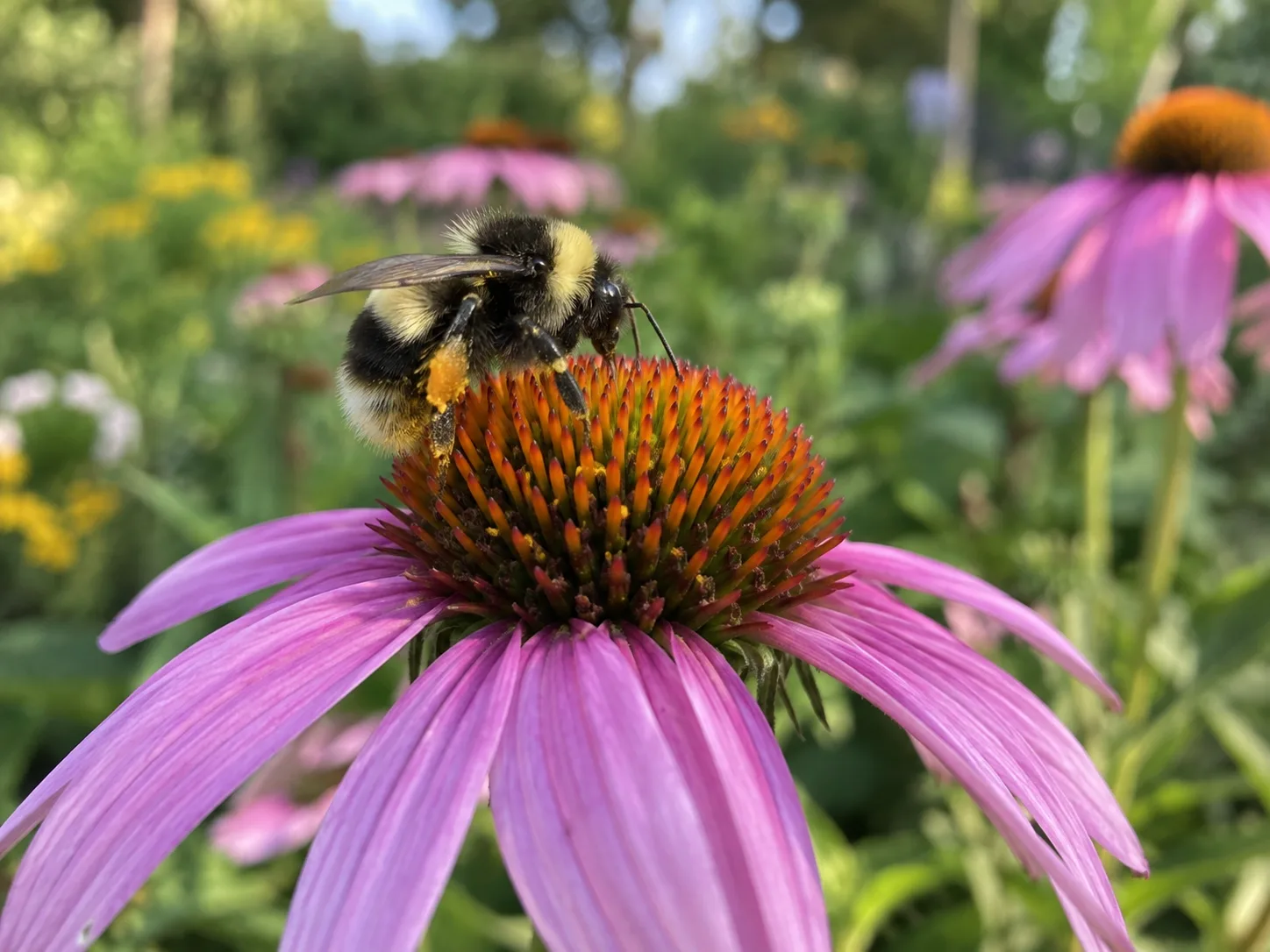
Smooth and shiny versus densely hairy
The carpenter bee’s thorax—the middle body section behind the head—often looks plush with yellow, orange, or pale hairs. That furry thorax can make the insect appear bumblebee-like at a glance. Move your attention backward to the abdomen: on common large carpenter bees in the eastern United States, its upper surface is usually dark, smooth, and reflective, with comparatively little hair.
Bumble bees are hairy across the abdomen. In close view, the surface looks matte and plush rather than polished, and the bands may be black, yellow, white, orange, or reddish depending on species. Texas Parks and Wildlife Department compares an American bumble bee and an eastern carpenter bee directly and emphasizes this bare-versus-furry abdominal surface. That is a better quick field mark than counting stripes.
Notice the whole insect, not only one patch of color. A carpenter bee often has a broad, robust body, a large head, and a shiny abdomen that catches light as it changes angle. A bumble bee tends to look rounder and more uniformly fuzzy. If the bee is moving, wait for it to land; trying to track stripes on a fast insect is both difficult and more likely to bring you too close.
Why size and color can mislead you
Both bees can be roughly similar in size, and individual carpenter bees are not always noticeably larger than the bumble bees in a particular yard. Size varies with species, sex, nutrition during development, and the individual insect. A close comparison is especially unreliable when one bee is nearer the camera or when you only see a silhouette against a bright sky.
Color is also variable. Bumble bee species differ in band patterns, and males may have facial or body markings that differ from queens and workers of the same species. The Texas identification guide specifically cautions that color pattern varies within species and between male and female bumble bees. Carpenter bees beyond the familiar eastern species may also be blue-black or metallic, depending on region.
For a homeowner’s first decision, you rarely need the precise species name. First separate a shiny-abdomen wood-nesting bee from a fuzzy social bee. If you need a species-level identification—for conservation records, unusual behavior, or a professional treatment decision—photograph the bee from the side or above without touching it, note your location and date, and ask a local Cooperative Extension office or a regional pollinator expert.
Read the nest site before assuming a bee is damaging wood
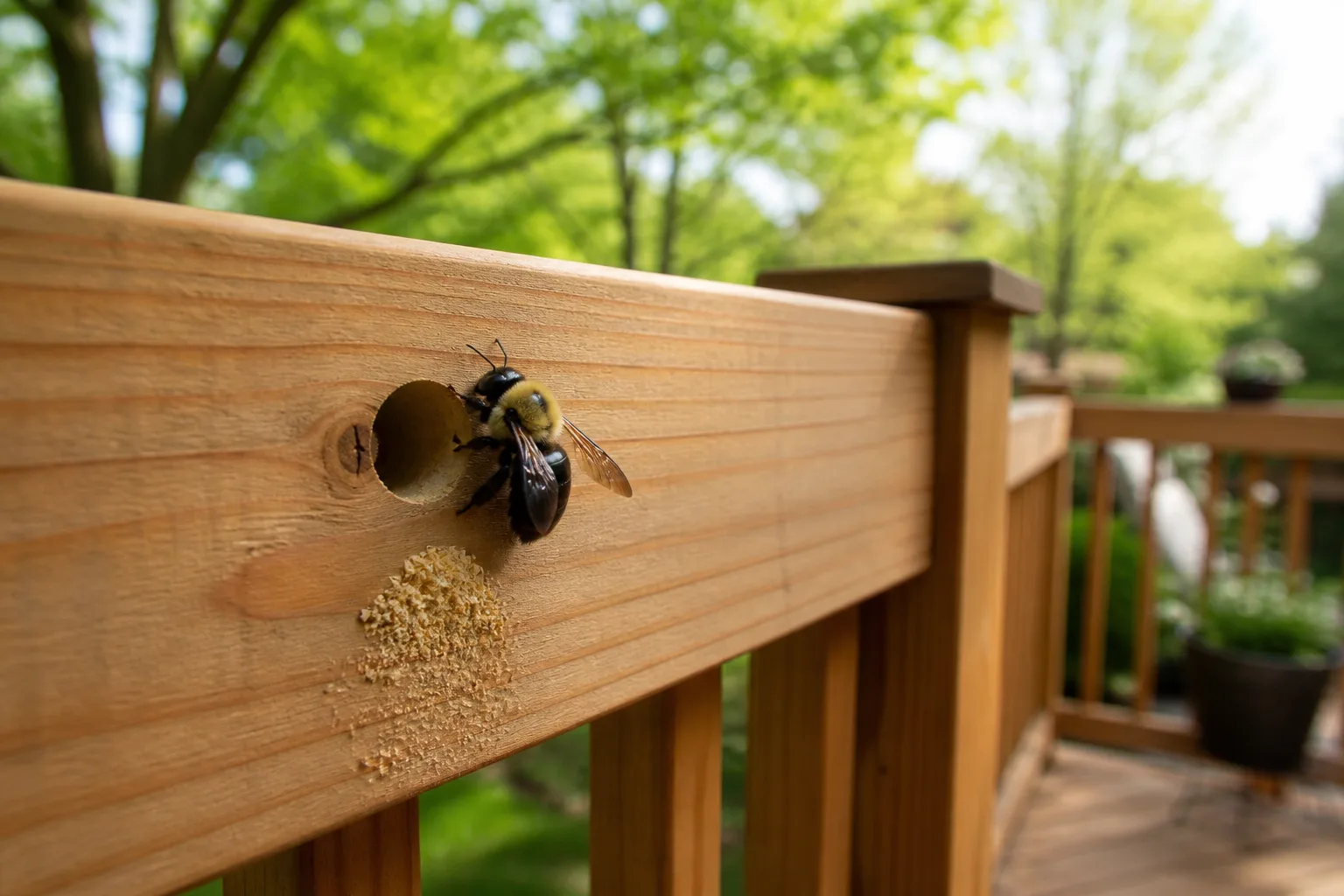
Carpenter bees use wood as nesting material. A female chews an entrance into a board, then excavates a gallery where she provisions brood cells with pollen and nectar. The entrance is often close to half an inch wide and nearly circular; fresh activity may leave coarse shavings, yellow-brown staining, or pollen below the hole. Ohio State University Extension explains that the female is making a protected nursery rather than eating the wood.
Bumble bees do not make these drilled galleries. Their colony occupies a sheltered cavity, commonly an abandoned rodent burrow or another protected space near the ground. Some species may nest aboveground in a tussock, compost, wall cavity, or other suitable void, so “underground” is a common pattern, not a guarantee. BBC Gardeners’ World notes that bumble bee species use different nest locations, including below-ground and aboveground sites.
The nest clue becomes stronger when it fits the bee. A round hole plus a shiny-abdomen bee repeatedly entering the same wood is persuasive evidence of carpenter bee nesting. A round hole in the lawn without a bee entering it is not. Soil-nesting solitary bees, wasps, rodents, and other insects can all create ground openings, and the opening alone does not tell you which animal made it.
Several carpenter bees may share a deck or beam without forming a colony. A grouping of holes can mean separate galleries close together, while a bumble bee colony is a social group occupying one nest cavity. Ohio State describes carpenter bee females as independent nest builders even when multiple galleries occur in the same wood. For an inspection checklist focused on wood damage, see signs of carpenter bees around a home.
Solitary carpenter bees and social bumble bees have different lives
Carpenter bee galleries are separate nests, even when clustered
“Solitary” does not mean you will only ever see one carpenter bee. Several females can choose the same favorable beam or fascia, especially if it is dry, weathered, and unpainted. Their holes may be close together, and they may reuse or extend old galleries over multiple seasons. But each female provisions her own brood cells; a crowd of nearby carpenter bees is not automatically a queen-led colony.
The wood itself can tell a longer story than the insects. A new entrance may cause limited initial damage, while repeated reuse and branching can enlarge internal tunnels. That is why a homeowner should distinguish “a carpenter bee visited my flowers” from “carpenter bees are entering a structural board.” The latter calls for a closer look at the wood condition, not a blanket response to every bee in the yard. Ohio State Extension notes that extensive galleries over time can compromise a structural member, even though a single nest is often a modest concern.
Bumble bee colonies change through the season
A bumble bee nest has a seasonal social cycle. In temperate regions, a fertilized queen overwinters alone, emerges as weather warms, and starts a nest in spring. She raises the first workers, which then take over much of the foraging and nest care; later in the season, the colony produces males and new queens. Those new queens mate and overwinter, while the old colony generally declines rather than remaining a permanent hive year after year. Savvy Gardening describes bumble bees as social nesters whose queens start a new nest in spring, often using an existing cavity.
This seasonal cycle changes how you should interpret what you see. Early in the year, a large bumble bee flying low over the lawn may be a queen searching for a nesting cavity. Later, repeated trips along one route may indicate workers carrying resources to an established nest. A single bee moving between flowers is simply foraging. Do not use activity alone to locate or expose a nest; watch from a distance and let the surrounding behavior provide context.
Can either bee sting, and which one is defensive?
Both can sting, but the practical risk depends on sex and situation. Male carpenter bees cannot sting because they lack a functional stinger. They may hover in front of people or dart at movement near a nest, which can look threatening, but that display is bluffing. Female carpenter bees can sting, although they are generally reluctant to do so unless handled, trapped, or directly provoked. Penn State Extension describes the territorial hovering of male carpenter bees and the distinction between males and sting-capable females.
Bumble bees also usually leave people alone while foraging. Females, including queens and workers, can sting when their nest is threatened or they are grabbed or stepped on. A bee at a flower is not behaving like a bee defending a colony. The key is to avoid pressing, trapping, or swatting any bee and to give a suspected nest entrance space, especially when children, pets, or high-traffic paths are nearby.
Anyone with a known severe sting allergy should follow their clinician’s emergency plan and avoid approaching active nests. If people cannot safely use a path or entrance, or if a nest sits in a place that will be disturbed, a qualified local professional can assess the site. Do not test whether a bee is aggressive by waving at it; that creates needless risk and does not improve identification.
Both bees pollinate, but their flower visits can differ
Carpenter bees and bumble bees both feed on nectar and pollen, and both can transfer pollen between flowers. Bumble bees are particularly effective on some crops because they perform buzz pollination: a bee grips the flower and vibrates its flight muscles, shaking pollen loose from anthers that do not release it readily. Tomatoes, eggplants, and related plants benefit from this kind of vibration. New Mexico State University’s native-bee guide describes bumble bee buzz pollination in eggplant and also notes that carpenter bees are native pollinators.
Carpenter bees can be valuable visitors, too, though the way they feed may change how they pollinate a particular flower. On some long or narrow flowers, a carpenter bee may cut a small opening near the base and take nectar without contacting the pollen-bearing parts; this is called nectar robbing. It is a behavior associated with flower shape and access to nectar, not proof that carpenter bees do no pollination. The same bee may contact reproductive parts on other flowers or while gathering pollen.
The useful garden takeaway is not to rank one species as a pest and the other as a perfect pollinator. Bumble bees and carpenter bees have different nesting needs and roles, but both are part of native bee diversity. Savvy Gardening’s overview of yard bees describes how different bee groups use different flowers and nesting spaces. A garden with a range of bloom shapes and seasons can serve more pollinators than one designed around a single bee or a single crop.
What hovering and flight behavior can—and cannot—tell you
Carpenter bee males are conspicuous near wood because they patrol a territory, hovering and darting at other insects. They may approach a person who moves quickly nearby, even though they cannot sting. This is one reason people sometimes interpret a male carpenter bee as an unusually aggressive bumble bee. Its location near an eave or rail is a clue, but the abdomen and a repeated wood entrance are better evidence.
Bumble bees seen on flowers generally focus on foraging and may fly away if approached. Near a colony, workers may become defensive if a person disturbs the entrance or nest chamber. A lone bumble bee on a flower does not mean a nest is under that bed, and a bee’s humming sound cannot reliably distinguish these genera. The Texas Parks and Wildlife Department recommends respectful observation and notes that foragers away from their nests are usually easier to photograph than nest-associated bees.
Flight season can help only in combination with other clues. In many northern areas, carpenter bees become visible in spring as adults emerge and females prepare or reuse galleries. Bumble bee queens may also be seen in spring, with worker activity increasing as a colony develops. Warmth, latitude, species, and the weather shift timing, so there is no universal month that proves which bee you saw.
A safe one-minute identification check
Stand several feet away and observe before taking action. If the bee lands, use these steps:
- Look at the abdomen. Is it glossy and mostly bare, or covered in dense hairs? This is the strongest quick visual cue.
- Note the setting. Is the bee visiting flowers, repeatedly entering a clean round hole in wood, or traveling to one sheltered cavity?
- Look for fresh evidence. Coarse shavings below a wood hole support recent carpenter bee excavation; a hole without bee traffic or debris may be old or unrelated.
- Watch the pattern. One hovering bee may be a male carpenter bee; repeated traffic to a shared entrance may indicate a bumble bee colony, but activity alone is not a species ID.
- Stop if the next step could disturb a nest. Take a photo from a safe distance and ask a Cooperative Extension or insect-identification service if certainty matters.
Avoid catching the insect in a jar, touching it, or leaning close to a nest entrance. A phone photo that shows the abdomen and general body pattern is often enough to make a preliminary distinction. Add a wider picture of the nest location, plus your state or region and the date. Texas Parks and Wildlife’s identification guide notes that exact bumble bee species identification can be tricky because color patterns vary; a local expert is useful when a management decision depends on the answer.
Other insects that can fool a quick glance
Not every fuzzy black-and-yellow insect is a bumble bee, and not every shiny large bee is a carpenter bee. Bumble bee mimics include certain day-flying moths and robber flies. A clearwing moth may hover in front of a flower rather than land and crawl across it, while robber flies often perch and pursue other insects. The Texas guide lists these lookalikes and explains the difference in feeding behavior.
Other bees can also resemble one of the two. Some mining bees and digger bees are robust and hairy, and some large carpenter bee species do not match the familiar black-and-gold eastern form. If you are outside the range of the common eastern carpenter bee, or the insect’s body traits do not fit the standard comparison, avoid forcing an identification based on a single image. The broad groups are enough for most household decisions; species-level identification is a separate task.
Wasps are another possible source of confusion, especially around ground holes. Yellowjackets have a less fuzzy, more sharply defined body pattern and can defend a colony vigorously; they are not bumble bees. A hidden cavity with many insects moving in and out deserves caution until you know what occupies it. If uncertain, keep people away and let a local extension office or licensed pest professional identify the nest before anyone blocks or treats it.
What to do when bees are around your home
If a bee is visiting flowers or hovering near wood
For a bee feeding on flowers, give it room and let it forage. Do not remove flowers, spray blooms, or try to swat the visitor simply because it is large. If it is a male carpenter bee hovering by a structure, the display can be startling, but observing from a distance is safer than reacting to the flight. Check nearby exposed wood later for a clear round entrance and fresh shavings rather than treating the hovering itself as damage.
If you find a possible carpenter bee hole, photograph it, note whether bees enter or exit, and look for fresh debris from a safe position. Avoid sealing an entrance while bees may still be inside, and do not put tools or liquids into the gallery. Structural members, high eaves, multiple active holes, or wood that is soft or damaged deserve professional assessment. For a longer wood-focused sequence, see how to address carpenter bee activity.
If you find an active nest or cannot identify it
Keep a respectful buffer around any suspected bumble bee nest. Do not dig it up, flood it, block the entrance, or put a mower or trimmer over it. If it is in a quiet area away from people, leaving the nest undisturbed is often the simplest course. Bumble bee colonies are seasonal, although timing varies by region and species; a local extension or pollinator group can advise if you need to plan around a particular nest.
If the nest is beside a door, child play area, or required walkway, keep people and pets away while you seek qualified help. If you suspect a ground nest but cannot tell whether it belongs to bumble bees, solitary bees, or wasps, do not treat the hole based on its shape alone. Our guide to identifying and managing ground bees explains why ground openings need an insect identification before control decisions.
Conclusion
The quickest carpenter bee versus bumble bee check is the abdomen: carpenter bees usually have a smooth, glossy abdomen, while bumble bees are fuzzy across the abdomen. Confirm that visual clue with what the insect is doing and where it repeatedly goes—a round wood entrance supports carpenter bee nesting, while a social group using a protected cavity suggests bumble bees. Size, stripes, hovering, and buzz alone are less reliable.
Both bees pollinate, and neither benefits from a reflexive swat or an improvised nest treatment. Give foraging bees room, keep away from active nest entrances, and ask a local extension or qualified professional when a structure or safety decision depends on an accurate identification.