42 Alternative Christmas Tree Ideas for Any Space
Find an alternative Christmas tree for a small apartment, minimalist room, or creative home, plus practical advice for anchoring, lighting, and storage.
An alternative Christmas tree is not one specific craft. It is any holiday focal point that gives you some of the things a conventional tree provides—height, a recognizable triangular silhouette, greenery, lights, ornaments, or a place for presents—without requiring a full-size evergreen on the floor.
That distinction matters because the best choice depends on the constraint you are trying to solve. A wall outline is brilliant in a studio apartment but less useful if you cannot attach anything to the paint. A potted plant can be a beautiful living centerpiece, but it still needs the right light and careful watering. Fresh branches bring fragrance and texture, while paper and cardboard are easier to store but need a stricter distance from heat.
The ideas below are grouped by material and setup. Start with the short decision guide, choose one dominant shape, and then borrow only the details that fit your home. The goal is not to imitate a traditional tree perfectly; it is to create a seasonal focal point that feels intentional, safe, and easy enough to live with.
Choose the Right Alternative Before You Start
Match the idea to the room you actually have
Measure the space in three directions: floor width, wall width, and usable height. If the floor is the problem, choose a wall-mounted, hanging, or window display. If the walls are rented, textured, or already crowded, use a freestanding tabletop tree, a branch-filled vase, or a narrow potted plant. If the ceiling is low, a wide horizontal silhouette can feel more generous than a compressed cone.
Also identify the viewing angle. A tree-shaped display that faces the sofa can be shallow; one in the middle of a room needs a finished back and a stable base. For a dining table, keep the center low enough for conversation. For a child’s room, keep breakable ornaments and cords above the reach zone rather than making the display tall just for drama.
Choose materials for reuse, weight, and storage
Before choosing a look, decide whether you want fragrance, portability, texture, or a project the family can make together. Fresh greenery wins on scent but has a short display window. Paper, fabric, and canvas fold flat. Wood and metal last for years but need more storage volume. Edible designs are wonderfully low-commitment, yet they are not a good fit for a display that must survive curious children, pets, or a long holiday gathering.
Weight is the hidden design decision. A wall tree made from paper can use removable strips or pins; a branch tree carrying glass ornaments needs stronger anchors and a clear load path. Test the structure with the heaviest planned decoration before you add dozens of light strands or keepsakes. If it flexes, sags, or pulls away from the wall when empty, it is not ready for decoration.
42 Alternative Christmas Tree Ideas
There is no prize for using all 42 ideas. Choose one as the main display, then take a color, texture, or ornament trick from another. That approach keeps the result festive without turning a small room into a storage problem in miniature.
Wall and hanging displays
1. Removable light-outline tree. Shape a strand of low-heat lights into a triangle on a blank wall, then add a small star or a few lightweight ornaments. It is the thinnest option here and works well behind a console, but use attachment points rated for the surface and keep the cord route tidy.
2. Washi-tape silhouette. Build the trunk and branches with removable washi tape, then hang paper stars, cards, or tiny felt ornaments from the lines. The graphic shape reads as a tree even when the materials are flat, and the tape can be removed in sections instead of pulled from one corner.
3. Canvas tree. Paint or print a simple tree on canvas and hang it from a dowel. A canvas display folds or rolls for storage, weighs little, and can be redesigned next year with a different palette. Keep the embellishments sewn or lightly attached rather than loading the fabric with heavy glass ornaments.
4. Tapestry tree. Use a textile with a tree motif or arrange a plain woven tapestry into a triangular composition with brooches, ribbons, or fabric ornaments. This is a good renter-friendly solution when you can hang it from one sturdy rod, and it adds softness where a hard wall display might feel stark.
5. Paper-card garland tree. Hang a vertical line of holiday cards, tags, or folded paper shapes in gradually increasing rows. The display becomes a family archive as the season goes on, but keep the heaviest cards low and avoid placing it directly above a heater or open flame.
6. Pegboard ornament tree. Mount a pegboard or lean one securely against a wall, then use hooks to create a triangular outline. The holes make it easy to move ornaments, stockings, and an advent calendar without drilling new holes. It can also become a craft or storage panel after the holidays.
7. Window ornament tree. Suspend baubles, stars, or ribbons from a curtain rod at different lengths so the negative space forms a tree. Use lightweight, shatter-resistant pieces near glass and keep the arrangement clear of a window that must open as an exit or ventilation route.
8. Hanging branch chandelier. Suspend a few slender branches horizontally above a table and decorate them as a floating tree canopy. This works best as a shallow, upside-down interpretation rather than a literal cone. Check the ceiling anchor, use lightweight ornaments, and leave enough headroom for anyone walking beneath it.
9. Advent-calendar tree. Arrange small pockets, envelopes, or numbered tags into a tree shape on a wall. It supplies the daily ritual of a decorated tree while earning its footprint, and the pockets can be reused for notes, recipes, or family prompts in future years.
Branches and greenery
10. Ladder branch tree. Lean a wooden ladder safely against a wall and wrap its rungs with garland, ribbon, or lights. Presents can sit on the lower steps, but keep the ladder closed or stabilized and do not treat it as a climbing structure once decorated.
11. Wall-mounted branch fan. Arrange fallen branches from shortest to longest, with the tips spreading upward to form a fan. Tie them to a narrow backing board or secure each branch at a tested point. The result looks sculptural and uses less greenery than a full tree.
12. Foraged tabletop tree. Place a bundle of thin, branching twigs in a heavy vase and hang tiny ornaments from the tips. Choose a vessel with a broad base, add stones or floral foam if needed, and keep the arrangement low enough that it cannot be knocked over by a passing sleeve or pet tail.
13. Lighted branch bouquet. Fill a tall floor vase with bare branches and weave battery lights through them. This is a particularly good winter display because it can stay up after the holiday ornaments come down. Hide the battery pack where it remains reachable for a shutoff, not buried under paper or fabric.
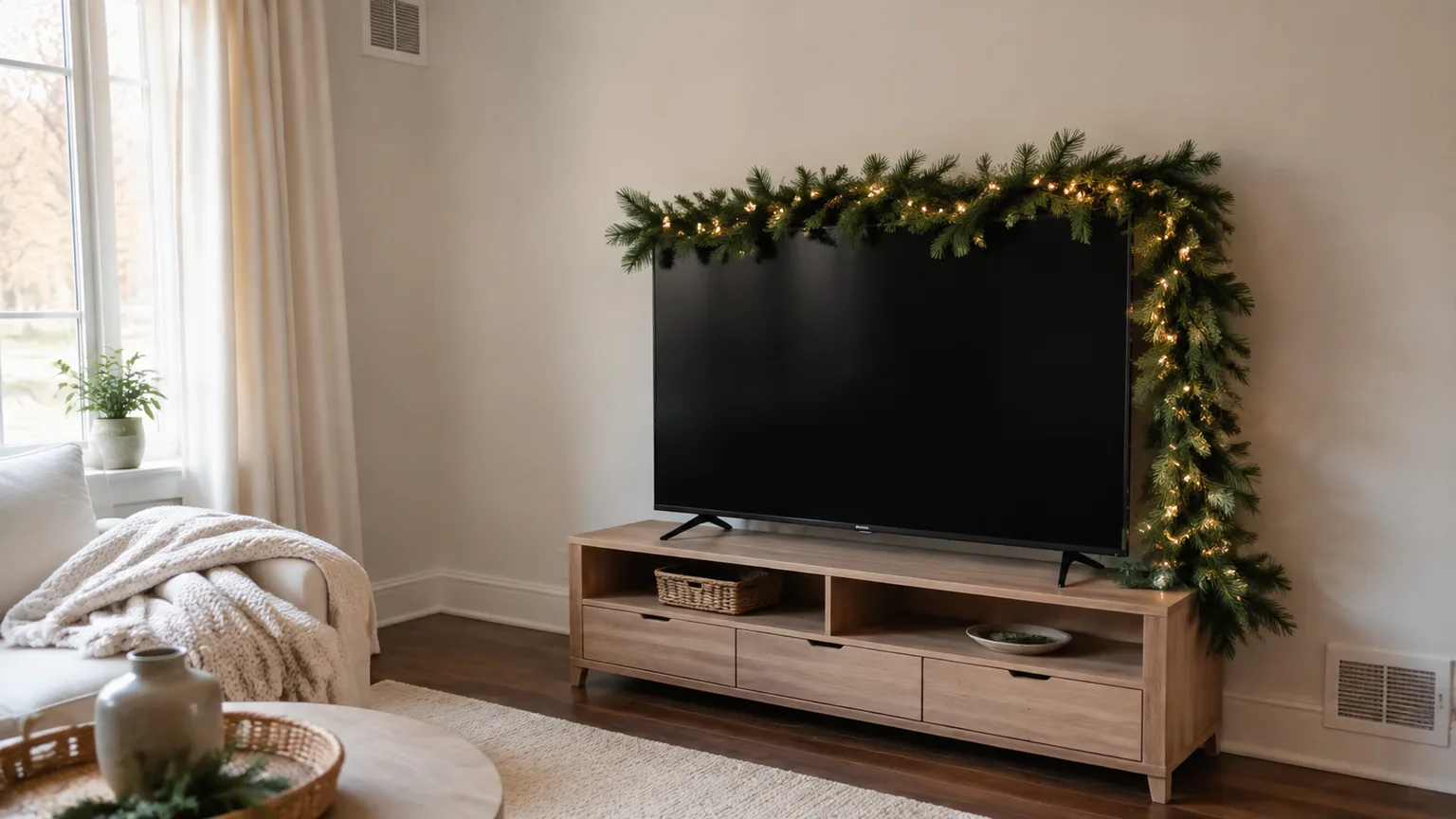
14. Evergreen garland outline. Use garland to trace a triangle around a mirror, television, doorway, or empty wall. A wall-mounted garland method is easy to store because the greenery can be coiled, but leave enough space around vents and do not block an exit, thermostat, or electrical panel.
15. Upside-down branch display. Hang one sturdy branch with the thicker end at the top and the smaller twigs pointing down. Add a few ornaments rather than filling every tip. This is whimsical, but the ceiling hardware must be rated for the branch, the decorations, and the movement caused by air currents.
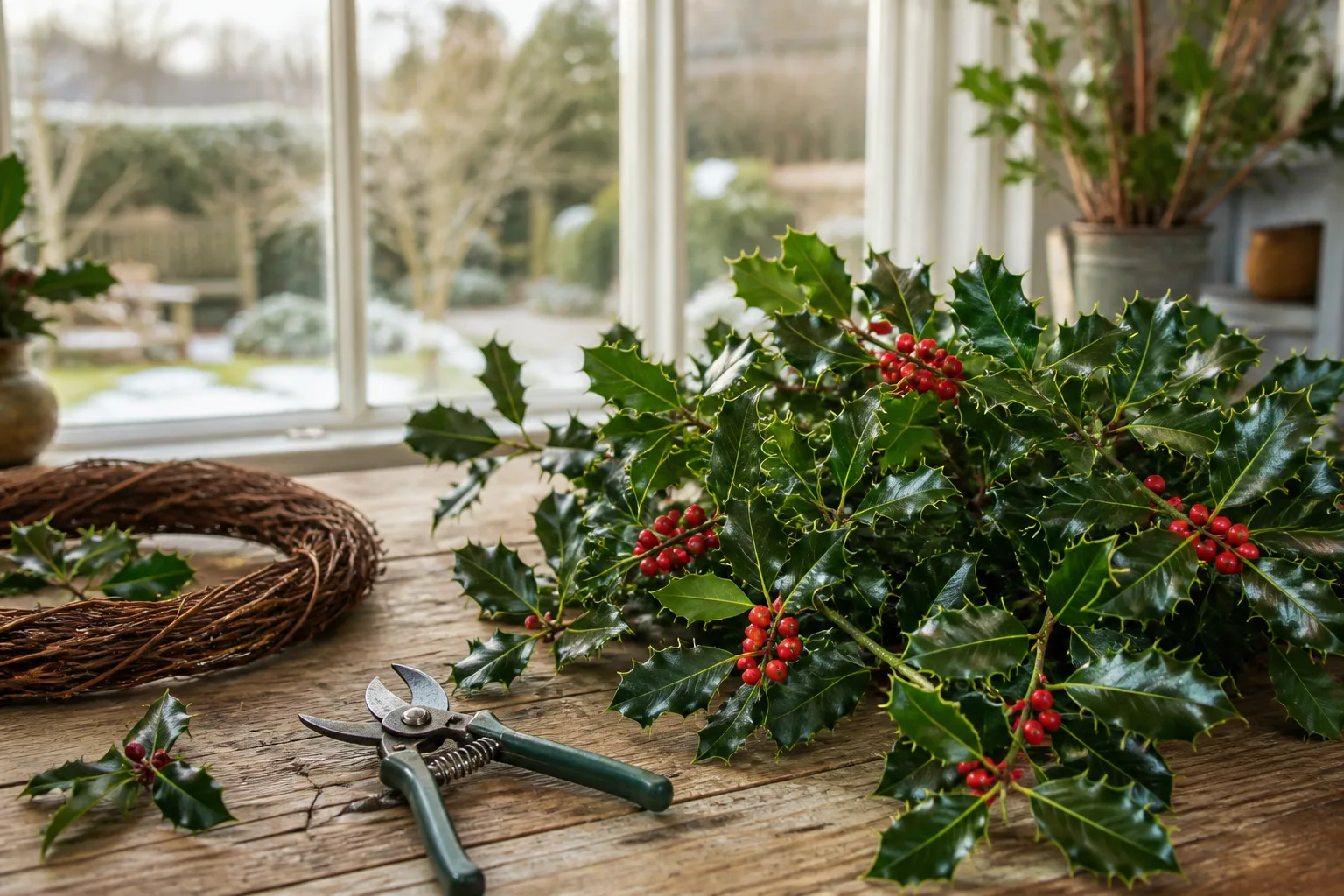
16. Holly-and-berry tree. Layer cut holly, winterberry, or another locally appropriate evergreen against a board or in a tall container to create a dense triangular arrangement. Wear gloves with prickly foliage, keep berries out of the reach of children and pets, and discard the display once the stems become brittle.
17. Rosemary topiary. A cone-shaped rosemary plant can serve as a fragrant tabletop tree and later return to a sunny growing spot. Decorate with tiny, light ornaments only. It is a living plant, not a cut bouquet, so protect it from hot air vents and do not let the pot sit in water.
18. Potted Norfolk Island pine. A small Norfolk Island pine has a tree-like silhouette without the scale of a cut tree. Use miniature ornaments and gentle lights, rotate the pot if one side leans toward a window, and plan its post-holiday light and watering routine before you buy it.
Paper, cardboard, and fabric
19. Kraft-paper accordion tree. Fold wide sheets into an accordion, fan them open, and stack or hang the forms in graduated sizes. Kraft paper gives a warm, quiet look and can be flattened for storage. Use battery lighting placed in front of the paper rather than a hot bulb pressed against it.
20. Corrugated-cardboard forest. Cut several simple tree silhouettes from clean shipping boxes and vary their heights. Score or slot the pieces so they stand without glue, then paint only if you want a color block. The flat-pack construction is ideal for a guest room, storefront-like entry, or playroom.
21. Felt tree forest. Make a group of felt cones or flat felt trees in two or three colors. The soft edges are forgiving around children, and the pieces can become garland accents or gift tags later. Place the largest tree on a stable surface and keep tiny detachable pieces away from toddlers.
22. Yarn-wrapped cones. Wrap yarn around foam, cardboard, or paper cones to build a cluster of miniature trees. Mix one thick yarn with one smooth yarn for contrast, but secure the starting and finishing ends so the display does not unravel when moved.
23. Fabric-ribbon trees. Gather leftover ribbon, fabric strips, or bias tape around cone forms. This lets you coordinate the display with curtains, napkins, or gift wrap without buying a new ornament collection. Use a washable, colorfast material if the trees will sit near food or a humid kitchen.
24. Paper-rosette tree. Layer folded paper rosettes from large at the bottom to small at the top on a backing board. Leave some wall or board visible so the shape does not become a solid triangle. Metallic paper can catch light, but it should stay away from hot bulbs and flame.
25. Origami tree wall. Fold a collection of paper trees in one size or a controlled range of sizes, then arrange them as a forest or one large silhouette. This is slow in the best way: it turns decorating into a group activity and stores in a shallow box with tissue between the pieces.
26. Gingerbread tree. Bake star-shaped cookies in graduated sizes and stack or hang them into a tree. Use a firm base and accept that this is a short-lived edible centerpiece, not an heirloom. Keep it covered if pets are likely to investigate and replace pieces when they soften.
27. Dried-flower tree. Arrange dried flowers, grasses, and seed heads in a tree outline on a backing board or fabric. The restrained colors suit a natural room, and the material can be composted when finished if it has not been treated with paint, glitter, wire, or synthetic foam.
Wood, metal, and upcycled materials
28. Plywood slat tree. Cut or arrange wood slats from shortest to longest around a center spine. A shallow wall version gives a clean Scandinavian feel; a freestanding version needs a wide foot or weighted base. Sand every edge and use only decorations that the structure can comfortably support.
29. Pallet herringbone tree. Reuse sound pallet boards in a zigzag or herringbone pattern. Check for a legible heat-treatment mark, remove nails, sand splinters, and seal the finished piece. This has visual weight, so it works best as a single focal object rather than part of a crowded vignette.
30. Wooden-dowel tree. Join dowels in horizontal lengths that grow toward the bottom, then hang them from a central cord or attach them to a narrow spine. The open framework lets the wall show through and makes a small collection of ornaments look more abundant.
31. Copper-pipe tree. Build a geometric cone or triangular frame from copper pipe and fittings, then wrap it with lights. Metal conducts heat and can be heavy when loaded, so keep the lighting low-heat, use a stable base, and inspect every joint before hanging anything.
32. Antique-spindle tree. Stack or mount turned spindles to suggest a tree, using their varied profiles as the decoration. This suits a vintage or farmhouse room and can live as a sculptural object year-round. Anchor tall versions to prevent a narrow piece from tipping.
33. Dress-form tree. Cover a dress form with a light layer of greenery, fabric, or ribbon to create a tree for a craft room or bedroom. Keep the center of gravity low and avoid attaching heavy ornaments to the shoulder line, where the form can become unstable.
34. Floating-shelf tree. Install three or more shelves in descending lengths to create a triangular outline, then style each one with ornaments, books, or greenery. Anchor shelves into the appropriate wall structure, leave a little air between levels, and treat the shelves as furniture rather than temporary hooks.
35. Bicycle-wheel tree. Stack or hang small wheels vertically, adding ribbons and ornaments so the circular forms create an abstract tree. This is a playful upcycle for a garage, studio, or covered porch. Remove grease and sharp protrusions first, then secure every wheel against rotation.
Tabletop, edible, and plant-based options
36. Pinecone cone. Glue or stack pinecones around a cone form for a textured centerpiece. Keep the natural brown color or add a light dusting of paint, but avoid loose glitter around food. The finished cone is heavy enough to look substantial and small enough for a mantel or sideboard.
37. Bottle-brush forest. Cluster miniature bottle-brush trees in different heights and colors on a tray. A group creates more presence than one tiny tree, and the tray makes the display easy to move for meals. Keep the palette to a few colors so the collection reads as one scene.
38. Present-stack tree. Stack empty boxes or wrapped gifts from largest to smallest, then top the pile with a star or bow. This doubles as a package display, but do not use fragile wrapped boxes as structural supports if children or pets may pull at the lower layers.
39. Poinsettia-and-evergreen centerpiece. Combine poinsettias, cut evergreen, berries, and dried stems in a broad container to create a low tree-like focal point. This is a better replacement for a dining-table tree than a tall cone because it keeps sightlines open. Protect the table from water and place candles well away from foliage.
40. Fruit-and-greenery tree. Arrange citrus, apples, or pomegranates with evergreen sprigs in a tiered bowl or cone-shaped stand. The color and scent make the display feel generous without additional ornaments. Rotate fruit as it ripens and remove any piece that softens or leaks.
41. Living succulent tower. Build a vertical arrangement of rosette succulents in a tiered planter or shallow wall planter. It reads as a contemporary tree, especially with a few wooden or ceramic ornaments, but it needs bright light and careful watering. Do not treat a dim holiday corner as a permanent growing location.
42. Ceramic-tree village. Group ceramic or wooden tree figurines in a loose forest across a mantel or sideboard. Vary height, finish, and spacing instead of lining them up evenly. This is the easiest no-mess choice for a home that needs a low display, and every piece can return to a small shelf after January.
How to Build a Wall or Branch Tree That Holds Up
Plan the silhouette and anchor points
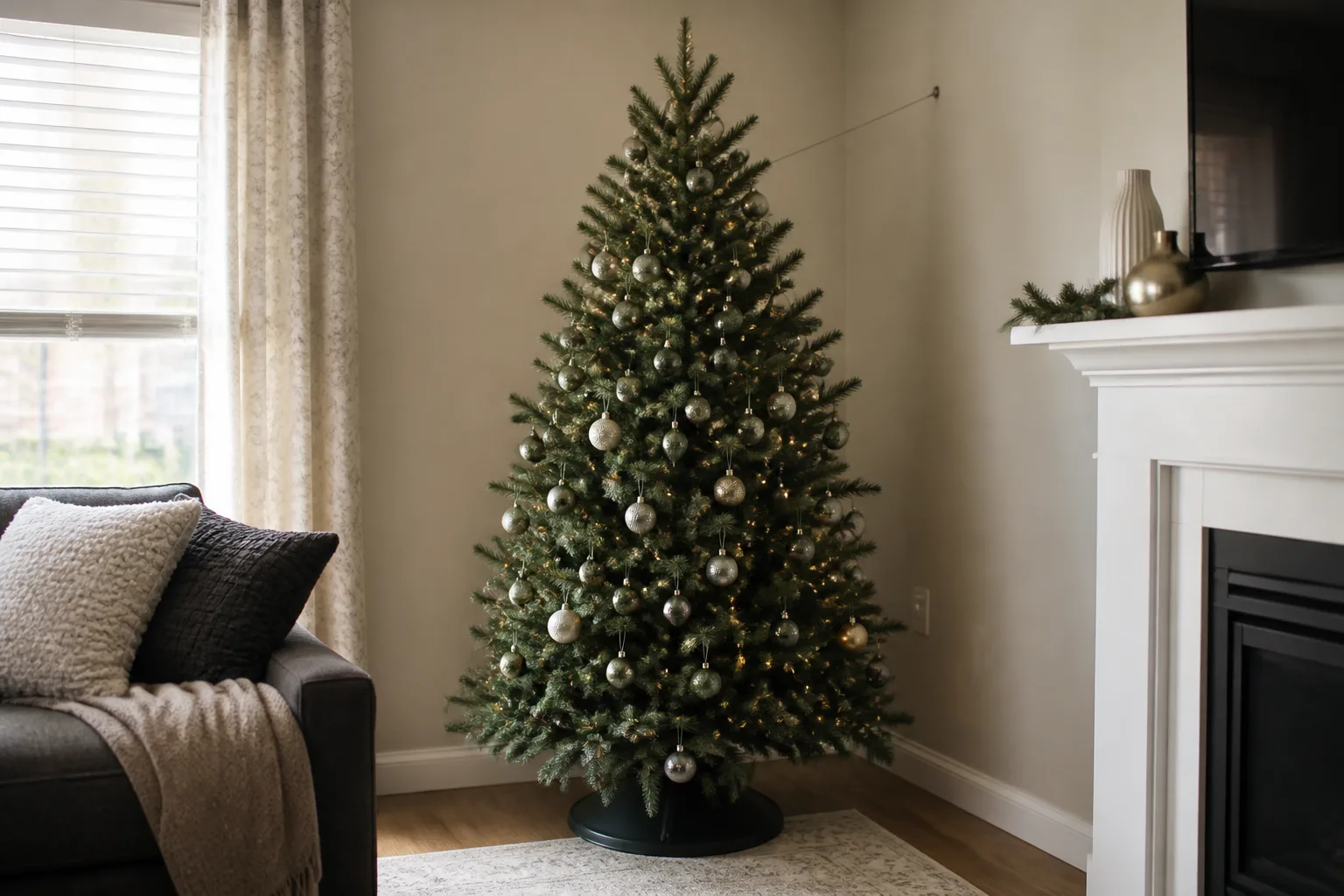
Start with painter’s tape or removable paper pieces to map the triangle at full scale. Stand across the room and check whether the base is wide enough, the peak is centered, and the display sits above furniture rather than competing with it. A quick outline catches proportion mistakes before you cut branches or attach adhesive.
Next, mark the points that carry weight: the peak, the two lower corners, the center spine, and any place where a branch changes direction. Use hardware that matches the surface and the load. Removable strips are for appropriately light, smooth-surface items; they are not a universal solution for plaster, textured walls, damp rooms, or heavy wood.
For a branch tree, make the structure slightly smaller than the space you measured. Branch ends need room to flex, and a vase or backing board needs a safety margin so a person brushing past it does not turn the display into a falling object. Build from the center out, then add the lightest decorative layer.
Add lights and ornaments safely
Put the light source on before the delicate ornaments. It is easier to hide a cord behind garland or a backing board than to thread it through a finished display, and you can check the silhouette while the lights are still the main feature. Battery packs should remain accessible, and extension cords should never become a trip hazard.
Use lightweight decorations on paper, fabric, and narrow branches. Put heavier ornaments low and close to a sturdy anchor, not at the end of a flexible twig. A useful rule is to hang one test ornament, wait a few minutes, and check for sagging before repeating the pattern across the whole display.
If you want the display to feel abundant, vary depth instead of adding weight. A few ornaments close to the wall, a few near the branch tips, and some empty space create dimension without asking a flat structure to behave like a full tree. The same principle makes a tabletop cluster look intentional rather than crowded.
How to Make the Display Feel Like a Tree
The eye recognizes a tree through a few cues: a tapering shape, a clear top and base, upward or radiating lines, and a focal point near the crown. You do not need all four, but repeat at least two. A light outline supplies silhouette and sparkle; a branch fan supplies silhouette and natural lines; a ceramic village supplies taper and repetition.
Use a simple palette. One main color, one supporting neutral, and one texture are usually enough for a small alternative. If the material is already visually loud—red gingham, multicolor yarn, copper pipe, or patterned fabric—quiet the ornaments. If the structure is nearly invisible, repeat one strong color at the tips or add a single line of lights so the shape reads from the doorway.
Give the display a base even when it has no trunk. A small rug, tray, stack of wrapped gifts, painted rectangle, or low basket tells the eye where the tree ends. On a wall, a horizontal ledge or a few presents can create that grounding line. Without a base, a floating triangle can look unfinished rather than intentionally weightless.
Finally, edit from a distance. Take one step back, then look from the room’s entrance and from the seat where you will spend the most time. Remove the decoration that interrupts the silhouette or duplicates a color already doing the work. Alternative trees look strongest when the unusual material remains visible.
Storage, cleanup, and next-year reuse
Choose a storage plan before you choose a construction method. Fold-flat ideas belong in a shallow portfolio or under-bed box; disassembled wood or metal needs labeled bundles; fresh greenery needs to be removed before it becomes brittle; edible displays go into the compost or trash according to the material and your local rules. Do not store damp branches, fabric, or paper together.
Photograph the finished arrangement before taking it down. That reference is more useful than a label such as “Christmas wall” because it records the spacing, anchor locations, and which pieces looked balanced. Keep a small envelope with the template, hardware, battery type, and any measurements that you would otherwise have to rediscover next December.
Clean decorations before packing them. Brush crumbs from edible or natural displays, wipe dust from ceramic and wood, let fabric dry completely, and coil lights loosely without tight bends. Separate fragile ornaments with tissue or soft cloth, and store small pieces in a lidded container so they do not disappear into a larger box.
Reuse is more than keeping something in a closet. A canvas can become seasonal wall art, a pegboard can return to a craft station, dowels can become a photo display, branches can move to a winter vase, and a potted plant can continue growing. If the only future use is “maybe next year,” the simplest flat or edible option may be the more honest choice.
Safety checks for lights, paper, greenery, and pets
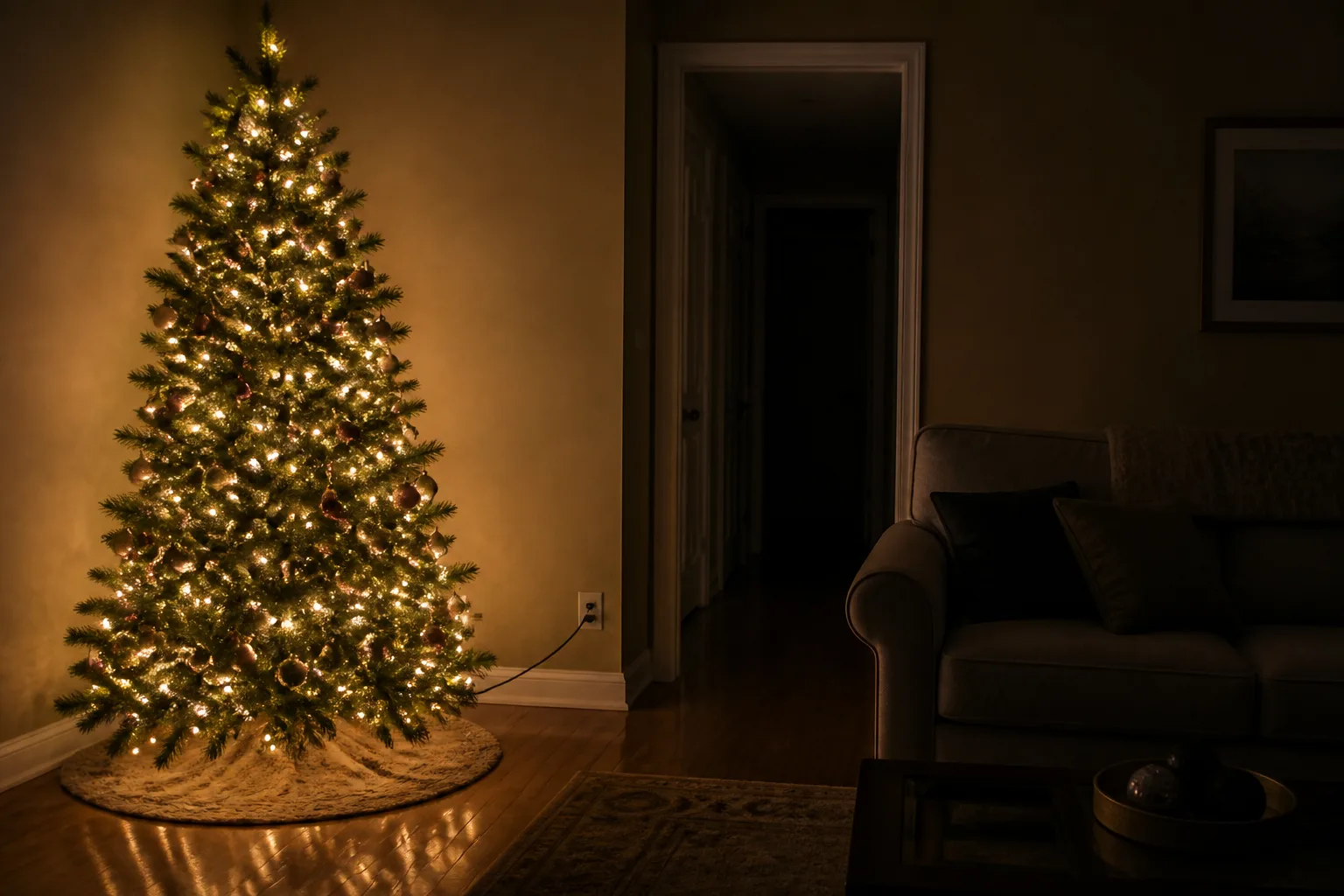
The U.S. Fire Administration says to inspect holiday lights, discard strands with frayed or pinched wires, follow the manufacturer’s limit for connected strands, keep a tree at least 3 feet from heat sources, water a live tree daily, and remove it when it becomes dry. Those rules still matter when the “tree” is made from branches, paper, fabric, or a potted plant because the surrounding lights and heat sources have not changed. (U.S. Fire Administration holiday fire safety)
The U.S. Consumer Product Safety Commission likewise advises watering live trees, looking for a fire-resistant label on artificial trees, keeping burning candles in sight and away from flammable items, avoiding overloaded outlets, and not connecting more than three sets of incandescent lights. For an alternative display, the practical translation is simple: use flameless candles near dry material, keep paper and fabric away from hot bulbs, and do not hide a questionable cord behind a pretty silhouette. (U.S. Consumer Product Safety Commission holiday safety)
Treat stability as a safety issue, not just a design issue. Anchor tall displays, keep freestanding pieces out of walkways, use shatter-resistant ornaments where children or pets can reach, and place battery packs or loose cords where they cannot be chewed or pulled. Avoid tinsel, tiny detachable pieces, sharp wire ends, and unknown berries when the display is accessible to animals or young children.
Fresh greenery needs its own check. Longfield Gardens recommends cutting branches with sharp pruners, making a fresh angled cut, placing stems in water, changing the water every few days, and moving flowering branches to a cooler spot once blooms open. Branches that have had enough winter cold may flower indoors, but cut stems still need monitoring for water loss, dropped needles, mold, and brittleness. (Longfield Gardens guide to forcing branches)
If you are choosing between several ideas, favor the one that keeps exits clear, uses the fewest hot or fragile components, and can be switched off or removed without climbing on furniture. A small, well-anchored wall tree is safer than an overloaded tall display, and a plain branch vase is safer than one packed with dry material beside a candle.
Conclusion
The best alternative Christmas trees solve a real problem while still giving the room a place to gather around. Choose a wall display when floor space is scarce, branches or a potted plant when texture and fragrance matter, paper or fabric when storage matters, and wood or metal when you want a durable object that can return every year.
Once you choose the material, make the silhouette first, test the anchors with the heaviest decoration, and add lights and ornaments in layers. Keep heat, cords, falling objects, and drying greenery in view. A smaller or stranger tree can feel more festive than a conventional one when every part has a clear job.