9 Great Climbing Rose Varieties Compared
See how nine climbing roses differ in color, flowering season, fragrance, and height, with tips for matching each variety to your support and climate.
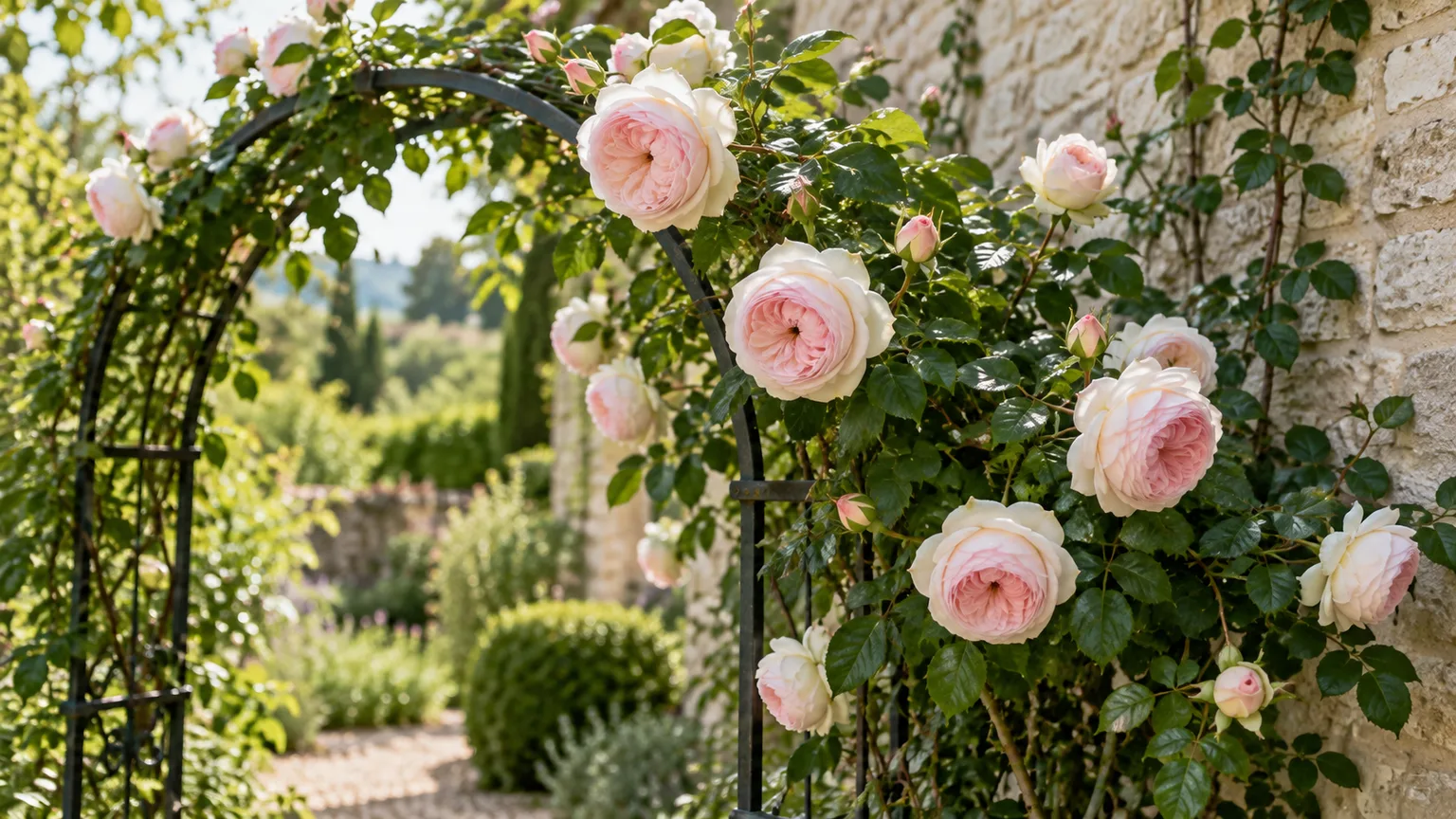
A climbing rose can give you a long season of flowers on a fence or a spectacular early-summer flush over an arbor, but those are different jobs. The nine roses below range from compact repeat bloomers to old-fashioned plants with long canes and one concentrated flowering period. Choose by mature scale, bloom schedule, and the exact color and flower form you want—not by a photo of a rose covering a structure much larger than your own.
The words “climber” and “rambler” are useful starting points, but cultivar labels and local growing conditions matter more than a broad category. Heights and hardiness ranges can differ among nurseries, especially for older roses, so treat published figures as planning estimates and confirm the specific plant with a regional grower before you buy.
Start with the flowering habit and the support
Climber and rambler are useful labels, not guarantees
Roses do not cling by themselves. They lack tendrils or adhesive roots, so gardeners tie their long canes to wires, a trellis, an arbor, or another sturdy support. A climbing rose generally has stronger main canes and can repeat flowers through much of the season; a rambler often has more flexible, vigorous growth and a large single flush. Those patterns have exceptions, so the named cultivar and its flowering record should guide your decision.
The Royal Horticultural Society describes repeat flowering through summer and into autumn as typical of climbing roses, while ramblers usually flower once around early summer. That distinction is useful for anticipating the display, but do not use it as a substitute for the plant label: older roses and climbing sports may be sold inconsistently. If bloom history is uncertain, ask the nursery whether flowers form on the previous year’s growth or repeat on newer laterals before pruning.
Use mature size and exact cultivar name before color
Measure the support and decide how much of it the rose should cover. A 5- to 7-foot miniature climber can be managed on a small pillar; a rose listed at 15 feet or more needs a broader or taller frame and more room to spread side shoots. If the support is narrow, a long, vigorous plant will not become compact simply because you prune it hard.
Confirm the full cultivar name, growth form, expected height and width, flowering habit, and locally recommended hardiness before ordering. A cultivar may have a similar-looking shrub form, and the same rose can be listed at different heights by different nurseries. A zone range describes expected winter cold tolerance, not summer heat, humid weather, or resistance to black spot. For a dependable example of the value of an exact plant record, NC State Extension documents New Dawn as a large, repeat-flowering climber with a specific mature size rather than treating all climbing roses as interchangeable. (NC State Extension Plant Toolbox, Rosa ‘New Dawn’)
Nine climbing roses worth comparing
These cultivars make different impressions even when they share a wall or arbor. Use the flower color and habit as your shortlist, then check the current plant tag for size and local suitability; names and catalog descriptions are not always consistent across sellers.
Danse du Feu
Danse du Feu is a red-flowered climbing floribunda suited to gardeners who want clusters of color instead of a few isolated, high-centered blooms. Its semi-double flowers read as clear, warm red from a distance, and their light fragrance is more subtle than the deep perfume of many old garden roses. The plant is usually described as a medium-to-tall climber, so give it a frame with room for several long canes rather than a tiny decorative obelisk.
Its appeal is a repeat display: flowers can return in flushes during the warm season, though a reblooming rose does not stay covered with flowers every day. That makes it a useful choice where a red focal point should last beyond one early-summer week. Give it a sunny, airy position and check how it performs locally; “floribunda” does not guarantee immunity from foliar disease or an identical bloom rhythm in every climate.
Souvenir du Docteur Jamain
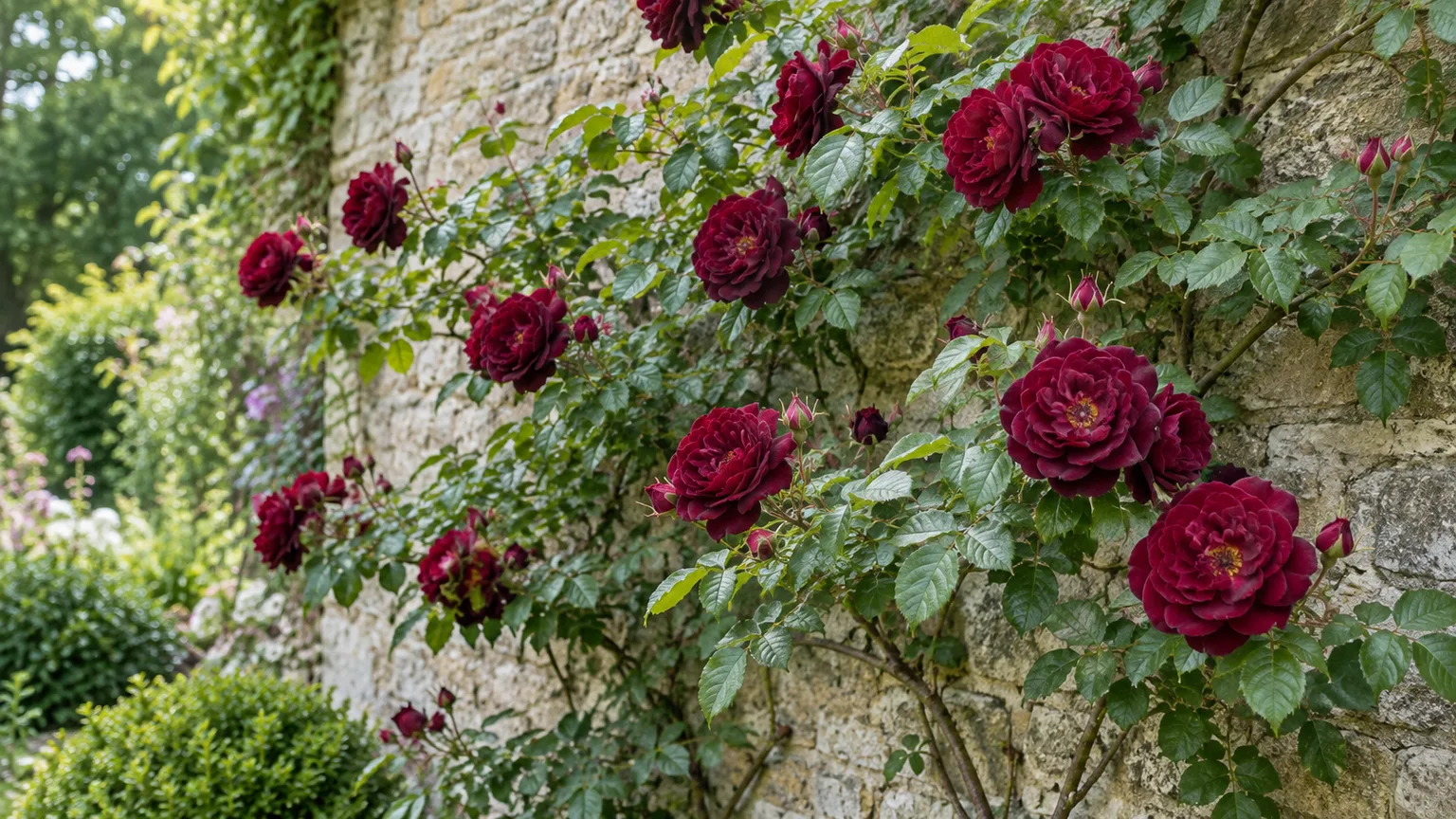
Choose Souvenir du Docteur Jamain for an old-fashioned, velvety bloom in deep burgundy, wine, or plum tones with a strong traditional rose fragrance. It is a Hybrid Perpetual introduced in 1865 and is often sold as a rose that can be trained as a climber or grown more like a shrub. Gardenia lists a typical height of roughly 5 to 10 feet, but sellers may report a different mature size, so confirm the form and scale on the label.
This cultivar is the most compelling choice in this group for a bright, lightly shaded wall, particularly where harsh afternoon sun fades or scorches dark petals. The English Garden and Gardenia both describe its tolerance for partial shade; that means useful daylight with several hours of sun or bright open shade, not a deep, tree-covered corner with little air movement. (The English Garden, “Best Roses for Shade”; Gardenia, Souvenir du Docteur Jamain)
Fourth of July
Fourth of July is the obvious pick if you want a climbing rose with a graphic red-and-white stripe rather than a solid-color flower. Its semi-double blooms open in clusters and carry a light, sweet fragrance, so the display feels lively rather than formal. The Missouri Botanical Garden lists it at 10 to 14 feet tall, recommends full sun, and records USDA zones 5 through 9; that makes the plant a better fit for a fence, arch, or larger trellis than a small patio frame. (Missouri Botanical Garden Plant Finder, Fourth of July)
This is a repeat-blooming cultivar, but expect waves with pauses between them rather than uninterrupted color. Use the striped flowers as the central feature of a support and avoid crowding them with another strongly patterned vine. The Missouri Botanical Garden also notes that full sun generally supports stronger flowering and disease resistance; in a very hot location, assess the cultivar’s performance locally rather than assuming a zone range predicts heat tolerance.
Alchymist
Alchymist is for gardeners who want a nostalgic, highly petaled flower in shifting apricot, gold, peach, and warm pink tones. The large, densely layered blooms have a strong fragrance and make a dramatic seasonal event, but the cultivar is generally treated as a once-flowering rose. Its main flush can be spectacular; after it passes, the plant contributes foliage and structure rather than another equally generous round of roses.
Set aside enough space to appreciate the flower display without expecting the rose to bloom continuously. A plant that flowers once is not necessarily a poor choice: it suits a garden built around a spring or early-summer highlight, especially if other perennials and shrubs take over later. Before pruning, verify the label and bloom habit for the exact plant being sold as Alchymist because the consequence of cutting at the wrong time is losing the next year’s main display.
Clarence House
Clarence House brings a softer palette to the list: creamy, rounded blooms with many petals and a refined, old-fashioned appearance. It is often described as a modern climber with a heavy early-summer flush followed by another period of bloom when cooler weather returns. A mature plant is commonly sold in the 10- to 12-foot range, so plan for a substantial wall or arbor and keep enough access to tie and inspect the canes.
Its cream-colored flowers suit gardens where bright red or pink would dominate the planting. The best display will come from giving the rose adequate light and not packing it against a hot, reflective wall; light shade may protect pale petals during a scorching afternoon, but deep shade reduces the energy available for flowers. Ask the seller about repeat performance in your region, as a second flush may be modest in a short or very hot growing season.
May Queen
May Queen is the largest-space choice here. It is a vigorous rambler with long, flexible canes and lush, densely petaled pink flowers that typically appear in one main spring-to-early-summer flush. Listings commonly place its mature canes around 15 to 25 feet, although climate, pruning, and support conditions change the final reach. Choose it for a tall fence, a broad pergola, or a dedicated large frame—not for a narrow arch over a doorway.
The long growth makes May Queen rewarding when you want abundant flowers high above a garden path, but it also makes access important. A mature rambler is harder to manage if it is planted where you cannot reach the canes or where its thorns would snag people passing below. Give the plant its own sturdy support rather than allowing it to scramble into a tree; the structure will be easier to inspect, prune after flowering, and keep clear of roofs or gutters.
Dublin Bay
Dublin Bay is a useful choice for a clear, saturated red flower that is more refined than the candy-striped Fourth of July. It produces semi-double blooms with a light fragrance and is generally listed as a repeat-flowering climber. A typical nursery range is about 8 to 12 feet, making it a medium-size option for a tall fence or arbor where you want color from lower laterals as well as the top.
Its dark foliage and red petals make it a strong focal point against pale walls or green garden backgrounds. A climber’s flowers can concentrate near the upper canes when those canes are left straight up, so plan to spread flexible growth across the support instead of letting it form a narrow column. Do not rely on a catalog description such as “disease resistant” as a promise: local rainfall, airflow, and cleanup affect how well leaves hold up through the season.
Eden
Eden, also sold as Pierre de Ronsard, is the romantic, large-flowered choice. Its cupped, densely petaled blossoms combine cream and pale green outer petals with richer pink toward the center, giving each flower a softer, layered look than the brighter reds in this group. The climbing form is commonly listed at about 6 to 10 feet, but sellers can differ on mature width and rebloom; confirm you are buying the climbing form, not a shrub rose with a similar name.
Use Eden where its heavy blooms can be seen at eye level, such as an arch, a broad trellis, or the front of a pergola. Because fully double flowers can be heavy and packed petals dry more slowly after rain, leave room around the plant and choose a site with good air movement. Its romantic appearance is not a reason to place it in deep shade or against a wall that keeps the foliage wet; it still needs conditions that let leaves dry and canes mature.
Warm Welcome
Warm Welcome is the compact option among these nine. This miniature climbing rose is commonly listed around 5 to 7 feet tall, with bright orange-red flowers and reliable repeat bloom. It can be easier to place beside a patio or on a small pillar than a vigorous rambler, though “miniature” describes the rose’s relative scale, not a plant that can be ignored or planted in a tiny pot without care.
Choose it when a small support needs color but you still want the look of a trained rose. The container option is possible only with a large, well-drained pot, regular root-zone checks, and winter protection appropriate to your climate; the small dimensions do not remove the needs of a rose’s roots. Ask whether the plant is being sold as Warm Welcome or under its alternate name Chewizz, and keep the label so future pruning advice matches the cultivar.
Compare the nine by bloom schedule, scale and display
| Variety | Flower character | Typical display | Approximate scale |
|---|---|---|---|
| Danse du Feu | Clustered, semi-double red | Repeat flushes | Medium to tall |
| Souvenir du Docteur Jamain | Velvety wine or plum, fragrant | Repeat or flushes; verify listing | About 5–10 ft in some listings |
| Fourth of July | Red-and-white stripes | Repeat flushes | 10–14 ft per Missouri Botanical Garden |
| Alchymist | Highly petaled apricot and gold | One main seasonal flush | Medium to tall |
| Clarence House | Cream, densely petaled | Early flush; may repeat in cooler weather | Often around 10–12 ft |
| May Queen | Full pink flowers | One main seasonal flush | Long canes, often 15–25 ft |
| Dublin Bay | Clear red, semi-double | Repeat flowering | Often around 8–12 ft |
| Eden | Cupped cream and pink | Repeat in flushes | Often around 6–10 ft |
| Warm Welcome | Orange-red miniature blooms | Repeat flowering | Often around 5–7 ft |
Use the table to narrow the list, not to make a final purchase from a size number alone. The same cultivar may be described differently by regional nurseries, and a rose trained on a fence can reach farther sideways than its “height” suggests. If the actual support is less than the listed height, choose a compact cultivar rather than planning to hold a vigorous plant small with severe pruning.
The range runs from Warm Welcome, which can fit a modest pillar or patio frame, to May Queen, which needs room for long canes and a large mass of growth. For a medium trellis, compare Dublin Bay, Souvenir du Docteur Jamain, and Eden, then choose by color, fragrance, and local performance. For a strong repeat display in a large frame, Fourth of July is a better-documented choice because the Missouri Botanical Garden gives its size, hardiness range, and sun preference in one profile.
Match a rose to the wall, arbor, fence or small frame
Start with the structure rather than the nursery photograph. A fence with several horizontal wires can support canes distributed across its width; a tall arch needs a rose with flexible growth that can be trained without forcing mature wood around tight curves. A narrow post or obelisk is a poor match for a huge rambler unless you are prepared to renew canes and keep growth within its footprint.
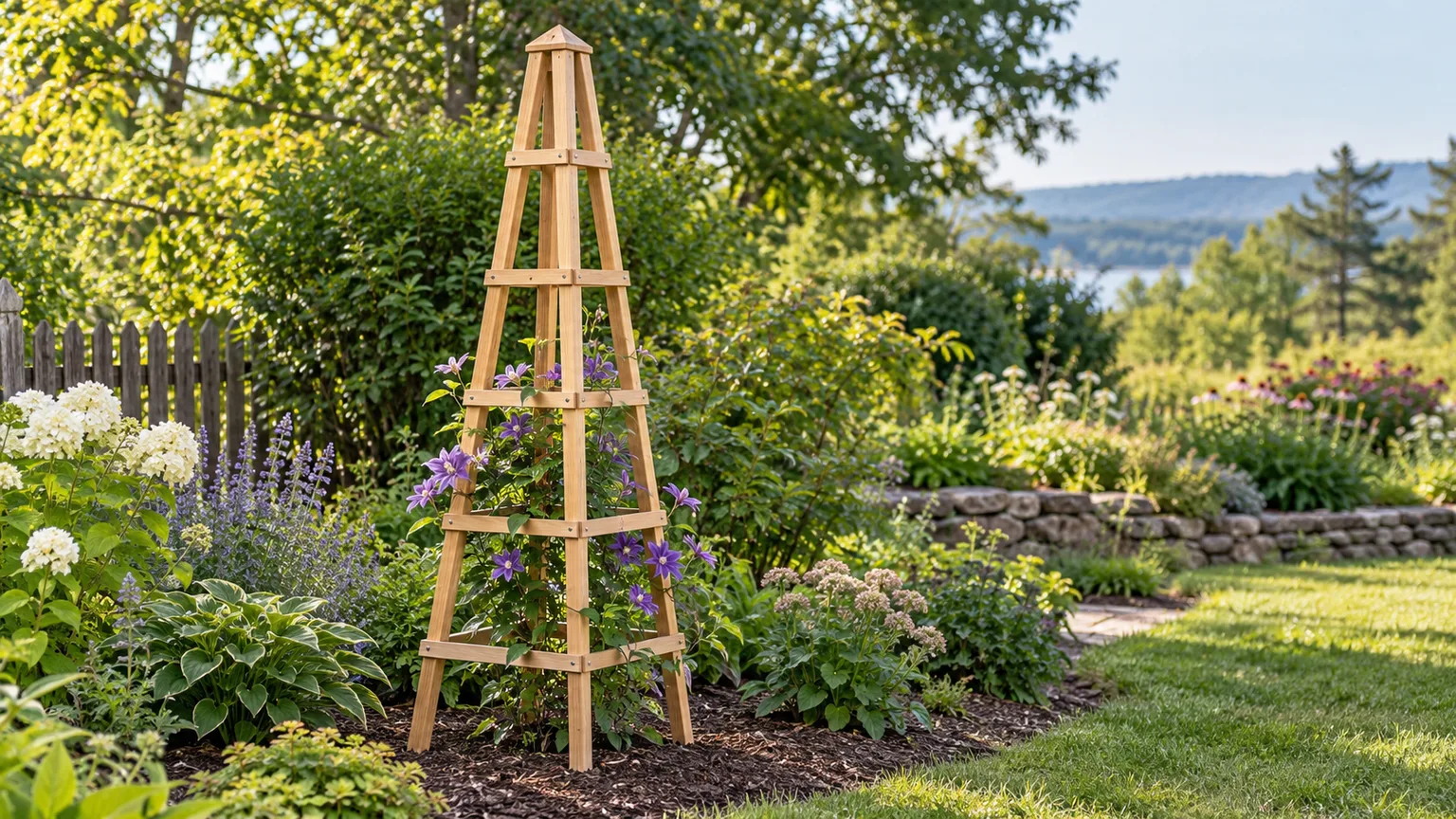
Roses are trained by tying, so leave room for hands and pruning tools behind or beside the support. Avoid fastening canes directly to a wall in a way that traps wet foliage against it; a stand-off trellis or horizontal wires improve access and airflow. The RHS notes that climbers are not self-clinging and recommends tying their shoots to a support; for step-by-step training details, see our guide to training and pruning climbing roses. (RHS climbing-rose pruning guide)
For a small frame, Warm Welcome is the logical starting point. A medium fence or arch can accommodate Eden or Dublin Bay, while Fourth of July’s reported 10- to 14-foot height calls for more space. May Queen’s long canes should be treated as a landscape-scale feature; planting it next to an undersized trellis usually turns the rose into a maintenance problem rather than a focal point.
Choose between a single flush and repeat flowers
The most important difference after size is the season of display. Repeat bloomers can produce several waves through summer, but they still need time and healthy foliage between flushes. Once-flowering roses concentrate their energy into one large display; they can be the better choice when you want a dramatic early-season event and are content with foliage for the rest of the year.
From this group, Alchymist and May Queen are generally selected for their single main flush; Danse du Feu, Fourth of July, Clarence House, Dublin Bay, Eden, and Warm Welcome are usually presented as repeat bloomers. Souvenir du Docteur Jamain is sold as a Hybrid Perpetual with repeat or flush flowering, but compare current seller descriptions before buying because historical class names are not a promise of continuous flowers. The RHS uses flowering time to distinguish the typical climber and rambler habits, while also treating them as separate pruning groups. (RHS climbing-rose pruning guide)
This choice changes when you prune. A once-flowering rose that blooms on older canes can lose its next display if you cut those canes in late winter; routine shaping is often done soon after flowering. Repeat-flowering climbers are generally pruned in the dormant season or as growth resumes, depending on region and cultivar. Follow a cultivar-specific guide rather than cutting all roses to the same height.
Set expectations for sun, climate and disease pressure
Most roses in this group will flower best in a sunny, open site with soil that drains well. The exception is not “shade-loving” in the sense of thriving in darkness: Souvenir du Docteur Jamain may hold its dark petals better when it receives bright shade or protection from the strongest afternoon sun. The English Garden highlights this cultivar’s tendency to fade or scorch in harsh sun; Gardenia also describes it as suited to partial shade. Check your own exposure through the day, because a wall can reflect heat even when it is not south-facing.
Hardiness is only one part of matching a rose to place. The Missouri Botanical Garden lists Fourth of July for USDA zones 5–9, but that number cannot tell you how it handles a humid summer, repeated rain, coastal wind, or a long spell of heat. Seek a regional source for winter survival and disease performance, then consider whether the site gives leaves enough space to dry after rain.
Give the roots consistent moisture without leaving them waterlogged, and avoid crowding a rose against dense shrubs. Good airflow, removal of diseased leaves, and watering at the soil surface can reduce common foliage problems, but no variety should be treated as disease-proof. If black spot or mildew is a recurring issue in your garden, local rose-society or extension advice is more useful than an old catalog claim.
Buy a named plant and verify the climbing form
Before purchase, read the full tag and ask the seller for the plant’s exact registered or commonly accepted cultivar name. Check whether it is a climber, a rambler, a shrub trained as a climber, or a separate climbing sport. This is especially important when names are shared across plant forms: a photograph can show a large trained rose while the item in the cart is a smaller shrub selection.
Then confirm four details: likely mature height and spread, whether it flowers once or repeats, the recommended pruning window, and the winter range reported by a source for your region. If a seller can only offer a general label such as “red climbing rose,” you cannot reliably know how large it will get or when it will bloom. Keep the tag, plant invoice, and any care notes; they make it much easier to verify identity if flowers do not match the picture.
Look for strong, healthy canes and a sound root system, but do not judge a young plant by how many flowers it has at the nursery. Many roses need time to establish before they make their best display. If the exact cultivar is unavailable, choose a substitute by the same job—similar mature size and bloom schedule—rather than buying a famous rose that does not fit the support.
Conclusion
A good climbing rose choice starts with the size of the structure and the flowering season you want. Choose Warm Welcome for a smaller frame, May Queen for a large support and a single dramatic flush, Fourth of July for striped repeat flowers, or Souvenir du Docteur Jamain for deep, fragrant blooms in a bright, lightly shaded spot. Confirm the exact form and local hardiness before planting, then let the cultivar’s own bloom habit—not a generic rose calendar—guide your care.