11 Common House Spiders: Identification Guide
Found a spider indoors? Compare 11 frequent U.S. house spiders by web type, markings, and region so you know what is harmless, helpful, or worth a doctor call.
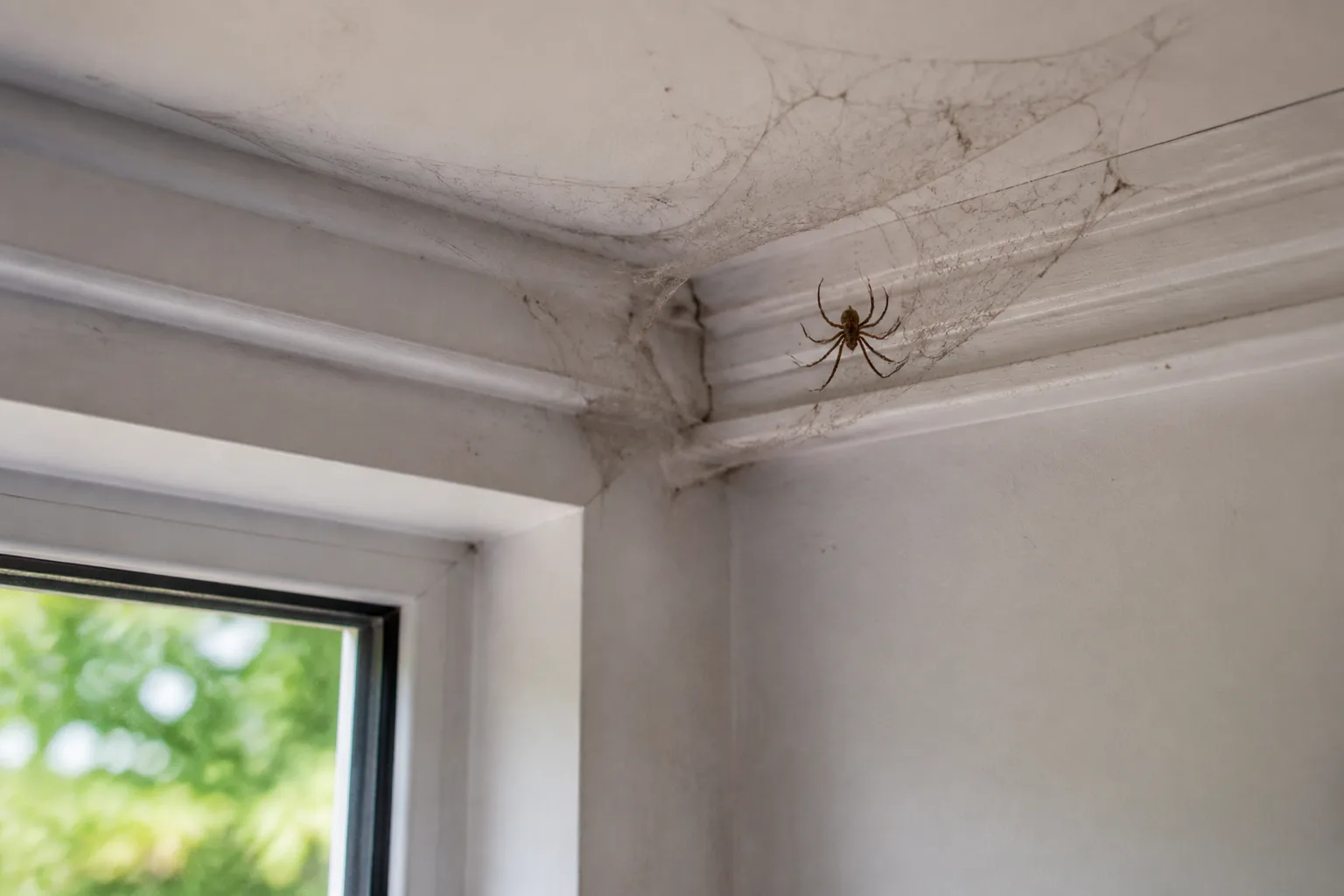
A spider on the baseboard is rarely an emergency. It is usually a sign that your home still has insects—and that an unpaid exterminator moved in to eat them. The hard part is not whether spiders exist indoors; nearly every U.S. home hosts at least a few. The hard part is knowing which spider you are looking at, whether it can hurt you, and whether swatting it solves anything.
North America has roughly 3,000 spider species, and Colorado State University Extension notes that most are harmless to humans. Only a handful show up often enough indoors to memorize. This guide walks through the 11 most common house spiders (plus one frequent lookalike that is not a spider at all), with field marks, typical rooms, bite risk, and what to do when you find one.
How to identify any indoor spider in three steps
Before you scroll species by species, run the spider through a short ID sequence. It saves panic and stops you from mislabeling a harmless cellar spider as a brown recluse because both are brown and have long legs.
Step 1 — Where is it and what is the web like? Ceiling-corner sac? Tangled cobweb? Fuzzy sheet on the floor? Perfect orb in a window? No web at all? Web architecture narrows the list faster than color alone.
Step 2 — Body shape and eyes. True spiders have two body regions (cephalothorax + abdomen) and eight legs. Jumping spiders have huge front eyes. Brown recluses have six eyes in three pairs. Harvestmen look like one oval body with legs—because they are not spiders.
Step 3 — Harm tier. Tier 1: harmless helpers. Tier 2: can bite but rarely do, and wounds stay local. Tier 3: medically significant venom—black widows and, within their range, brown recluses. Everything else on this page is Tier 1 or 2.
Web type tells you half the story
| Web type | What it looks like | Likely suspects |
|---|---|---|
| Irregular cobweb | Messy silk in corners, often dusty | American house spider |
| Long-legged tangle | Loose web in basement or garage | Cellar spider |
| Silken sac / retreat | Flat tent in upper wall corners | Yellow sac spider |
| Funnel or sheet on ground | Horizontal sheet with a hole at one end | Funnel weaver, grass spider |
| Classic orb | Spiral wheel, often on porches or plants | Orb-weaver |
| None visible | Hunting on foot | Jumping spider, wolf spider |
Sort spiders into three harm tiers before you react
Tier 1 — Harmless and beneficial. American house spiders, cellar spiders, jumping spiders, most funnel weavers, wolf spiders, orb-weavers, and grass spiders belong here. They eat flies, gnats, mosquitoes, and other spiders. UC IPM emphasizes that most funnel-weaving species in California, for example, do not cause serious injury to humans.
Tier 2 — Can bite, usually minor. Yellow sac spiders are the most likely indoor biters in some regions. CSU Extension reports painful but short-lived sac spider bites with pain fading in minutes for many people. Wolf spider bites can hurt because of size, not potent venom.
Tier 3 — Seek medical guidance if bitten. Black widows (neurotoxic venom) and brown recluses within their native range (venom that can damage skin tissue). The CDC lists both as the primary venomous spiders of concern for U.S. workers and homeowners.
American house spider — the cobweb builder you see everywhere
If you have dusty cobwebs in ceiling corners, you probably have American house spiders (Parasteatoda tepidariorum, still widely called Achaearanea tepidariorum). They are small—about 1/8 to 5/16 inch body length—with dull brown bodies and darker abdominal markings. Males often have lighter legs than females.
They are the most common spider in North American homes, from southern Canada through the United States. Webs are irregular and abandoned webs collect dust, which is why people notice them more than the spider.
Habitat: Random corners—bathrooms, closets, window frames, garages.
Bite risk: Tier 1. They can bite if squeezed, but venom is not considered dangerous to people.
What to do: Vacuum the web. If the spider is present, cup-and-card relocation works fine.
House spiders live about one to two years and reproduce year-round indoors. Keeping them often means fewer flying insects. If cobwebs bother you aesthetically, regular vacuuming is more effective than spraying.
Cellar spider — long legs in basements and corners
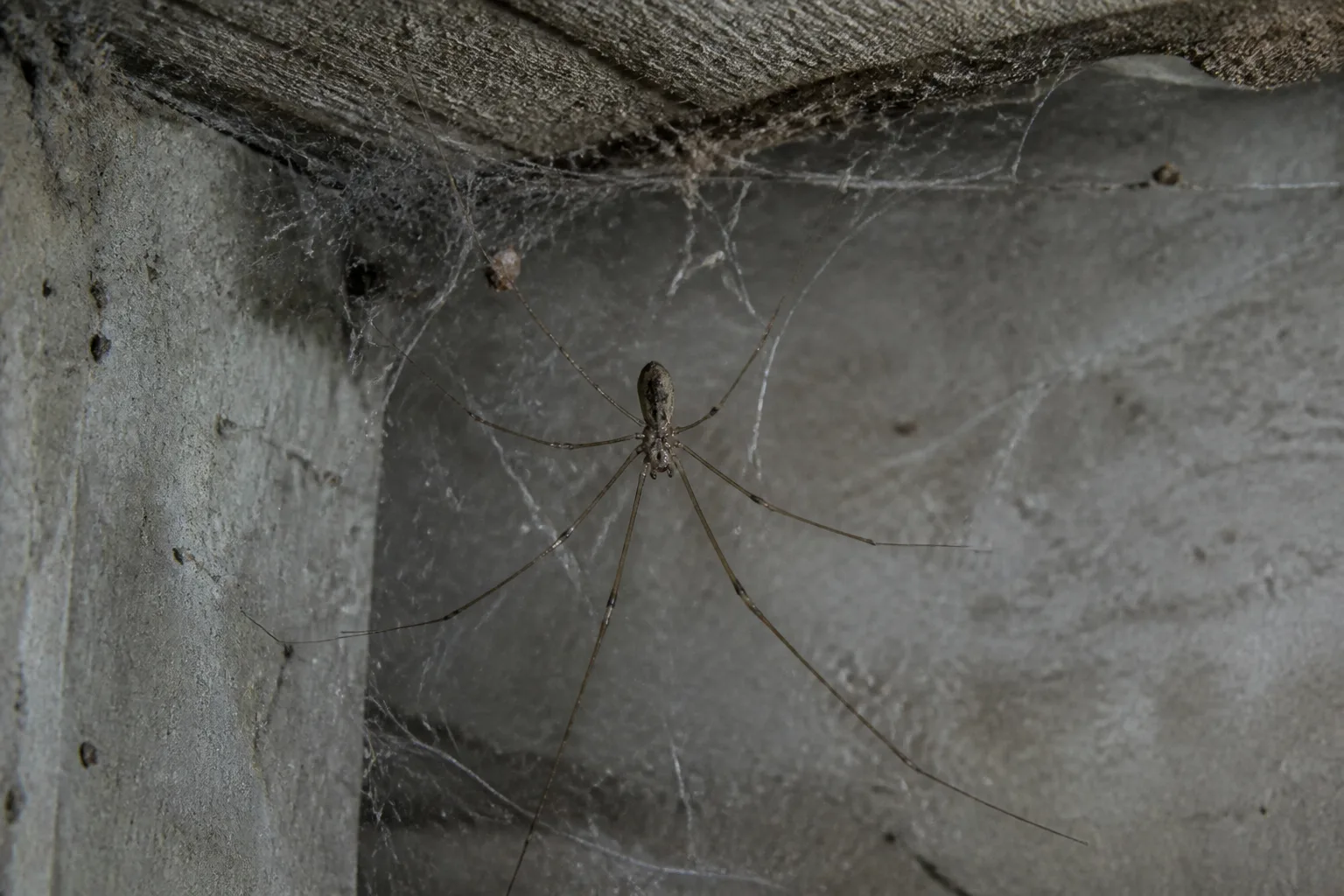
Cellar spiders (family Pholcidae) are the spindly, gray-yellow spiders bouncing in basement webs. Bodies are tiny; legs are very long. Females carry eggs loosely in their jaws until they hatch—an easy field mark if you look closely.
People call them “daddy longlegs spiders,” which creates confusion with harvestmen (covered next). Cellar spiders are true spiders with two body segments.
Habitat: Dark, humid zones—crawl spaces, garages, utility rooms.
Bite risk: Tier 1. They cannot pierce human skin easily; venom is weak.
Fun fact: They often eat other spiders, including widows, when they share space.
When disturbed, cellar spiders vibrate rapidly in the web—a defense that makes them look bigger. It also makes them easy to spot.
Harvestmen — daddy longlegs are not spiders
Harvestmen (order Opiliones) show up indoors near garages and crawlspaces, especially in fall. They have one pill-shaped body and eight very long legs. No silk, no venom, no fangs—because they are not spiders.
The myth that daddy longlegs are the “most venomous spider but fangs too weak to bite” is false on two counts: harvestmen are not spiders, and spiders in the Pholcidae family (cellar spiders) are not dangerously venomous to humans.
Habitat: Outdoors in leaf litter and wood edges; indoors in cool, damp areas.
Bite risk: None—they lack venom glands.
ID tip: Single body segment vs cellar spider’s obvious two-part body.
If it cannot make a web, it is probably not the spider you need to worry about.
Jumping spider — the bright-eyed hunter on your windowsill
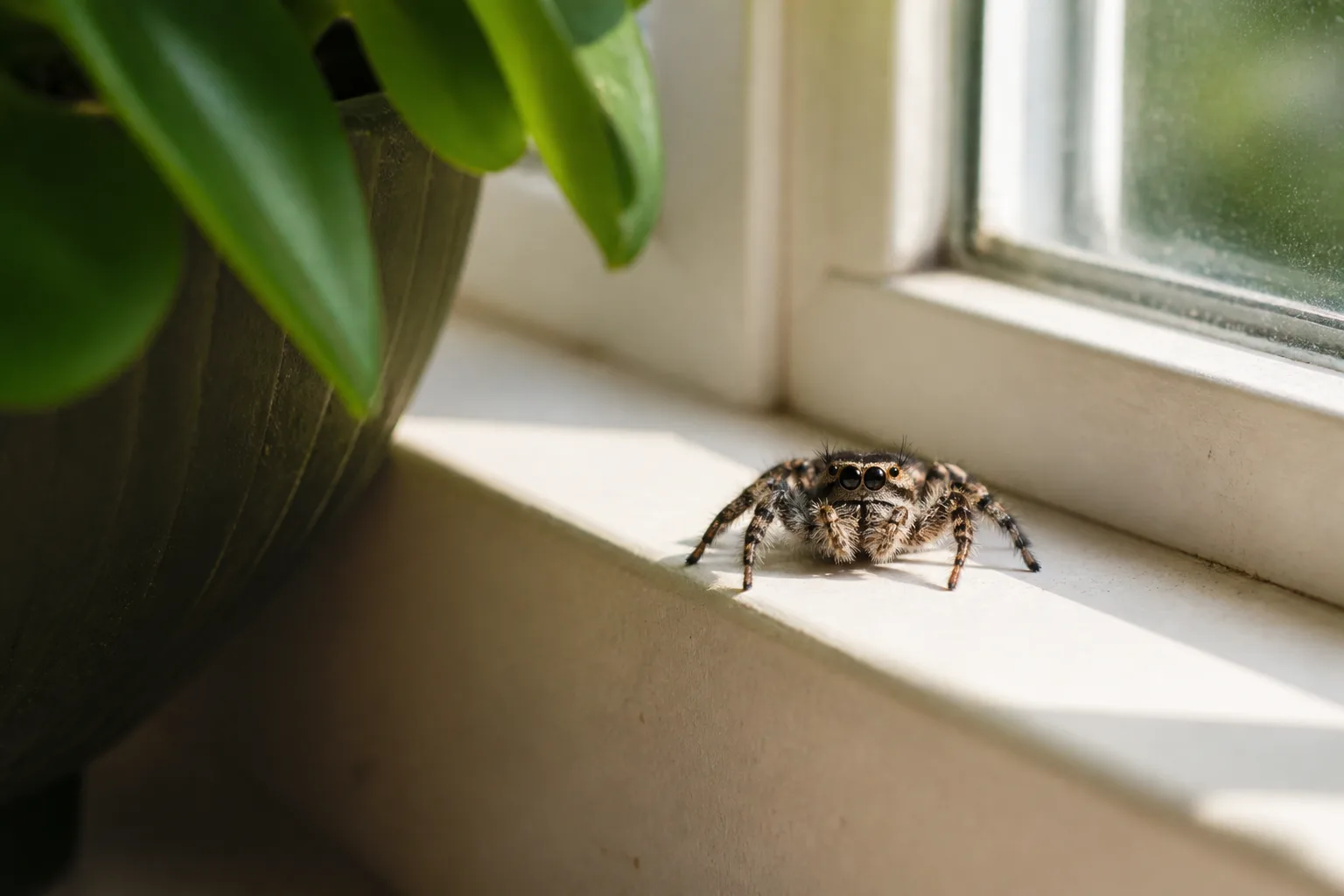
Jumping spiders (Salticidae) are compact, often fuzzy, and unmistakable once you see the two huge front eyes. They stalk prey by day and can leap several body lengths. Many species have bold black-and-white or red markings, which triggers black-widow panic—but jumping spiders are stout, hairy, and active, not glossy black with a hanging web.
Size: About 1/8 to 3/4 inch body length.
Habitat: Sunny windows, door frames, houseplants, firewood brought indoors.
Bite risk: Tier 1–2. Bites are rare; pain compares to a mosquito bite when they happen.
They are among the most beneficial indoor spiders because they hunt flies and small pests in plain sight. Relocation to a potted plant on the porch is a better default than killing them.
Funnel weavers and hobo spiders — sheet webs at ground level
Funnel weavers (family Agelenidae) build horizontal sheet webs with a retreat hole at one end—often on grass, steps, or low corners near doors. In the Pacific Northwest you may hear about hobo spiders (Eratigena agrestis), once feared as “aggressive house spiders.”
Research changed that story. UC IPM now states the hobo spider bite is not considered of medical importance, and the species is not established in most of California despite frequent misidentification. Funnel webs in the rest of the country usually belong to grass spiders or related agelenids—not the Australian funnel-web spiders of internet horror stories.
Size: Roughly 1/5 to 3/4 inch body, legs excluded.
Habitat: Ground-level webs near doors, window wells, garages, outdoor steps.
Bite risk: Tier 1 for most U.S. funnel weavers. Defensive bites may occur if trapped against skin.
CSU Extension notes funnel weavers are often mistaken for brown recluses but have eight eyes in two rows (not six in three pairs), striped legs, and faster movement. If you are outside recluse range, a brown violin-shaped marking is almost always a different spider.
Wolf spider — fast, hairy, and often misunderstood
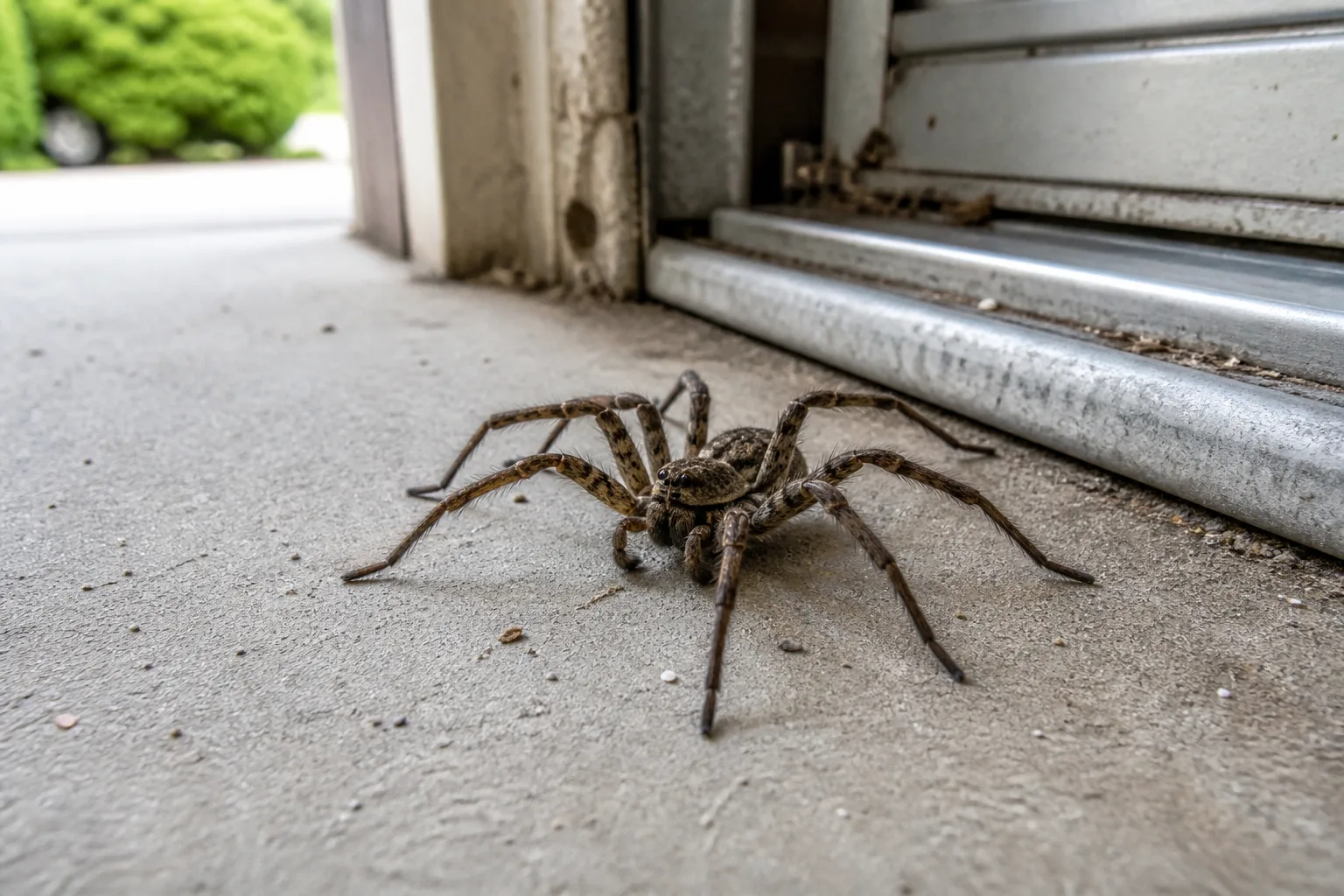
Wolf spiders (Lycosidae) are robust, fast hunters with three rows of eyes and a mottled brown or gray pattern. They do not build prey-capture webs. Females carry egg sacs attached to the spinnerets, and spiderlings ride on her back for days—a memorable sight if you have ever seen it.
Size: 1/2 inch to over 2 inches including legs; large species startle people who think they are small tarantulas.
Habitat: Ground level—garages, basements, sliding door tracks, entryways after rain. Often wander indoors from garden beds.
Bite risk: Tier 2. Shy, but a trapped wolf spider can bite. Pain and swelling are usually local; clean the wound and monitor.
Because they hunt cockroaches, crickets, and earwigs, wolf spiders are working pests control on your floor. Sticky monitors along baseboards can confirm how many are present without spraying broad pesticides indoors.
Black widow spider — the neurotoxic web-builder to respect
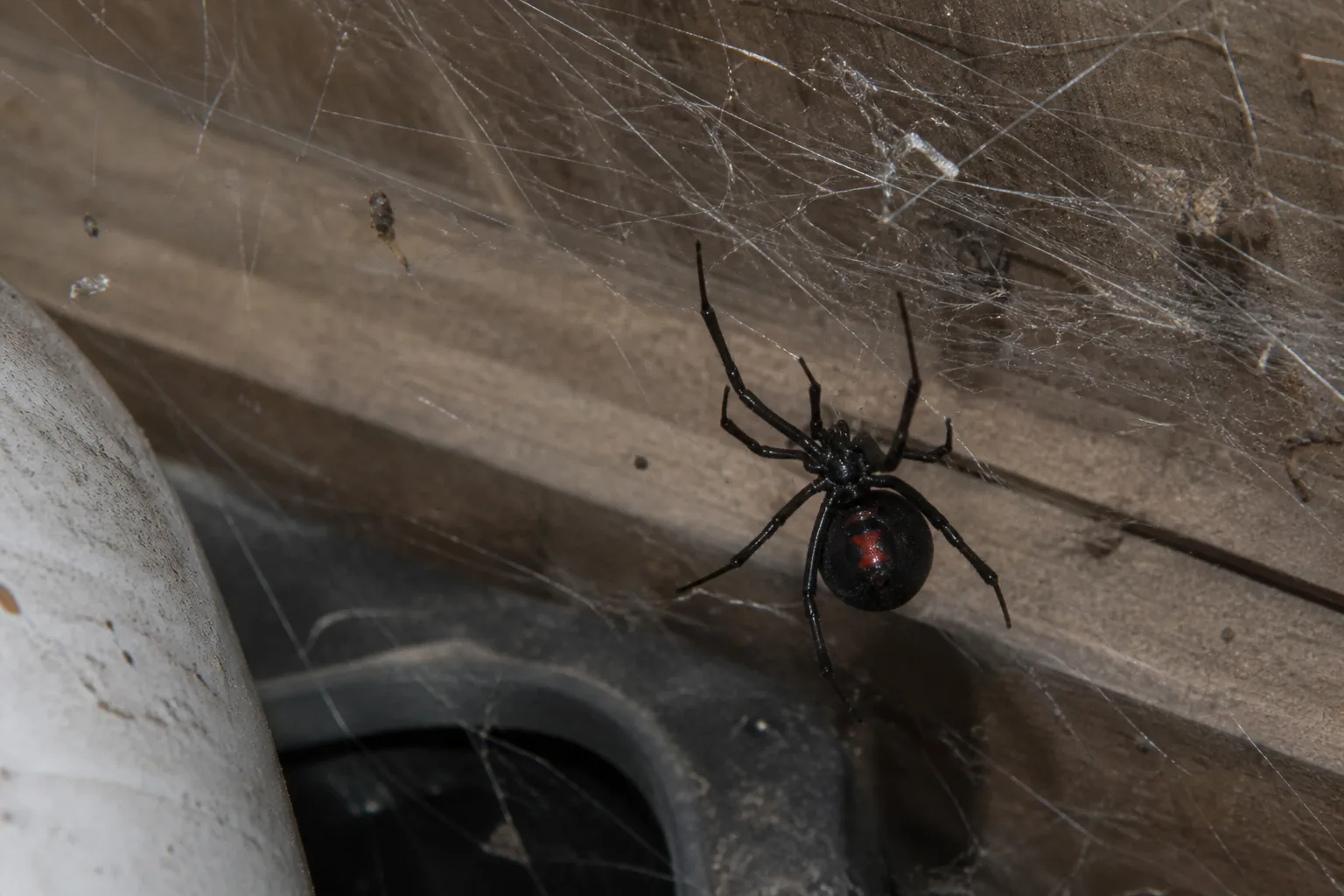
Black widows (Latrodectus spp.) are the most recognized venomous U.S. house spider. Females are glossy black with a red or orange hourglass on the underside of the abdomen (visible if the spider hangs upside down in its web). Males are smaller and less dangerous. Brown widows—lighter with an orange hourglass—also occur in southern states.
Habitat: Dry, undisturbed pockets—woodpiles, meter boxes, outdoor furniture, rarely used boots, sheds, and garages. Indoor bites are uncommon but possible in cluttered storage.
Size: Up to about 1.5 inches including legs.
Bite risk: Tier 3. The CDC notes neurotoxic venom causing pain that may spread to chest, abdomen, or body. Cleveland Clinic lists muscle cramps, sweating, nausea, and elevated blood pressure as possible symptoms.
Widows are shy and bite when the web or body is pressed—reaching into a box, pulling on stored gloves, cleaning a rarely used grill. Wear gloves for dark storage areas. If bitten, seek medical care; antivenom exists for confirmed widow bites.
Not a widow: Jumping spiders, false widows (Steatoda), and dark cobweb spiders lack the combination of glossy black female body plus ventral hourglass in a tangled low web.
Brown recluse spider — range-limited and easily confused
The brown recluse (Loxosceles reclusa) is the other U.S. spider with medically significant venom for humans. It is not nationwide. The CDC places it in midwestern and southern states—Kansas, Oklahoma, Texas, Arkansas, Missouri, and neighboring areas—not the Pacific Northwest or most of the Northeast.
Field marks: uniform brown body, dark violin-shaped marking on the cephalothorax, and six eyes in three pairs (most spiders have eight). They build loose, messy retreats in cardboard, closets, attics, and piles of clothing.
Size: About 3/8 inch body length.
Bite risk: Tier 3 within range. Bites often happen when dressing—spider pressed against skin in a shoe, sleeve, or stored blanket. Cleveland Clinic describes a stinging bite, white blister, and possible slow-healing ulcer in susceptible individuals.
Outside native range, “brown recluse bites” are frequently misdiagnosed. CSU Extension warns that recluse bites are greatly over-diagnosed in Colorado, where the spider is rare. Funnel weavers, wolf spiders, and sac spiders cause most brown-spider panic in non-recluse states.
Prevention in range: Shake shoes and gloves, store linens in sealed bins, avoid leaving clothes on the floor, and wear gloves cleaning storage areas.
Yellow sac spider — pale wanderers in ceiling corners
Sac spiders (Cheiracanthiidae) hide in flat silk sacs in upper corners of rooms by day and hunt at night—often the spider you see running across a ceiling. Color varies from pale yellow to greenish or tan.
CSU Extension identifies Cheiracanthium species as among the most common sources of verified indoor spider bites, though most cause only brief pain. Research on venom is ongoing; treat them as Tier 2: respect but do not catastrophize.
Size: 1/4 to 3/8 inch body.
Habitat: Wall corners, crown molding, behind picture frames.
Bite risk: Tier 2. Pain, redness, and sometimes headache or nausea are reported; symptoms usually resolve but can be uncomfortable for hours.
Vacuum the sac and corner web, or gently relocate at night when active. They are not colony spiders—one sac usually means one hunter.
Orb-weaver — big garden spiders that drift indoors in fall
Orb-weavers (Araneidae) build the classic spiral “wheel” webs. Many species are large, round-abdomen spiders seen on porches, decks, and garden plants in late summer and fall. Banded garden spiders (Argiope spp.) and barn spiders are common.
Size: 2 to 6 inches leg span for large females; males are tiny.
Habitat: Outdoors on vegetation, eaves, porch lights; occasionally wander indoors.
Bite risk: Tier 1–2. Docile; bite compared to a bee sting if provoked.
If an orb-weaver is in your living room, it likely wandered from outside. Escort it out rather than treating it as an infestation.
Grass spider — striped sheet-web builders near lawns
Grass spiders (Agelenidae, often Agelenopsis) resemble funnel weavers and build low sheet webs on shrubs, foundations, and lawn edges. They are striped brown and cream with long spinnerets pointing backward.
Size: 1/2 to 3/4 inch body.
Habitat: Where lawn meets house—window wells, foundation cracks, patio edges.
Bite risk: Tier 1. Venom immobilizes insects; human bites are uncommon and not considered dangerous.
They surge in late summer when dew highlights webs at dawn—often the “suddenly spiders everywhere” season people notice on siding.
Quick comparison: 11 common indoor spiders at a glance
| Spider | Size (body) | Web | Key mark | Bite tier | U.S. notes |
|---|---|---|---|---|---|
| American house | 1/8–5/16 in | Cobweb | Dull brown, dusty webs | 1 | Most common indoors |
| Cellar | Tiny body, long legs | Tangle | Vibrates in web | 1 | Basement specialist |
| Harvestman | 1/10–1/3 in | None | One body segment | N/A | Not a spider |
| Jumping | 1/8–3/4 in | None | Huge front eyes | 1–2 | Daytime hunter |
| Funnel weaver | 1/5–3/4 in | Sheet/funnel | Horizontal web | 1 | Hobo myth debunked |
| Wolf | 1/2–2+ in | None | Three eye rows, fast | 2 | Carries young on back |
| Black widow | Small body | Tangled | Ventral hourglass | 3 | Southern/western common |
| Brown recluse | ~3/8 in | Retreat | Violin on head, 6 eyes | 3 | Midwest/South range |
| Yellow sac | 1/4–3/8 in | Sac retreat | Pale, ceiling corners | 2 | Common biter |
| Orb-weaver | Variable | Orb | Round abdomen | 1–2 | Mostly outdoor |
| Grass | 1/2–3/4 in | Sheet | Striped abdomen | 1 | Lawn perimeter |
When a spider bite actually needs medical care
Most “spider bites” are bacterial skin infections, insect bites, or unknown skin lesions. Spiders bite defensively, not offensively. Still, know the escalation signs.
Seek medical care promptly if you have:
- Spreading pain, muscle cramps, or abdominal rigidity after a bite (widow concern)
- A blister that darkens or an enlarging ulcer, especially in recluse range
- Difficulty breathing, severe headache, fever, or vomiting
- A child, older adult, or immunocompromised person was bitten
The CDC lists possible spider bite symptoms including rash, radiating pain, blistering, sweating, nausea, and elevated blood pressure. Capture the spider in a jar if you can do so safely—positive ID changes treatment.
For minor bites from unknown spiders: wash with soap and water, apply a cold pack, elevate the limb, and watch for 24 hours. Do not cut the wound or apply folk remedies.
How to manage house spiders without making the problem worse
Killing every spider while leaving flies, gnats, and roaches untouched is backwards pest control. Spiders are symptoms of prey availability. Sustainable control follows integrated pest management:
Reduce prey first. Fix window screens, store food in sealed containers, manage fruit flies and drain gnats, and turn off outdoor lights that draw insects to doors. Less insect traffic means fewer spiders setting up shop.
Seal entry points. Caulk gaps around pipes, doors, and foundation cracks. CSU Extension and UC IPM both emphasize exclusion over indoor spraying for spiders.
Declutter storage zones. Cardboard boxes, clothing piles, and unused furniture are widow and recluse habitat. Switch to plastic bins with lids in basements and attics.
Clean webs on a schedule. Vacuum corners monthly. Outside, sweep eaves and door frames in fall when spider movement peaks.
Use targeted tools, not fogging. Sticky monitors along garage walls help you see what is actually present. Essential-oil sprays may repel briefly but do not replace sealing and prey reduction.
Relocate when possible. Cup-and-card works for visible hunters. For heavy infestations in recluse range or dense widow populations in a child’s play space, call a licensed pest professional who practices IPM—not a perimeter spray that ignores why spiders arrived.
A single spider on the ceiling is not an invasion. Multiple egg sacs, dozens of webs in one room, or a venomous species in a high-traffic zone are the thresholds to act.
Conclusion
The 11 most common house spiders in U.S. homes break into three practical groups: harmless web-builders and hunters that earn their keep (American house, cellar, jumping, wolf, funnel, grass, and orb-weaver spiders), occasional biters that hurt but rarely harm (yellow sac and large wolf spiders), and the two species that deserve respect—black widows and brown recluses within their native range. Harvestmen look spooky but are not spiders and pose no venom risk.
Identification starts with web type, body shape, and geography, not panic. Most indoor spiders are shy, short-lived guests eating worse pests. Seal gaps, cut insect attractants, and clean corners on a routine schedule, and the spider population usually drops without turning your home into a chemical fog. When in doubt after a bite—or if you are in widow or recluse territory and find egg sacs in a child’s closet—take a photo, bag the spider if safe, and call your clinician with facts instead of fear.