How to Grow and Care for Inkberry Holly
Grow inkberry holly (*Ilex glabra*) with the right cultivar, acidic soil, and male pollinator — plus pruning, berry troubleshooting, and when to skip it near the house.
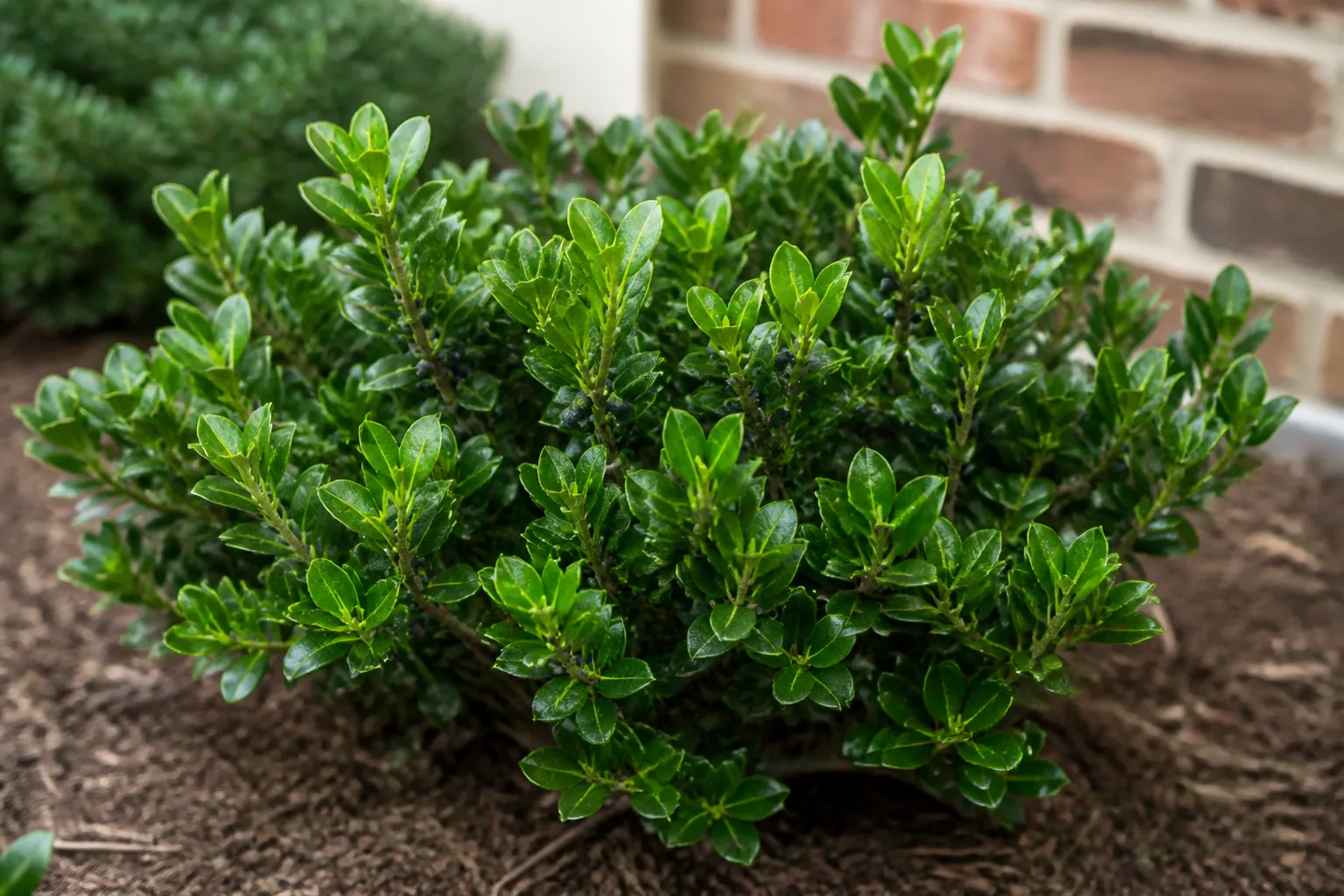
Inkberry holly (Ilex glabra) is a slow-growing, spineless native evergreen that handles wet soil better than most hollies — and most boxwoods. Its glossy leaves stay clean through winter in mild climates, pea-sized black berries feed birds through fall, and compact cultivars like ‘Shamrock’, Gem Box®, and Strongbox® have become go-to boxwood alternatives where blight, alkaline soil, or soggy foundation corners make boxwood a gamble.
That does not mean inkberry is foolproof. Plant it in alkaline clay, bury the crown, or skip the male pollinator and you will get yellow leaves, no berries, and a leggy shrub that looks nothing like the nursery tag. This guide covers cultivar choice, site prep, pollination math, pruning timing, and the troubleshooting steps extension sources recommend — so you can match the plant to your soil and job before you dig.
What Inkberry Holly Is — and Why It Fits Native and Rain-Garden Beds
Inkberry — also called gallberry or Appalachian tea — is a multi-stemmed broadleaf evergreen shrub in the holly family (Aquifoliaceae). Unlike American holly (Ilex opaca) or English holly, its leaves are smooth and spineless, usually under 1.5 inches long, with fine teeth near the leaf tip. The species name glabra means smooth, which is the quickest field ID clue.
Native range, identification, and wildlife value
Inkberry is native to the southeastern United States, with a coastal distribution from Nova Scotia south to Florida and west to Louisiana, according to NC State Extension. In the wild it grows along swamp edges, bog margins, and sandy acidic woodlands — which explains why it tolerates moisture that would rot drier evergreens.
Mature species-form plants reach 5 to 10 feet tall and 5 to 8 feet wide with a rounded, upright habit. Growth is slow, so what you buy in a three-gallon pot is a long-term commitment, not a quick screen. Do not confuse inkberry with big gallberry (Ilex coriacea): inkberry leaves are narrower (under half an inch wide), widest above the middle, with crenate margins on the upper half; big gallberry leaves are wider, about an inch across, with entire or spiny margins.
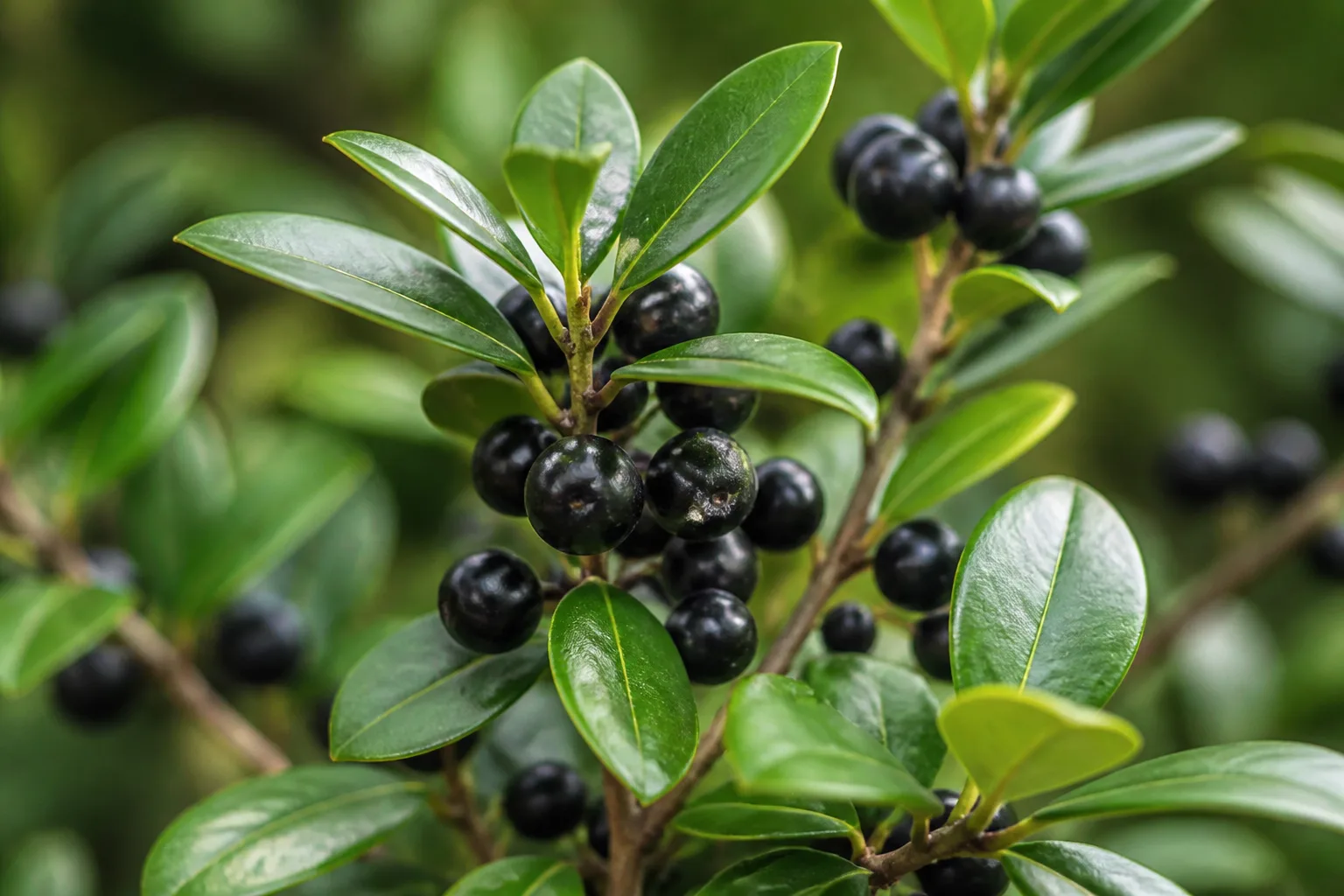
Inkberry punches above its weight for wildlife. Greenish-white spring flowers attract bees — including the specialist bee Colletes banksi — and the shrub is a larval host for Henry’s elfin butterfly (Callophrys henrici). Jet-black berries mature in fall and persist into November, feeding birds and small mammals. Beekeepers value inkberry honey highly. If you want a native evergreen that supports pollinators without the spines of traditional holly, inkberry earns its bed space on ecology alone.
Pick the Right Cultivar Before You Dig
Wild-type inkberry is shaggy, suckers freely, and looks informal. For foundation beds, low hedges, and tidy borders, named cultivars are the practical choice. Match the cultivar to your height target and whether you need berries.
| Cultivar | Typical size | Form / notes | Best for |
|---|---|---|---|
| ’Shamrock’ | 3–5 ft H × W | Compact, bright green, sucks less than species | Informal hedge, mass planting |
| ’Densa’ | 4–6 ft H, slightly wider | Dense upright habit | Mid-height hedge, screening |
| ’Compacta’ | 3–4 ft H, up to 6 ft W | Low, spreading | Wide border, ground-hugging mass |
| ’Nigra’ | 6–10 ft H × W | Dark green foliage, taller | Background screen, larger lots |
| Gem Box® | ~3 ft H × W | Dwarf female, ball-shaped | Boxwood substitute, formal accents |
| Strongbox® | ~3 ft H × W | Dense mounded female; pest-resistant | Low hedge, boxwood alternative |
Shamrock, Densa, Gem Box, Strongbox, and species-form trade-offs
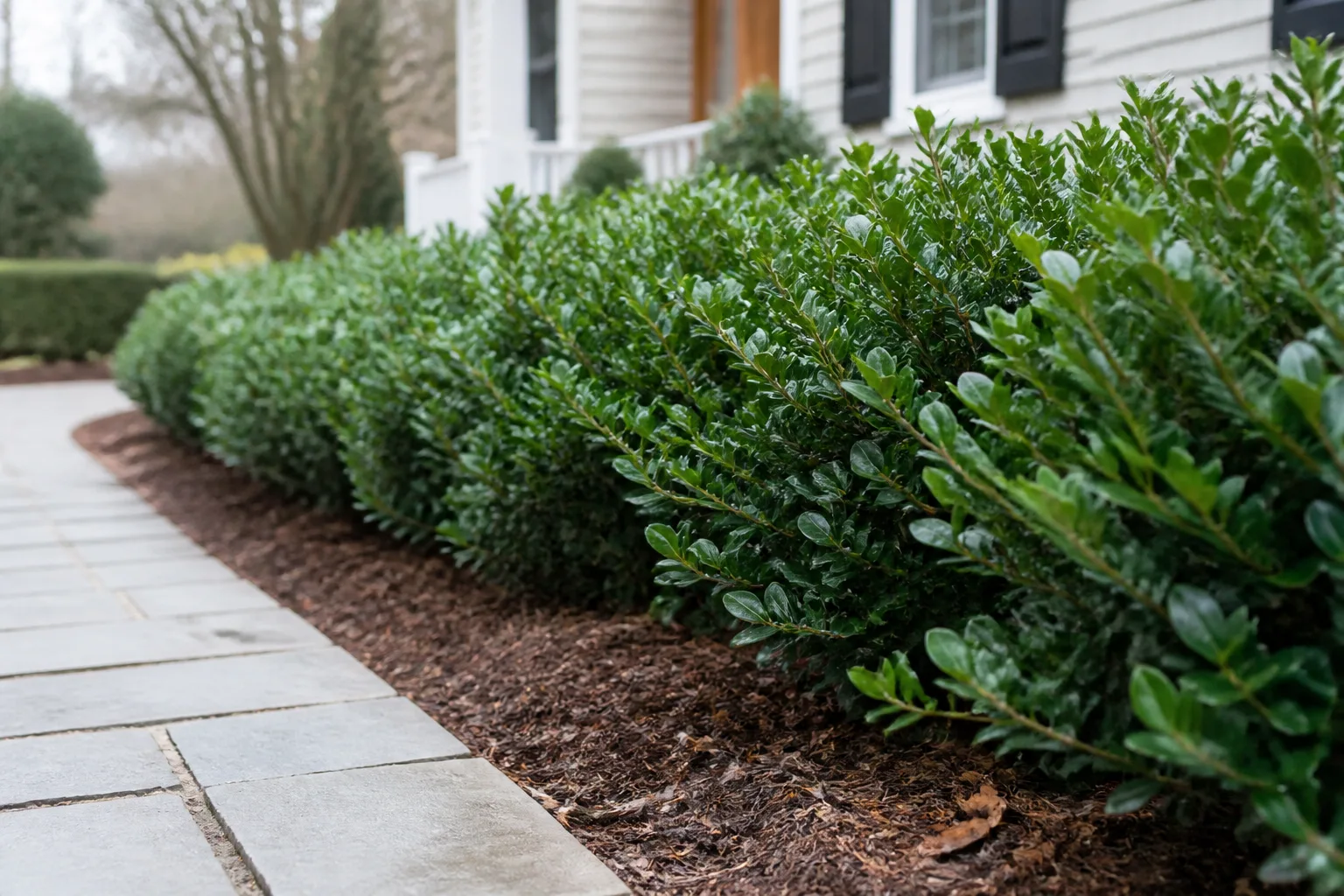
‘Shamrock’ and ‘Densa’ are the workhorses for informal hedges in the 4-to-6-foot range. Shamrock is widely praised for reduced suckering compared to straight species plants. Densa lives up to its name with a tighter upright silhouette — useful when you need height without the 10-foot sprawl of wild inkberry.
Gem Box® and Strongbox® are the picks when you want a boxwood-like ball or low hedge without boxwood blight exposure. Both are female selections that fruit when a compatible male is nearby. Strongbox was bred partly for improved pest resistance — a real consideration where holly leafminer and scale pressure run high.
Skip species-form inkberry for formal foundation corners unless you want a naturalistic colony and have room for suckers. For a single tidy evergreen beside a walk, a compact cultivar saves years of corrective pruning.
Light, Soil, and Where to Plant
Inkberry prefers full sun (six or more hours of direct light) in cool climates and tolerates partial shade (two to six hours), which can reduce summer stress in hot southern zones. More sun generally means denser foliage and better berry set on female plants. Deep shade produces thin, leggy growth — not a hedge.
Acidic soil, chlorosis prevention, and soil testing
This is the line that separates success from chronic yellow leaves: inkberry needs acidic soil with pH below 6.0, per NC State Extension. It grows in clay or sand as long as drainage is reasonable, but alkaline soil causes chlorosis — interveinal yellowing while veins stay green — because iron becomes unavailable. Lime-heavy foundation beds, fresh concrete walks, and naturally high-pH clay are the usual suspects.
Test soil before planting. If pH is above 6.5, lower it with elemental sulfur or acidic organic matter (pine bark fines, peat-substitute mixes labeled for azaleas and rhododendrons) worked into the planting zone — not just the backfill hole. Surface-applied sulfur takes months; plan ahead. In chronically alkaline sites, inkberry is the wrong plant; consider yew, certain junipers, or another acid-tolerant native after amending fails.
Inkberry also tolerates moist and occasionally wet soil — a Coastal FACW wetland indicator in the Piedmont and Coastal Plain. That makes it a strong candidate for rain gardens, bioswales, and low spots where boxwood would drown. It is moderately salt-tolerant, helpful near coastal driveways and sidewalk de-icing splash zones, though no shrub loves constant salt bath.
Rain gardens, wet soil, and coastal salt exposure
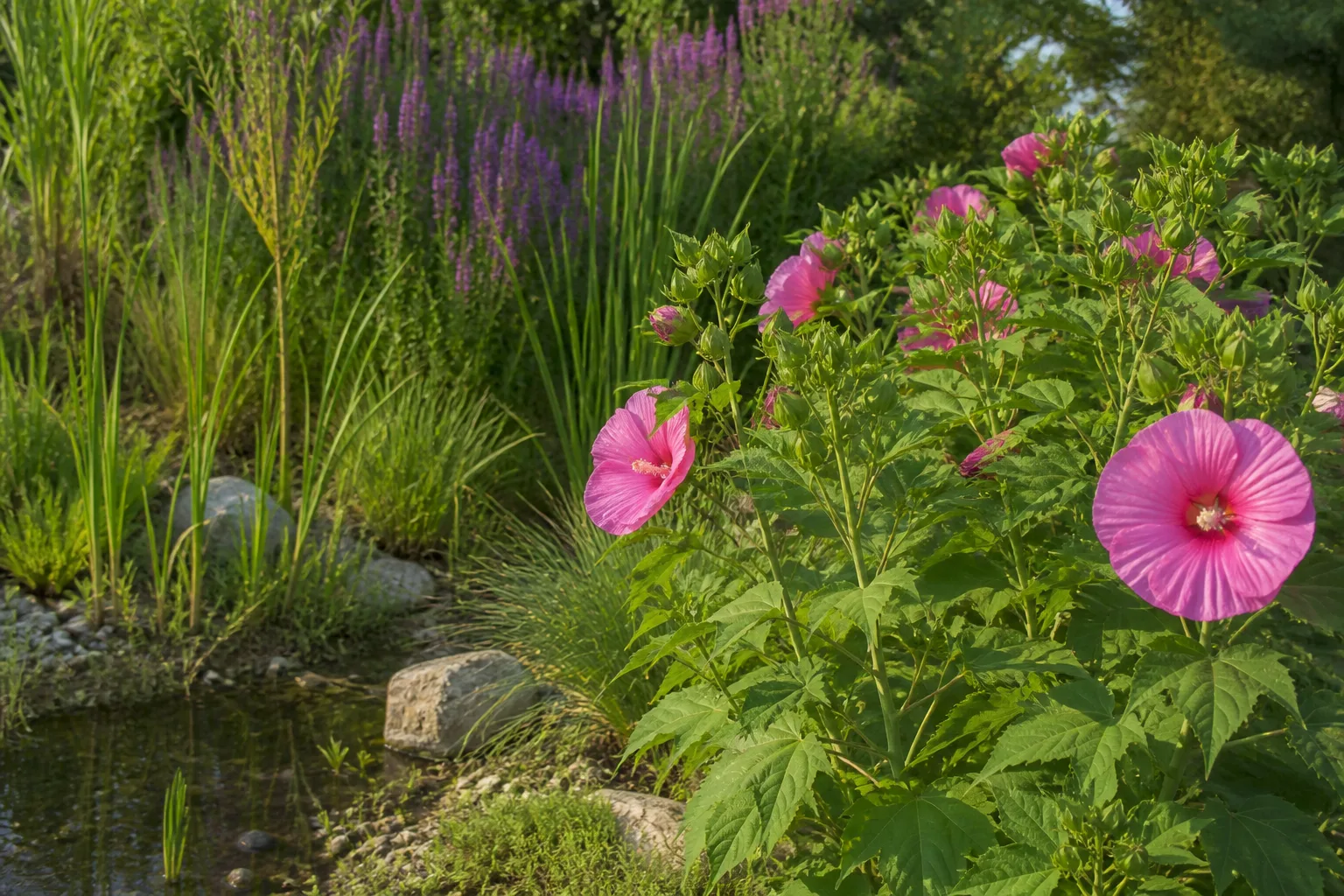
Place inkberry where water collects after storms but drains within a day or two — not in standing pools. In rain-garden designs, plant it in the mid-zone between the wettest basin and the drier berm. Pair with other moisture-tolerant natives like sweetspire (Clethra alnifolia) or wax myrtle (Morella cerifera) for layered wildlife value.
For coastal or roadside salt exposure, leach soil with plain water in spring if white crust builds on mulch. Mulch with pine bark rather than hardwood bark dyed black, which can raise surface pH over time.
How to Plant Inkberry Holly
Plant inkberry in spring or early fall so roots establish before temperature extremes. Avoid planting at the height of summer drought unless you can irrigate consistently.
Dig a hole twice as wide as the root ball and no deeper than the root ball height. Plant at the same depth as the container — the top of the root ball level with or slightly above native grade. Burying the crown is a common mistake that leads to root rot and yellowing leaves. If your soil is heavy clay, plant slightly high (one inch) and feather mulch thinly over the root zone, not piled against stems.
For hedges, space compact cultivars 2 to 3 feet apart for a solid row in three to five years; species-form or ‘Nigra’ need 4 to 5 feet or more. Stagger rows only if you need a deep screen — inkberry is not a fast gap-filler.
Water thoroughly at planting. No fertilizer in the hole; let roots find the native soil interface first.
Watering Through Establishment and Dry Spells
Inkberry likes consistent moisture, especially the first two years. Water deeply once or twice weekly during dry spells until the plant is established — roughly when it pushes new growth without wilting through a dry week. A 2-to-3-inch layer of pine-bark mulch reduces evaporation and keeps soil acidic.
Established plants tolerate short droughts better than boxwood in many soils, but prolonged dry periods — particularly in full sun on sandy sites — trigger leaf scorch and spider mite flare-ups. If leaves look dull and stippled, check soil moisture before reaching for pesticide.
Containers are possible with compact cultivars but require more frequent watering and winter protection in zones 4 and 5. Plan to upsize pots as roots fill the container.
Fertilizer, Mulch, and Soil Amendment
Inkberry is low maintenance once established and rarely needs heavy feeding. If a soil test shows low nitrogen or general nutrient deficiency, apply a slow-release fertilizer formulated for acid-loving plants (often labeled for hollies, azaleas, or rhododendrons) in early spring before new growth emerges. Avoid high-nitrogen lawn fertilizer near the root zone — it pushes soft growth mites love.
Skip fertilizer the year you plant unless a test shows clear deficiency. Overfeeding is a common cause of lush, pest-prone foliage without solving chlorosis — which is a pH problem, not a nitrogen problem.
Refresh pine-bark mulch annually, keeping it off the crown. In alkaline areas, top-dressing with composted pine bark each spring helps maintain acidity slowly.
Getting Berries: Male Pollinators and Plant Ratios
Inkberry is dioecious: individual plants are male or female. Only female plants produce the black berry-like drupes; males provide pollen. If your hedge is all female ‘Shamrock’ or Gem Box and you see flowers but no fruit, you need a male inkberry within pollinator range — typically within 50 feet, though closer is better.
One male can pollinate several females. For a row of six to eight female shrubs, tuck one male plant at the end of the row or behind the hedge where its looser form is less visible. Male flowers appear in clusters (cymes); female flowers may be solitary or in cymes. Bloom time is late spring to early summer (May–June in most zones).
If berries matter for birds or winter interest, confirm sex at purchase — tags are not always clear. When in doubt, buy from a nursery that labels male and female selections explicitly.
Pruning for Hedges, Shape, and Sucker Control
Inkberry blooms on old wood. That means heavy pruning in late summer removes next spring’s flowers and fall berries. Prune in early spring before new growth starts for shape and size control, or just after flowering if you want to preserve maximum berry display.
For formal hedges, shear lightly one to two times per year — spring and optionally midsummer — rather than cutting back to bare wood. Inkberry recovers slowly from hard rejuvenation cuts. Species-form and ‘Compacta’ may go leggy with bare lower stems; renewal prune one-third of the oldest stems at the base in early spring over three years to regenerate lower growth.
Root suckers are how wild inkberry colonizes. Remove suckers with a sharp spade if you do not want a spreading patch. You can transplant suckers with roots attached in early spring — treat them like small divisions.
Propagation: Softwood Cuttings and Transplanted Suckers
Inkberry propagates reliably from softwood cuttings taken in late spring or early summer when new growth is firming but not woody. Cut 4-to-6-inch tips from healthy shoots, strip lower leaves, dip in rooting hormone, and stick in moist rooting mix under humidity cover. Roots typically form in four to eight weeks. Hardwood cuttings in winter work for patient propagators but take longer.
Suckering divisions are the zero-cost method: sever a rooted sucker from the parent, replant immediately, and keep moist for the first season. Label sex if you know it — future berry production depends on having both sexes in the yard.
Pests, Diseases, and Troubleshooting
Inkberry is generally trouble-free compared to many ornamentals, but it is not immune. Clemson Cooperative Extension lists holly leafminer, Japanese wax scale, and southern red mite as the most common holly pests. Mites flare in hot, dry weather — wash foliage with a strong water spray before spraying oils or insecticides.
Leaf spot and powdery mildew appear in humid summers. Improve air circulation by thinning crowded branches and avoid overhead irrigation at night. Fungicides are a last resort for valuable hedges.
Inkberry is particularly resistant to deer browsing compared to many shrubs, though NC State Extension notes deer and rabbits may nibble leaves in heavy pressure years. It is not deer-proof.
Yellow leaves, no berries, legginess, and winter purpling
Yellow leaves usually mean one of three things: alkaline soil (chlorosis), planted too deep (waterlogged crown), or winter cold injury. Test pH first. If pH is fine, check that the root flare is visible at the soil surface. For chlorosis on established plants, lower pH and consider chelated iron foliar spray as a short-term bridge while soil amendments work.
No berries almost always means missing male pollinator, all-male planting, immature plants, or pruning that removed flower buds. Verify sex and pollinator proximity before assuming disease.
Legginess happens in shade, after years without thinning, or on species-form plants left unpruned. Move or limb up surrounding plants for more sun, or renewal-prune over several seasons.
Winter purpling — leaves turning deep purple instead of green — is a cold response on some cultivars and is not necessarily fatal. If buds are firm and spring pushes green growth, the plant is fine. Persistent dieback below zero in exposed sites may mean a cultivar at its hardiness limit; USDA zones 4a through 11b are listed for the species, but microclimate matters.
Fire Risk, Toxicity, and Pet Safety
NC State Extension rates inkberry high flammability. Do not plant it in the defensible space immediately around your home in fire-prone regions. Use lower-flammability shrubs within 30 feet of structures and reserve inkberry for farther zones or irrigated beds.
Berries and leaves carry low-severity toxicity to humans and pets, per extension poison ratings. Poison Control reports that swallowing holly berries can cause nausea, vomiting, and diarrhea — symptoms possible from as few as two berries in children. Berries are not a snack. Teach children not to eat landscape fruit, and call Poison Control at 1-800-222-1222 or use webPOISONCONTROL if ingestion occurs.
Landscape Uses That Actually Work
Inkberry shines where other evergreens struggle: wet foundation corners, native pollinator gardens, informal hedges, windbreaks, and bird-friendly winter borders. Its spineless leaves make it safer near paths and play areas than holly with prickles.
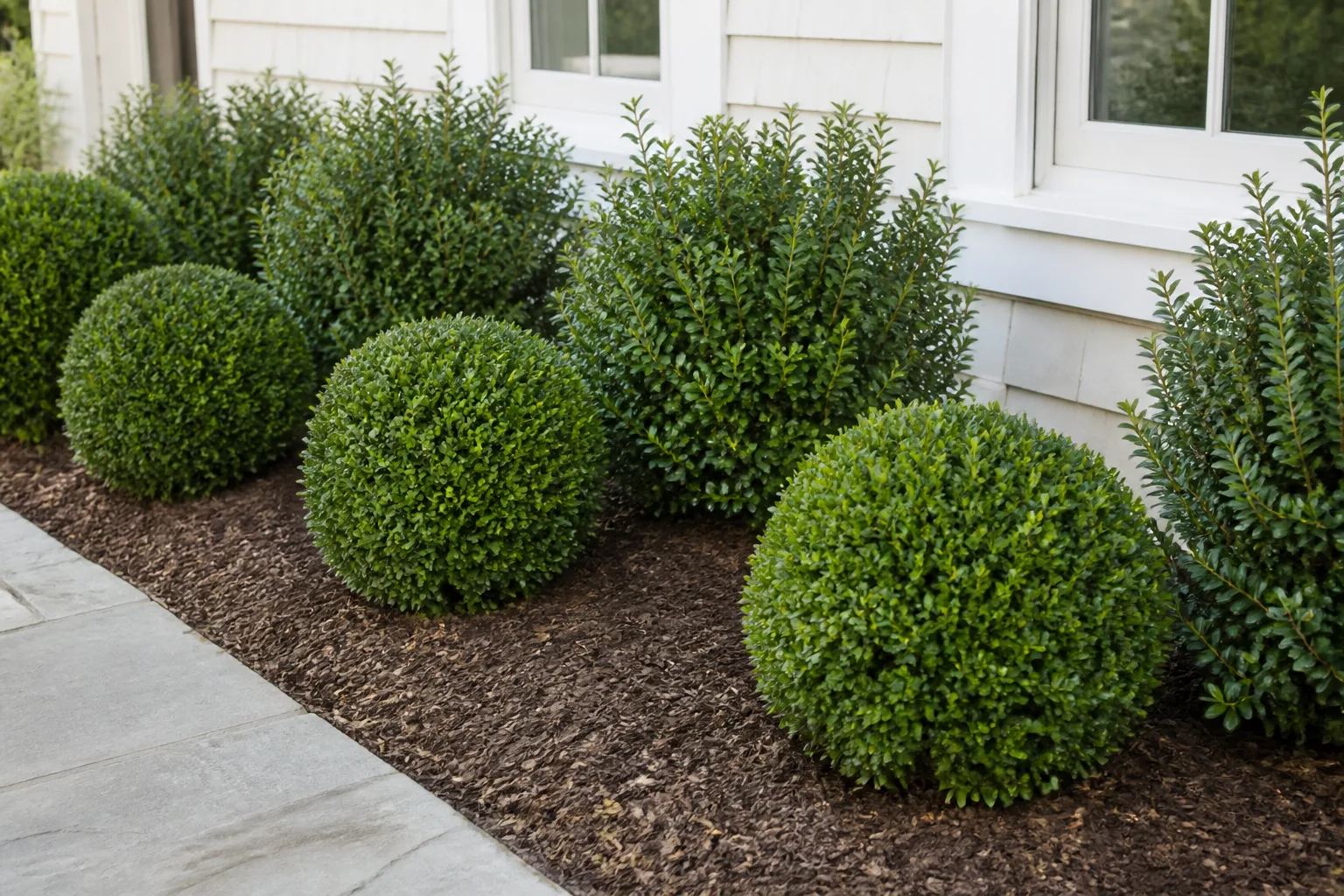
Pair female fruiting cultivars with winter-interest grasses or red-twig dogwood for contrast. Avoid planting as a single specimen in alkaline urban fill — chlorosis will disappoint you within two years.
For a boxwood-replacement low hedge, Gem Box or Strongbox on acidic, irrigated soil is the most asked-for use right now. For naturalistic colonies along a woodland edge, species-form inkberry with sucker management looks right at home.
Conclusion
Inkberry holly rewards gardeners who respect its native habits: acidic soil, steady moisture while young, correct planting depth, and a male pollinator when berries matter. Choose ‘Shamrock’ or ‘Densa’ for mid-size hedges, Gem Box or Strongbox for boxwood-like form, and give the plant sun, pine-bark mulch, and spring pruning on old wood. Test soil pH before you blame pests for yellow leaves, keep it out of high-fire-risk zones next to the house, and treat berries as ornamental — not edible. Get those decisions right and inkberry becomes one of the most useful native evergreens in the eastern landscape.



