Do Deer Eat Hydrangeas? Risk by Type and Protection
Yes, deer eat hydrangeas, but browsing varies by species and season. Learn to spot damage, save old-wood buds, and choose a protection plan that fits.
Yes. Deer browse hydrangeas, including their leaves, tender shoots, flower buds, and open blooms. An established shrub can survive a light visit and still lose the flowers you were waiting for, especially when browsing removes buds formed the previous summer.
No species or cultivar is a dependable “deer-proof hydrangea.” Which plants a herd eats first changes with the season, local food supply, deer density, and the animals’ learned habits, so a variety that grows untouched in one yard may be stripped in another. The reliable decision is to choose a hydrangea for your climate and the bloom you want, then protect it if losing that bloom is not acceptable.
The Short Answer: Yes, Deer Browse Hydrangeas
Deer eat hydrangea foliage, soft stem tips, flower buds, and flower clusters. They often target the newest growth because it is easy to reach and tender, but winter scarcity or heavy deer pressure can bring browsing to woody shrubs too. A deer may remove only a few stems or reduce a whole shrub to its reachable outline; either can ruin the season’s display.
Treat “deer-resistant” as a comparison, not a promise. Rutgers NJAES rates bigleaf, climbing, oakleaf, panicle, and smooth hydrangeas as category C, meaning “occasionally severely damaged,” in its regional landscape database. The list was compiled with New Jersey nursery, landscape, Extension, and Master Gardener input, and Rutgers cautions that results depend on local deer populations and weather. University of Maryland Extension likewise says there are no reliably deer-resistant hydrangeas, even though some species may be less appealing in some gardens. (Rutgers NJAES deer-resistance database; University of Maryland Extension’s answer on deer-resistant hydrangeas)
A plant label can still help you compare options, but it cannot replace a barrier. If you are choosing hydrangeas for a yard with occasional deer visits, relative differences may matter. If deer feed there nightly or the plant must bloom for an event, plan protection as part of the planting rather than waiting to see whether a “resistant” cultivar passes the test.
Check the Damage Before Blaming Deer
Deer usually leave a rough, torn look on the parts they can reach. University of Minnesota Extension describes deer browsing on hydrangeas as leaves, flowers, buds, and small branches less than an inch in diameter removed with ragged edges; feeding can extend from ground level to about six feet. Look for missing shoot tips across several stems and, when possible, hoofprints or other fresh deer signs nearby. (University of Minnesota Extension’s hydrangea damage guide)
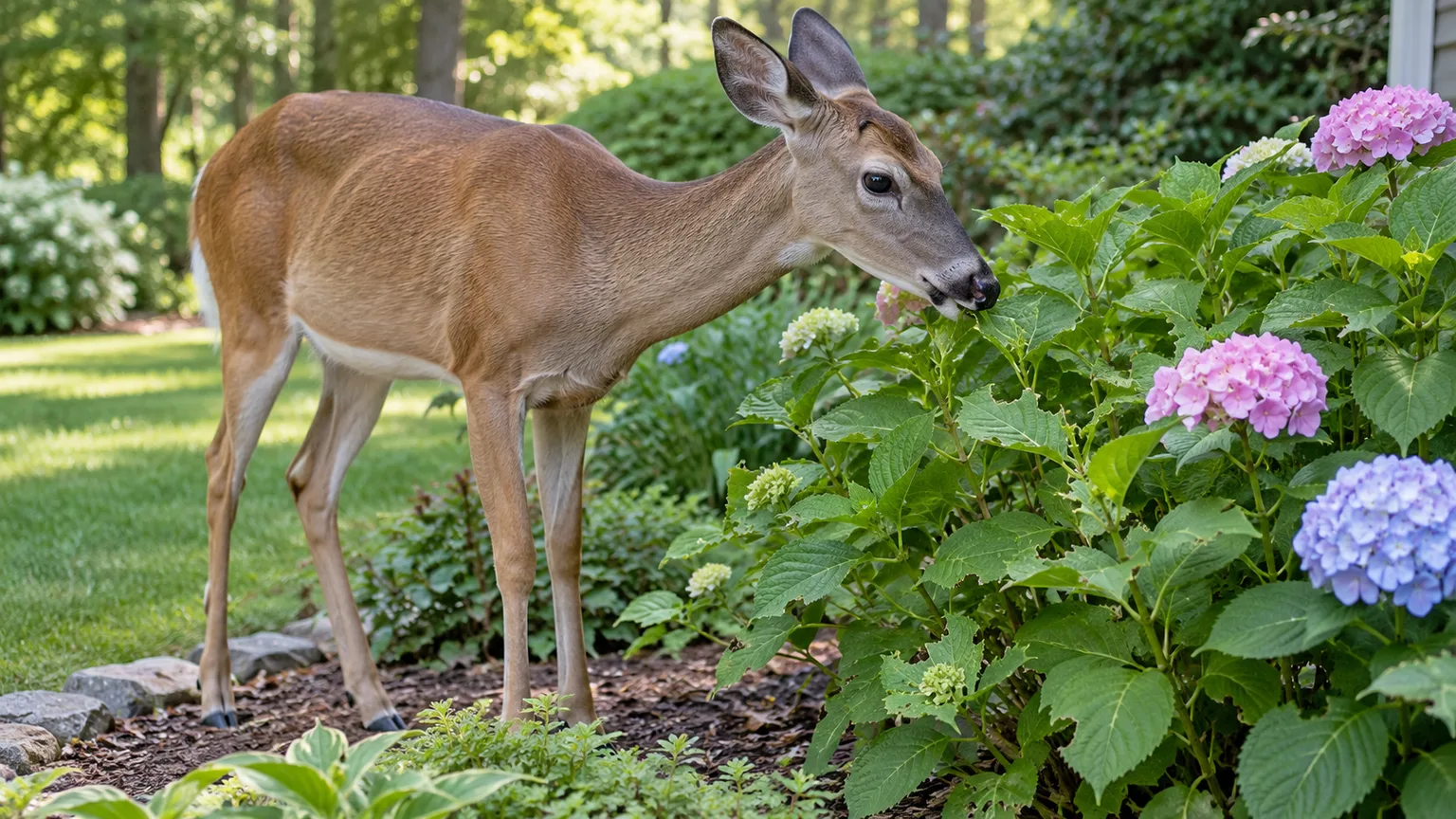
Damage pattern alone is not a perfect diagnosis, but it can prevent a wrong fix. If the shrub has flowers missing at about shoulder height and fresh, ragged stem ends, deer are plausible; if the leaf blades have small holes while the stems remain intact, look for insects, slugs, or other causes before adding a repellent.
Deer Browse Looks Different From Rabbit or Weather Damage
Rabbits usually work lower and leave a cleaner cut on small stems; Minnesota Extension notes that rabbit bark feeding tends to occur near the ground or snowline and that stems are often cut sharply at an angle. Vole damage is usually below the snowline and focuses on bark, while deer remove foliage, buds, flowers, and small branches at greater heights. Use height and cut quality together instead of diagnosing from one damaged leaf.
A hydrangea that fails to bloom is not automatically a deer victim. Late frost, winter cold, drought, and pruning at the wrong time can also remove or damage flower buds on bigleaf hydrangeas. If stems are intact and buds are blackened or absent throughout the shrub, compare the timing of cold snaps and pruning with the expected bloom wood before installing a fence. (University of Maryland Extension’s hydrangea problem guide)
Which Hydrangeas Are Most Vulnerable to Deer?
Published species rankings do not agree on one universal order, and that disagreement is useful. Fine Gardening’s New England observations describe bigleaf, mountain, and oakleaf hydrangeas as frequent deer targets while smooth and panicle types are often browsed less; Rutgers still rates all five common types in its “occasionally severely damaged” category. Another horticulturist’s long-term observations in a high-deer yard found bracted and bigleaf hydrangeas less affected than oakleaf, panicle, and smooth types. These are observations from different sites, not a controlled nationwide trial, so none should be read as a universal guarantee. (Fine Gardening’s hydrangea browsing guide; Hydrangea.com’s field observations on hydrangea deer resistance)
| Hydrangea type | What the available guidance suggests | What to plan for |
|---|---|---|
| Bigleaf (H. macrophylla) | Fine Gardening reports it as a deer favorite; other garden observations find it less browsed. Rutgers rates it C. | Protect swollen buds if next summer’s flowers matter. |
| Mountain (H. serrata) | Fine Gardening reports frequent browsing; another high-deer garden found it comparatively less affected. | Most cultivars flower on old wood, so spring browse can cost that year’s bloom. |
| Oakleaf (H. quercifolia) | Readily browsed in some gardens; its coarser, hairy foliage may discourage deer in others. Rutgers rates it C. | Do not count on leaf texture to save flower buds. |
| Smooth (H. arborescens) | Sources conflict: some observe less browsing, while others report heavy feeding. Rutgers rates it C. | It blooms on new wood, but repeated clipping can still remove shoots before they flower. |
| Panicle (H. paniculata) | Sometimes browsed less than bigleaf types, but other gardeners report severe damage. Rutgers rates it C. | New-wood bloom offers some recovery potential, not immunity. |
| Rough-leaved or bracted (H. aspera, H. involucrata) | Hairy foliage may reduce interest; observations are limited and local. | Treat texture as a possible advantage, not protection. |
| Climbing (H. anomala subsp. petiolaris) | Established growth may rise above the usual browse zone; Rutgers rates climbing hydrangea C. | Shield young, low growth and reachable flower buds. |
The table is a planning aid, not a resistance score. Fine Gardening’s article reflects practical regional observation, the Rutgers list reflects a northern New Jersey consensus rating, and Maryland’s Extension answer warns against relying on hydrangea leaf hairs alone. Deer pressure, alternative forage, plant age, and the exact shoots within reach can change the outcome. (Rutgers NJAES; University of Maryland Extension)
Bigleaf, Mountain, and Oakleaf Types Have Valuable Buds
Bigleaf hydrangeas (Hydrangea macrophylla) are the familiar mopheads and lacecaps with rounded clusters of pink, blue, purple, or white flowers. Many set flower buds on the previous year’s stems, so deer browsing in late winter or spring can remove buds before they open; mountain hydrangeas (H. serrata) share that old-wood vulnerability. Reblooming bigleaf cultivars are an exception in that they can flower on both old and new growth, but losing the old-wood buds still cuts the first flush and does not guarantee a full second display. (University of Minnesota Extension on hydrangea pruning; University of Maryland Extension)
Oakleaf hydrangeas (H. quercifolia) have coarse leaves and peeling bark, which sometimes leads to the assumption that deer will leave them alone. They are browsed in many gardens, especially when flower buds are within reach; an Extension horticulturist suggests the hairy leaves may be somewhat unappealing but explicitly says not to rely on that trait by itself. If the shrub is valuable, protect it rather than betting on leaf texture. (Fine Gardening; University of Maryland Extension)
Smooth and Panicle Types May Recover Differently
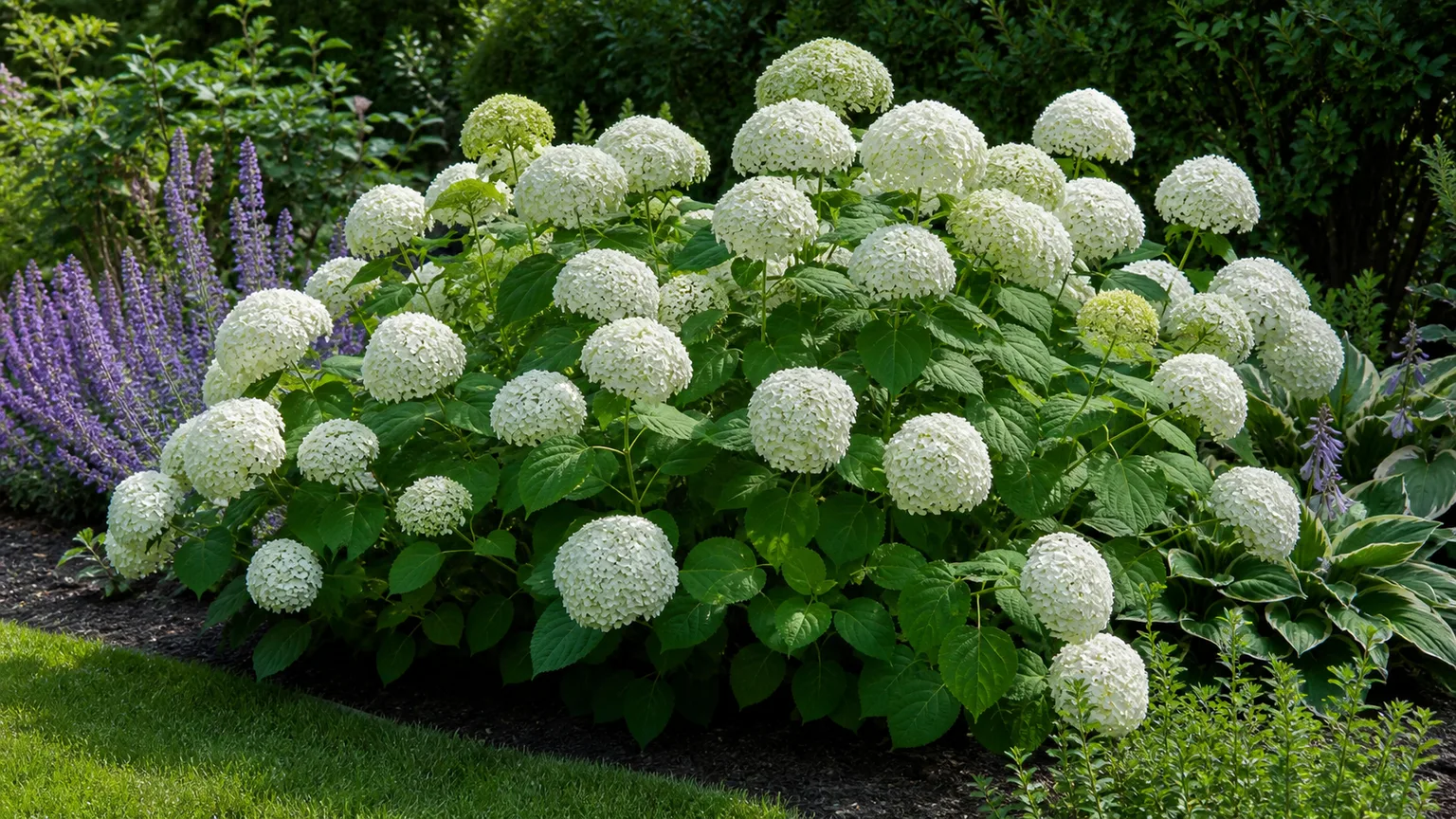
Smooth hydrangea (H. arborescens, including ‘Annabelle’) and panicle hydrangea (H. paniculata) form flower buds on the current season’s growth. That gives them a different recovery pathway after early browsing: if the plant still has time and resources to make new stems, it may set some flowers later. It does not mean deer damage is harmless. Repeated browsing can remove the replacement shoots too, and a plant clipped after its main flush may have little time to flower. (University of Minnesota Extension; Fine Gardening)
Use bloom biology to choose a hydrangea for the garden, not as an excuse to skip protection. A panicle type may be a sensible choice if you want a shrub that flowers on new wood and can tolerate some spring setback, while an old-wood bigleaf may need a cage just as buds swell. But local deer can browse any of them, and a new plant is more exposed than a mature, thick-stemmed shrub.
Rough-Leaved, Bracted, and Climbing Types Are Not a Guarantee
Rough-leaved hydrangeas such as H. aspera and bracted hydrangeas such as H. involucrata have textured or hairy foliage that some growers consider less appealing to deer. A hydrangea horticulturist’s seven-year account from a high-pressure deer garden ranked bracted hydrangea as the least browsed there, while an Extension response offers a more cautious view: no hydrangea is reliably deer-resistant. Treat the reported texture effect as a reason to compare plants locally, not a reason to leave a prized shrub unprotected. (Hydrangea.com’s field observations; University of Maryland Extension)
Climbing hydrangea can eventually place much of its foliage and its flower-bearing growth above a deer’s reach, but its base and young shoots remain vulnerable. Rutgers includes climbing hydrangea in its C category, and vines take time to climb; for the first seasons, protect the lower growth and the parts you need to survive for the plant to establish. Height helps only when the shrub or vine actually puts the important growth above the browse line.
Bloom Wood Changes the Cost of Browsing
A bitten shrub can live and still fail to flower. To estimate the damage, identify whether your hydrangea set its buds last year or will make them on this year’s new shoots; the same deer visit has different consequences for those two groups. Keep the plant label, because common names such as “snowball hydrangea” can refer to more than one species.
Old-Wood Hydrangeas Can Lose Next Season’s Flowers
Bigleaf and mountain hydrangeas usually carry their flower buds on stems grown the previous season, and oakleaf hydrangeas also flower from old wood. If deer remove a stem tip carrying a mature bud, that flower is gone for the coming season; cutting the rest of the shrub lower to “even it out” can remove additional buds. Reblooming bigleaf cultivars can form some flowers on new growth, but a second flush is cultivar- and season-dependent. (University of Maryland Extension; University of Minnesota Extension)
That timing makes late winter through spring especially important in many climates. Protect old-wood types before buds swell, not after you see flowerheads disappear. In winter, deer may also browse shrubs when food is limited, so a temporary spring-only barrier may not be enough in a yard with repeated winter damage.
New-Wood Hydrangeas May Regrow, but Repeated Browsing Still Hurts
Panicle and smooth hydrangeas produce flower buds on current-season growth. If deer clip a few early shoots and the shrub has healthy roots and a long growing season ahead, replacement growth may flower later; the timing and number of flowers are not guaranteed. A new transplant, drought-stressed shrub, or plant browsed repeatedly has less capacity to replace lost stems.
Do not rely on “new wood” as a deer-control strategy. It describes where buds form, not how much foliage a hydrangea can afford to lose. Protect the plant while it is young, then judge how much protection it still needs from the actual browse line and damage pattern in your yard.
Use a Cage to Protect One or Two Hydrangeas
For a specimen shrub or a pair of hydrangeas, a sturdy individual exclosure is often easier than fencing the whole property. Use rigid welded wire or a similarly strong barrier on stable stakes, with enough room that branches and flowerheads do not press through the mesh. The cage should extend above the entire canopy you need to protect; deer can reach roughly six feet on shrubs, and a low ring will protect only the lower growth.
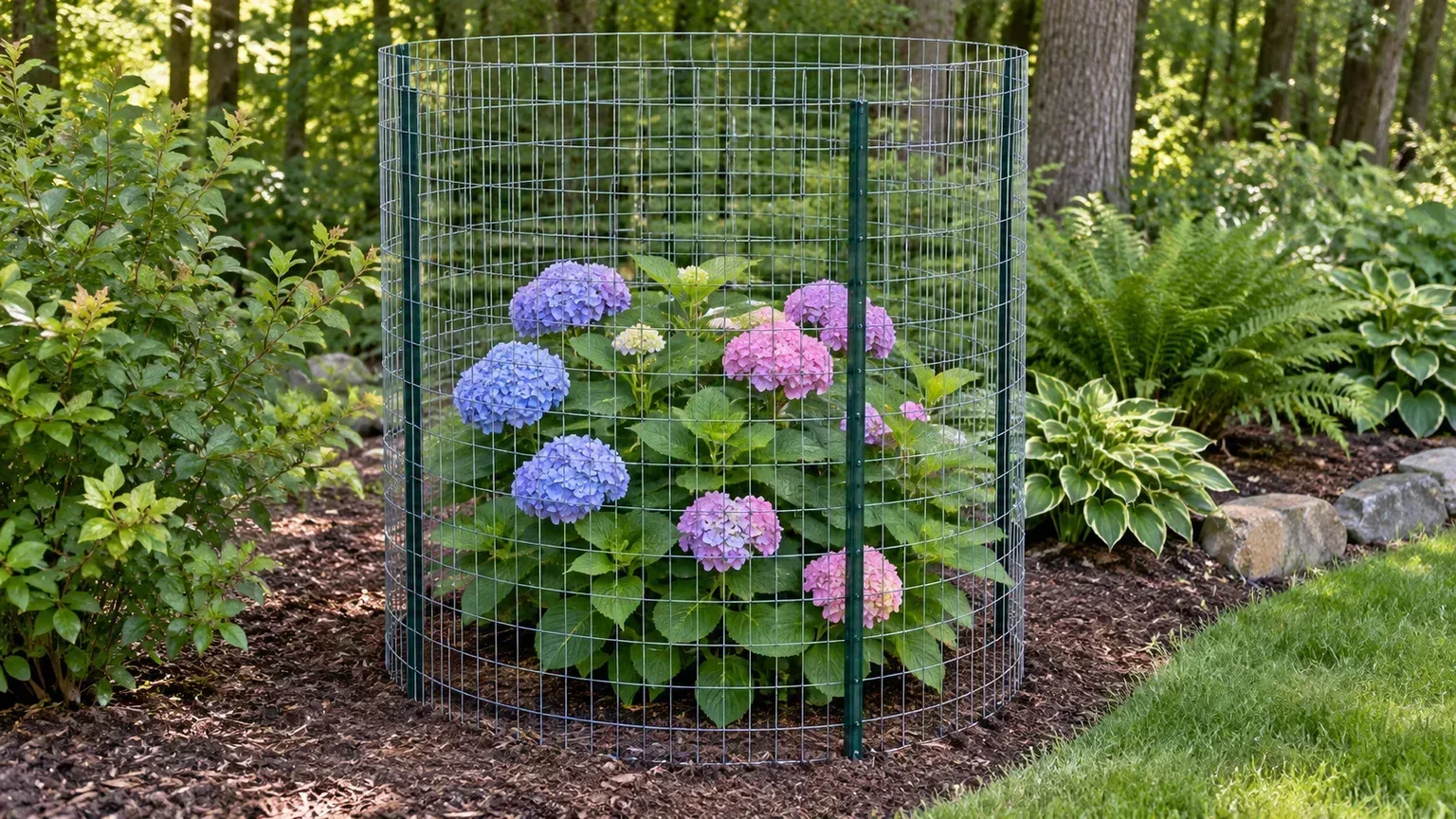
University of Maryland Extension reports that three- to five-foot wire exclosures can protect many shrubs and young trees, but plants growing over the edge can still be browsed; five feet offers more protection than four. Oregon State recommends six feet or more for rings around individual trees or small areas. These measurements are a starting point, not a magic number: size the barrier to the shrub and local deer behavior, and keep the foliage inside it. (University of Maryland Extension’s deer-damage guidance; Oregon State University Extension’s deer guide)
A cage is most useful when it protects the flower-bearing parts without rubbing against them. Anchor it so deer cannot push it aside, check that the base meets the soil, and widen or raise it as the shrub grows. Remove or open the barrier only when the browse risk has passed; otherwise a single night of access can undo months of growth.
Fence the Whole Bed When Deer Pressure Is High
If you have several hydrangeas, repeated losses, or a small garden bed that must stay intact, a perimeter fence gives more dependable protection than a collection of repellents. University of Maryland Extension calls an eight-foot fence the surest way to protect valuable plantings where deer are abundant, while Oregon State’s home-landscape guidance recommends a sturdy fence at least about 6.3 feet high in places where deer can get a running start. The difference reflects site and pressure: choose the higher, well-built barrier when losing the plants is not an option. (University of Maryland Extension; Oregon State University Extension)
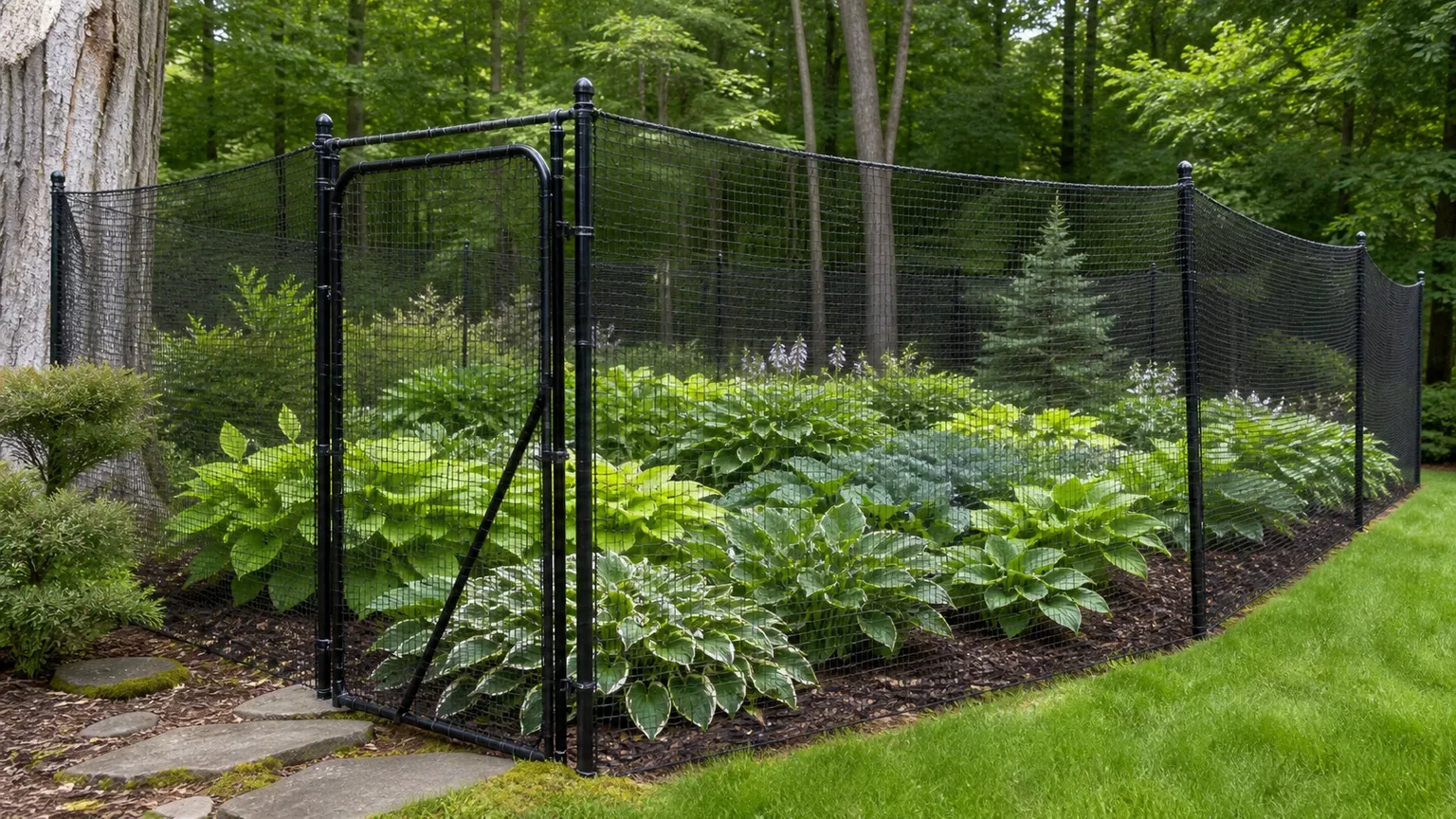
A fence only works if deer cannot slip beneath it or through the gate. Keep the lower edge close to the ground, secure corners, inspect openings after storms, and use a gate that closes completely. A tall perimeter fence costs more and changes the garden’s view, but it reduces nightly maintenance and avoids repeated chemical applications.
For a temporary or smaller protection area, a compact exclosure can work because deer may be reluctant to jump into a small, enclosed space. Minnesota Extension’s micro-exclosure project recorded one breach across two growing seasons of monitoring, then no further breaches after the enclosure was made to appear smaller; this is a promising technique, not a guarantee for every suburban herd. If deer already have a regular route through the bed, observe and adjust the enclosure rather than assuming the first installation is foolproof. (University of Minnesota Extension’s micro-exclosure guidance)
Use Repellents Before Deer Form a Habit
A contact repellent can help protect a few shrubs when fencing is impractical, especially if you begin before deer repeatedly feed there. Apply a product labeled for ornamental shrubs to the foliage and shoots you need to protect, and follow its instructions for weather, temperature, reapplication, and plant safety. Rain, irrigation, sun, and new growth can reduce coverage; some products can injure tender leaves, so test a small area if the label advises it. (UC Statewide IPM Program’s deer guidance)
There is no universal spray schedule. Many products call for repeat applications every one to three weeks or after heavy rain, but the label for the exact product controls. Rotate among different labeled repellent types if deer start ignoring one, and remember that repellents work best when pressure is not extreme. In a high-deer yard, combine a repellent with a cage or fence instead of counting on odor or taste alone. (University of Maryland Extension; Iowa State University Extension)
Minnesota Extension also describes a simple egg-and-water spray based on a 1994 deer-repellent study: blend three eggs, add water to make one gallon, strain, and spray new growth until the leaves have a sheen; reapply every two weeks or after rain. The same guidance says heavy deer pressure can override the odor and that extra ingredients may reduce effectiveness by masking it. This can be a low-cost summer option for ornamental shrubs where local rules allow it, but it smells, washes off, and is not a substitute for exclusion when the blooms are important. (University of Minnesota Extension’s deer-protection guide)
Treat Motion Devices as a Temporary Backup
Motion-activated sprinklers can startle deer without coating a plant, and they may help break a nightly route when the shrub is close to the device’s sensor. Position the spray so it reaches the entry path, not a neighbor’s walkway, and check that the device has water and battery power when deer are active. It may deter visitors for a while, but it does not create a physical barrier around the buds.
Lights, noise makers, reflective tape, and other fixed scare devices tend to lose effect as deer learn that they pose no threat. Extension guidance describes these methods as temporary and recommends moving or changing them rather than leaving one in the same place indefinitely. Use a sprinkler or light as one layer while a cage or fence does the lasting work. (Iowa State University Extension; UC Statewide IPM Program)
What to Do After Deer Browse a Hydrangea
First, photograph the shrub and identify the type before pruning. Remove only stems that are split, crushed, or hanging; leave sound stems and intact buds in place, particularly on bigleaf, mountain, or oakleaf hydrangeas that flower from old wood. A neat haircut may make the shrub look even, but it can compound the flower loss by cutting away stems the deer did not reach.
If the soil is dry, water the root zone as you normally would and keep moisture steady while the shrub replaces leaves. Avoid a heavy dose of fertilizer as a quick “recovery” fix; it cannot restore removed flower buds, and soft new growth may simply become the next target. Established hydrangeas often recover from mild browsing, while a young plant that is repeatedly stripped has less leaf area to support new growth. (Oregon State University Extension)
Then protect the plant before the next visit. If only a few outer tips were nipped, a cage or repellent may be enough; if deer are taking every new shoot, stop access with a taller exclosure or fence. Check the same stems over the next few weeks. New growth is a good sign that the shrub remains active, but whether it flowers this year depends on species, bud location, and how much time remains in the growing season.
Conclusion: Choose the Hydrangea You Want, Then Protect It
Deer eat hydrangeas, but the species ranking changes by garden, and even types considered less attractive can be severely browsed. Choose the hydrangea for the climate, size, and bloom pattern you want, then protect the plant according to what you can tolerate losing: use a cage for one specimen, a high fence for repeated or widespread damage, and repellents or motion devices as supporting layers. If you already see ragged stems or missing buds, identify the hydrangea’s bloom wood before pruning so a deer visit does not become a second round of flower loss.