Potting Soil vs. Potting Mix: The Real Difference
Compare potting soil and potting mix by ingredients, drainage, plant type, and setting. See what works for containers, seed starting, raised beds, and repotting.
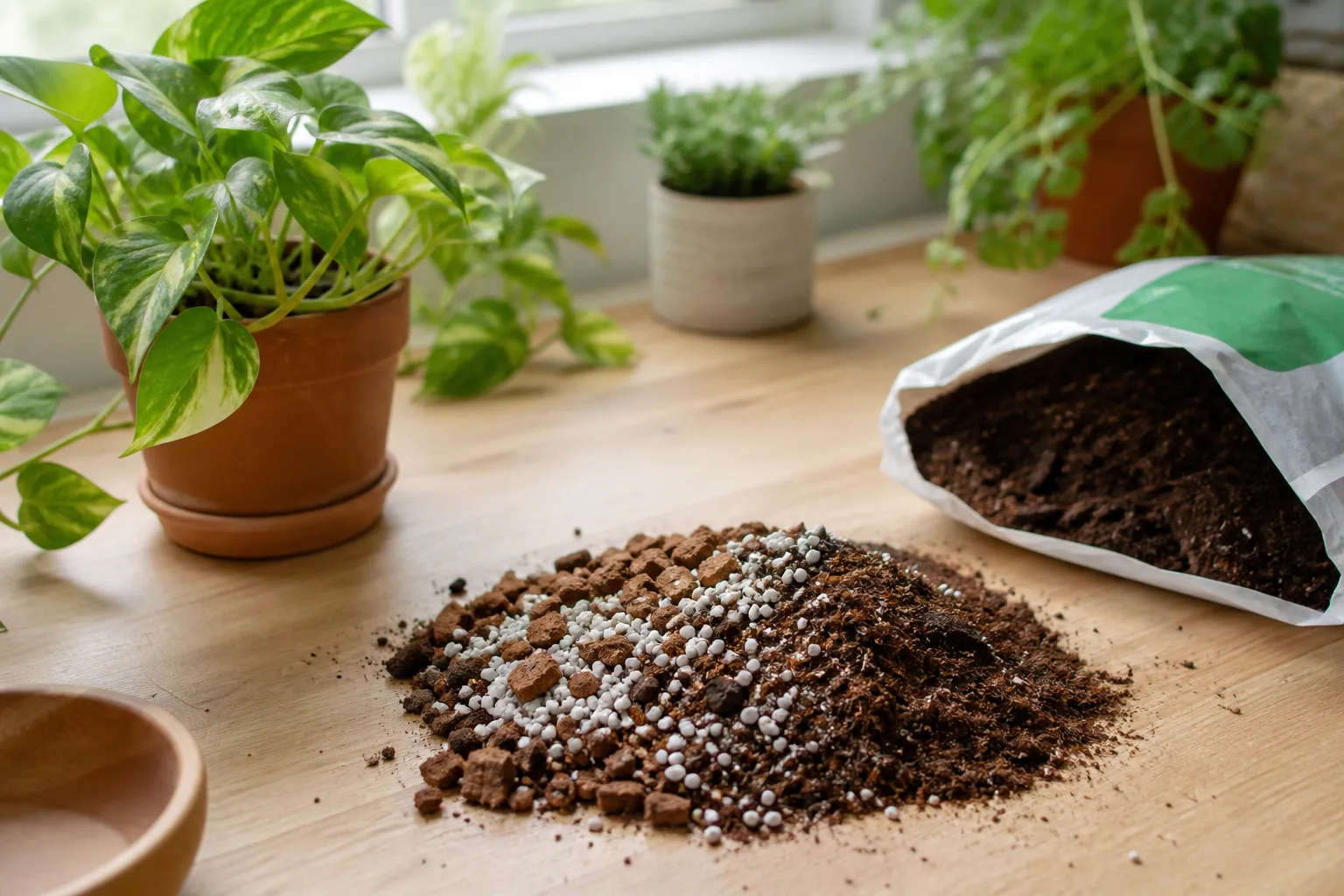
A bag marked “potting soil” may contain garden soil, a blended soil medium, or a soilless container mix. A bag marked “potting mix” is usually designed for pots, but its texture, ingredients, fertilizer charge, and moisture behavior still vary. The words on the front are clues; the ingredient list and the job you need the medium to do are more reliable.
For most everyday containers, choose a product explicitly formulated for containers and built to hold some water while leaving air around roots. That product is often called potting mix, but a container-ready product can also be called potting soil. For a garden bed, start with the existing ground or a bed blend intended for that use rather than filling the bed with a small-pot mix.
The quick answer
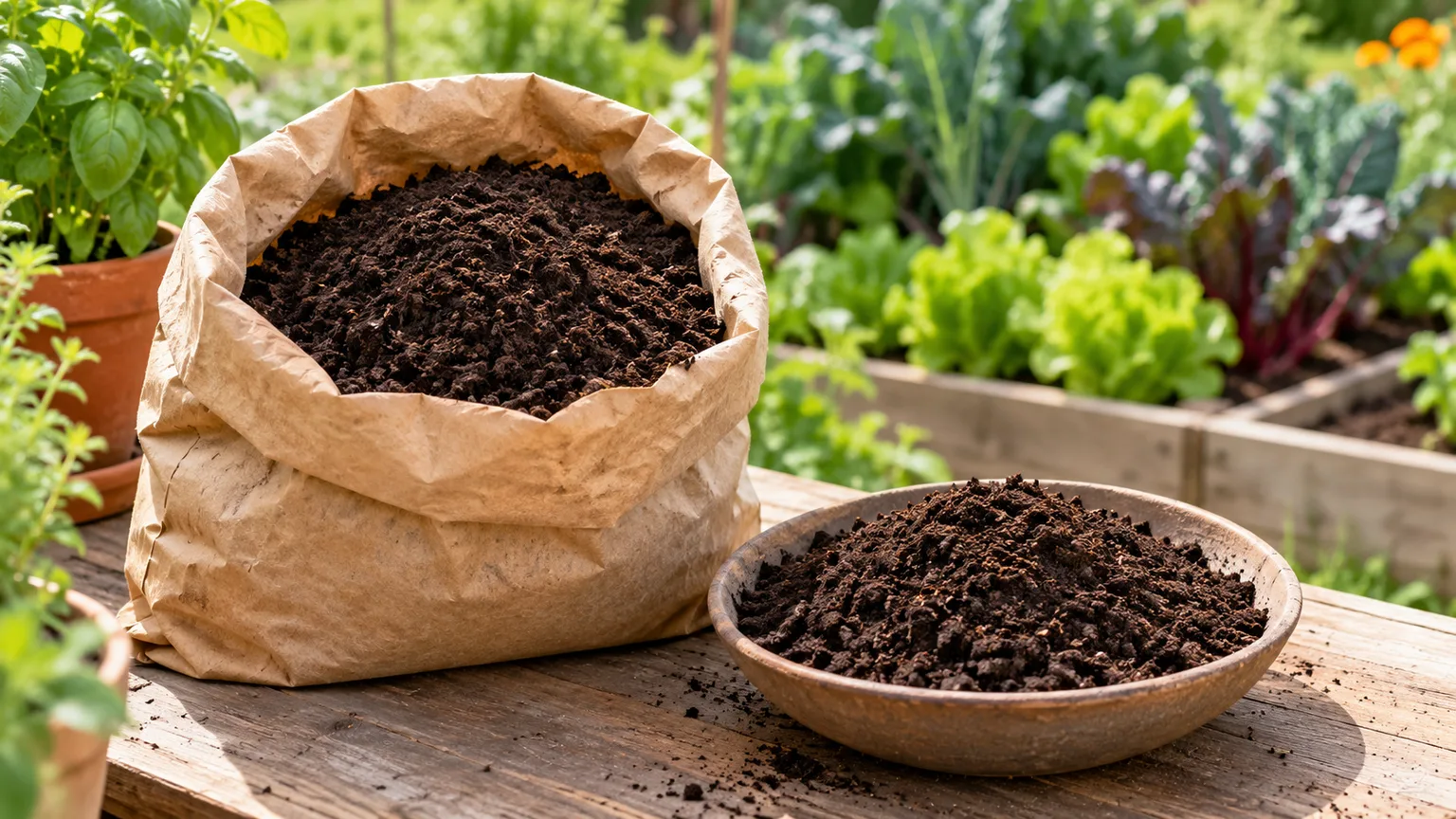
If you are filling a houseplant pot, window box, patio planter, or container for vegetables, look for a container or potting medium with a loose, springy structure. Many soilless blends use peat or coir to hold water, with perlite, bark, or vermiculite to balance water movement and air space. A well-made soil-containing product can also work in pots if it is specifically blended for containers and its label says so.
If you are improving an in-ground garden, do not treat a bag of lightweight potting mix as a substitute for garden soil. Use the native soil and amend the bed according to its condition; in a raised bed, use a product intended for raised beds or a suitable blend of mineral soil and finished organic matter. The volume, watering pattern, and root environment are different from a small pot.
The practical rule is short: buy for the growing situation, then confirm the ingredients. Do not put ordinary garden soil into a pot just because it is inexpensive, and do not assume a bag labeled “potting soil” is automatically unsuitable for every container.
Bag names do not guarantee the ingredients
In casual retail language, “potting soil” and “potting mix” often overlap. Some bags called potting soil are soilless; others include actual mineral soil or a heavier soil-based blend. Some potting mixes are mostly peat or coir, while others add bark, compost, fertilizer, or water-retention ingredients. The name alone does not tell you how quickly the pot will dry or how much air the roots will get.
The University of Connecticut’s Home & Garden Education Center notes that packaged media labeled “potting soil” can contain mixes of organic and inorganic ingredients, including peat, bark, sand, compost, and vermiculite; soilless mixes, by definition, omit mineral soil particles such as sand, silt, and clay. UConn also notes that product formulations vary and that a heavier medium can make sense for large or top-heavy plants (UConn’s potting-media guidance). That is more useful than relying on one universal definition of the two front-of-bag terms.
Why “potting soil” can still be container-ready
A label is not a recipe. The City of Tacoma, for example, calls one of its products “potting soil” and describes it as a bark-and-sawdust blend with pasteurized biosolids for container plants, while it sells a separate topsoil product for refreshing beds (City of Tacoma’s TAGRO product guide). That example does not mean every product called potting soil belongs in a pot. It shows why the ingredients, use directions, and finished texture matter more than a strict vocabulary rule.
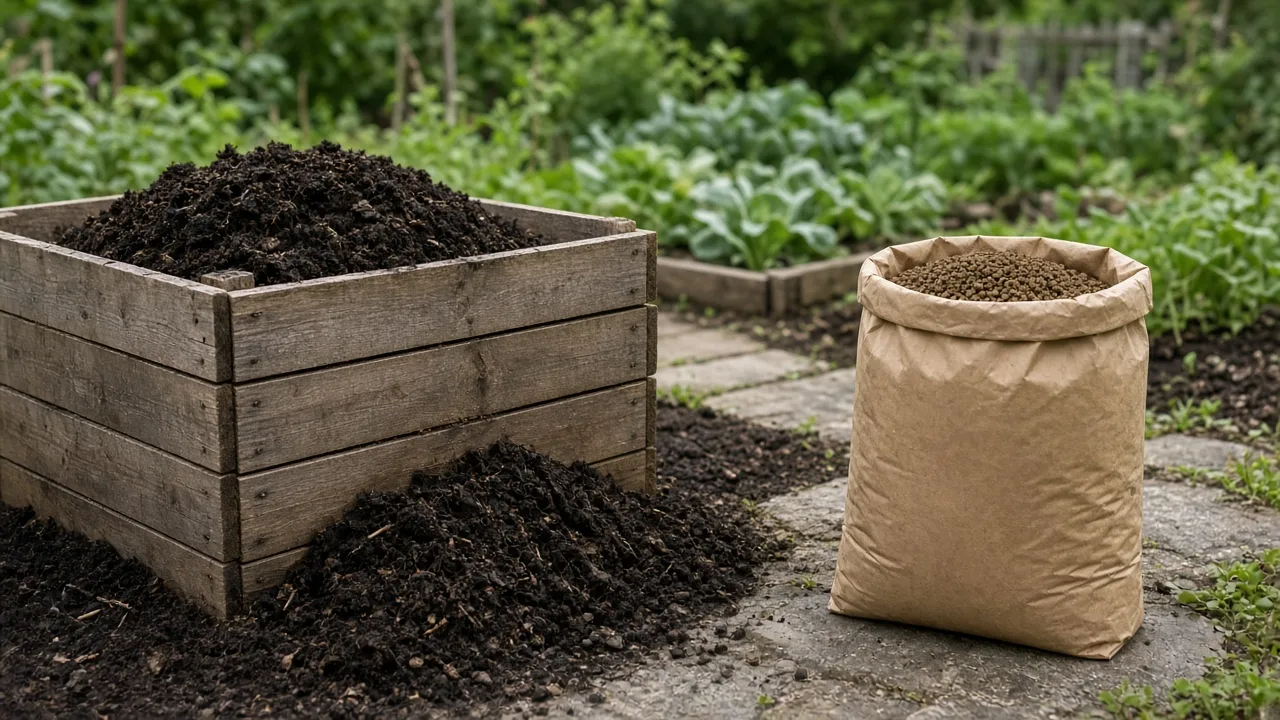
Treat garden soil, topsoil, raised-bed mix, and potting mix as different product categories until you read the label. Garden soil is usually designed to blend into outdoor ground; topsoil supplies mineral soil; raised-bed blends vary by maker and can include topsoil and compost; potting media are designed to perform inside a container. If a bag gives no ingredients or use directions, choose a clearer product rather than guessing from weight, color, or a “premium” badge.
Why a container needs a purpose-built root zone
A plant in a bed can send roots through a large volume of soil. A potted plant is confined to a short column of medium, watered from above or below, and limited to the drainage openings in its pot. The growing medium has to hold enough moisture and nutrients for the roots while maintaining pathways for air and excess water; UConn identifies drainage, air circulation, water storage, nutrient storage, and physical support as core functions of a potting medium.
Ordinary garden soil can work outdoors yet become too dense when packed into a pot and repeatedly watered. Fine particles settle into gaps, the medium can compact, and water may take longer to drain. Roots then have less oxygen available even if the pot has drainage holes. A suitable container mix is not simply “fluffy”; it should wet evenly, drain freely, and remain open enough that it does not collapse into a hard mass after repeated watering.
The medium also affects how often you water. A small plastic pot on a sunny, windy patio may dry quickly; a large glazed planter in a dim room may stay wet for days. That is why “better drainage” is not the only goal. A gritty medium can dry too quickly for a fern, while an overly moisture-retentive medium can suffocate roots in a cool, low-light room. Aim for a balance that suits the plant, pot, and conditions you actually have.
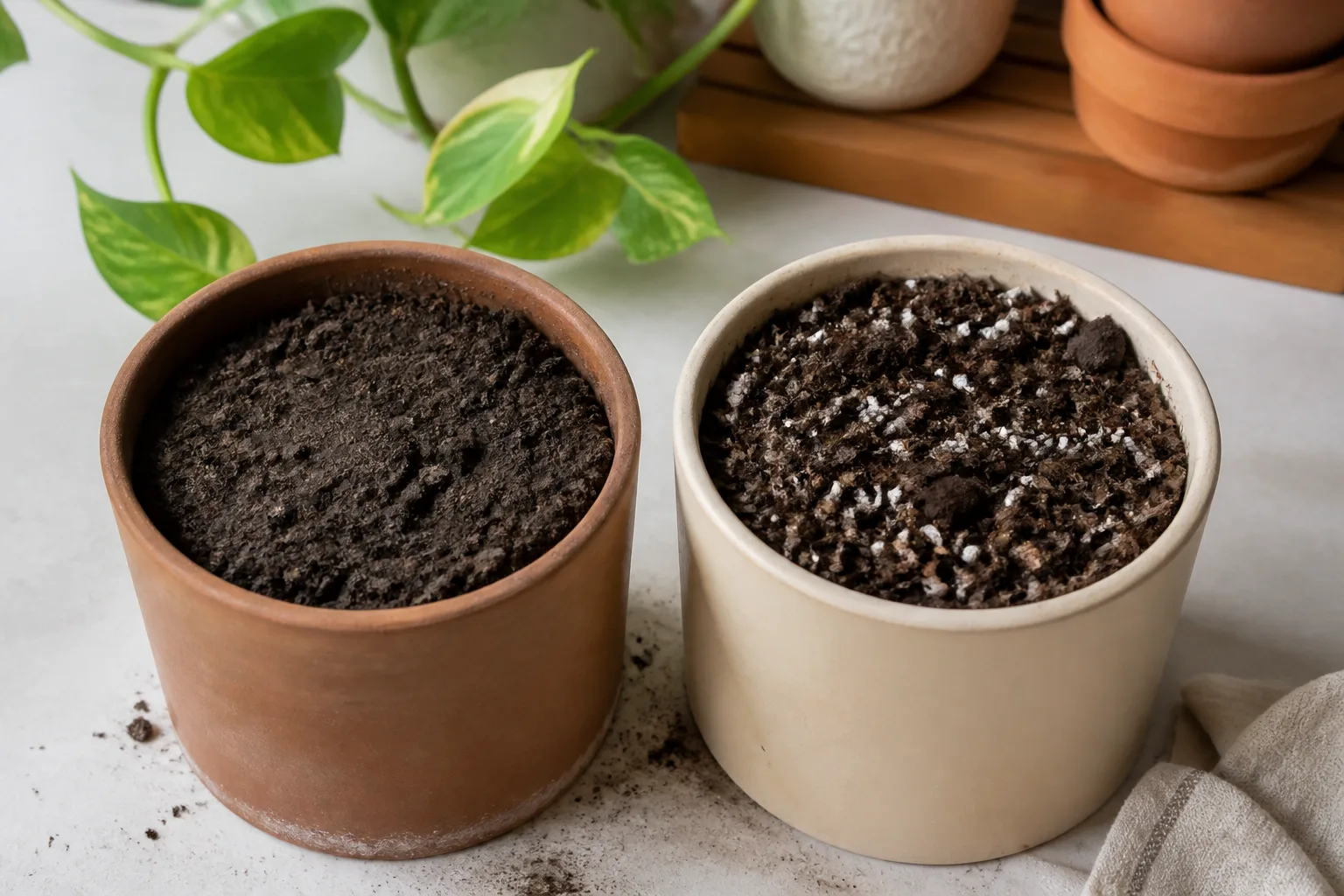
What ingredients change how a medium behaves
Growing media use combinations of materials rather than one magic ingredient. The same ingredient can help one property while making another harder to manage: peat holds water but can be slow to rewet when very dry; coarse bark improves structure but can dry sooner; compost adds organic matter and nutrients but varies with what went into it. UF/IFAS describes potting media as blends tailored to the plant and growth stage, with requirements for support, air, water, and nutrients (UF/IFAS’s potting-mix overview).
Read ingredients as a description of expected behavior, not as a guarantee. The first listed ingredients usually give you a sense of the base, but particle size, processing, amount of each component, how compressed the bag is, and whether it arrives dry also matter. If a product is a mystery blend, test a small amount in a spare pot before repotting a collection.
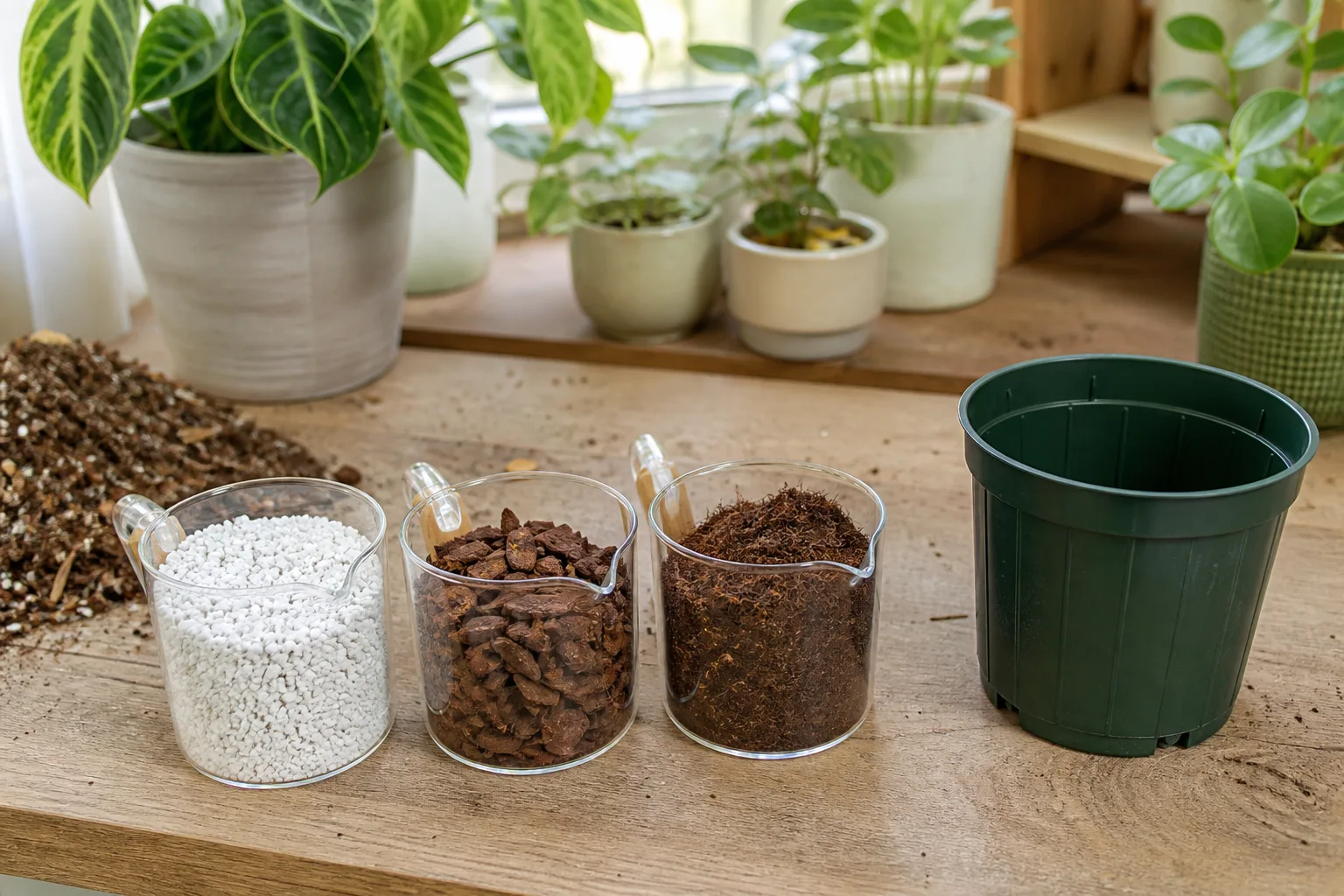
Moisture-holding ingredients
Peat moss is light and water-retentive, which is why it is common in conventional soilless mixes. When thoroughly dry, peat-based media may resist wetting and let water run down the sides of the pot rather than soaking the root ball. Pre-moisten a dry bag gradually and mix it through; do not assume the first quick pour has hydrated the entire root zone. Peat also tends to be acidic, and commercial formulas may include lime to adjust pH.
Coconut coir is made from coconut husk fiber and is sold loose or in compressed bricks. It also holds moisture, but the grade and processing matter; compressed material must be fully expanded before use, and some products may need rinsing. Finished compost can contribute organic matter and nutrients, though its nutrient content depends on the feedstocks and process. UF/IFAS emphasizes that compost quality depends on the materials composted, so “contains compost” is not the same as a predictable fertilizer analysis.
Aeration and drainage ingredients
Perlite is a lightweight expanded mineral that adds larger pores and helps water drain; it does not supply a complete fertilizer program. Vermiculite holds both water and nutrients and is used where a mix needs more retention, including some seed-starting blends. UConn and UF/IFAS list both materials among common growing-media ingredients, but the amount and particle grade determine whether the finished blend is airy, moisture-retentive, or dense.
Composted bark can add structure and air space; bark size and aging affect both its stability and how quickly a pot dries. Pumice and coarse horticultural grit are heavier aeration materials used in some mixes. Sand can increase weight and may help a particular formula, but fine sand can fill pores and make a blend denser. You are shopping for a balanced finished medium, not a checklist that must contain every ingredient.
Potting soil vs. potting mix at a glance
| What to compare | Soil-containing potting medium | Soilless potting mix |
|---|---|---|
| What the term tells you | It may contain mineral soil, but some products use the name loosely | It should contain no mineral soil particles if the label uses “soilless” accurately |
| Common ingredients | Mineral soil, compost, peat or coir, bark, sand, or other amendments | Peat or coir, bark, perlite, vermiculite, compost, and sometimes fertilizer |
| Typical feel | Often heavier; texture varies considerably | Often lighter and more open, though fine blends can still hold a lot of water |
| Usual role | In-ground or raised-bed use; some formulas are designed for containers | Most ordinary houseplant and outdoor container planting; some seed starting |
| Fertility | May contain compost or nutrients, but amount can vary | May be low-nutrient, pre-fertilized, or contain a slow-release charge |
| Main check | Confirm whether the label recommends it for pots or beds | Match texture, water retention, and fertilizer to the plant and setting |
This table compares common patterns, not product laws. A light, bark-rich bag called potting soil may work better in a pot than a fine, waterlogged product called potting mix. Check whether the product is intended for containers, what minerals or amendments it contains, and how it feels when lightly moistened.
Choose a medium for the planting job
Start with the container, not with a universal recipe. The same bag can behave differently in a small nursery pot, a wide trough, and a large patio tub. Then match it to the plant’s root needs and your weather: how long the pot stays wet is a joint result of the medium, drainage holes, pot size and material, light, heat, humidity, airflow, and watering.
Houseplants, flowers, herbs, and vegetables
For most common houseplants and annuals, choose an indoor or all-purpose container mix with a moderate balance of moisture retention and air space. Look for bark, perlite, pumice, or vermiculite if the plant dislikes a dense, slow-drying root zone. A moisture-control product may help a fast-drying patio pot, but can prolong saturation in a cool room or oversized container. Read the package’s use directions, not just the plant photo.
For tomatoes, peppers, herbs, and flowers in outdoor containers, use a container medium that remains workable through repeated watering. A fast-draining mix can be useful in hot weather, but expect to water more often and feed according to the label and the plant’s growth. A heavier, soil-containing formula may be appropriate when its label explicitly covers containers; balance its added weight against how often the pot will be moved and how well it drains.
For indoor plants with special root needs, start with a suitable base and alter it only when you have a reason. A chunky aroid mix, for example, may use bark and coarse aeration material, while a moisture-loving fern generally needs more water retention. Our guide to choosing potting mix for indoor plants explains how to tune that balance by plant type. Do not add perlite to every bag by habit: if the product already stays evenly moist and drains, extra amendment can make it dry too fast.
Seeds and young transplants
For seeds, use a fine-textured seed-starting medium or a product whose label says it is appropriate for starting seeds. Small seeds and new roots can struggle in coarse bark, large chunks, or a heavy soil that leaves uneven wet and dry pockets. Some seed mixes are low in nutrients because seeds begin with stored energy; once seedlings develop and are ready to grow beyond the starter cell, they need to be moved into a more substantial medium and fed as the product instructions indicate.
Do not assume every soilless medium is sterile. UConn says soilless mixes are usually sterilized, while soil-containing media may or may not be; “soilless” describes the ingredients, not a guaranteed pathogen-free status. If cleanliness matters for propagation or the bag claims a specific treatment, confirm that claim on the label. For seed starting, fine texture and even moisture are at least as important as the words “soil” or “mix.”
Succulents, cacti, and orchids
Cacti and many succulents need a medium that dries more quickly than a typical all-purpose mix, especially indoors or in a humid climate. Choose a labeled cactus or succulent medium and check the actual ingredient list; some commercial bags still contain a high proportion of fine organic material and may need a mineral amendment. Avoid making the mix so gritty that it cannot hold enough water for the roots to use between waterings.
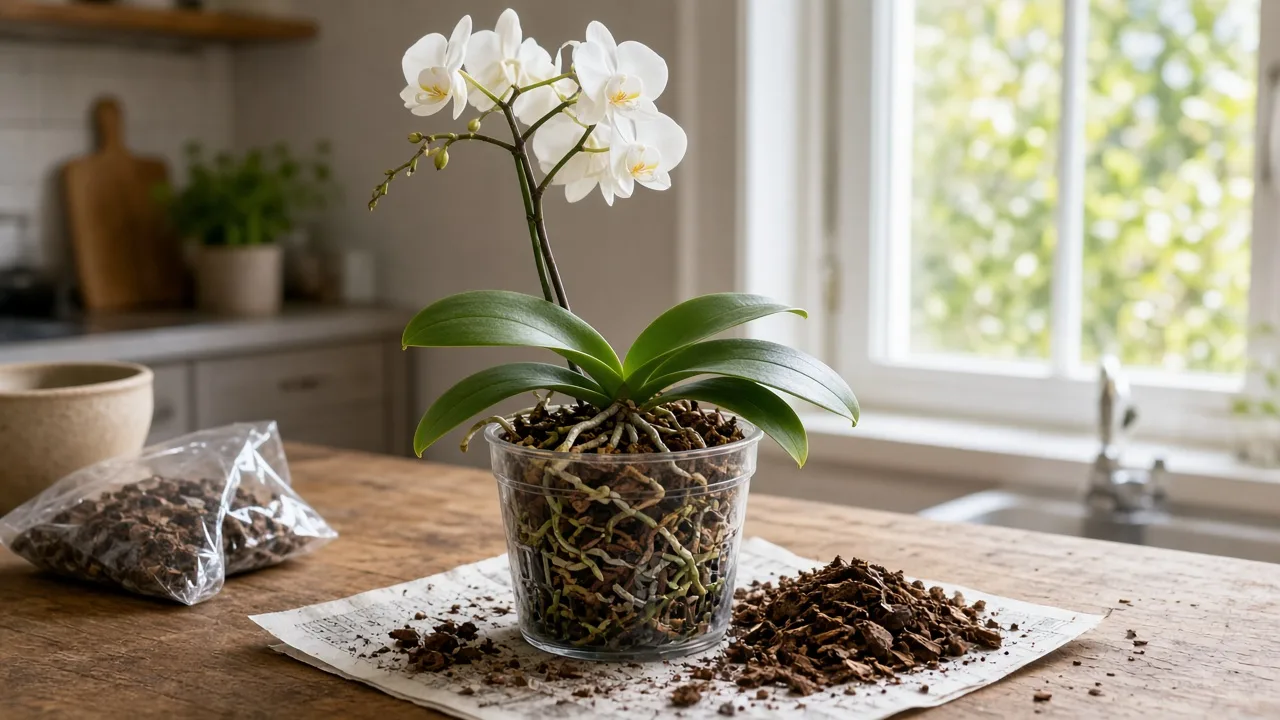
Orchids need a product made for their growing habit. Many common epiphytic orchids are grown in coarse bark-based media rather than a fine all-purpose houseplant mix because their roots need air and should not remain in dense, wet material. “Orchid mix” can mean different bark sizes and additives, so use the product for the orchid type and pot style. Do not treat a label as a substitute for learning whether the plant grows in bark, moss, or another specialized medium.
Large outdoor planters and small trees
Big planters create two competing needs: the medium must support the plant and remain moist enough, but a large volume can stay wet long after the surface looks dry. Avoid filling a deep container with garden soil simply to save money; it may compact and make the pot unnecessarily heavy. Choose a container-rated formula that suits the plant, pot depth, and exposure, and keep the drainage openings clear.
For a tall or top-heavy plant, a somewhat heavier mix can reduce tipping, as UConn notes, but do not solve stability by sacrificing root aeration. A wider or heavier pot, protected placement, or a stake is often a better fix than turning the root zone into dense soil. On balconies, rooftops, and decks, remember that saturated media weigh much more than a dry bag; follow building load limits and avoid placing a wet, oversized planter where its weight is uncertain.
What to use in raised beds and in-ground gardens
For an in-ground bed, the native soil is the growing medium; improve it with suitable organic matter or targeted amendments based on the actual soil rather than replacing it with potting mix. Lightweight container media can dry quickly in a broad, exposed bed, settle, and cost far more than the volume requires. Potting mix can be useful for a small planting pocket or specialty container, but it is not a practical default for filling a landscape bed.
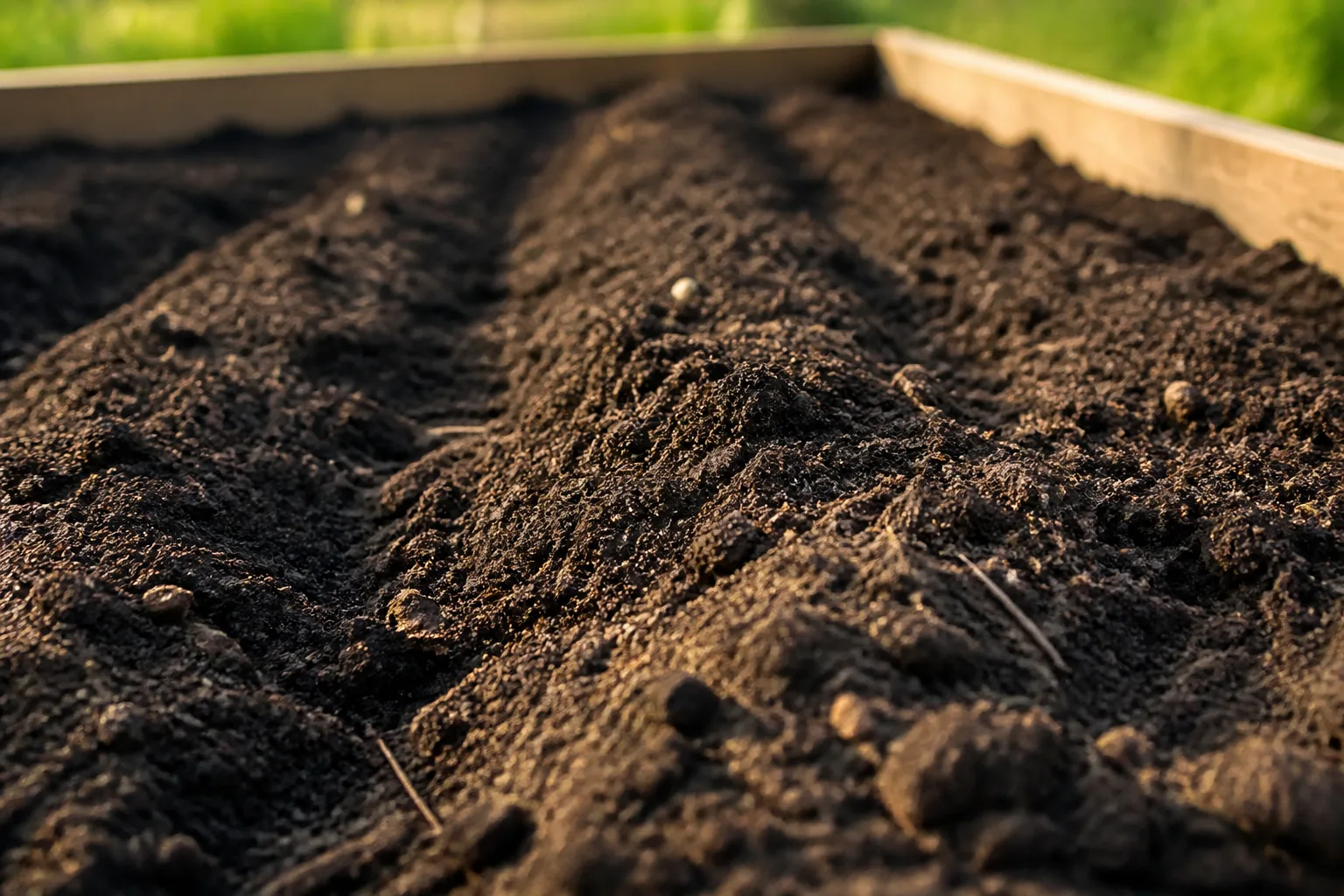
Raised beds need enough mineral soil and organic matter to support long-term roots. A product called raised-bed mix may be soil-based, compost-heavy, or a combination; check its ingredients and intended depth. Compost can improve a bed, but an all-compost fill may shrink as it decomposes and may have a nutrient profile that does not suit every crop. Use a blend intended for raised beds, and keep the mixture consistent with the bed’s irrigation and local climate.
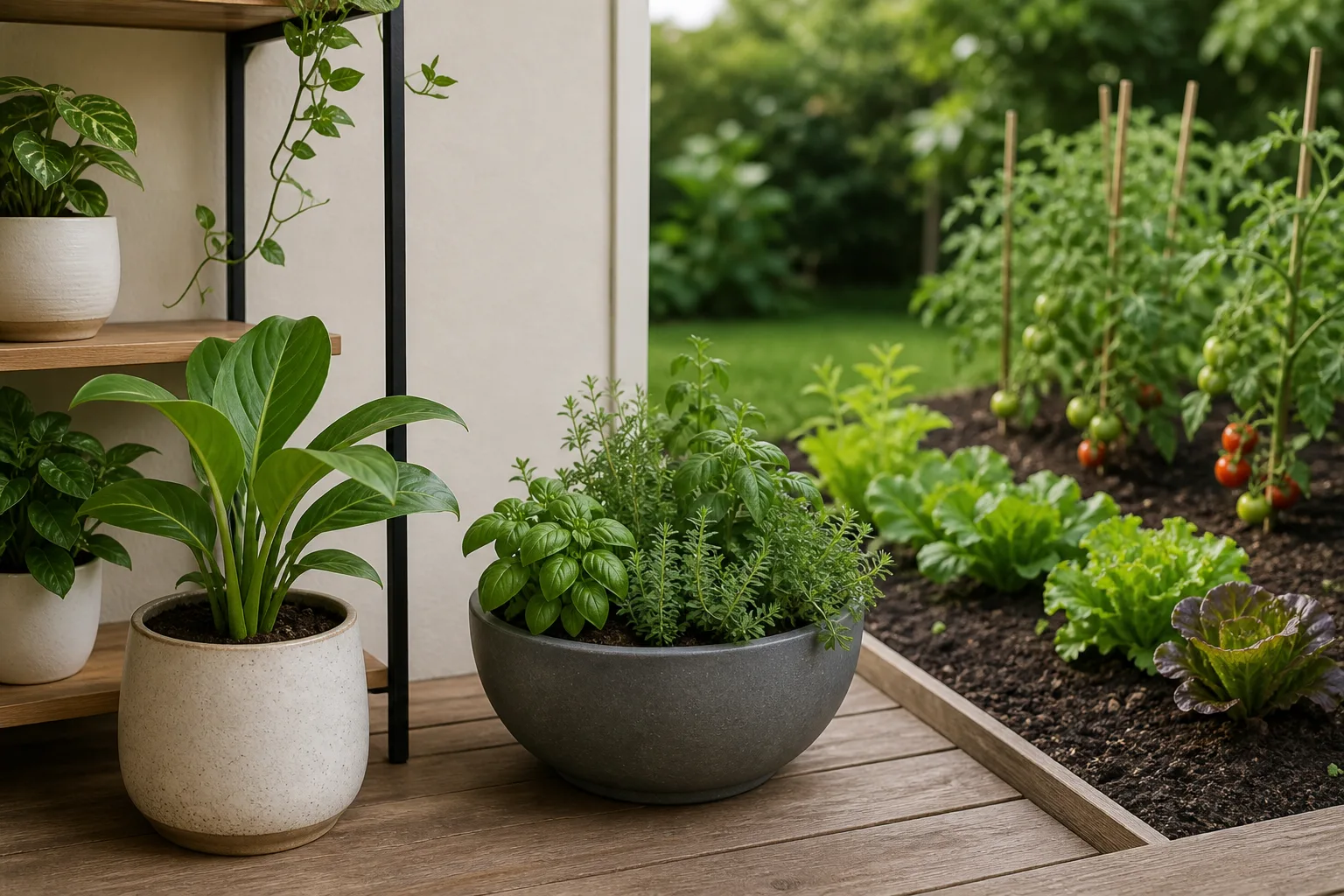
There are products labeled potting soil that are also formulated for boxes or containers, so the name does not make a product wrong for a raised planter. A small box with flowers is closer to a container; a deep vegetable bed is closer to a garden bed. Choose by scale and root environment, then follow the manufacturer’s directions. If you need a guide to another commonly confused material, see what topsoil is and how to use it.
How to shop by label and texture
At the store, turn the bag around and check these details before you compare prices:
- Intended use: Look for indoor plants, outdoor containers, seed starting, cacti, orchids, raised beds, or in-ground use. Avoid using a garden-bed product in a small pot unless the label also allows container use.
- Ingredient list: See whether the base is peat, coir, bark, compost, mineral soil, or a combination. A list is more informative than the name, “organic” badge, or package color.
- Particle structure: For most containers, a visibly open texture with particles that do not turn to paste when moistened is a useful starting point. Seed-starting mixes are often finer by design.
- Fertilizer: Check whether fertilizer is included, how long it is meant to feed, and whether it is slow-release. Do not add a full dose of fertilizer on day one just because you are unsure; an existing fertilizer charge plus a fresh dose can overfeed a new planting.
- Moisture additives: Water-retention crystals or extra wetting agents may be useful for a hot, exposed basket but a poor match for plants that must dry between waterings.
- Special handling: Compressed coir needs expansion; a dry peat-heavy mix may need pre-moistening; a dusty or unusually wet bag deserves inspection before use.
A quick hand test can help after purchase: moisten a handful evenly, squeeze gently, then open your hand. A balanced container medium should hold together briefly but loosen with a touch rather than staying in a solid muddy clump. Water should soak in rather than bead on a bone-dry surface, and the mix should not feel like a dense lump. This is a practical screening test, not a laboratory measure; the best confirmation is how a planted pot dries over several watering cycles.
Do not use bag weight as your deciding test. Moisture content, bag size, compaction, and the ingredients all affect weight. One editorial comparison from Martha Stewart’s gardening coverage also underscores that both product terms are common at retail while formulations and use cases differ. If an unlabeled product offers no ingredients or directions, choose another bag with a clearer description.
Chartered horticulturist Tony O’Neill makes a related practical point in Simplify Gardening’s comparison: check what a product contains instead of trusting the name. That is sound shopping advice, even though claims about sterility or fertilizer still need to be confirmed on the specific bag.
How to adjust a mix that is too dense or too dry
If a freshly opened mix looks dense, first check whether it is simply compressed or still wet from storage. Fluff it in a clean tub and break up clods without grinding the particles into dust. If it is a container product but remains fine and slow-draining when moistened, blend a small test batch with a coarse aeration material such as perlite, pumice, or appropriately sized bark. Start with a modest amount and compare the drying time before changing every pot.
If a dry peat-based mix sheds water, pre-moisten it before planting: add water in stages, turn the medium between additions, and let it absorb before you fill pots. Pouring a large volume onto a dry, hydrophobic mix can send water straight through the sides while the center stays dry. If the mix is old, collapsed, sour-smelling, or repeatedly stays saturated, amendment may not restore its structure; replacing it and checking the pot’s drainage is often more effective.
A simple trial pot can tell you more than a complicated recipe. Plant a small, healthy specimen or fill a spare pot, water thoroughly, let it drain, then check its weight and moisture over several days in the same place as the finished plant. If it remains heavy for too long, increase aeration or use a smaller pot; if it dries too quickly, add a more retentive component or change the watering plan. Change one factor at a time so you can tell what actually helped.
Plan for nutrients and media breakdown
Potting medium is not automatically fertilizer. A bag may contain compost or a starter fertilizer charge, or it may be a low-fertility soilless blend that mainly provides physical support, water, and air. Read the analysis and feeding directions. UConn notes that starter nutrients can be used up and container plants eventually need a regular nutrient source; UF/IFAS likewise explains that the ingredients and proportions vary with plant type and growth stage.
Watering also moves soluble nutrients through a pot’s drainage holes. Feed according to the label, crop, season, and growth rate instead of applying the same schedule to every plant. A newly planted seedling, a mature vegetable in active growth, and a slow-growing houseplant do not have the same demand. If you use a fertilizer-loaded mix, wait for the label’s stated release period before adding another fertilizer.
Organic ingredients break down, and repeated watering can leave a medium more compacted than it was when new. If a plant’s potting mix has shrunk, drains much more slowly, or no longer wets evenly, inspect the roots and the medium before automatically increasing fertilizer. Repotting into a fresh, suitably structured product may solve a physical problem that added nutrients cannot fix. For a deeper guide to blending your own materials, see DIY soil mixes for plants.
Mistakes that make the wrong medium worse
Using garden soil as a cheap pot filler is a common false economy. It can be dense in a pot, difficult to rewet after drying, and inconsistent from one shovel to the next. Use garden soil where it belongs—in a garden bed—or choose a container product that explicitly includes soil and is formulated for pots.
Choosing by “organic,” “moisture control,” or “premium” alone does not tell you whether a product drains appropriately. Organic certification is about the inputs and production rules stated by the label; it does not guarantee an airy texture. A moisture-control blend can be useful in one exposed pot and too wet in another. Read the ingredients and intended use together.
Assuming every potting mix is sterile or fertile can lead to disappointing seedlings or overfertilized roots. Soilless describes the lack of mineral soil, not a universal sanitation or nutrient guarantee. Check explicit product claims, fertilizer analysis, and seed-starting directions instead of relying on the category name.
Adding gravel at the bottom of a pot to improve drainage does not fix a mix that drains poorly or a blocked drainage hole. Use a pot with open holes and a medium suited to its depth; keep the container raised enough that runoff can escape. Likewise, adding a large amount of fine sand can make some blends denser rather than airier.
Watering by calendar after changing the medium ignores how the new mix behaves. After repotting, note the pot’s weight just after watering and as it dries, then use that change as a reference. A new coir-based, bark-heavy, or moisture-retentive blend can shift the interval even if the plant and room have not changed.
Conclusion
For most containers, choose a medium made for containers and matched to the plant’s need for moisture, air, and drainage. That product is often sold as potting mix, but the label “potting soil” does not rule it out; some soil-containing products are intentionally formulated for pots. Conversely, garden soil and raised-bed products are not interchangeable with small-pot mixes just because all of them look like dark soil in a bag.
Turn the bag around, read the ingredients and directions, check for fertilizer or moisture additives, and consider the plant and setting. If you are unsure, test a small batch in a spare pot and watch how it wets and dries. That short check is more reliable than picking by the bold product name—and it gives roots a medium that fits the way you actually grow.