How Dish Soap Can Kill Moss in Your Lawn—and Its Limits
Learn whether dish soap kills lawn moss, why the home remedy can damage turf, and how to remove moss and repair the bare spot without guesswork. Test first.
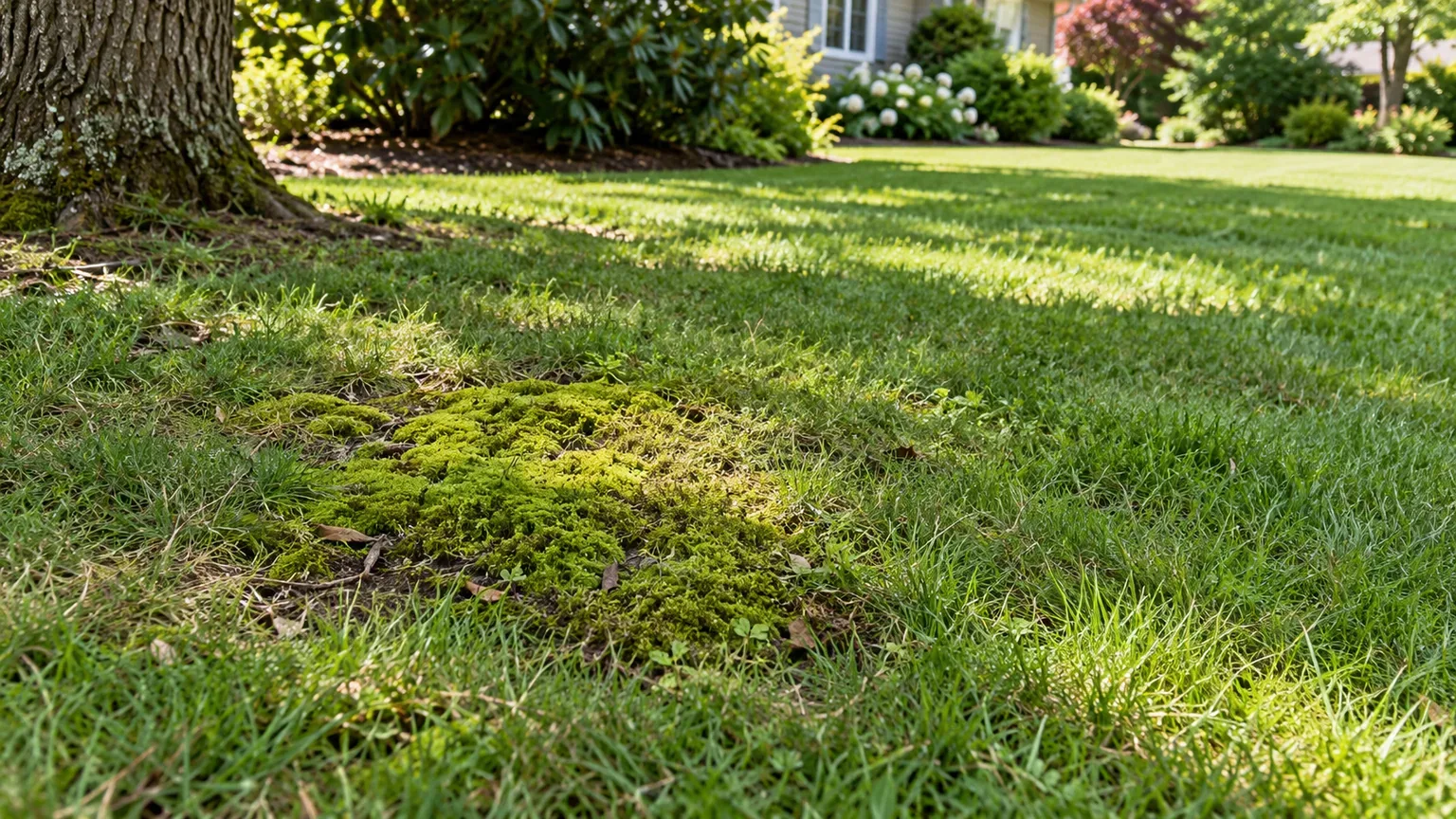
Dish soap can appear to kill a small moss patch because a concentrated surfactant solution can damage exposed growth and dry it out. That quick change in color is not proof that the moss is gone for good, and the same solution can injure the grass you want to keep. Ordinary dish detergent is also not automatically equivalent to a lawn product formulated and labeled for moss control.
If you are considering the remedy, think of it as an uncertain spot treatment—not a reliable full-lawn plan. First decide whether the moss is actually unwanted, then check why the grass is thin there. If you do test any household solution, keep it off desirable turf, use only on a very small area, and expect to remove the dead material and repair the opening. For a lasting improvement, favor the conditions that help grass compete: suitable light, drainage, soil structure, mowing, and seed.
Does dish soap kill lawn moss?
It may damage or desiccate moss that the solution directly contacts, but a household dish-soap mixture is not a proven, one-size-fits-all moss treatment for lawns. Results depend on the detergent formula, dilution, coverage, weather, moss thickness, and how much healthy grass gets hit. A brown or orange patch tells you that surface growth has been injured; it does not show that every fragment has been removed or that the patch will stay moss-free.
That distinction matters because moss is usually growing where turf has already thinned. The University of Wisconsin–Madison Extension explains that moss does not kill turf; it occupies bare areas where grass is not living. University of Georgia Cooperative Extension likewise describes moss and algae as developing as turf declines, rather than as parasites attacking healthy grass. A contact treatment can remove visible growth, but it cannot correct the reason grass is sparse.
The practical verdict: do not soak an entire lawn with dish detergent or assume a kitchen product is harmless because it is familiar. If a few square feet are affected and you are willing to accept some uncertainty, a contained test may show whether the moss browns. For a broad infestation, an expensive-to-repair lawn, or an area beside ornamental plants, choose mechanical removal or a product specifically labeled for moss on the turfgrass you have.
Why moss is in the lawn
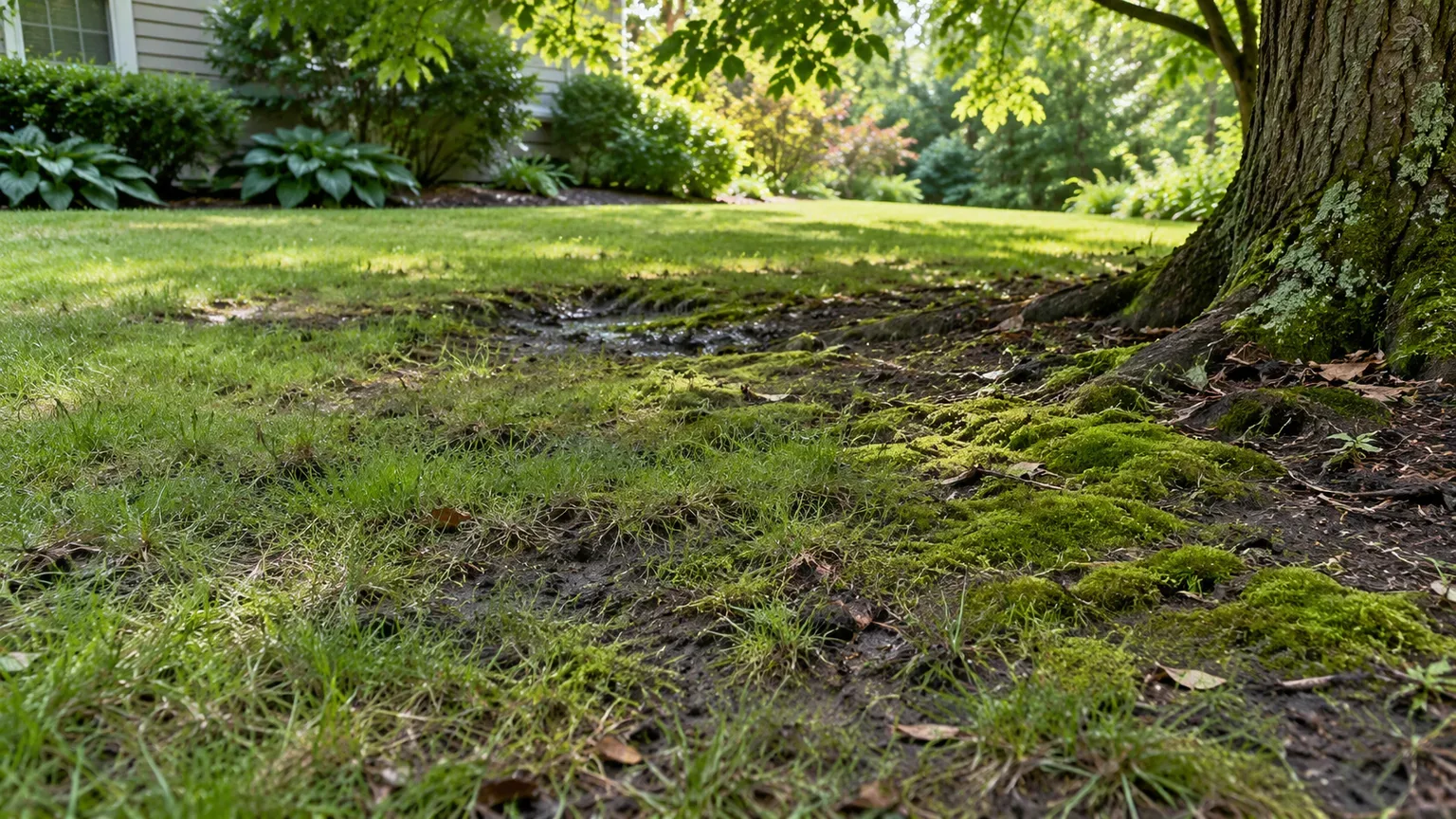
Moss is a clue about the site, not a diagnosis by itself. The usual pattern is a thin grass canopy paired with conditions moss tolerates better than lawn grass. Shade and persistent moisture are common contributors, but compacted soil, poor drainage, wear, excessive thatch, mowing too low, unsuitable grass, and nutrient or pH problems can overlap. A patch beneath a tree may have both limited light and dry, competitive roots; a patch beside a downspout may instead stay saturated.
The Royal Horticultural Society lists sparse or weak grass, worn bare ground, compaction, waterlogging, damp weather, and acidic soil among conditions associated with lawn moss. Wisconsin Extension similarly points to shade, poor drainage, compaction, irrigation, mowing height, and soil fertility. These overlapping causes explain why adding lime or spraying a moss killer often disappoints when the real issue is shade or standing water.
Diagnose the patch before treating it
Walk the lawn after rain and again after a dry spell. Note whether the moss is limited to a shaded strip, a low spot that stays wet, a path that receives foot traffic, or an area where grass has been scalped. Check for downspout discharge, sprinkler overspray, puddles, a thick thatch layer, and tree branches that block light. Look at the grass around the patch: if it is sparse or weak, replacing the moss alone will leave open ground ready for another round.
Soil pH is one possibility, not the default explanation. Moss can establish for several reasons, and lawn soils should not be limed based on moss presence alone. A soil test through a local Extension service can show whether pH or nutrient levels need correction. If the grass is healthy and the moss is a small, soft, stable patch, removing it may not provide a practical benefit at all.
Also make sure the green growth is actually moss. Georgia Extension distinguishes moss, which forms a threadlike mat, from algae, which can appear as a green surface scum or crust on poorly drained soil. Both can show that turf has thinned, but the appropriate response may differ; a slick film after rain suggests you should inspect drainage and soil-surface conditions before reaching for a moss treatment. If you cannot identify the growth, take a clear photo and ask a local Extension office rather than applying products by guesswork.
What the dish-soap method can do
Dish soap is a surfactant: it helps water spread across a surface. A sufficiently strong solution may damage exposed moss tissue on contact, after which the moss can look dry or discolored. This is a limited physical effect, not selective weed control. Dish liquid does not recognize moss as a target; spray drifting onto grass, clover, groundcovers, tree seedlings, or flower borders can affect those plants too.
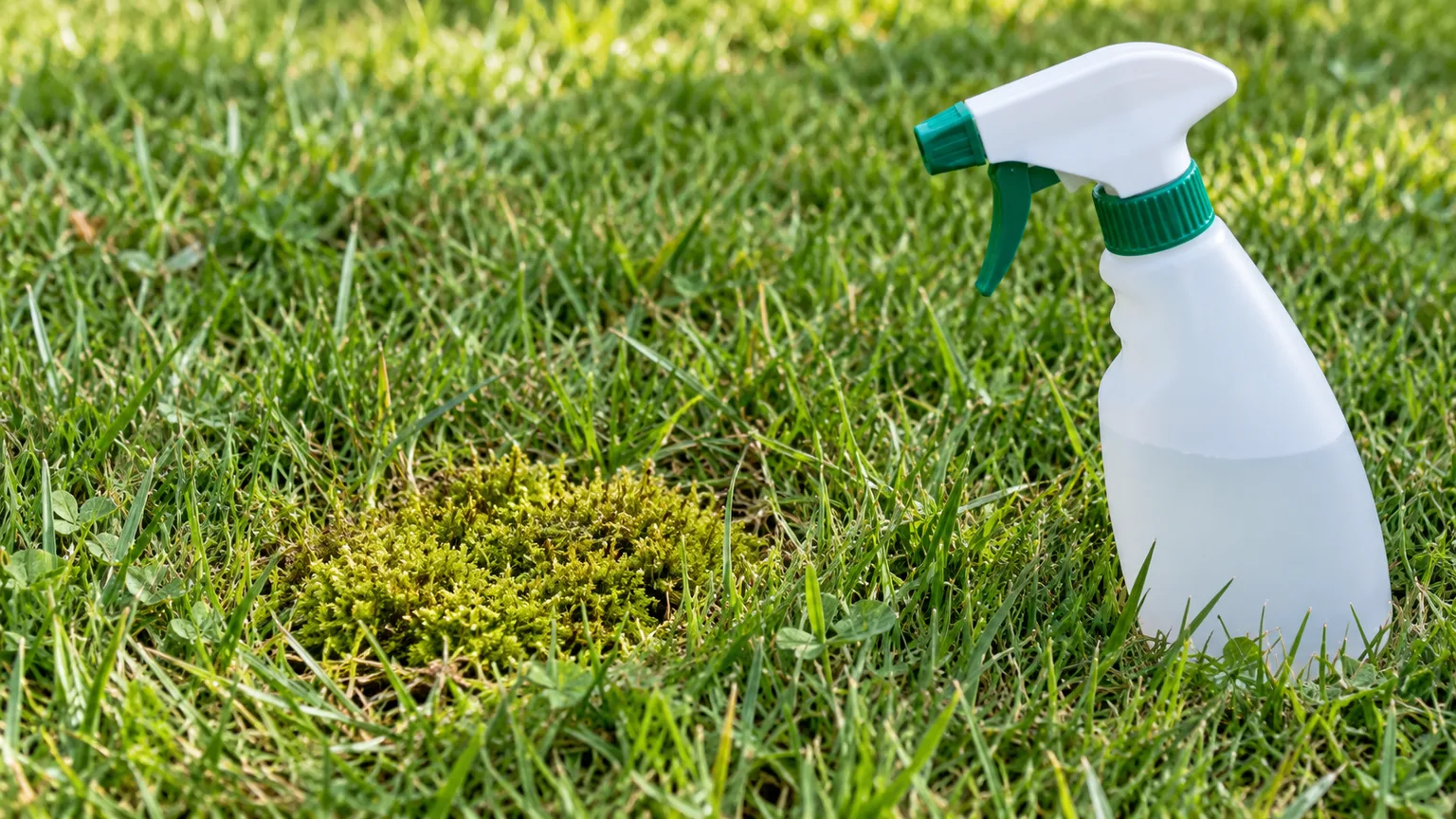
There is a second limitation: a surface treatment may not reach every strand in a dense mat. Moss does not have the same deep root system as turfgrass, but its low, interwoven growth can remain attached in pieces. Even when the visible mat turns brown, leaving it in place can obscure the soil and make it harder to prepare a clean seedbed. Removal and repair are still part of the job.
Household detergent is not a labeled moss killer
Do not confuse dish detergent with insecticidal soap or a lawn moss product. University of Georgia Cooperative Extension discusses turf products whose active ingredients include potassium salts of fatty acids and says these act by contact; it also warns that desirable turf can be injured if product directions are not followed. That is a product-specific recommendation, not an endorsement of any bottle under a kitchen sink. Formula, concentration, additives, intended site, and application directions matter.
The same caution applies to stronger or repeated mixes. More detergent does not make a treatment more selective or more permanent; it raises the chance of harming grass and nearby plants. There is no universally safe dilution for every dish liquid and turfgrass combination in the Extension guidance cited here. So a popular internet ratio should not be treated like a tested label rate, especially for broadcast spraying over a lawn.
If you need a predictable chemical option, choose a product whose current label explicitly allows moss control on lawns and fits your grass type and location. Some products are designed as contact treatments for turf, but the label is the authority for dose, timing, protective steps, and reseeding intervals. “Natural,” “soap-based,” or “pet-friendly” on a label does not remove the need to read its directions.
If you try dish soap, protect the lawn around it
The lowest-risk way to evaluate an unstandardized home remedy is to avoid broad application. Treat a tiny patch away from prized grass, vegetables, ponds, storm drains, and sensitive ornamentals; use a separate hand sprayer and label it so it is not later mistaken for plain water. Do not mix it with bleach, vinegar, salt, or other cleaners. Combining household chemicals can create hazards and offers no reason to expect better moss control.
Mix only what you can use and test a small spot
Because household formulas vary, this guide does not give a universal dish-soap dose. A product may contain degreasers, fragrances, colorants, moisturizers, or other ingredients not evaluated for broadcast use on turf. If you decide to test a recipe you found elsewhere, follow its stated concentration exactly rather than improvising a stronger one, and remember that a tiny test is not a guarantee for every season, grass species, or soil.
Choose a roughly one-square-foot test area where the moss is dense and the surrounding grass is expendable. Mark the boundary with a small stake so you can find it later. Apply only enough to wet the moss surface, not enough to flood the soil. Wait several days and watch both the moss and the grass at the edge. If the grass yellows, wilts, or develops a scorched ring, stop; do not repeat or scale up.
Avoid treating drought-stressed turf, new seedlings, newly laid sod, or grass recovering from heat, mowing, or disease. A stressed lawn has less margin for an additional chemical or moisture stress. If rain is likely, the solution can move beyond the intended patch; if the lawn is hot and dry, the turf may be more vulnerable. A calm, mild day gives you better control, but weather cannot make an untested formula safe.
Apply carefully and keep runoff contained
Shield nearby grass with cardboard or a plastic barrier while you work, and direct the spray downward at the moss. Keep the nozzle close to the patch, use a coarse droplet rather than a fine mist, and stop before liquid runs off. Wear gloves and eye protection if the product label or your sprayer requires it. Keep children and pets away until the treated spot has dried and any product directions say it is safe to re-enter; for a household detergent test, err on the side of keeping them away and prevent them from licking or eating treated material.
Do not pour leftover mixture into a storm drain, pond, or stream. Use only what you need, and dispose of any remainder according to the detergent label and local wastewater guidance. Keep it away from vegetable beds and avoid treating a slope where solution may wash into a waterway. If you cannot confine the solution to the moss, skip the treatment and rake the patch instead.
Remove treated moss and fill the opening
Once the moss has dried or changed color, loosen it with a spring-tine rake or a hand rake. Work gently on small patches and lift the mat out rather than chopping repeatedly into the soil. Remove loose debris so you can see what remains. If the moss is still green and firmly attached, the treatment may not have killed it; additional detergent is not automatically the answer. Mechanical removal may be more direct.
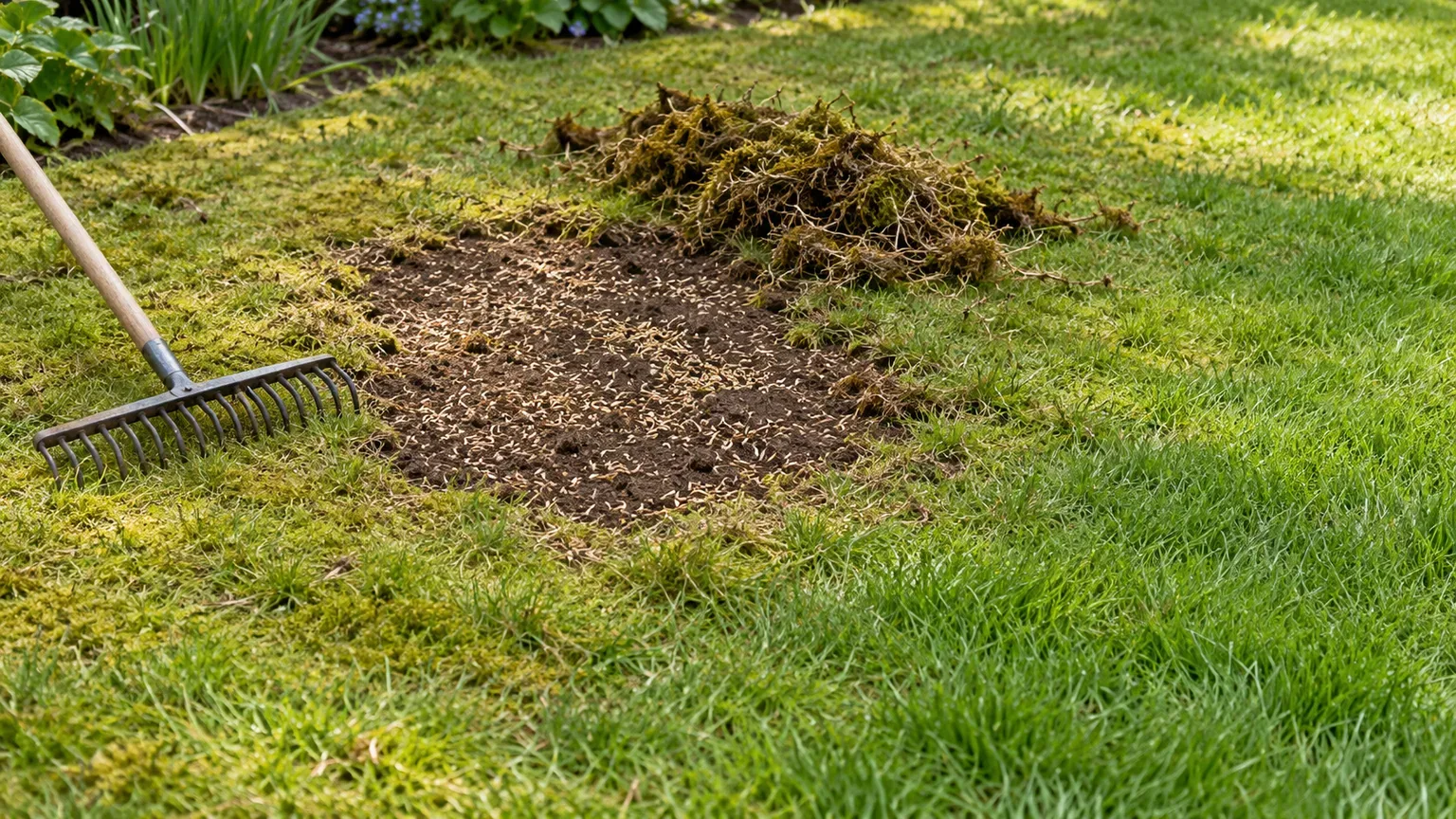
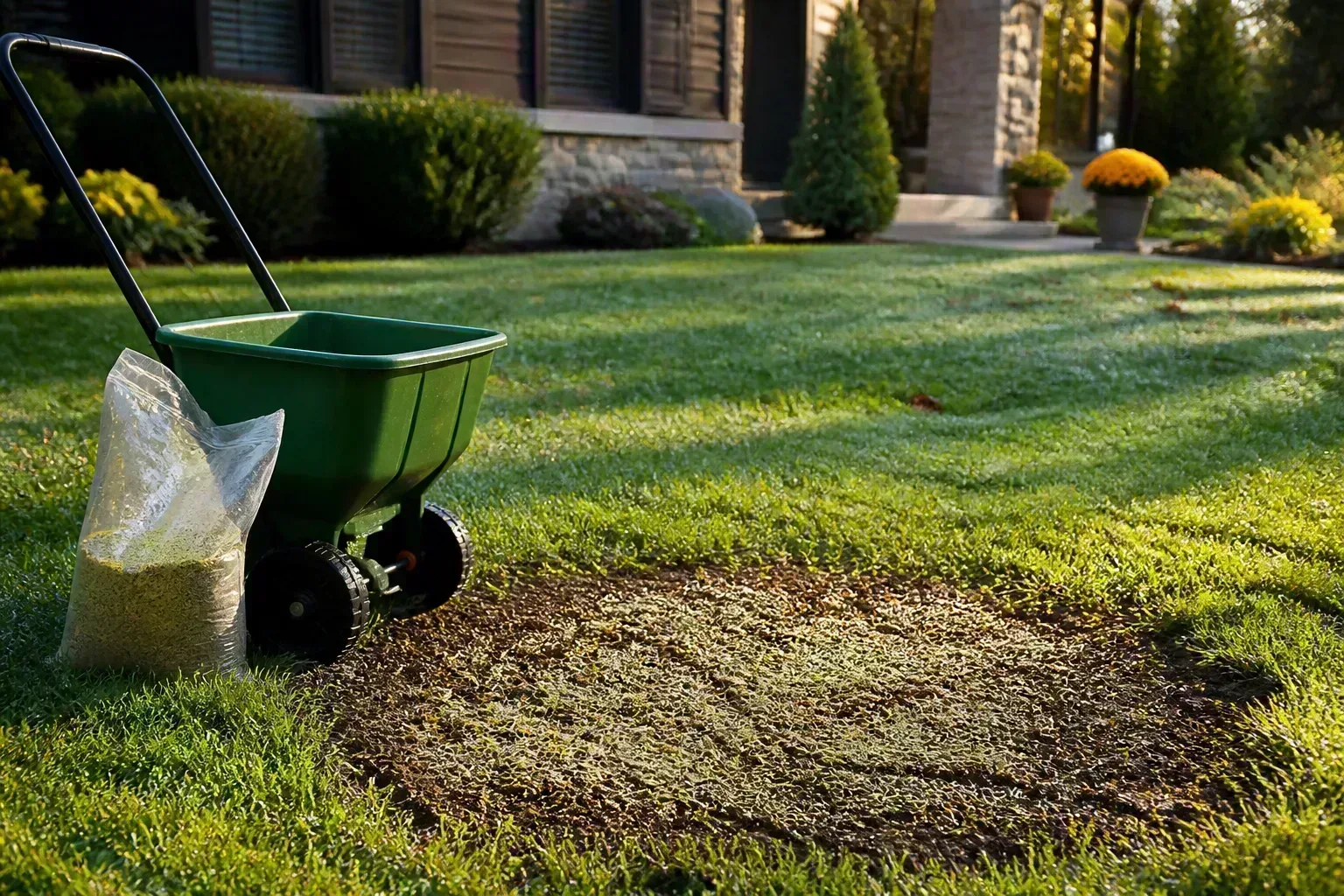
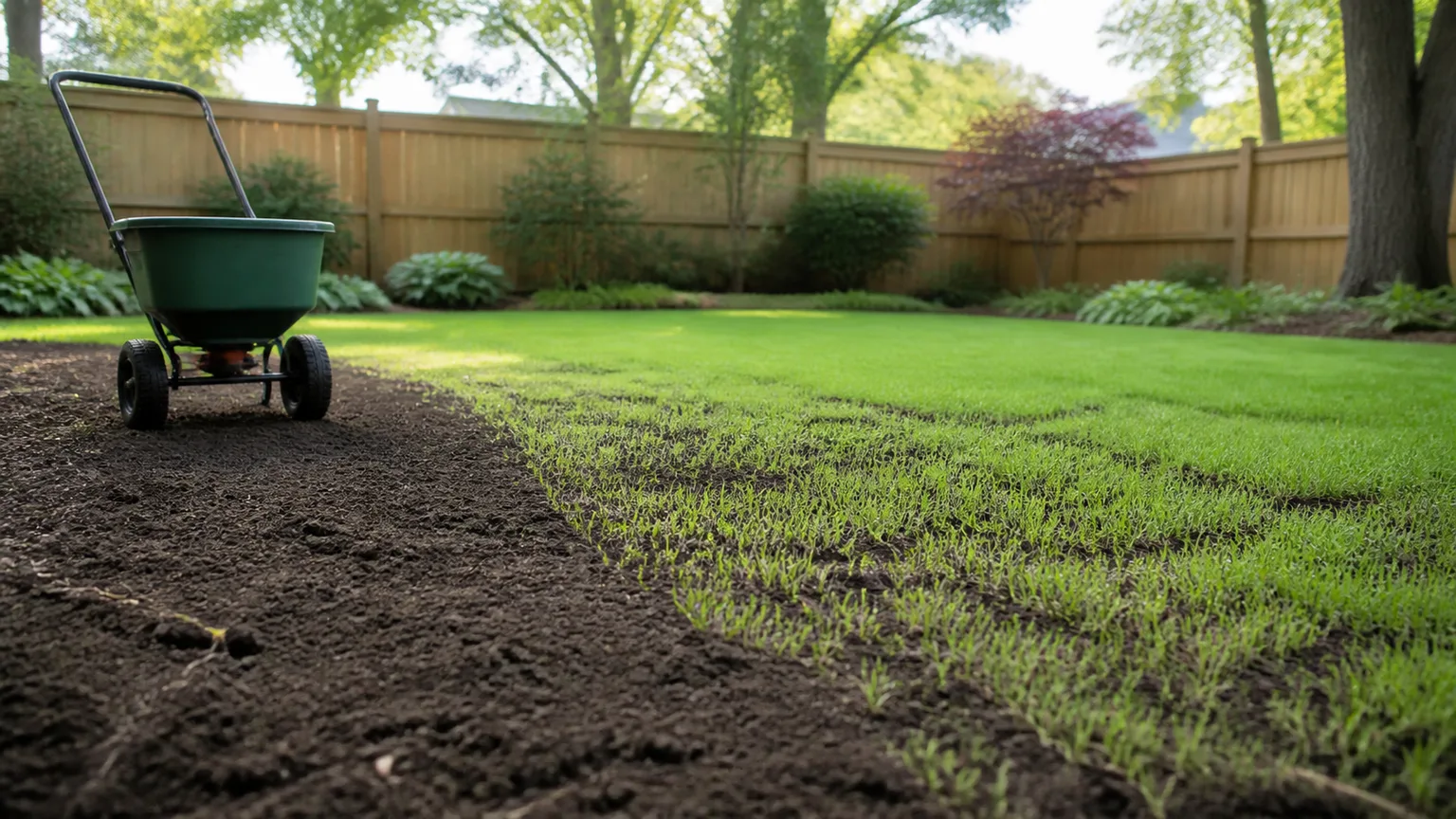
Inspect the exposed area. If grass roots remain and the soil is firm, rake lightly to open the surface, then overseed with a grass suited to your climate and the amount of light. Keep seed in contact with soil and follow the seed package’s watering directions. For a bare, compacted, or waterlogged area, correct that condition before expecting seed to establish. If the patch is large or the turf is mostly gone, renovation may require loosening the soil, topdressing, and reseeding or replacing sod during a suitable growing period.
Do not bury the opening under a thick layer of soil; a thin, compatible topdressing is enough to improve seed contact without smothering adjacent grass. Avoid heavy foot traffic until seedlings are established. New grass is easily pulled out by pets, children, and mower wheels, so wait until it is rooted and tall enough for its first cut. Timing varies by grass type and temperature; the seed label and local Extension calendar are more useful than a fixed number of days.
The Royal Horticultural Society notes that lawn moss can be composted, while BBC Gardeners’ World Magazine recommends collecting scarified material and adding it to compost. If you used a household detergent in the patch, however, be conservative: do not compost heavily treated moss if the detergent label cautions against it or if it would add a concentrated residue to the pile. For a small test, let the moss dry and dispose of it in household green waste according to local rules. Never compost weeds or treated material contrary to a pesticide label.
When a labeled lawn moss product makes more sense
For a large, recurring moss problem, a formulated lawn product may be more predictable than kitchen detergent because its active ingredient and turf directions are specified. Some lawn moss controls act on contact and can cause the moss to darken; some combine moss control with fertilizer. That does not mean every product is suitable for every region or grass. Check that the label names lawn use, the moss target, your grass species, application rate, protective equipment, and any limits around water, pets, or children.
Mechanical removal alone is often enough for a small patch if the soil is workable and grass can recover. For a widespread mat, treat only if the product label fits your lawn, then remove the dead material when the label allows and repair the bare ground. A product cannot make a shaded, compacted, chronically wet area behave like a sunny, well-drained lawn. If you do not want to change the site, repeated chemical suppression may become an annual expense rather than a solution.
Read the label before you apply
The label controls how much to use, how to spread it, what weather to avoid, when people and pets can return, and when reseeding is allowed. Do not copy a rate from a different brand or use a golf-course recommendation on a home lawn; a chemical can have different allowed sites and instructions. Do not assume that combining fertilizer and moss control is desirable if your soil test or grass type does not call for fertilizer.
Iron-containing moss products can stain concrete, stone, clothing, and other surfaces. Protect hardscape as the label directs and sweep stray granules or rinse only as indicated. If the label says not to compost clippings or treated moss, follow that instruction. If the application timing or grass tolerance is unclear, ask your local Extension office before treating the whole lawn.
Correct the conditions that favor moss
Long-term moss management is mainly about whether grass can cover the site. After treatment or raking, choose one or two underlying problems to fix first instead of changing everything at once. A damp hollow needs different work from a dry patch under a dense evergreen. Compare the affected spot with a healthy part of the same lawn and ask what differs: sunlight, slope, irrigation, foot traffic, mowing height, soil firmness, or grass type.
Test soil before adding lime or fertilizer
Moss does not prove your soil is too acidic, and lime is not a moss killer. Wisconsin Extension says lime is usually not effective as a direct moss treatment. Georgia Extension recommends testing soil to determine lime and fertilizer needs rather than guessing; its guidance gives pH ranges for many turfgrasses and notes that requirements vary by grass type. Follow the result from a local test, since soil recommendations depend on the turf and region.
Do not add fertilizer just because grass looks thin. Too much nitrogen can create excess growth and additional maintenance without fixing shade or poor drainage. If the test indicates a nutrient deficiency, use the recommended rate for your grass and apply it at the right time in its growth cycle. If pH is already appropriate, adding lime may waste money and move the soil away from the range the grass needs.
Adjust shade, water, compaction, and mowing
Where it is practical, prune selected branches to admit more light and air; do not remove a healthy tree solely to rescue a small patch without considering the landscape. If the site receives too little sun for turf, use a shade-tolerant grass recommended for your region or replace the lawn with groundcover, a planting bed, or an intentional moss area. The Royal Horticultural Society points out that moss can serve as low-growing cover in places where grass struggles and that removing it can reduce habitat for small wildlife.
Correct water problems next. Divert downspouts, fix sprinkler overspray, fill shallow depressions where appropriate, and improve drainage if water repeatedly stands. Water deeply enough for your grass but less often than a frequent light sprinkle; do not irrigate a patch that remains wet. For compacted soil, core aeration removes plugs and opens channels for air and water. It is most useful when compaction is the cause and the grass is actively growing, not as a reflexive treatment for every mossy lawn.
For example, if a shaded patch is surrounded by otherwise vigorous grass, start by raising the mowing height and checking whether a shade-tolerant seed mix is appropriate; a soap spray cannot compensate for insufficient light. If the patch lies in a low, muddy corner, solve the water-movement problem before reseeding. If it sits along a worn route, reduce traffic or make a path so new grass is not trampled again. This order prevents you from repeatedly treating the symptom while the same site factor keeps thinning the turf.
Raise the mower if it is scalping grass, and use a height appropriate for your species. Taller turf shades the soil and can help the grass maintain a denser canopy, but an extreme height is not a substitute for a correct grass choice or drainage. Remove only excessive thatch; some thatch is normal. Scarify gently in a window when the lawn can recover, commonly spring or early autumn for cool-season lawns, and avoid aggressive raking during heat, drought, freezing weather, or immediately after seeding.
Is moss always bad for a lawn?
No. Moss is not automatically a sign of lawn disease, and it is not always worth fighting. If you prefer a soft, low-growing green cover and the area is too shady or damp for reliable grass, keeping moss may take less work than repeatedly killing and reseeding it. The RHS describes moss as a habitat and food resource for small invertebrates and says it can be a sensible option where conditions favor it over turf.
Choose based on how you use the space. A play area, sports surface, or lawn that needs firm, uniform footing may benefit from turf repair and site changes. A quiet shaded corner may work better as moss, woodland groundcover, or a mixed planting. If you want a conventional grass lawn, plan for the light and drainage that grass requires; no soap mixture can substitute for that site-level choice.
Conclusion
Dish soap may brown or dry a small moss patch, but ordinary dish detergent is not a dependable, selective, or permanent lawn moss killer. Because the formula and turf response vary, avoid broad spraying and do not treat a household recipe as a product-label rate. If you test it at all, confine it to a tiny area, protect surrounding plants, watch for grass injury, then remove the dead moss and repair the bare ground.
For most lawns, the more useful sequence is simple: identify why grass is thin, remove moss without damaging turf, reseed when conditions suit your grass, and fix the shade, water, compaction, mowing, or soil problem that opened the door. Test before liming or fertilizing, and use only a lawn moss product whose label fits your grass and site. If moss is doing no harm to how you use the yard, keeping it may be the easiest and most durable choice.