Best Soil for Orchids and How to Repot Them at Home
The best soil for orchids depends on roots, room, and watering habits. Compare bark and moss, choose a mix, and repot step by step at home with less guesswork.
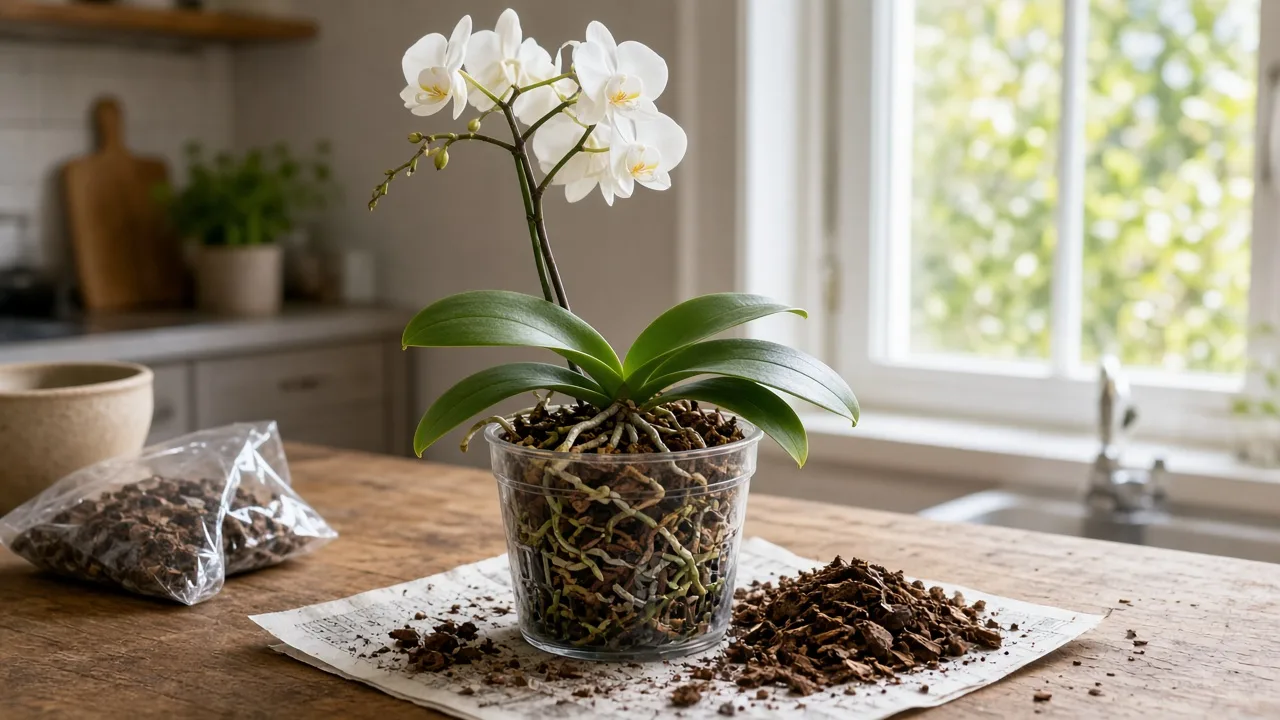
For most familiar indoor orchids, the best “soil” is a loose, chunky orchid medium, usually based on fir or pine bark. It should hold a little moisture, then drain quickly enough that air can reach the roots. Ordinary houseplant potting soil is too dense for most of these orchids, but there is no single orchid mix that suits every species or home.
If you have a grocery-store moth orchid, or Phalaenopsis, start with a medium-grade orchid bark mix in a small pot with drainage holes. Add a little moisture-retentive material only if your home is warm and dry or the mix dries before you can water again. If your orchid is a ground-growing species, identify it before using a bark-only recipe.
The short answer for most indoor orchids
Choose an orchid mix that stays airy after watering, drains freely, and does not remain wet for days in your conditions. A ready-made bark-based orchid mix is the simplest starting point for a typical Phalaenopsis; look for bark as the main ingredient, with optional perlite, pumice, charcoal, or a small amount of sphagnum moss. You do not need every ingredient on the shelf to grow one healthy orchid.
The useful test is not whether a bag says “orchid soil.” Check what happens after a full watering: water should pass through the pot, and the mix should stay damp long enough for your routine without turning into a compact, sour-smelling mass. The American Orchid Society describes successful media ranging from bark mixes to moisture-retentive mixes, with the choice tied to how the grower waters and the conditions around the plant (American Orchid Society on potting media; American Orchid Society repotting guidance).
Why orchid roots need an open potting medium
The word “orchid” covers thousands of kinds of plants, but many house orchids are epiphytes: in nature they attach to tree trunks or branches rather than rooting into garden soil. Others grow on rock surfaces. Their roots are adapted to repeated wetting and drying with plenty of air around them, so a dense potting mix that stays saturated creates a very different root environment.
A bark-based medium creates larger gaps than fine potting soil. Those gaps let excess water leave and air move through the pot, while bark and any added moss hold a modest moisture reserve. That balance matters more than a long ingredient list: roots need moisture, but they also need to dry enough between waterings to stay firm and functional. The University of Connecticut’s Home and Garden Education Center describes Phalaenopsis roots as adapted to humid air and recommends a specially formulated orchid bark mix rather than standard soil (UConn orchid care and repotting).
Regular potting soil is therefore the wrong default for most epiphytic orchids. It has fine particles that can settle around roots and hold water for longer than a chunky orchid mix. Even a well-draining houseplant blend is not automatically suitable; use it only for an orchid whose growth habit calls for a soil-like medium, not simply because it is already in your cupboard.
Identify the orchid before choosing a mix
A care label is useful because species and hybrids differ in root thickness, moisture needs, and how quickly their medium should dry. If the plant came with no label, a photo search can often identify a common Phalaenopsis or Dendrobium, but do not guess at a specialized species and then repot it into a generic recipe. Ask an orchid society or a knowledgeable nursery when the plant is unusual or valuable.
Common epiphytic house orchids
Most mass-market moth orchids (Phalaenopsis) do well in a medium-grade bark mix with plenty of drainage. Many Cattleya and Dendrobium hybrids also grow in bark-based media, but their preferred particle size and drying pace can differ. A thick-rooted orchid in a cool, dim home may need a more open mix than the same plant grown in a bright, warm greenhouse because its pot dries more slowly.
If the plant is a typical grocery-store Phalaenopsis, you can use bark as the default and adjust from what the roots and medium show you. This is a good point to avoid two extremes: a pot packed with a tight ball of moss that never dries inside, and a very coarse mix that becomes bone-dry before you have a chance to water. A healthy orchid’s roots are the guide to the right balance, not a universal recipe. 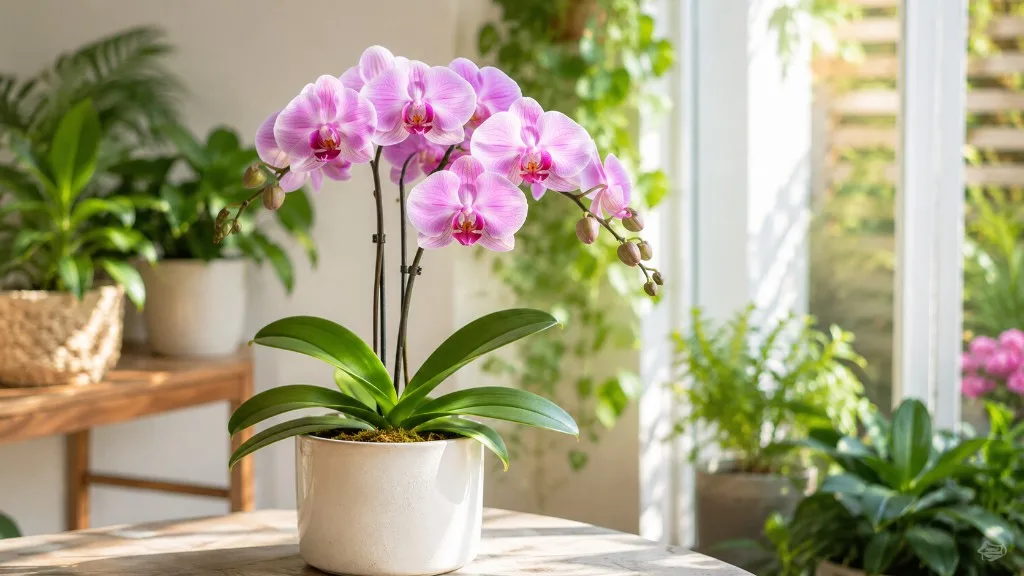
Terrestrial orchids need a different starting point
Some orchids grow in the ground or in forest-floor litter instead of clinging to trees. They need a medium that is more soil-like and moisture-retentive than the coarse mix used for a typical moth orchid. The correct recipe depends on the species; “orchid mix” on a retail bag usually signals a bark blend for common epiphytes, not a universal formula for every orchid.
For a terrestrial orchid such as a jewel orchid, check species-specific growing guidance before repotting. Paphiopedilum slipper orchids also have different needs from a typical Phalaenopsis, even though both are commonly grown indoors. The simple rule is to identify how the orchid grows before deciding whether the roots belong in bark, a finer organic mix, or another medium (Gardening Know How’s orchid-medium guide).
What orchid potting mix is made of
A useful mix has a framework of particles that do not collapse into fine sludge, plus any moisture-holding ingredient your room and watering habits require. The ingredients below are tools with different jobs, not a checklist to combine in equal amounts. A commercial orchid mix can be a perfectly good choice if its texture suits the roots and local drying conditions.
| Ingredient | What it contributes | Best reason to use it | Watch for |
|---|---|---|---|
| Fir or pine bark | Open structure and moderate moisture retention | A practical base for many epiphytic orchids | Old bark eventually breaks down and holds less air |
| Sphagnum moss | Holds more water while remaining loose when placed lightly | A dry home, small pots, or a grower who waters less often | A dense plug can stay wet in the center while the surface looks dry |
| Coconut husk chips or coir | Moisture retention with a fibrous structure | A blend that dries too quickly | Fine coir can pack down; use a product intended for horticulture |
| Perlite or pumice | Adds air space and helps a mix stay open | A bark mix that feels too dense or stays wet | Very small particles can settle or sift out of a coarse mix |
| Horticultural charcoal | A stable, chunky component in some blends | A supplementary ingredient when it suits the local water and mix | It is optional; barbecue briquettes are not a substitute |
Bark and chips create the framework
Bark is the workhorse of many orchid mixes because its coarse pieces create spaces around the roots and let water drain. Fir and pine bark are common, and packaged orchid bark may already include smaller amounts of other ingredients. The size of the pieces matters: fine pieces hold moisture longer and fit smaller roots, while larger pieces dry faster and suit larger roots or frequent watering.
Do not rely on bark that has turned soft, crumbly, or soil-like. As organic media decomposes, smaller particles fill the air spaces and drainage slows; that is a reason to refresh the medium even if the plant has not filled the pot. The American Orchid Society and Epic Gardening both emphasize matching bark-based media with airflow and drainage rather than treating bark as a permanent fill (American Orchid Society; Epic Gardening’s orchid-bark overview).
Moss, coir, and mineral ingredients adjust moisture
Sphagnum moss holds considerably more water than coarse bark. That can help when a home is dry, watering opportunities are limited, or a plant has fine roots, but the moss should be arranged loosely rather than compressed into a solid plug. Water can move unevenly through a tight moss core, so the top may look dry while the center remains wet.
Advice about sphagnum can sound contradictory: UConn recommends removing dense shipping moss from retail moth orchids, while the American Orchid Society discusses adding loose sphagnum to indoor media (UConn; American Orchid Society). The difference is the setup—a tight wet plug can be replaced with bark, while a small loose amount can be blended into a mix when the room dries it too fast.
Perlite and pumice are lightweight mineral ingredients that help keep a mix open; coarse grades are easiest to combine with bark. Coconut husk chips can add water retention without turning the whole pot into fine soil. Charcoal is common in some commercial mixes, but it is optional and cannot make a pot with poor drainage safe. 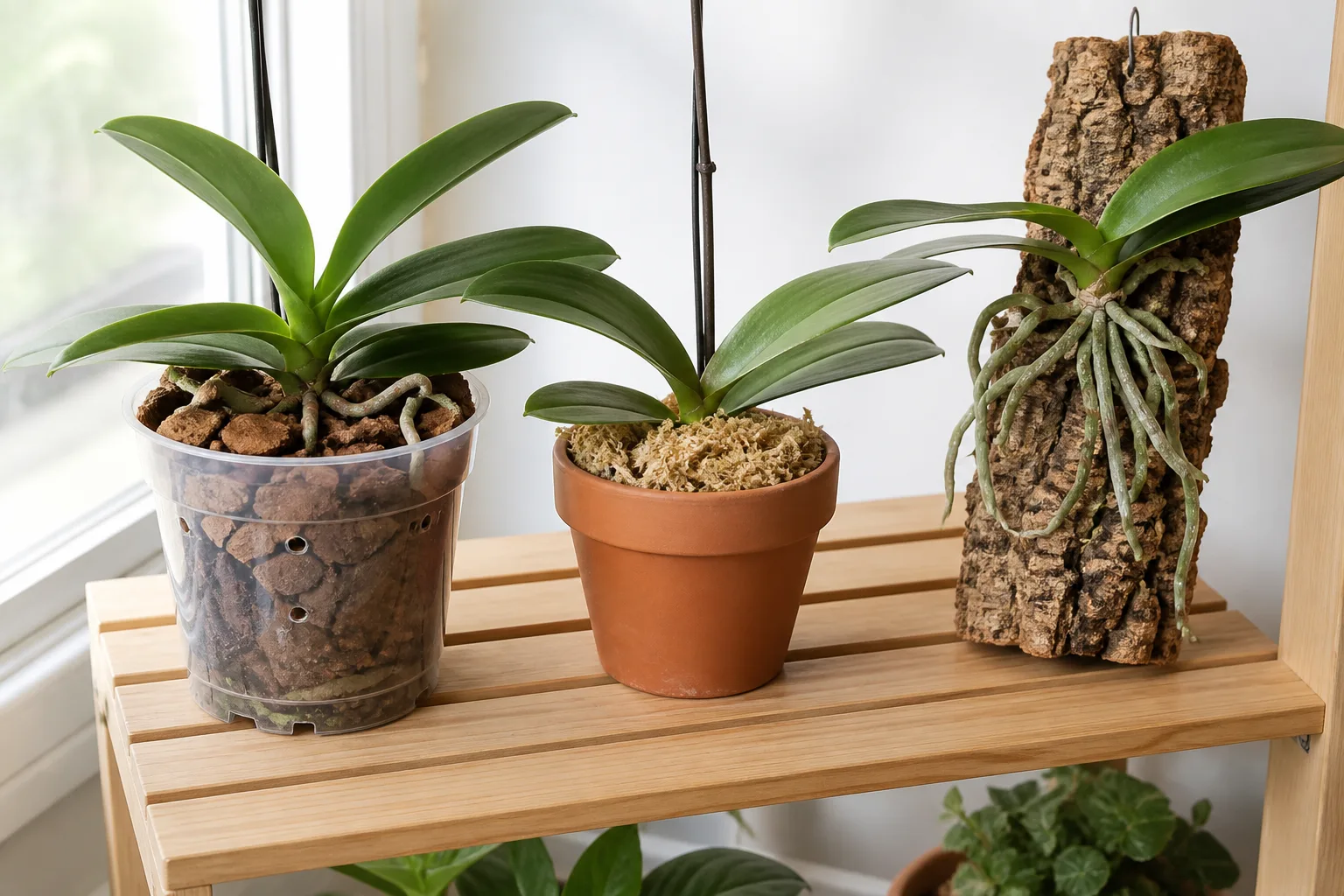
Match the medium to your room and watering habits
The best blend is the one that gives your orchid a predictable wet-to-dry cycle in the place where it actually lives. Temperature, light, airflow, pot material, pot size, and humidity all affect how quickly the medium dries. That is why the same bag can work well in one home and keep another grower’s roots wet for too long.
Use this as a starting decision, then check the pot a few days after watering:
| Your conditions or habit | Start with | Change if you notice |
|---|---|---|
| Warm, bright room; mix dries quickly | Medium bark, with a little loose sphagnum or husk if needed | If the center is still wet long after the surface dries, remove some moisture-holding material |
| Cool room, low light, or frequent watering | Coarser bark and a pot that drains freely | If roots shrivel and the mix is dry very soon after watering, use a finer grade or add a small amount of moss |
| You tend to overwater | Bark-heavy, open mix; avoid a tight moss core | If it still stays wet, inspect drainage and pot size before adding more amendments |
| You forget to water or travel often | A modest amount of sphagnum or husk mixed through the bark | If moss remains wet inside for too long, loosen or reduce it |
The American Orchid Society summarizes the trade-off plainly: bark mixes drain well and forgive some watering mistakes but break down sooner; peat-based mixes hold moisture longer and require more careful watering. Its repotting guidance also says the medium should reflect a grower’s watering habits, while the pot size and particle grade should fit the plant and conditions (American Orchid Society). Gardening Know How likewise treats bark, sphagnum, coir, perlite, and pumice as ingredients with different moisture and airflow effects, not interchangeable filler (Gardening Know How).
Simple starter mixes you can adjust
For a common indoor Phalaenopsis, the easiest starting recipe is a quality, medium-grade commercial orchid bark mix. If you are blending from separate ingredients, combine three parts medium orchid bark with one part coarse perlite or pumice. That keeps the bark as the main structure and adds an airy mineral ingredient without making the pot mostly fine particles.
If the mix dries too quickly in your room, add up to one part loose sphagnum moss or coconut husk chips to that starting blend, then observe the next few watering cycles. If it stays damp inside for too long, remove the moss or use a coarser bark grade before changing several other care habits. Treat these proportions as a starting point, not a tested universal formula; orchid type and conditions can require a different balance. For a species-specific mix, follow its grower guidance instead of scaling this recipe blindly.
Before potting, remove dust and small fragments that can fill air gaps. Pre-moisten very dry bark or moss so it does not repel the first watering, but let excess water drain before the plant goes into the pot. Keep leftover mix dry in a closed, clean container; do not save a batch that smells sour, has visible mold, or came from a pot with a serious disease problem.
When to repot, and when to wait
Repot because the medium or root system needs attention, not just because a date on the calendar arrived. Good reasons include bark that has broken into fine pieces, water that drains slowly, a sour or stagnant smell, roots that are crowded into a waterlogged pot, or a plant that cannot stay upright. A few roots growing over the rim are normal for many epiphytic orchids and are not, by themselves, proof that the plant needs a bigger pot.
For a healthy flowering moth orchid, waiting until the flowers fade is usually less disruptive. UConn recommends repotting after flowering, and the American Orchid Society notes that a newly acquired plant may need a fresh medium but can wait until bloom ends if it is flowering. Do not postpone an urgent rescue if the medium is soggy and roots are actively rotting, the pot has no drainage, or the plant is deteriorating; the risk of losing flowers is smaller than leaving a failing root system in a damaging setup (UConn; American Orchid Society).
When timing is flexible, repot as new root tips begin to emerge. They can grow into the new medium and anchor the plant. Many growers refresh bark every year or two, but that is a rough inspection interval rather than a deadline: particle size, watering frequency, and growing conditions change how quickly a mix breaks down.
Choose a pot that fits the roots and drains
Pick a pot that holds the cleaned root mass with a little room for fresh medium, not a container several sizes larger. A pot that is too large can keep unused mix wet around the roots for longer. Drainage holes are essential; decorative cover pots are fine if you can remove the inner pot to water and empty standing water afterward.
Clear plastic pots make it easier to see whether the center is still wet and whether roots are firm, so they are useful for beginners. They are not mandatory, and a clear container does not replace checking the medium. Pot material changes drying speed: UConn favors porous terracotta for Phalaenopsis, while American Orchid Society guidance describes plastic as a slower-drying option that suits many indoor setups. Those recommendations prioritize different conditions, so choose based on how quickly your pot dries and how often you can water, while keeping drainage nonnegotiable.
Do not choose a pot only because it has decorative side holes, and do not place coarse stones at the bottom as a substitute for drainage holes. The root zone should have an unobstructed path for water to leave the pot. If you use a plastic nursery pot inside a ceramic cachepot, lift it out to water and let it drain fully before returning it. 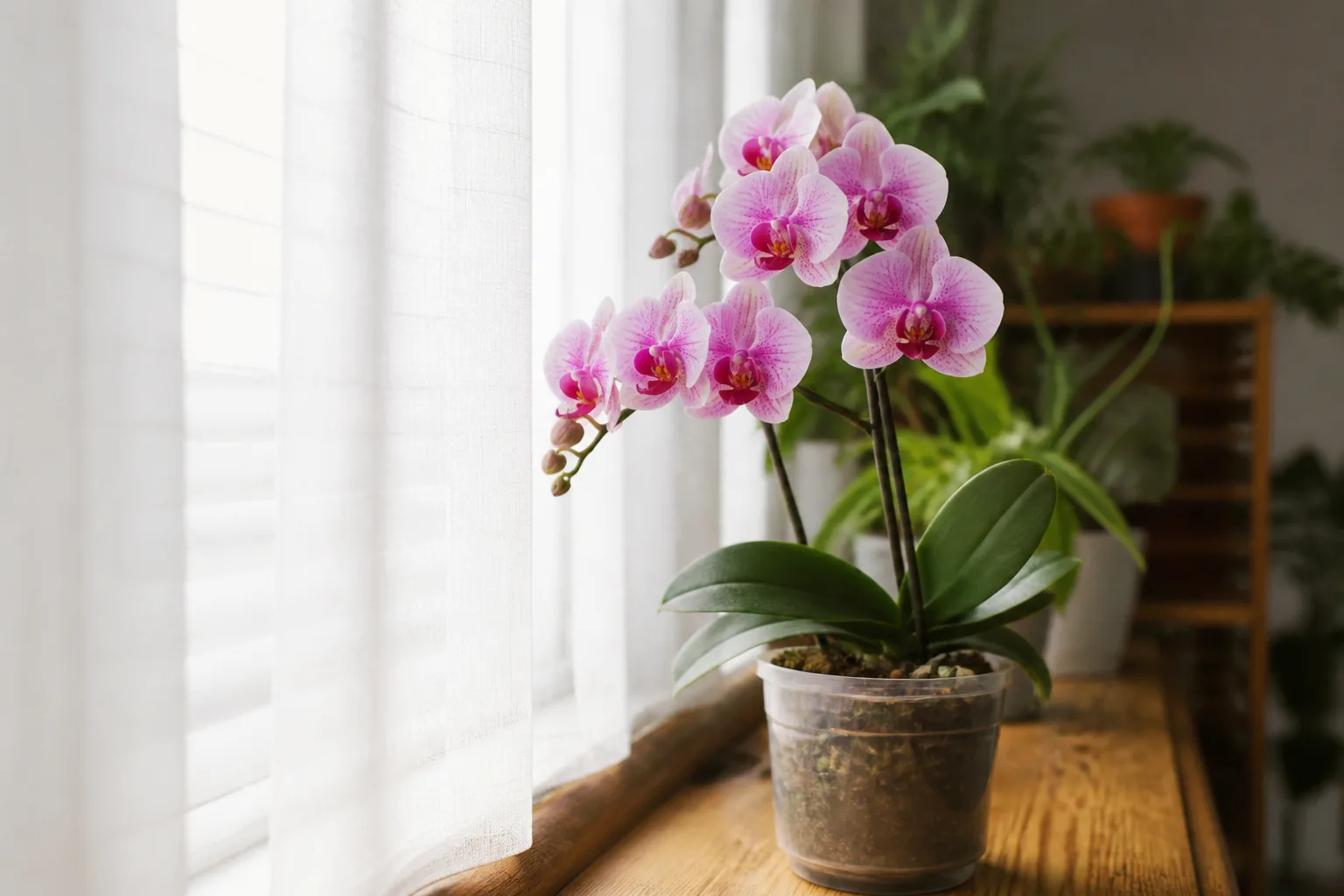
How to repot an orchid at home
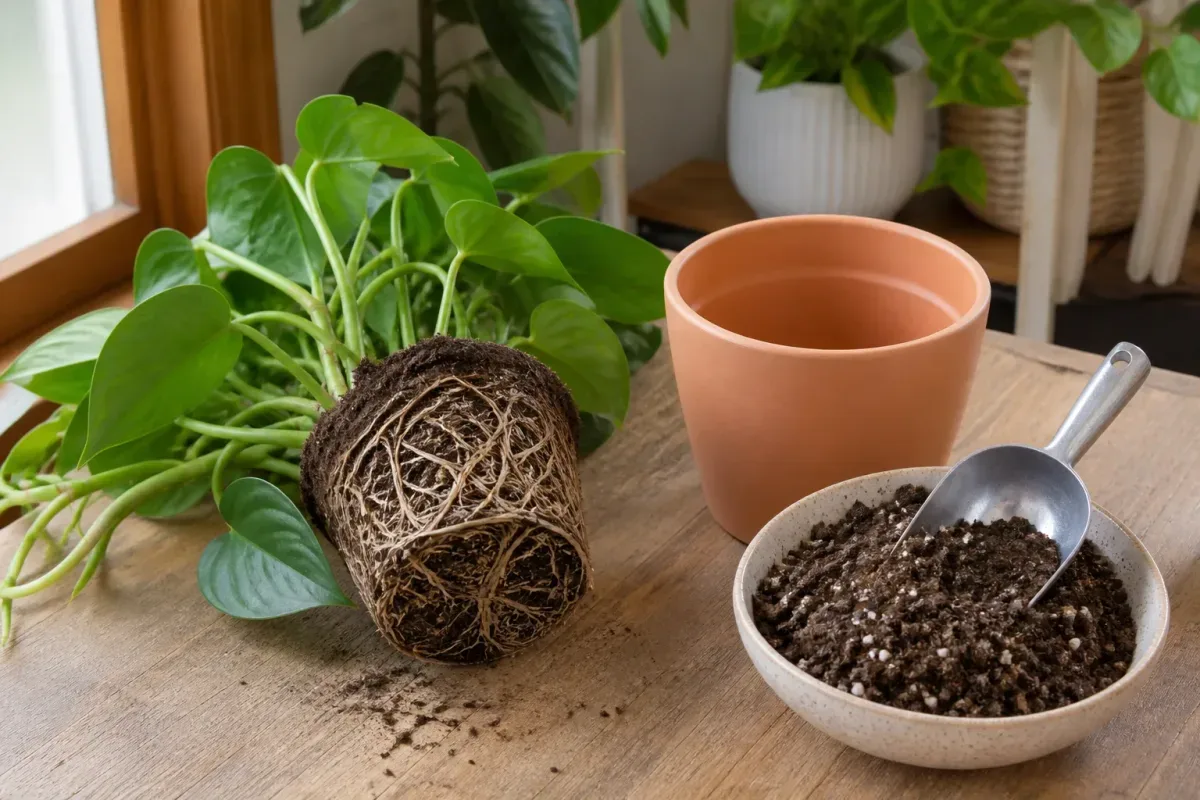
Set out fresh orchid mix, a pot with open drainage, clean scissors or snips, and a surface you can wipe down. If the orchid is stuck to the old pot, gently flex a plastic pot or slide a blunt tool around the inside edge rather than pulling hard on the leaves. The UConn Home and Garden Education Center recommends removing old moss, trimming dead or rotted roots, anchoring the plant, and soaking the new bark mix so it settles around the roots (UConn repotting steps).
-
Prepare the new mix and pot. Pre-moisten dry bark or moss, then let the extra water drain. Wash a reused pot and use clean, sharp snips; a fresh pot should have holes at the bottom or sides.
-
Slide the orchid out gently. Support the base of the plant and ease the root ball from the pot. If healthy roots have grown through holes, cut the old pot away when possible instead of tearing the roots free.
-
Remove loose old medium. Tease out material that falls away easily and work damp moss loose a little at a time. Do not scrape or pull firmly at roots just to remove every speck of old medium; minimizing breakage matters more than making roots look spotless.
-
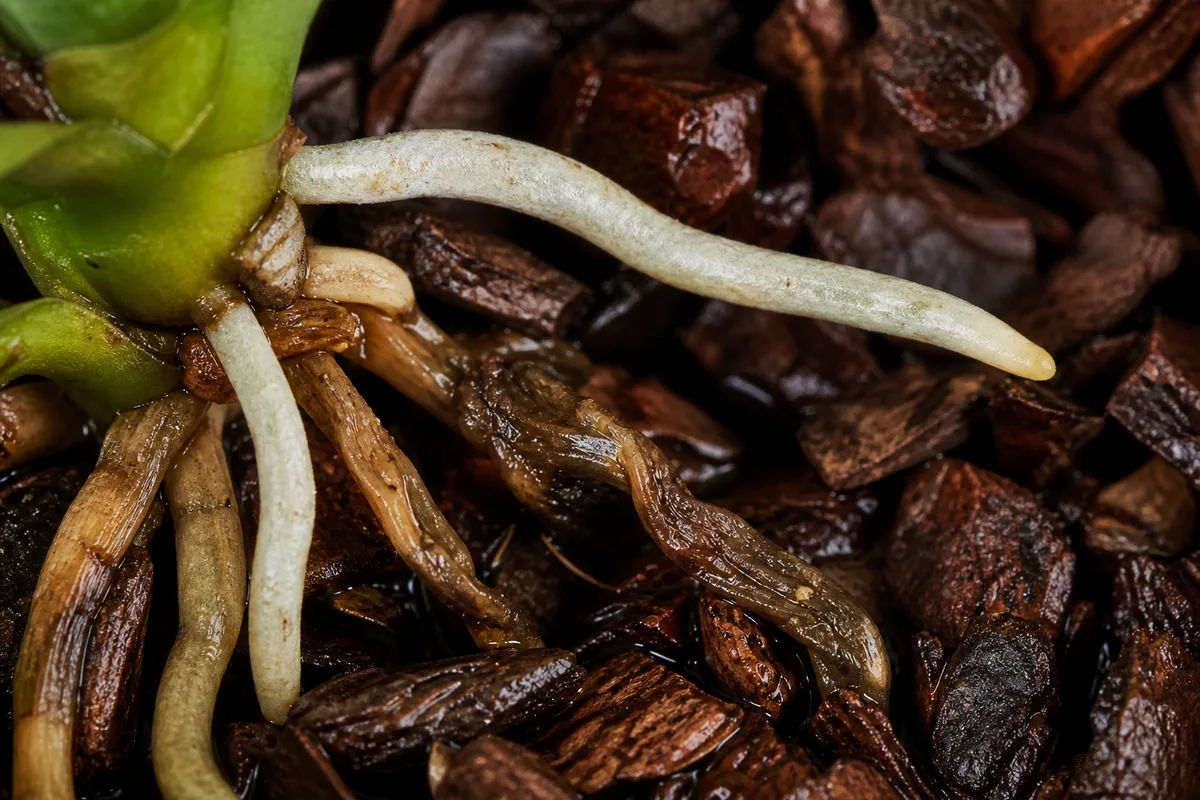
Inspect before pruning. Healthy roots are generally firm, not hollow or mushy. Cut roots that are clearly dead, papery and empty, or soft and rotted; leave firm roots even if their color is not bright green. A silver surface can simply mean a root is dry, and a healthy aerial root is not waste to trim.
-
Set the plant at the right height. Center the orchid so its crown and leaf bases stay above the mix. Hold it in place while adding medium around the roots; do not bury the crown or force stiff aerial roots into the pot.
-
Settle, do not pack, the mix. Tap the pot gently or use a chopstick to guide bark between roots without crushing them. The plant should be secure enough not to rock, but the medium should remain loose and airy; add a stake if the plant is top-heavy.
-
Drain and label. Water or soak the bark enough to wet it, then let all excess drain before the pot goes back into its cover. Note the date and ingredients so you can judge how the mix performs rather than guessing at the next repot.
Aftercare during the first weeks
Return the orchid to its usual bright, indirect-light spot and avoid changing every part of its care at once. Water according to how the new mix dries, not the calendar: bark, moss, plastic, and terracotta all change the interval. When you do water, wet the medium thoroughly and empty the saucer or decorative pot so roots do not sit in runoff.
If you removed several rotten roots, be especially careful not to keep the smaller root mass in a large wet pot. Let the medium approach its normal watering cue before watering again, and do not add fertilizer simply to compensate for lost roots. The plant needs time to establish; a brief pause in growth after repotting is less concerning than a mix that stays wet and continues to damage roots.
Check the pot after the first two or three waterings. If water runs straight through and the roots wrinkle quickly, the mix may be too coarse for your conditions or the plant may need a more even soak. If the center remains wet while the top looks dry, loosen or reduce moss, check that holes are clear, and consider whether the pot is larger than the root mass needs.
Troubleshoot common repotting problems
The orchid wobbles after repotting. The roots may not yet grip the new mix, especially if you removed decayed roots. Secure the stem with a stake or clip and gently settle bark around the roots; do not tamp the pot hard to make it feel firm.
The leaves look limp, but the pot is wet. Limp leaves do not always mean the plant needs more water. Roots damaged by rot cannot take up water normally, so adding more water to a soggy pot can worsen the cause. Check the roots and the center of the mix before watering again.
The surface looks dry while the middle is damp. This is common with a tight moss plug or a deep pot. Feel or inspect the center through a clear pot, and water based on that inner moisture rather than the top layer alone. If the pattern persists, repot into a looser mix with less moss.
Aerial roots remain outside the pot. Leave them alone if they are firm. They can continue growing in the air; forcing them into a pot can crack them, particularly when they are dry. Focus on the roots already inside the pot and on fresh medium with a good air-water balance.
Some old roots are brown. Color alone is not a reliable reason to cut. A firm root may be stained by old medium, while a rotten root often feels soft or hollow and may lose its outer layer. Prune only roots that are clearly nonfunctional, then adjust the new mix and watering conditions that contributed to decline.
Conclusion
For a typical indoor moth orchid, start with a medium-grade bark-based orchid mix in a small, well-draining pot. Add moss, coir, or another moisture-holding ingredient only when your room and watering routine call for it, and identify a less common orchid before assuming it wants the same mix.
Repot when the medium breaks down, drainage fails, or the roots need a reset; if the plant is healthy and blooming, waiting until flowers fade is usually sensible. At home, remove old mix gently, trim only clearly dead or rotted roots, keep the crown above the medium, and let the fresh mix drain. Then watch how quickly the pot dries. That observation is the best guide to whether your orchid’s new “soil” is working.