How to Grow and Care for a Chaste Tree
Learn when to plant, water, prune, and protect vitex, plus how mature size, winter dieback, and self-seeding affect where chaste tree belongs.
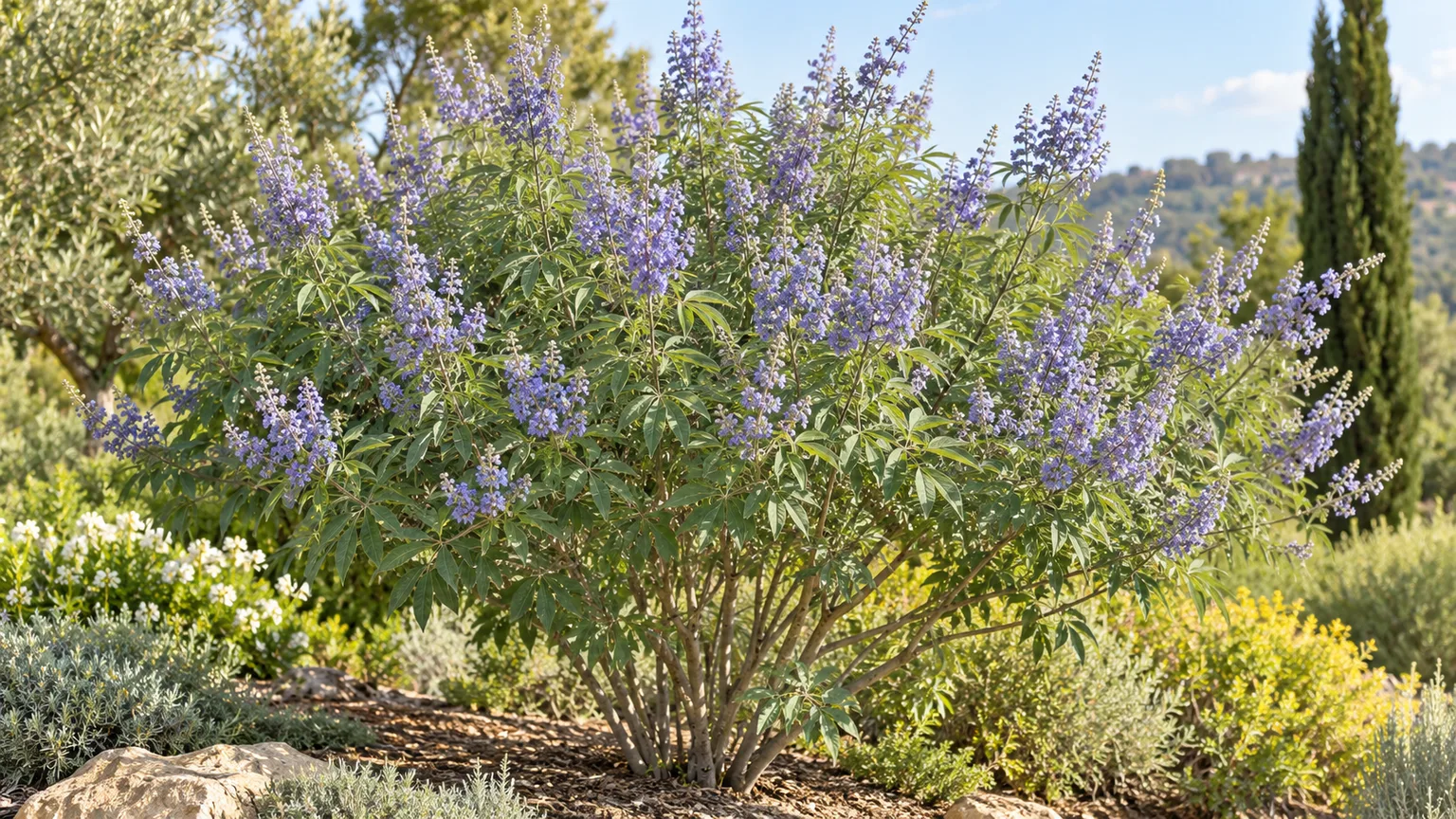
Chaste tree, or vitex (Vitex agnus-castus), is a sun-loving, deciduous shrub or small tree prized for aromatic palmate leaves and upright clusters of lavender, blue, pink, or white flowers. It suits warm, dry gardens particularly well, but the planting decision takes more than checking a hardiness-zone label: mature size varies widely, cold may kill the stems even when roots survive, and fertile seeds can spread beyond the bed in some regions.
Give it sun and soil that drains after rain, then water regularly while it establishes. After that, the main care choice is how you want it to grow. Leave its base shoots for a broad, informal shrub, or select a few trunks and shape an open canopy. Because flowers form on new growth, dormant-season pruning usually does not sacrifice the next bloom; the right amount of pruning depends on the form, not on a rule to cut every plant to the ground.
Is chaste tree a good fit for your garden?
Vitex earns a place where summers are warm, the planting area receives direct light, and water does not linger around the roots. It can be useful as a specimen, a loose flowering screen, or a pollinator plant. Its drought tolerance after establishment and tolerance of heat are practical advantages in a waterwise landscape.
It is a poor fit for a permanently wet site, a narrow foundation strip that cannot accommodate the mature width, or a region where local authorities list it as invasive. In parts of Central Texas, the Invasive Plant Atlas of the United States reports that it has escaped landscaping and established in dry creek beds and limestone outcrops. The Atlas also notes that its map is incomplete, so a blank map is not proof that a plant is harmless locally. Check a state or county extension service before planting near natural areas, especially in warmer parts of the South.
The simple decision is this: choose vitex when you can give it room, sun, drainage, and occasional seedling cleanup. If those conditions do not fit, select a locally recommended native shrub with a similar height, bloom season, or pollinator value. NC State Extension’s plant profile lists alternatives such as American beautyberry, red buckeye, and fringe tree for gardeners seeking native options in its region.
What chaste tree looks like as a shrub or small tree
The species develops an open, vase-shaped crown with several stems from the base unless a gardener removes them. Long, hand-shaped leaves give the plant a loose texture, and the flowers rise in terminal clusters above the foliage. The plant is deciduous in much of its range; it may leaf out later than nearby shrubs, so wait for buds to swell before deciding winter has killed it.
A multi-stem shrub is the lower-maintenance default. It can spread as wide as it is tall, and flowering branches arch outward. A trained small tree has a few permanent trunks and a raised crown, which exposes the sculptural leaves and keeps the lower area open. Neither form is inherently healthier. Pick the one that suits the site before the plant becomes too large to reshape easily.
Choose a sunny site and give it room
Aim for at least six hours of direct sun. Vitex tolerates some light shade, but the tradeoff is usually weaker or later flowering and a looser, more stretched canopy. In hot inland areas, afternoon sun is not a problem if the roots can establish and the soil drains; a wall that reflects heat can make a dry site even harsher, so check moisture during the first summer.
Check the label for the specific cultivar’s mature width, then plan around that figure rather than the nursery pot. Large selections may become small trees with a broad spread, while named compact forms can remain several feet tall and wide. Do not plant an unverified seedling right beside a walk, fence, or utility line and expect annual shearing to keep it naturally compact. Repeatedly cutting the outside into a tight ball creates dense, twiggy growth and removes the plant’s airy outline.
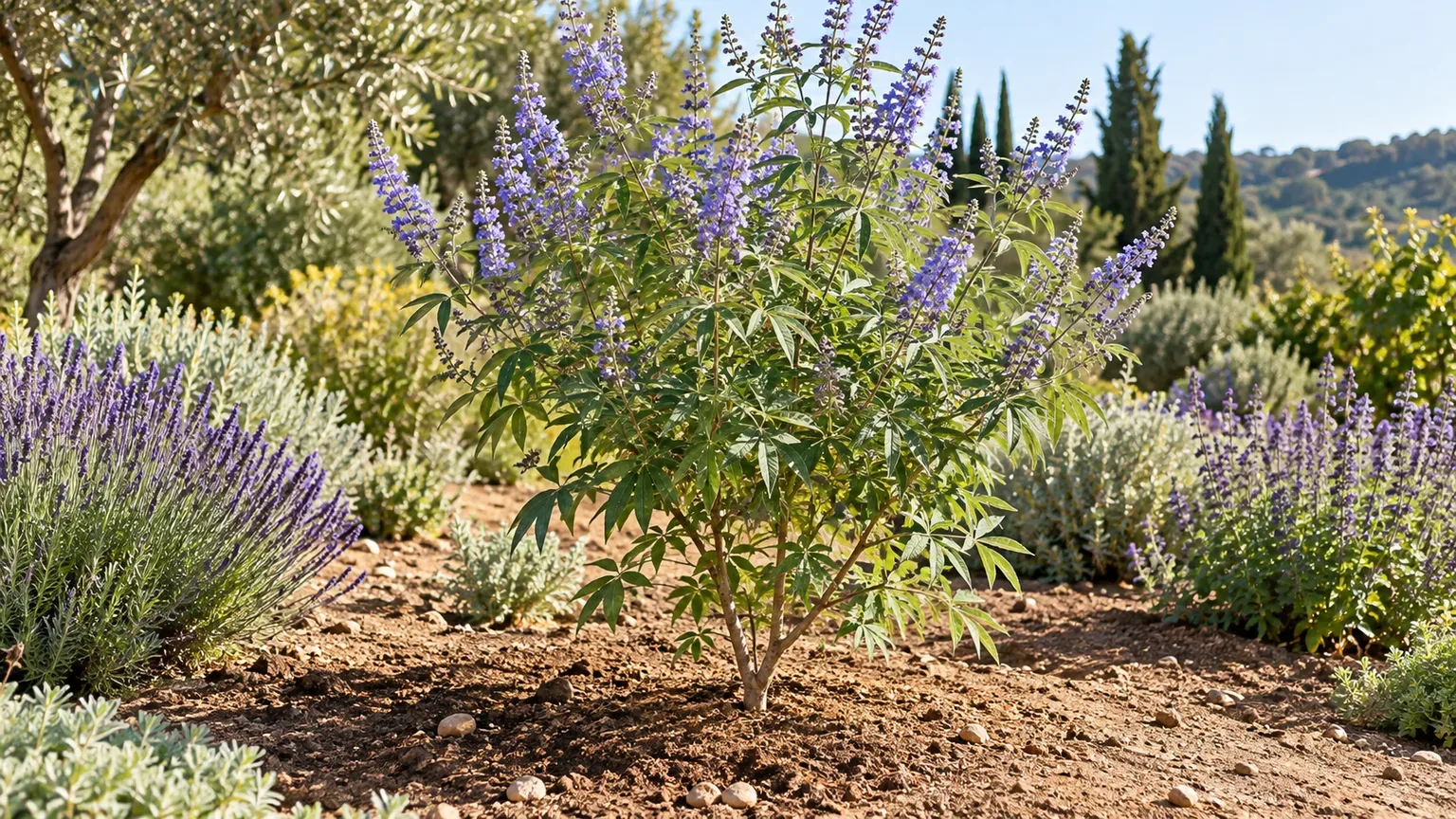
Plant in soil that drains well
Vitex tolerates many soil textures, including ordinary garden soil, but it does not tolerate roots sitting in water for long periods. A sunny site with a slope or open soil that dries between rains is better than a low spot that puddles. Root rot and weak growth are more likely where winter rain or irrigation keeps the root zone saturated.
Plant in spring in cold-winter areas so roots have time to settle before freezing weather. In mild climates, spring or early fall planting can work. Dig a hole about as deep as the root ball and several times its width, loosen circling roots, and set the top of the root ball level with or slightly above surrounding grade. Backfill with the soil you removed; rich amendments in the hole can create a sharp boundary that holds water or discourages roots from exploring surrounding ground.
Water the root ball thoroughly after planting and apply a light layer of mulch over the root zone if desired, leaving a gap around the stems. Mulch can moderate soil temperature, but a thick, constantly wet layer against the crown defeats the goal of drainage. On heavy clay, a broad raised planting mound or another naturally draining location is more reliable than adding a small amount of sand to the planting hole.
Water deeply while roots establish
During the first growing season, water when the root ball and surrounding soil begin to dry rather than following a fixed weekly schedule. Newly planted roots occupy a small area, so the plant may need irrigation during a hot, rainless stretch even though mature vitex handles drought. Apply water slowly over the original root ball and the soil just beyond it, then let excess drain.
As roots spread, lengthen the interval between waterings. Established plants generally need supplemental water only during extended drought, but “drought tolerant” does not mean that a shallow-rooted plant never needs help. In sandy soil or extreme heat, check more often; in clay or a rainy season, hold off. If leaves droop while the ground is wet, do not add more water. Check drainage and root health first.
Fertilize only when the plant needs it
A chaste tree in reasonably fertile soil usually does not need routine feeding. Too much nitrogen can push soft leafy growth at the expense of flowers and can make the canopy harder to manage. If growth is weak across the whole plant, first check sun, drainage, planting depth, and whether the root ball dries out. Those problems cannot be corrected with fertilizer.
Use a soil test when poor growth persists or when the site has a history of nutrient problems. If the test indicates a deficiency, apply an appropriate product at the labeled rate during active spring growth. Skip late-season feeding that encourages tender shoots just before cold weather. A calendar application every year is unnecessary if the plant is growing and flowering normally.
Prune according to the form you want
Vitex flowers on new growth, so late-winter or early-spring shaping generally leaves time for flowering shoots to form. In cold areas, wait until the worst freeze risk has passed and buds show which stems are alive before removing winter-killed wood. NC State Extension likewise notes that early-spring pruning is possible because blooms develop on new wood.
Start by removing dead, broken, crossing, or unusually weak stems. Then cut only enough to meet the goal: reduce height, thin a crowded interior, renew an aging shrub, or maintain a chosen trunk framework. Make cuts just above a healthy bud or lateral branch. Avoid topping every stem at the same height; the resulting stubs can create a crowded knuckle of shoots that is harder to manage each year.
Keep a multi-stem shrub
For a natural shrub, keep several strong shoots arising from the base and remove a small number of the oldest or weakest stems at ground level when the center becomes crowded. Shorten overly long branches to a lower outward-facing bud rather than shearing the whole perimeter. This preserves the vase-shaped habit and encourages fresh flowering wood without forcing every branch into the same outline.
A mature shrub that has become too large can be renewed over more than one season. Remove about a third of the oldest stems near the base in late winter, then reassess after the new shoots develop. This gradual approach keeps some flowering wood in place and reduces the shock of an unnecessary annual hard cut. If winter routinely kills stems to the ground, you can instead treat it like a dieback perennial and clean up once new shoots are visible.
Train a small tree
To train a tree form, begin while the plant is young. Select one to three vigorous trunks that are well spaced and rise in the direction you want the canopy to grow. Remove competing basal shoots gradually, especially those that crowd the chosen trunks. Keep the strongest trunk upright and avoid stripping off too many lower branches in a single year.
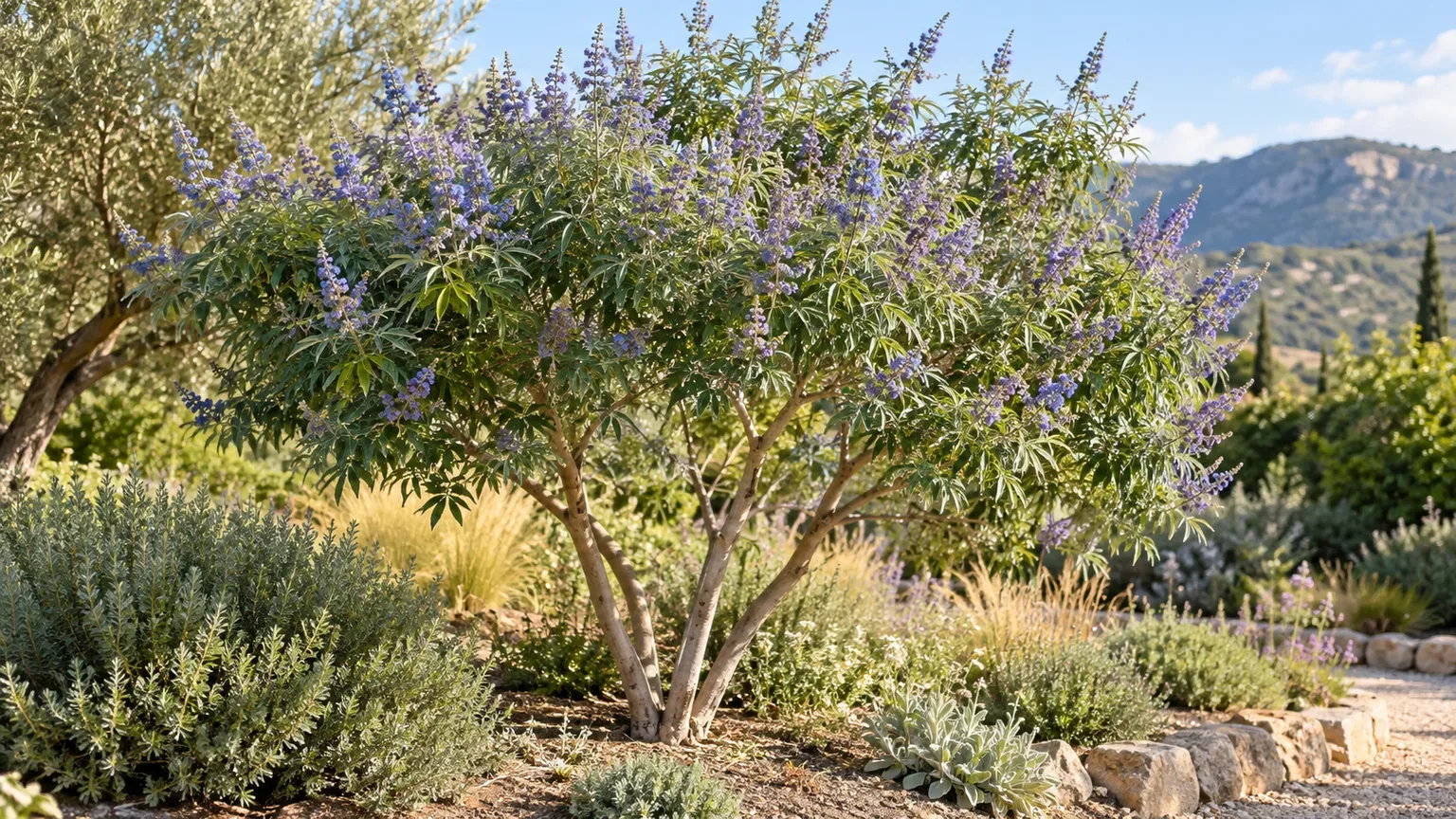
Once the trunks reach the desired clear height, retain a balanced canopy of outward-facing branches. Remove rubbing limbs and water sprouts that grow straight up through the center. A few well-placed structural cuts each year are easier on the plant than repeatedly cutting the whole canopy back to a lollipop shape. Specialist nursery guidance describes the same basic choice: vitex can remain a rounded shrub, or a few base stems can be retained and trained as a small multi-trunk tree.
Match winter care to your climate
Hardiness descriptions for chaste tree differ among references and cultivars. NC State Extension describes reliable shrub hardiness around Zones 7 to 8 and reports that plants in Zones 5 and 6 may die to the ground but often resprout from surviving roots. Other horticulture references extend the range into adjacent zones. Treat the lower edge as a trial, not a promise that an exposed plant will keep its stems or flower on schedule. A UK gardener’s account also stresses drainage, shelter, and the preceding summer’s warmth; those observations are useful context, not a substitute for local U.S. extension guidance.
There are two different questions: will the roots survive, and will the plant keep enough top growth to bloom as a shrub or small tree next year? In a colder garden, vitex may return vigorously but behave as a broad perennial clump rather than a woody shrub. A late spring start and short growing season can also delay flowering or reduce the display even when the roots survived winter.
Choose a sheltered, sunny spot with excellent drainage, particularly where winter rain and freeze-thaw cycles are common. Avoid planting in a frost pocket or where roof runoff saturates the base. A mulch layer over the root zone can buffer temperature swings, but do not mound it around the trunks. In the first winter after planting, protect the root area and avoid late-season fertilizer; do not promise yourself a tree-shaped specimen in a zone where stems reliably freeze back.
Encourage flowers without forcing growth
Flower clusters develop at the ends of current-season shoots, typically through summer and into early fall depending on climate and cultivar. Full sun, healthy roots, and moderate fertility do more for flowering than heavy feeding. If an established plant has plenty of leaves but few flowers, first ask whether it receives direct sun and whether you pruned off much of the new growth after it started growing.
Deadheading can encourage additional flowering in some conditions and keeps developing fruit from forming. Snip a fading flower cluster back to a leaf pair or lateral shoot. The result is not guaranteed: rebloom depends on the remaining warm season and the plant’s vigor. If you want seed for propagation or enjoy the berries, leave some clusters. If you want fewer volunteers, remove spent clusters before the fruits mature.
Do not make a deep structural cut after the plant has already produced much of its current-season growth unless reducing size is more important than the next flush of flowers. In a short-summer climate, repeated deadheading or midsummer pruning may not leave enough warm weather for another show. Prioritize the plant’s form and local season over forcing a second bloom.
Choose a cultivar by size and habit
Cultivar names are useful only when paired with mature size and growth habit. A plant sold as “dwarf” may still become a broad shrub several feet across, and estimates vary with climate, soil, and pruning. Ask the nursery for the expected height and spread of the exact selection, and compare that with your available space. Garden Design’s vitex profile is another useful cross-check for cultivar form and landscape use.
Compact cultivars such as ‘Blue Diddley’ and ‘Blue Puffball’ are more appropriate for a smaller border or a large container than a vigorous species plant. ‘Shoal Creek’ is known for conspicuous violet-blue flower spikes and can become a substantial shrub or small tree. ‘Alba’ offers white flowers and a larger, spreading habit. NC State’s cultivar list shows why a single species-level size range can mislead: selections range from compact shrubs to plants listed at 25 feet or more.
Buy a named cultivar from a nursery when consistent flower color or compact size matters. Seedlings may not match a parent cultivar in size or bloom color. Leave space for the plant’s natural spread even if you plan to prune; choosing a compact variety at the start is usually simpler than trying to restrain a large one indefinitely.
Grow compact vitex in a container
A compact cultivar can grow in a large outdoor pot, but a container limits root volume and exposes roots to faster drying in summer and greater cold in winter. Choose a heavy pot with generous drainage holes and a free-draining container mix. Set it in full sun and water when the upper portion of the mix begins to dry, checking more often during hot, windy weather.
Avoid keeping the pot in a saucer full of water. Reduce irrigation in cool weather, but do not let the root ball become bone dry for long periods. In cold climates, move the container to a protected, unheated area before severe freezes if you want to preserve the woody stems. A plant that survives in the ground may be less hardy in a pot because its roots lack the insulation of surrounding soil.
Repot when roots circle densely or water runs through without wetting the root ball, usually into a container only moderately larger than the existing one. Severe root pruning is a poor shortcut for controlling a shrub that naturally wants more room. If the cultivar repeatedly outgrows the pot, plant it in the landscape where locally appropriate or replace it with a better-scaled selection.
Troubleshoot common growing problems
Few or no flowers: Check for insufficient sun, excessive nitrogen, or pruning after spring growth has begun. If the plant freezes to the ground, a late-season flower display may be inconsistent even if it regrows. Give a young planting time to establish before judging its mature bloom.
Yellowing, wilt, or leaf drop: First feel the soil several inches down. Dry soil during heat points to a need for a slow, deep soak; persistently wet soil points to poor drainage or overwatering. Do not diagnose every yellow leaf as a nutrient deficiency. Root stress can look like hunger but will worsen if fertilized without correcting water conditions.
Leaf spotting or distorted growth: NC State Extension identifies thrips and root rot among possible problems. Inspect leaf undersides and new shoots before treating. Remove badly affected debris, improve airflow, and avoid frequent overhead irrigation. Use a pesticide only if you identify a pest and the product label allows that use; mild cosmetic damage does not automatically justify spraying.
Weak, crowded structure: Look for old stems dominating the base, repeated blunt cuts, or several trunks competing in the center. Remove a few poor stems at their origin and preserve healthy outward growth. If you want a tree form, decide which trunks to retain while they are still young rather than trying to convert a mature shrub in one heavy pruning session.
Manage fruit and seedlings responsibly
After flowering, chaste tree produces small, rounded fruits that can drop beneath the canopy. They may be messy on paving and can germinate where conditions are favorable. If volunteers would be a nuisance, deadhead flower spikes before fruit sets, collect fallen fruit, and pull young seedlings promptly while their roots are shallow.
Seed control matters beyond tidiness in areas where vitex has escaped cultivation. The Invasive Plant Atlas documents fertile seed and naturalized plants in parts of Central Texas, but it also cautions that distribution records are incomplete. That is a reason to check local guidance rather than to assume every state has the same risk. Where a state or county advises against planting it, choose another shrub instead of relying on pruning or deadheading to contain it.
Propagate from seed or cuttings
Seed is a straightforward way to grow the species, but seedlings may differ from named cultivars. Collect mature dry fruit, remove the seeds, and sow them in a well-drained seed-starting mix. Keep the mix lightly moist rather than saturated, and allow for uneven germination. Outdoor autumn sowing exposes seed to seasonal conditions; if sowing indoors, follow the seed supplier’s instructions for any pretreatment and keep each seedling labeled.
Cuttings preserve the traits of the parent plant more reliably than seed. Take a healthy, nonflowering shoot during active growth, remove leaves from the lower portion, and insert it into a clean, moist propagation mix. High humidity and bright indirect light help limit water loss while roots form. Not every cutting will root, so take several and pot up only those with enough new root growth to hold the mix together.
Plant young starts into the landscape after they have developed a stable root system and can be watered reliably. If the parent is a compact named cultivar, label the propagated plant so its identity does not get lost. Before sharing seedlings, remember that the same self-seeding tendency that makes propagation easy can make the plant inappropriate in regions where it is naturalizing.
Use vitex where its traits make sense
The open canopy and long flower spikes fit informal borders, pollinator plantings, and sunny waterwise gardens. Use it where bees and butterflies can reach the flowers and where fallen fruit will not constantly land on a deck, pool surround, or high-traffic path. Allow enough distance from neighboring shrubs for air movement and future pruning access.
In a mixed border, pair it with plants that enjoy sun and soil that drains freely rather than moisture-loving shrubs that need frequent irrigation. In cooler parts of its range, treat the plant as a seasonal flowering shrub that may need renewal pruning, not as a guaranteed permanent tree. If the risk of seedlings outweighs the flowering benefit locally, choose a native alternative selected for your soil and region.
Conclusion
Chaste tree grows best in a sunny, freely draining site with enough space for its natural spread. Water it while it establishes, then irrigate mainly during prolonged drought; fertilize only when a real deficiency is indicated. Prune in late winter or early spring to remove dead wood and shape the structure, choosing either a multi-stem shrub or a few trunks trained as a small tree.
Most importantly, separate cold survival from dependable flowering and tree form. In colder gardens the roots may return after top growth dies, but a short season can change the plant’s shape and bloom timing. Check local invasive-plant guidance before planting, and control fruit if seedlings are not welcome. With those tradeoffs understood, vitex can be a rewarding flowering shrub where heat, sun, and drainage suit it.



